![Christ Appearing to St. Peter [John 21:1-8] by Maerten de Vos](https://uqcgieillyvefzmohzpn.supabase.co/storage/v1/object/public/art-thumbs/met-365053/256.webp)
John 21
People in this chapter
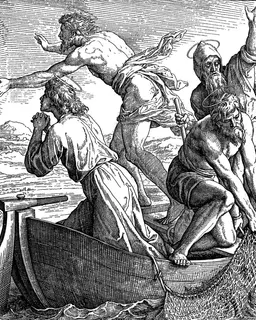
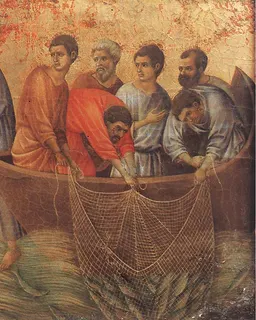
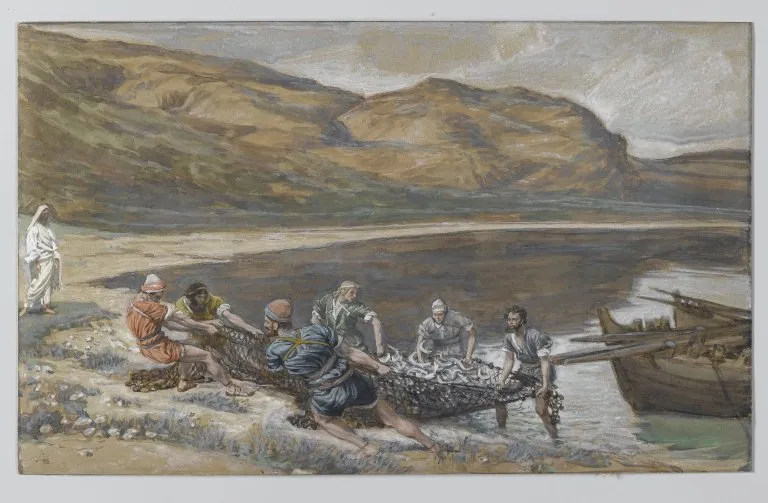
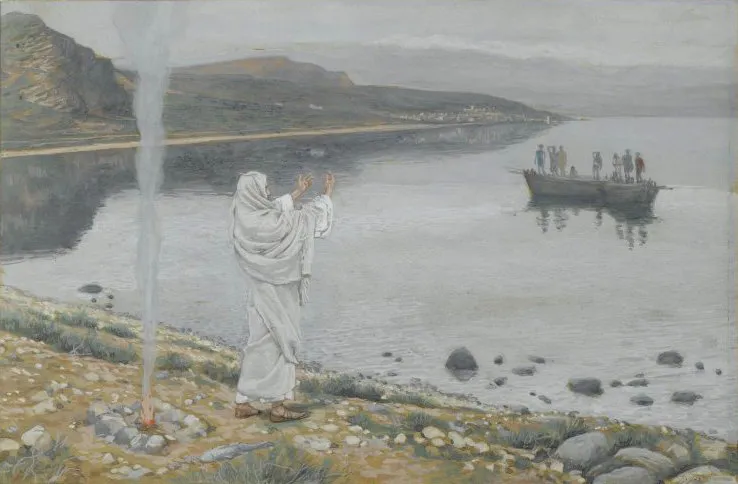
After the locked-room appearances of the previous chapter, the scene moves back to Galilee, to the lake the disciples knew best. Seven of them are together, and Peter breaks the waiting with a sentence as plain as it is restless: I go a fishing. The others go with him, and the night that follows is empty - that night they caught nothing (v. 3). At first light a figure stands on the shore, unrecognized, and asks whether they have any food; then comes the word that turns the night around: Cast the net on the right side of the ship, and ye shall find (v. 6).
They cast, and cannot haul the net for the sheer weight of fish. The beloved disciple knows before anyone else: It is the Lord. Peter throws himself into the water to reach Him, and the rest drag the laden net to land, where they find a fire of coals already burning, with fish laid on it, and bread - and the count is exact, an hundred and fifty and three: and… yet was not the net broken (v. 11).
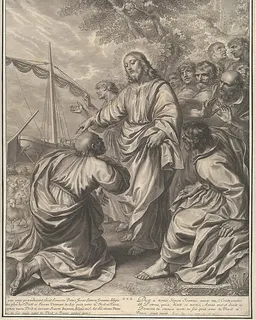
The Lord's first word on the beach is not a question or a charge but an invitation: Come and dine.1
Tap any highlighted phrase to jump to the commentary that unpacks it.
John 21:1-14Cast the Net on the Right Side · Come and Dine
1After these things Jesus shewed himself again to the disciples at the sea of Tiberias; and on this wise shewed he himself. 2There were together Simon Peter, and Thomas called Didymus, and Nathanael of Cana in Galilee, and the sons of Zebedee, and two other of his disciples. 3Simon Peter saith unto them, I go a fishing. They say unto him, We also go with thee. They went forth, and entered into a ship immediately; and that night they caught nothing. 4But when the morning was now come, Jesus stood on the shore: but the disciples knew not that it was Jesus. 5Then Jesus saith unto them, Children, have ye any meat? They answered him, No. 6And he said unto them, Cast the net on the right side of the ship, and ye shall find. They cast therefore, and now they were not able to draw it for the multitude of fishes. 7Therefore that disciple whom Jesus loved saith unto Peter, It is the Lord. Now when Simon Peter heard that it was the Lord, he girt his fisher’s coat unto him, (for he was naked,) and did cast himself into the sea. 8And the other disciples came in a little ship; (for they were not far from land, but as it were two hundred cubits,) dragging the net with fishes. 9As soon then as they were come to land, they saw a fire of coals there, and fish laid thereon, and bread. 10Jesus saith unto them, Bring of the fish which ye have now caught. 11Simon Peter went up, and drew the net to land full of great fishes, an hundred and fifty and three: and for all there were so many, yet was not the net broken. 12Jesus saith unto them, Come and dine. And none of the disciples durst ask him, Who art thou? knowing that it was the Lord. 13Jesus then cometh, and taketh bread, and giveth them, and fish likewise. 14This is now the third time that Jesus shewed himself to his disciples, after that he was risen from the dead.
The Gospel that has moved through cross and empty tomb returns, for its last scene, to an ordinary lake and an ordinary morning. Seven disciples are together by the sea of Tiberias, and Peter speaks first: I go a fishing (v. 3). There is no need to read it as a fall from grace - these were fishermen, and a man must eat and wait somewhere - but there is something poignant in it all the same.
The one who had been called from these very nets to catch men is back among the nets, in the lull between the resurrection and whatever came next, doing the thing he knew how to do. The others go with him, and John records the result with stark economy: that night they caught nothing. All night, the practiced hands, the familiar water, the old skill - and an empty boat at dawn. It is the way the chapter chooses to begin: with labour that comes up empty, the long fruitless night that sets the stage for the One who is about to stand on the shore.
They do not yet know He is near; they only know the nets are empty.
Light comes, and with it a figure: when the morning was now come, Jesus stood on the shore: but the disciples knew not that it was Jesus (v. 4). As with Mary in the garden and the two on the Emmaus road, the risen Lord is present before He is recognized; He stands close while they take Him for a stranger. He calls out to them across the water with a question that exposes the empty night - Children, have ye any meat? - and they answer with the single honest word of men who have failed at their own trade: No. Then comes the instruction that turns everything: Cast the net on the right side of the ship, and ye shall find (v. 6).
It is worth feeling how unlikely the obedience is. These are seasoned fishermen who have worked all night; a voice from the beach tells them to try the other side, as if a few feet of water would matter after so many hours. Yet they do it - and at once they were not able to draw it for the multitude of fishes. The same lake that gave them nothing all night gives them more than they can haul, the moment they do what He says.
Recognition comes to one of them first, and tellingly, it comes through the catch: that disciple whom Jesus loved saith unto Peter, It is the Lord (v. 7). John knows that net. Years before, near this same shore, there had been another night of nothing and another word from Jesus and another catch so great the nets began to break (Luke 5:4-6); the beloved disciple has seen this before, and he knows whose hand fills an empty net.
It is a quiet picture of how the risen Lord is known - by recognizing His unmistakable way of working. And Peter, the moment he hears It is the Lord, does what is so wholly Peter: he girt his fisher's coat unto him… and did cast himself into the sea (v. 7). He cannot wait for the boat. The same impulsiveness that once made him sink beneath the waves now flings him into them to get to Jesus faster.
Whatever shame might have held him back - he had, after all, denied this Lord - love overrules it. He is in the water and swimming for shore while the others bring the boat and the bursting net behind.
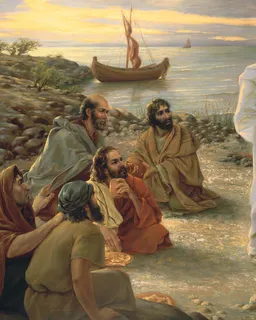
On the land they find a meal already underway: they saw a fire of coals there, and fish laid thereon, and bread (v. 9). The Lord who fed five thousand on a hillside has cooked breakfast for seven tired men on a beach - the fire lit, the food ready, before they ever dragged the catch ashore. Then comes the famous, precise count: Peter drew the net to land full of great fishes, an hundred and fifty and three: and for all there were so many, yet was not the net broken (v. 11).
The number is exact because someone counted, and the detail that the net was not broken is set against the earlier catch by this lake, where the nets brake (Luke 5:6). Readers down the centuries have hunted for hidden meanings in the figure, but the plain wonder is enough: the haul is specific, abundant, and held - not one fish lost through a torn net. It is the picture of a provision that is both lavish and secure.
What His word brings in, His net holds. The barren night is answered not by a modest correction but by an overflow that is carefully, fully kept.1
The Lord's words on the shore are not what a frightened conscience might expect. He does not open with the cross, or with the denial, or with any reckoning at all. He says, Come and dine (v. 12) - and the disciples come, subdued and certain: none of the disciples durst ask him, Who art thou? knowing that it was the Lord. They are sure who He is, and the certainty makes them quiet. Then He does the thing that ties this morning to so many others: Jesus then cometh, and taketh bread, and giveth them, and fish likewise (v. 13).
The risen Christ takes bread and gives it, exactly as He had on the hillside and in the upper room and at Emmaus, where the two knew Him in breaking of bread (Luke 24:35). He serves; He does not wait to be served. John marks the moment as the third time that Jesus shewed himself to his disciples, after that he was risen from the dead (v. 14) - and this third showing is a meal He made with His own hands, held out to men who had nothing to offer but an empty night and a borrowed catch.
Grace, here, looks like breakfast.
John 21:15-19Lovest Thou Me? · Feed My Sheep · Follow Me
15So when they had dined, Jesus saith to Simon Peter, Simon, son of Jonas, lovest thou me more than these? He saith unto him, Yea, Lord; thou knowest that I love thee. He saith unto him, Feed my lambs. 16He saith to him again the second time, Simon, son of Jonas, lovest thou me? He saith unto him, Yea, Lord; thou knowest that I love thee. He saith unto him, Feed my sheep. 17He saith unto him the third time, Simon, son of Jonas, lovest thou me? Peter was grieved because he said unto him the third time, Lovest thou me? And he said unto him, Lord, thou knowest all things; thou knowest that I love thee. Jesus saith unto him, Feed my sheep. 18Verily, verily, I say unto thee, When thou wast young, thou girdedst thyself, and walkedst whither thou wouldest: but when thou shalt be old, thou shalt stretch forth thy hands, and another shall gird thee, and carry thee whither thou wouldest not. 19This spake he, signifying by what death he should glorify God. And when he had spoken this, he saith unto him, Follow me.
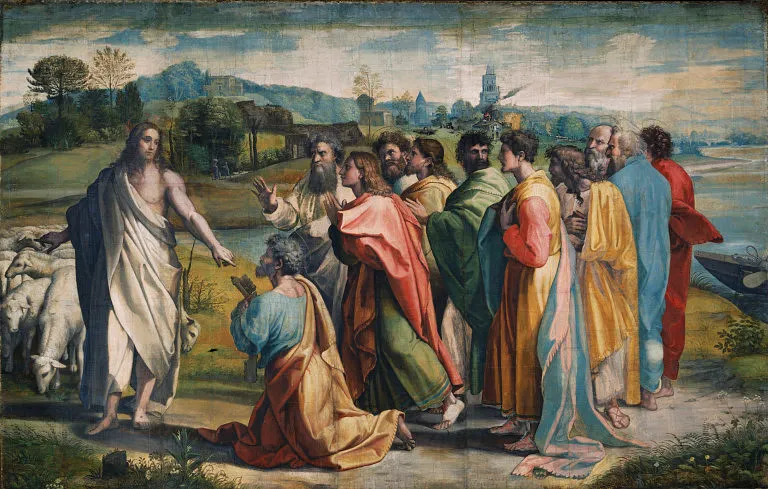
When breakfast is over, Jesus turns to Peter, and the address itself is deliberate: Simon, son of Jonas (v. 15). Not Peter, the rock-name Jesus had given him, but the old name from before the calling - as if to take him back to the beginning and start again. And the question is the one that searches everything: lovest thou me more than these? The more than these may glance at the very boats and nets and fish around them, or at the other disciples beside whom Peter had once boasted he would never fall.
Either way it touches the wound. Peter had said he would lay down his life for Jesus; he had denied Him before a servant girl. Now he is asked, simply, whether he loves Him. And three times the question comes - lovest thou me?… lovest thou me?… lovest thou me? - once for each denial. It is Jesus going back to the exact place of the failure and reopening it, gently, so that what was broken three times by a fire can be made whole three times by a fire.
The threefold question is the precise shape of the threefold denial, turned now toward healing.
Peter answers each time with the same words, and they are humbler than his old boasts: Yea, Lord; thou knowest that I love thee (v. 15). He no longer says more than these; he no longer ranks himself above the others or makes promises about dying. He simply appeals to what the Lord already knows. By the third asking the repetition has done its work and it hurts: Peter was grieved because he said unto him the third time, Lovest thou me? (v. 17).
The grief is the point. Each question presses on the bruise of a denial, and Peter feels it - but the grief is healing grief, the ache of a wound being cleaned rather than hidden. And out of that grief comes his fullest answer, an act of total trust: Lord, thou knowest all things; thou knowest that I love thee. He stops protesting and simply throws himself on the Lord's own knowledge of his heart.
It is the opposite of the night by the other fire, when he insisted he did not know Jesus. Now he stakes everything on Jesus knowing him - knowing all things, knowing the denial, and knowing, beneath it all, that Peter loves Him still.
Each answer is met not with a pardon spoken in so many words but with something better - a commission. Feed my lambs… Feed my sheep… Feed my sheep (vv. 15-17). The restoration is proved by the trust placed in the one restored: the Lord hands Peter the dearest thing He has, His flock, the sheep for whom He laid down His life. Notice what qualifies Peter for the charge. The single thing Jesus asks about, three times, before giving the commission is love: lovest thou me? Pastoral care of Christ's people flows from love for Christ Himself; the shepherd is, before anything else, one who loves the Lord of the flock and therefore loves what is His.
And the sheep remain emphatically His - my lambs, my sheep. Peter is not given a flock to own but a flock to tend on behalf of its true Shepherd. The fallen disciple is not merely forgiven and sent home; he is restored to usefulness, entrusted again with the work he must have feared he had forfeited forever. That is the shape of this grace: it does not only wipe the slate, it rebuilds the calling.
The calling comes with a cost, and Jesus names it plainly: When thou wast young, thou girdedst thyself, and walkedst whither thou wouldest: but when thou shalt be old, thou shalt stretch forth thy hands, and another shall gird thee, and carry thee whither thou wouldest not (v. 18). John tells us how to read it: This spake he, signifying by what death he should glorify God (v. 19). The man who once denied Jesus to save his own life is told that his life will end in laying it down - hands stretched out, led where he would not naturally choose to go.
What he failed to do at the first fire he will be given grace to do in the end: to follow his Lord all the way, even into death, and so to glorify God. There is a deep mercy in this. The denial is not the last word on Peter's courage; the Lord foretells a faithfulness that will outlast the failure. And the death itself is cast not as defeat but as glory - a death by which God is honoured, the final proof of a love that was real after all.
The one who could not stand by a servant girl will, in the end, stand by his Lord to the death.
John 21:20-25Follow Thou Me · The World Itself Could Not Contain the Books
20Then Peter, turning about, seeth the disciple whom Jesus loved following; which also leaned on his breast at supper, and said, Lord, which is he that betrayeth thee? 21Peter seeing him saith to Jesus, Lord, and what shall this man do? 22Jesus saith unto him, If I will that he tarry till I come, what is that to thee? follow thou me. 23Then went this saying abroad among the brethren, that that disciple should not die: yet Jesus said not unto him, He shall not die; but, If I will that he tarry till I come, what is that to thee? 24This is the disciple which testifieth of these things, and wrote these things: and we know that his testimony is true. 25And there are also many other things which Jesus did, the which, if they should be written every one, I suppose that even the world itself could not contain the books that should be written. Amen.
Peter, walking with Jesus, turns and sees another following: the disciple whom Jesus loved… which also leaned on his breast at supper (v. 20). He has just been told that his own road leads to a hard death, and his very human instinct is to look sideways: Lord, and what shall this man do? (v. 21). It is the question of comparison, and it is one of the oldest temptations of the heart that follows Christ - to measure my path against another's, to ask why my road is the costly one, to want to know how the burden will be shared before I take up my own.
Peter has only just heard Follow me, and already his eyes have drifted to his neighbour. There is no malice in it; it is simply the way we are, forever glancing at the next person's portion. But it is exactly the thing that will pull a disciple off his own course - and the Lord, who loves Peter too well to indulge it, answers it head-on.
The Lord's reply is firm and freeing at once: If I will that he tarry till I come, what is that to thee? follow thou me (v. 22). He does not tell Peter what the other disciple's future holds; He tells Peter that it is not his concern. The little word thou carries the weight - follow thou me. Whatever I may will for him, your business is your own following. It is a gentle but complete redirection of Peter's gaze, away from comparison and back to the single thing that is his to do.
The Lord assigns each of His own a particular path, and they are not the same path; one disciple is called to a martyr's death, another perhaps to a long life and a quiet pen, and neither is to be measured against the other. The freedom in this is real. Peter does not have to understand or approve of how Christ deals with anyone else; he is released from the exhausting work of comparison and given one clear thing: follow thou me. The Christian life is not run by watching the runner in the next lane.
It is run by keeping your eyes on the One who called you.
John pauses to clear up a rumour, and the care he takes is revealing: Then went this saying abroad among the brethren, that that disciple should not die: yet Jesus said not unto him, He shall not die; but, If I will that he tarry till I come, what is that to thee? (v. 23). A misunderstanding had spread - people had heard Jesus' words about the beloved disciple and concluded he would never die. John, who is that disciple, is scrupulous to correct it.
He does not let an exaggerated hope stand; he records exactly what the Lord said and exactly what He did not say. It is a small window into the character of the witness. He is the kind of man who will not let even a flattering rumour about himself pass uncorrected, who cares more for the precise truth of his Lord's words than for a legend that magnifies him. That scrupulous honesty is itself part of why his testimony can be trusted.
The man writing this Gospel is careful with words - careful enough to stop, mid-ending, and set a popular misquotation straight rather than let it ride.
Then the Gospel signs its own name: This is the disciple which testifieth of these things, and wrote these things: and we know that his testimony is true (v. 24). The whole book has been the witness of one who was there - who leaned on Jesus' breast at supper, who stood by the cross, who outran Peter to the empty tomb, who recognized the Lord on the shore. Now he steps forward and puts his name to it: these are not tales gathered at second hand but the testimony of an eyewitness, and his testimony is true. The book began by telling us why it exists - these are written, that ye might believe - and it ends by telling us who stands behind it.
The risen Christ of these pages is attested by a man who saw Him die and saw Him alive again, and who staked the truthfulness of his account on it. The Gospel does not ask to be believed as a beautiful idea; it asks to be believed as the true testimony of one who was there.
The last verse opens the door and lets the ocean in: there are also many other things which Jesus did, the which, if they should be written every one, I suppose that even the world itself could not contain the books that should be written (v. 25). It is a deliberate, glorious overstatement, and it is meant to leave the reader breathless. Everything John has written - the signs, the long discourses, the cross, the empty tomb, the breakfast on the shore - is only a cupful dipped from a sea.
The deeds of Jesus are not exhausted by any Gospel, by all four Gospels, by every book that could ever be written; the world has not shelves enough to hold the full account of what He did. There is something fitting about ending the story of the eternal Word this way. The book that opened in eternity - In the beginning was the Word - closes by confessing that its subject overflows every page. The reader is left not with a sense of completion but with a sense of inexhaustibility: here is a Lord too large for the books, whose acts of mercy and power run on past the final Amen. The Gospel ends, but Christ does not.
And so the last word is not really a full stop; it is an open door.1
Research trail
Sources & further study
These references support the historical, linguistic, manuscript, and contextual notes in this chapter. Scripture remains the primary text; external sources are provided so readers can inspect the research directly.
- John 21 - Translators' NotesThe NET Bible's detailed footnotes on John 21 - the precise count of the great fishes and the unbroken net (v. 11), the much-discussed alternation of agapaō and phileō in the threefold question (vv. 15-17), the foretelling of Peter's death in verses 18-19, and the hyperbole of the closing verse, that the world could not contain the books.
- John 21 · Greek interlinear, word by wordThe Greek text of John 21 set under the English word by word - useful for the two love-words in the threefold question (agapaō and phileō, vv. 15-17), for the shepherding verbs Jesus pairs with them (boskō, “feed,” and poimainō, “tend,” vv. 15-17), and for the charcoal fire of verse 9 (anthrakia), the same word used of the fire by which Peter denied Him in John 18:18.
- John 21 ↔ Ezekiel 34 · Psalm 23 · John 10Traces the threads tying John 21 to the rest of Scripture - the charge Feed my sheep (vv. 15-17) read beside the LORD's promise to feed my flock in Ezekiel 34:15, the Shepherd who maketh me to lie down and prepares a table (Ps. 23), and the good Shepherd of John 10 who giveth his life for the sheep now handing those sheep to Peter to tend.
Where this echoes in Scripture
Cast the Net on the Right Side · Come and Dine
- Luke 5:4-6Launch out into the deep, and let down your nets... they inclosed a great multitude of fishes: and their net brake.The earlier catch by this same lake that verses 6-11 deliberately echo - the net that brake then, unbroken now.
- John 10:11I am the good shepherd: the good shepherd giveth his life for the sheep.The Shepherd who feeds His own (vv. 9-13) - the One who first laid down His life for them.
- Psalm 23:1-2The LORD is my shepherd; I shall not want. He maketh me to lie down in green pastures.The provision pictured in the catch and the breakfast (vv. 6-13) - the Shepherd who supplies all need.
- John 15:5He that abideth in me, and I in him, the same bringeth forth much fruit: for without me ye can do nothing.The truth of the empty night and the full net (vv. 3-6) - fruitfulness only at His word.
- John 6:37All that the Father giveth me shall come to me; and him that cometh to me I will in no wise cast out.The welcome of “Come and dine” (v. 12) - the One who turns no comer away.
Lovest Thou Me? · Feed My Sheep · Follow Me
- John 18:25-27Art not thou also one of his disciples? He denied it... So Peter denied again: and immediately the cock crew.The threefold denial by a fire that the threefold question by a fire (vv. 15-17) precisely answers and heals.
- Ezekiel 34:15-16I will feed my flock, and I will cause them to lie down... I will seek that which was lost, and bring again that which was driven away.The LORD's own shepherding, the pattern behind the charge to feed and tend the sheep (vv. 15-17).
- 1 Peter 5:2Feed the flock of God which is among you, taking the oversight thereof, not by constraint, but willingly.Peter taking up the very charge given him here (vv. 15-17) and passing it on to other shepherds.
- Matthew 4:19And he saith unto them, Follow me, and I will make you fishers of men.The first call by this same sea, spoken again in verse 19 - “Follow me,” the first word and the last.
- 2 Corinthians 5:14-15For the love of Christ constraineth us... that they which live should not henceforth live unto themselves, but unto him.The love that restores Peter becoming the love that compels his service - the meaning of “Follow me” (v. 19).
Follow Thou Me · The World Itself Could Not Contain the Books
- Matthew 16:24If any man will come after me, let him deny himself, and take up his cross, and follow me.The cost folded into “follow thou me” (v. 22) - a cross of one's own, and the call to follow anyway.
- John 12:26If any man serve me, let him follow me; and where I am, there shall also my servant be.The promise inside the call of verse 22 - to follow Christ is to be where He is.
- John 20:31These are written, that ye might believe that Jesus is the Christ, the Son of God; and that believing ye might have life through his name.The purpose stated near the end, now signed by the eyewitness whose testimony is true (v. 24).
- Colossians 2:3In whom are hid all the treasures of wisdom and knowledge.Why the world could not contain the books (v. 25) - a Christ whose fullness no page exhausts.
- Ephesians 3:18-19To know the love of Christ, which passeth knowledge, that ye might be filled with all the fulness of God.The inexhaustible Lord of verse 25 - a love and a fullness beyond all telling.