John 18
People in this chapter
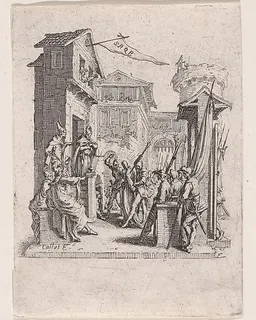
The long farewell of the upper room is over; now the Gospel turns to the night of the arrest. Jesus goes out with his disciples over the brook Cedron, where was a garden, a place He often used and that Judas therefore knew well (vv. 1-2). Judas comes with a band of men and officers from the chief priests and Pharisees… with lanterns and torches and weapons (v. 3) - a force armed against a man who has done nothing but teach in the open.
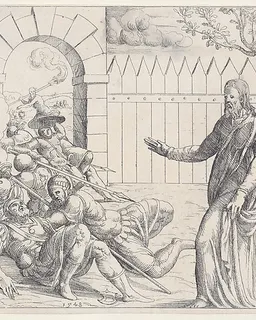
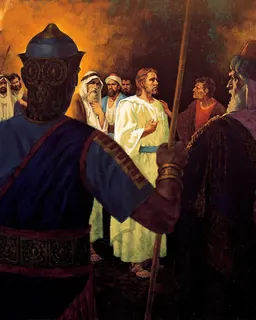
What follows is unlike any arrest. Jesus, knowing all things that should come upon him, went forth, and said unto them, Whom seek ye? (v. 4). At His answer, I am he, the whole company draws backward, and fell to the ground (v. 6). Only then, having shown that no one seizes Him unwilling, does He give Himself up - and His first concern is His own: if therefore ye seek me, let these go their way (v. 8).1
Tap any highlighted phrase to jump to the commentary that unpacks it.
John 18:1-11Whom Seek Ye? - I Am He
1When Jesus had spoken these words, he went forth with his disciples over the brook Cedron, where was a garden, into the which he entered, and his disciples. 2And Judas also, which betrayed him, knew the place: for Jesus ofttimes resorted thither with his disciples. 3Judas then, having received a band of men and officers from the chief priests and Pharisees, cometh thither with lanterns and torches and weapons. 4Jesus therefore, knowing all things that should come upon him, went forth, and said unto them, Whom seek ye? 5They answered him, Jesus of Nazareth. Jesus saith unto them, I am he. And Judas also, which betrayed him, stood with them. 6As soon then as he had said unto them, I am he, they went backward, and fell to the ground. 7Then asked he them again, Whom seek ye? And they said, Jesus of Nazareth. 8Jesus answered, I have told you that I am he: if therefore ye seek me, let these go their way: 9That the saying might be fulfilled, which he spake, Of them which thou gavest me have I lost none. 10Then Simon Peter having a sword drew it, and smote the high priest’s servant, and cut off his right ear. The servant’s name was Malchus. 11Then said Jesus unto Peter, Put up thy sword into the sheath: the cup which my Father hath given me, shall I not drink it?
The scene is set with deliberate quiet. Jesus crosses the brook Cedron into a garden He had often used - a place, John notes pointedly, that Judas also… knew (vv. 1-2). There is no attempt to hide. Into this familiar place Judas brings a band of men and officers… with lanterns and torches and weapons (v. 3): a substantial armed force, carrying light to search out a man in the dark and weapons to subdue Him.
And then the whole expectation of an arrest is overturned in a single phrase. Jesus, knowing all things that should come upon him, went forth - He steps toward them - and asks the question: Whom seek ye? (v. 4). Everything that has just been said about lanterns and weapons is quietly emptied of its menace. The soldiers have come to seize a fugitive; instead a man who knows exactly what is coming walks out to meet them.
From the first verse of the Passion, the prisoner is in command of the scene.1
To their answer, Jesus of Nazareth, He replies with two words: I am he (v. 5). The effect is immediate and astonishing: As soon then as he had said unto them, I am he, they went backward, and fell to the ground (v. 6). An armed company, sent to overpower one unarmed man, finds itself on the ground at the sound of His voice. John lets the moment stand without explaining it away. Something in the bare self-disclosure of Jesus - I am he - carries a weight the soldiers cannot stand against.
And then, having shown that He cannot be taken by force, He calmly asks a second time, Whom seek ye? (v. 7), and gives Himself up of His own accord. The order matters. He first demonstrates that no power present can touch Him, and only then submits. The surrender is real - and it is a surrender from strength, the act of one who is laying something down freely.
His first words after surrendering are for His followers: if therefore ye seek me, let these go their way (v. 8). At the very moment of His arrest, with everything closing in on Him, His concern is the safety of the disciples standing beside Him. John tells us why this matters: That the saying might be fulfilled, which he spake, Of them which thou gavest me have I lost none (v. 9). The shepherd who had spoken of laying down His life for the sheep now, in the act of being taken, shields the sheep from the danger.
He interposes Himself. The arresting party may have Him; they may not have those He came to keep. It is a small detail that opens onto the whole meaning of His death: He is the one who stands between His own and the harm, deliberately drawing the danger onto Himself so that others go free.
Peter, true to his impulsive courage, will not let it happen without a fight: Simon Peter having a sword drew it, and smote the high priest's servant, and cut off his right ear. The servant's name was Malchus (v. 10). It is a brave, desperate, and entirely wrong response - an attempt to defend with the sword the one who has just refused to be defended. Jesus stops him at once: Put up thy sword into the sheath (v. 11).
The kingdom that is about to be revealed before Pilate does not advance this way. Peter thinks he is protecting his Lord; in fact he is trying to prevent the very thing Jesus has come to do. There is a hard lesson here about zeal that runs ahead of understanding - the readiness to fight for Christ in a manner Christ Himself forbids. The sword is sheathed because this cause is won another way entirely.
John 18:12-18Led to Annas - the First Denial
12Then the band and the captain and officers of the Jews took Jesus, and bound him, 13And led him away to Annas first; for he was father in law to Caiaphas, which was the high priest that same year. 14Now Caiaphas was he, which gave counsel to the Jews, that it was expedient that one man should die for the people. 15And Simon Peter followed Jesus, and so did another disciple: that disciple was known unto the high priest, and went in with Jesus into the palace of the high priest. 16But Peter stood at the door without. Then went out that other disciple, which was known unto the high priest, and spake unto her that kept the door, and brought in Peter. 17Then saith the damsel that kept the door unto Peter, Art not thou also one of this man’s disciples? He saith, I am not. 18And the servants and officers stood there, who had made a fire of coals; for it was cold: and they warmed themselves: and Peter stood with them, and warmed himself.
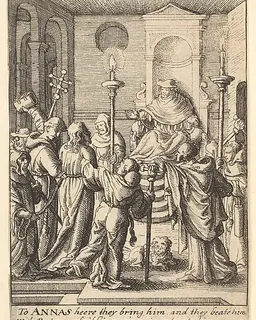
Now the arrest is completed: the band and the captain and officers of the Jews took Jesus, and bound him (v. 12). The hands that laid a whole company on the ground a moment ago are now tied. He permits it. They lead Him to Annas first (v. 13) - a striking detail, since Annas was not the reigning high priest that year; Caiaphas was. Annas was the patriarch of a powerful priestly family, a former high priest still wielding enormous influence behind the office now held by his son-in-law.
That Jesus is taken to him first, before any official hearing, tells us something about the nature of this proceeding. It begins in the house of the man who really holds the power - an informal, after-dark interrogation by the family that has already decided the outcome. The binding and the night visit to Annas set the tone: this is less a trial seeking truth than a process managing a verdict that has long since been reached.
John pauses to remind us who Caiaphas is: he, which gave counsel to the Jews, that it was expedient that one man should die for the people (v. 14). The reminder reaches back to an earlier scene, where Caiaphas, alarmed by Jesus' growing following, had argued coldly that it was better for one man to die than for the whole nation to be endangered. It was pure political calculation - sacrifice one troublesome figure to keep the peace with Rome.
But John had noted there, and the reader feels it again here, that Caiaphas spoke more than he knew. The high priest meant only ruthless expedience; yet his words landed on the deepest truth of all - that one man would indeed die for the people, though not in the sense Caiaphas intended. There is a heavy irony running under the whole trial: the men managing Jesus' death as a piece of statecraft are, without knowing it, presiding over the redemption of the world.
The plotters are unwitting prophets.
The camera now follows Peter. He followed Jesus - to his credit, he does not flee with the others - and so did another disciple, one known unto the high priest, who is able to go straight in (vv. 15-16). Peter, lacking that connection, is left at the door without, until the other disciple speaks to the servant girl keeping the gate and brings him in. The detail is quietly important: Peter's denial does not happen because he ran away.
It happens because he came close - close enough to be recognized, close enough to be asked. His courage gets him into the courtyard; it is there, inside, warming himself among the enemy, that his nerve fails. John is honest about the shape of the fall. The follower who got near and then could not hold his ground is the one who denies.
The first denial comes not from a soldier or an official but from the damsel that kept the door - a servant girl, the lowest figure in the scene. Her question is almost casual, and even framed to expect a no: Art not thou also one of this man's disciples? (v. 17). Peter, who hours earlier had sworn he would lay down his life for Jesus and had just drawn a sword against an armed band, crumbles before a doorkeeper's passing remark: He saith, I am not. The contrast with the man being questioned inside could not be sharper.
There is something painfully recognizable in it. Peter's great failure slips out as three small words to someone who could not have harmed him. And John leaves him there by the fire: Peter stood with them, and warmed himself (v. 18) - among the servants and officers, taking comfort at the enemy's coals, exactly where the next denials will find him.
John 18:19-27I Spake Openly to the World
19The high priest then asked Jesus of his disciples, and of his doctrine. 20Jesus answered him, I spake openly to the world; I ever taught in the synagogue, and in the temple, whither the Jews always resort; and in secret have I said nothing. 21Why askest thou me? ask them which heard me, what I have said unto them: behold, they know what I said. 22And when he had thus spoken, one of the officers which stood by struck Jesus with the palm of his hand, saying, Answerest thou the high priest so? 23Jesus answered him, If I have spoken evil, bear witness of the evil: but if well, why smitest thou me? 24Now Annas had sent him bound unto Caiaphas the high priest. 25And Simon Peter stood and warmed himself. They said therefore unto him, Art not thou also one of his disciples? He denied it, and said, I am not. 26One of the servants of the high priest, being his kinsman whose ear Peter cut off, saith, Did not I see thee in the garden with him? 27Peter then denied again: and immediately the cock crew.
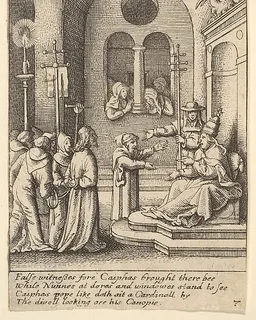
Annas opens the questioning broadly, probing of his disciples, and of his doctrine (v. 19) - who follows Him and what He has been teaching, as if hunting for a hidden movement or a secret subversive program. Jesus' reply quietly dismantles the premise: I spake openly to the world; I ever taught in the synagogue, and in the temple… and in secret have I said nothing (v. 20). There is nothing concealed to uncover. His teaching has been public from the start - in the synagogues, in the temple courts, in the places where crowds gather.
A teacher of error works in the shadows and swears his followers to secrecy; Jesus has done the opposite, saying everything in the open where anyone could hear and weigh it. So He turns the proceeding back on itself: Why askest thou me? ask them which heard me… behold, they know what I said (v. 21). It is, in effect, a demand for due process - produce the witnesses, examine the public record - spoken by a man who has nothing to hide to men who would rather not hold their case up to the light.
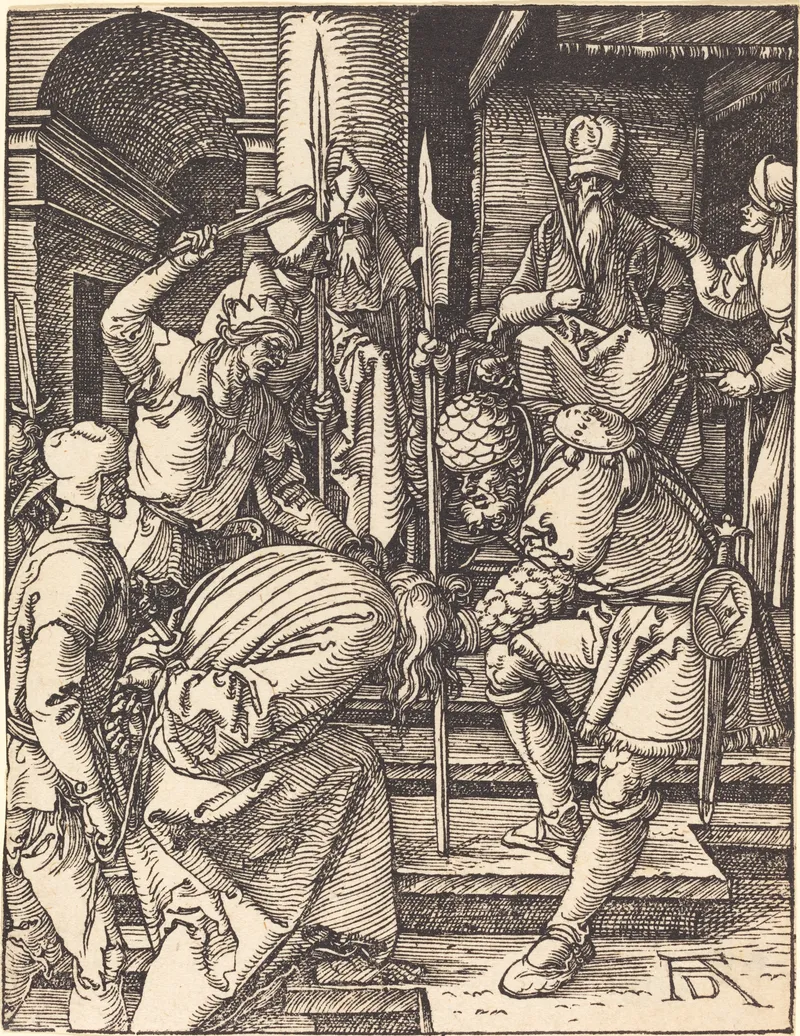
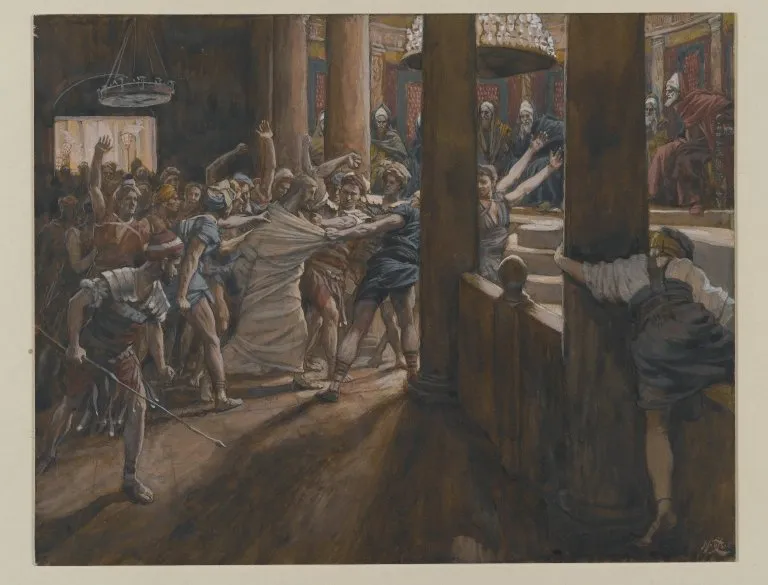
For this calm, unanswerable reply, Jesus is struck: one of the officers which stood by struck Jesus with the palm of his hand, saying, Answerest thou the high priest so? (v. 22). The blow is telling. Jesus has said nothing false and nothing insolent - only insisted that His words be examined honestly. The officer cannot meet the argument, so he answers with force, dressing the violence up as an offended defense of the high priest's dignity.
It is the reflex of a proceeding that has no real case: when truth cannot be refuted, it is silenced with a hand. And Jesus' response is composed and exact: If I have spoken evil, bear witness of the evil: but if well, why smitest thou me? (v. 23). He names the injustice for what it is and asks for evidence. The contrast holds all through the night - violence on one side, reasoned truth on the other - and the violence only exposes how empty the charge against Him really is.
With a single sentence John closes the hearing before Annas: Now Annas had sent him bound unto Caiaphas the high priest (v. 24). The informal interrogation has yielded nothing usable, so Jesus - still bound - is passed along to the sitting high priest for the next stage of the proceedings. John keeps this transition brief, almost offhand, and the brevity itself makes a point. The reader is not given a dramatic courtroom scene because, for John, the real drama is elsewhere: in the willing silence of the prisoner being shuttled from one authority to another, and in the parallel collapse happening just outside in the courtyard.
The Gospel deliberately interleaves the two - Jesus before the priests, Peter before the fire - so that we feel them as one moment. While the Lord is being moved, bound, from Annas to Caiaphas, His foremost disciple is finishing the work of disowning Him.
John returns us to the fire, where Peter is exactly where we left him: Simon Peter stood and warmed himself (v. 25). The pressure tightens. A second time the question comes - Art not thou also one of his disciples? - and a second time Peter disowns Him: I am not. Then the danger sharpens to a point. A third challenger is no stranger but a kinsman of the very man whose ear Peter had cut off, and he claims to have seen it: Did not I see thee in the garden with him? (v. 26).
Peter, who had been so bold with a sword in that garden, now flatly denies he was ever there. Peter then denied again: and immediately the cock crew (v. 27). John does not narrate Peter's reaction - no tears, no flight; only the sound of the cock, landing precisely on the word Jesus had spoken hours before. The crowing is left to do its own work. It is the sound of a promise of Jesus coming true even in the failure of His friend, and the reader, knowing what Peter had sworn, hears in it both the depth of the fall and the strange faithfulness of the Lord who foretold it - and who is, at that very moment, on His way to die for the man at the fire.
John 18:28-40My Kingdom Is Not of This World
28Then led they Jesus from Caiaphas unto the hall of judgment: and it was early; and they themselves went not into the judgment hall, lest they should be defiled; but that they might eat the passover. 29Pilate then went out unto them, and said, What accusation bring ye against this man? 30They answered and said unto him, If he were not a malefactor, we would not have delivered him up unto thee. 31Then said Pilate unto them, Take ye him, and judge him according to your law. The Jews therefore said unto him, It is not lawful for us to put any man to death: 32That the saying of Jesus might be fulfilled, which he spake, signifying what death he should die. 33Then Pilate entered into the judgment hall again, and called Jesus, and said unto him, Art thou the King of the Jews? 34Jesus answered him, Sayest thou this thing of thyself, or did others tell it thee of me? 35Pilate answered, Am I a Jew? Thine own nation and the chief priests have delivered thee unto me: what hast thou done? 36Jesus answered, My kingdom is not of this world: if my kingdom were of this world, then would my servants fight, that I should not be delivered to the Jews: but now is my kingdom not from hence. 37Pilate therefore said unto him, Art thou a king then? Jesus answered, Thou sayest that I am a king. To this end was I born, and for this cause came I into the world, that I should bear witness unto the truth. Every one that is of the truth heareth my voice. 38Pilate saith unto him, What is truth? And when he had said this, he went out again unto the Jews, and saith unto them, I find in him no fault at all. 39But ye have a custom, that I should release unto you one at the passover: will ye therefore that I release unto you the King of the Jews? 40Then cried they all again, saying, Not this man, but Barabbas. Now Barabbas was a robber.
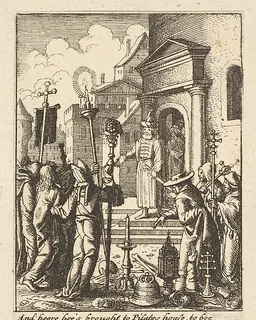
They lead Jesus from Caiaphas to the hall of judgment at dawn, and John records a detail dripping with irony: they themselves went not into the judgment hall, lest they should be defiled; but that they might eat the passover (v. 28). They are scrupulous about ceremonial purity - unwilling to enter a Gentile's residence and risk defilement before the feast - while in the same breath they hand an innocent man over to be killed.
They strain at the smallest ritual contamination and swallow the gravest moral wrong. Then comes the legal maneuvering. Pilate asks for a charge: What accusation bring ye against this man? (v. 29). They have none they can state plainly; they answer only that He is a malefactor - trust us, He is guilty (v. 30). When Pilate tries to send the matter back to them, they admit the real reason they need him: It is not lawful for us to put any man to death (v. 31).
They want an execution and only Rome can grant it. John adds that even this served a purpose: that the saying of Jesus might be fulfilled… signifying what death he should die (v. 32) - death by the Roman cross, lifted up, exactly as He had foretold.
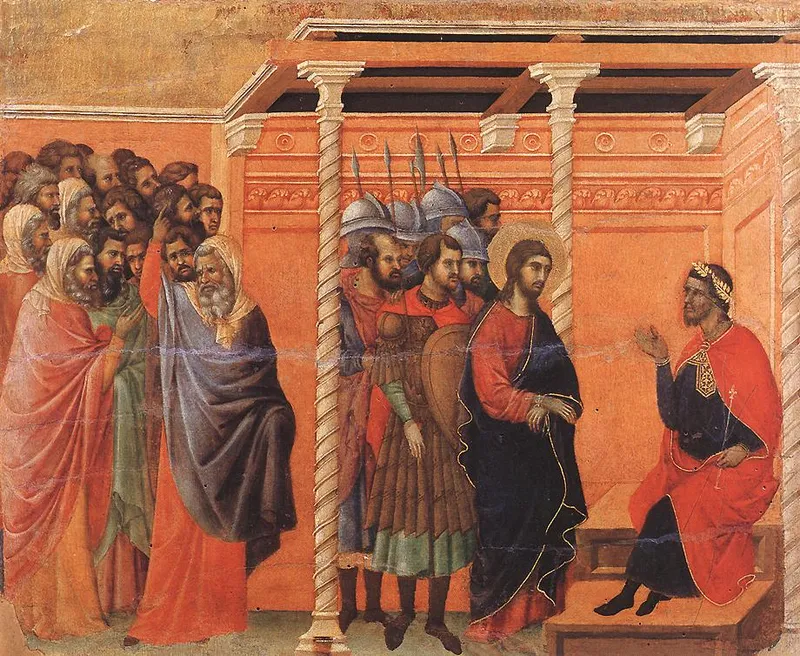
Pilate goes in and puts the question that Rome cares about: Art thou the King of the Jews? (v. 33). To Pilate “king” means rival, rebel, threat to Caesar - the one charge that would force Rome to act. Jesus probes the question first: Sayest thou this thing of thyself, or did others tell it thee of me? (v. 34). It is a real question. Is Pilate asking about a political insurrection - the only kind of king he can imagine - or is he open to hearing what kind of king Jesus actually is?
Pilate brushes it aside with contempt: Am I a Jew? (v. 35). He has no interest in the religious dispute; he only wants to know what Jesus has done to land in his hall. The exchange sets up everything that follows. Pilate and Jesus are using the same word, “king,” to mean two utterly different things, and the whole trial turns on the gap between them. Jesus is about to fill the word with a meaning Pilate has no category for.
Jesus answers with the line that gives the chapter its center: My kingdom is not of this world: if my kingdom were of this world, then would my servants fight, that I should not be delivered to the Jews: but now is my kingdom not from hence (v. 36). He claims a kingdom twice in a breath, and what He clarifies is that it is not of this world - it draws its origin and its methods from elsewhere.
He gives the proof: if it were that kind of kingdom, His servants would be fighting right now to stop His arrest - which is precisely what Peter had tried to do and been forbidden to do. A worldly kingdom defends itself by force; the absence of His soldiers' swords is the evidence that His reign runs on something else. The phrase not from hence points to source rather than location: His kingship does not arise from this world's power structures, though it is very much for this world.
He stands bound, condemned, defenseless - and calmly claims to be a king whose reign comes and conquers another way entirely.
Pilate seizes on the word: Art thou a king then? (v. 37). Jesus accepts it - Thou sayest that I am a king - and at once lifts it onto its true ground: To this end was I born, and for this cause came I into the world, that I should bear witness unto the truth. Every one that is of the truth heareth my voice. His kingship is bound up with truth. He came to bear witness to it, and His subjects are recognized by a disposition toward truth: those who are of the truth hear His voice.
Then comes one of the most haunting lines in all the Gospels: Pilate saith unto him, What is truth? (v. 38). The question can be read as cynical, weary, dismissive - the worldly governor brushing aside the very idea that truth is something one could stand under. What John makes unmistakable is the tragedy of it: Pilate asks what is truth? while the One who said I am… the truth stands before him, and he does not wait for an answer.
He turns and walks out. He is closer to the truth than any man alive at that moment, and he steps away from it to go manage a crowd.
Pilate goes out and renders his verdict on the case: I find in him no fault at all (v. 38) - a complete acquittal, the first of three times in John that the judge will declare Jesus guiltless. By every standard of justice, the matter should end there: no fault, no charge, release the man. But Pilate has no intention of simply doing the right thing he has just named. Instead he reaches for a custom, hoping to free Jesus without taking responsibility for it: will ye therefore that I release unto you the King of the Jews? (v. 39) - offering them, perhaps with a sneer, this “king” as the prisoner to set loose.
The gambit fails utterly. Then cried they all again, saying, Not this man, but Barabbas (v. 40). And John drops in the detail that turns the scene into a parable: Now Barabbas was a robber. The crowd, offered a choice between the innocent and a violent criminal, chooses the criminal. The guilty man walks free; the guiltless man is kept for the cross. A judge who knows the truth refuses to act on it; a crowd that should know better calls for blood.
The trial that was supposed to establish justice instead displays, in one exchange, exactly how the world treats the truth when it stands defenseless before it.
Research trail
Sources & further study
These references support the historical, linguistic, manuscript, and contextual notes in this chapter. Scripture remains the primary text; external sources are provided so readers can inspect the research directly.
- John 18 - Translators' NotesThe NET Bible's detailed footnotes on John 18 - the geography of the brook Cedron and the garden (vv. 1-2), the force of the bare I am he and the soldiers falling back (vv. 5-6), the legal tangle of the night hearings before Annas and Caiaphas (vv. 13-24), and the wording of Jesus' kingship before Pilate (vv. 36-37).
- John 18 · Greek interlinear + lexiconThe Greek text of John 18 word by word, with parsing and lexical links - useful for ego eimi (vv. 5-6, 8, the “I am he” at which the soldiers fell back), for basileia (v. 36, the “kingdom” not of this world), and for aletheia (vv. 37-38, the “truth” to which Jesus bears witness and over which Pilate stumbles).
- John 18 ↔ Isaiah 53 · Psalm 41 · John 10Traces the threads tying John 18 to the rest of Scripture - the silent, guiltless sufferer of Isaiah 53 read beside Pilate's I find in him no fault (v. 38), the betraying friend of Psalm 41:9 behind Judas in the garden (v. 2), and the good shepherd who lays down his life of himself (John 10:17-18) behind the willing surrender of verses 4-11.
Where this echoes in Scripture
Whom Seek Ye? - I Am He
- John 10:17-18I lay down my life... No man taketh it from me, but I lay it down of myself. I have power to lay it down, and I have power to take it again.The truth the garden proves - the soldiers fall back (v. 6) because His life is laid down freely.
- Matthew 26:53Thinkest thou that I cannot now pray to my Father, and he shall presently give me more than twelve legions of angels?Why Peter's sword is needless (vv. 10-11) - the One arrested could call down armies and does not.
- Luke 22:42Father, if thou be willing, remove this cup from me: nevertheless not my will, but thine, be done.The cup of verse 11 named in the prayer that preceded it - received from the Father's hand.
- Exodus 3:14And God said unto Moses, I AM THAT I AM... Thus shalt thou say unto the children of Israel, I AM hath sent me unto you.The name standing behind the bare I am he of verses 5-6, at which the company falls.
- Psalm 41:9Yea, mine own familiar friend, in whom I trusted, which did eat of my bread, hath lifted up his heel against me.The betraying friend behind Judas, who knew the place (v. 2) and led the band there.
Led to Annas - the First Denial
- John 11:49-51Caiaphas... said unto them, Ye know nothing at all, Nor consider that it is expedient... that one man should die for the people.The counsel recalled in verse 14 - the high priest prophesying more than he knew.
- Luke 22:31-32Simon, Simon... I have prayed for thee, that thy faith fail not: and when thou art converted, strengthen thy brethren.The prayer covering Peter even as he denies (v. 17) - the failure foreseen and already answered.
- John 13:37-38Peter said unto him, Lord... I will lay down my life for thy sake... Verily... The cock shall not crow, till thou hast denied me thrice.The boast that the first denial begins to unravel (v. 17) - foretold hours before.
- John 21:9, 15-17a fire of coals... Simon, son of Jonas, lovest thou me?... Feed my sheep.The healing of this night - another fire of coals, three questions undoing three denials.
- Matthew 10:32-33Whosoever therefore shall confess me before men, him will I confess... But whosoever shall deny me before men, him will I also deny.The weight of the word behind Peter's I am not (v. 17) - confessing or disowning before men.
I Spake Openly to the World
- Isaiah 50:6I gave my back to the smiters... I hid not my face from shame and spitting.The servant struck and not striking back, drawn long before the blow of verse 22.
- Isaiah 53:7he was oppressed, and he was afflicted, yet he opened not his mouth... as a lamb to the slaughter.The silent, willing sufferer behind Jesus' composure under questioning and the blow (vv. 19-23).
- 1 Peter 2:23who, when he was reviled, reviled not again; when he suffered, he threatened not; but committed himself to him that judgeth righteously.The pattern of verses 22-23 named - wrong absorbed and entrusted to the righteous Judge.
- Acts 4:13, 31they saw the boldness of Peter and John... they spake the word of God with boldness.The open, plain speech of verse 20 (parresia) carried on by the apostles - the same Peter, now unafraid.
- Luke 22:60-62immediately, while he yet spake, the cock crew... And Peter went out, and wept bitterly.The crowing of verse 27 and what it broke open in Peter - the grief that turned him back.
My Kingdom Is Not of This World
- John 10:17-18, 27I lay down my life... No man taketh it from me... my sheep hear my voice... and they follow me.The reign of verses 36-37 - a kingdom held by laying down life, whose subjects hear His voice.
- Daniel 7:13-14there was given him dominion, and glory, and a kingdom... his dominion is an everlasting dominion, which shall not pass away.The everlasting kingship behind verse 36 - a dominion not of this world's rise and fall.
- Zechariah 9:9thy King cometh unto thee: he is just, and having salvation; lowly, and riding upon an ass.The kind of king Jesus confesses to be (vv. 36-37) - lowly, riding on a donkey.
- Isaiah 53:9he had done no violence, neither was any deceit in his mouth.The guiltlessness Pilate stumbles onto in verse 38 - I find in him no fault at all.
- 1 Peter 3:18Christ also hath once suffered for sins, the just for the unjust, that he might bring us to God.The exchange of verse 40 - the guilty (Barabbas) freed, the just delivered up for the unjust.