Painter of the Bible
Albrecht Dürer
Albrecht Dürer is the towering Christian artist of the Northern Renaissance.

Their faith
Why Albrecht Dürer painted Christ
Albrecht Dürer, a pivotal figure of the Northern Renaissance, was deeply rooted in his Christian faith, which profoundly influenced his artistic vision. Born in Nuremberg in 1471, Dürer was the son of a goldsmith and was introduced to art through his apprenticeship under Michael Wolgemut. His travels to Italy allowed him to absorb the classical ideals of beauty and proportion, but it was his unwavering devotion to scripture and the burgeoning Protestant Reformation that shaped his work. Dürer was an early reader of Martin Luther and engaged with other reformers, reflecting a faith that was both personal and communal. His commitment to his craft was not merely artistic but also a spiritual discipline, as he sought to glorify God through his creations. His works were intended not only for aesthetic appreciation but also for devotional purposes, making them integral to the spiritual lives of those who viewed them.
Dürer's faith is vividly expressed in his masterpieces, such as "The Apocalypse" series, which powerfully illustrates the themes of Revelation and the struggle between good and evil. The dramatic imagery of the Four Horsemen and the Whore of Babylon resonates with the viewer’s spiritual journey, encouraging reflection on divine justice and mercy. Similarly, his engravings in the "Large Passion" and "Small Passion" series encapsulate the profound narratives of Christ’s suffering and redemption, inviting contemplation on the significance of the Gospel. Even in his more secular works, like "Adam and Eve," Dürer’s meticulous attention to human form and divine creation reveals his belief in the inherent beauty of God's handiwork. Today, Dürer's devotion continues to inspire countless viewers, reminding us of the transformative power of faith expressed through art.
Life & work
Albrecht Dürer is the towering Christian artist of the Northern Renaissance. Born in Nuremberg in 1471 to a Hungarian-born goldsmith, apprenticed to the painter and printmaker Michael Wolgemut, and twice traveled to Italy in his twenties and again in his fifties, he absorbed the proportional theory of Leon Battista Alberti and the figure science of his own anatomical studies and brought both home to a German workshop that produced more devotional imagery, in greater editions, than any other in Europe. He died in Nuremberg in 1528, a citizen of standing in a city in the middle of the Reformation.
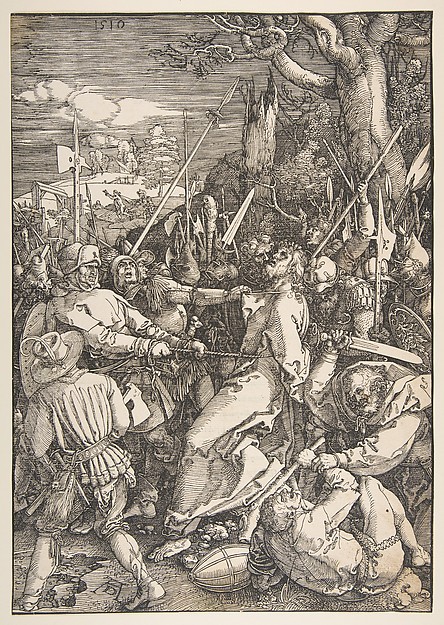
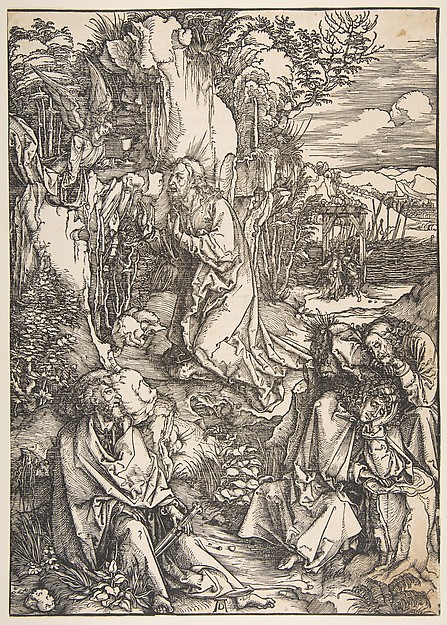
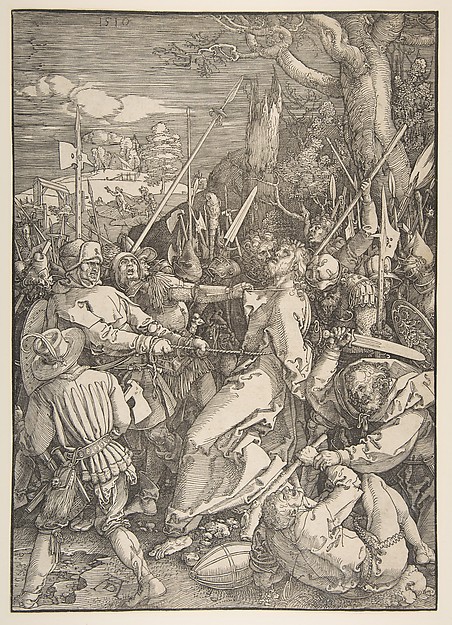
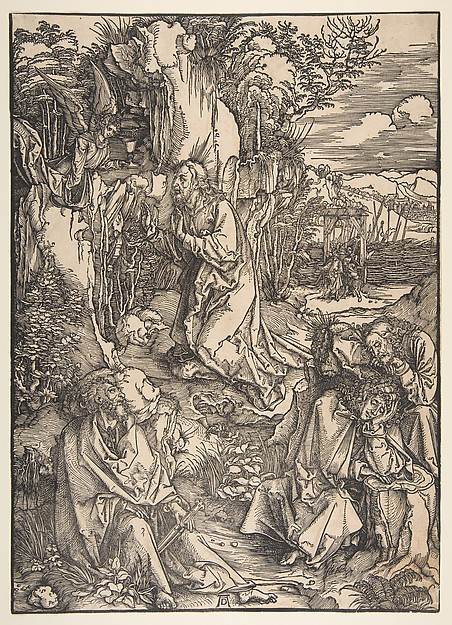
The Apocalypse, his fifteen woodcut series of 1498, is the founding work of the modern illustrated Bible. The Four Horsemen of Revelation 6, the Whore of Babylon, the angels staying the four winds — the cycle made him famous across Europe at twenty-seven and remained the standard visualization of John's Revelation for a hundred years. The Large Passion (twelve woodcuts, 1497–1510), the Small Passion (thirty-seven woodcuts, 1509–1511), and the Engraved Passion (sixteen plates, 1507–1512) extended that achievement across the entire arc of the Gospels' final chapters. Adam and Eve (engraving, 1504) crystallized the Northern Renaissance ideal of human proportion in a Garden-of-Eden composition that has been copied and quoted ever since.
His paintings are fewer but no less ambitious. The Paumgartner Altarpiece (Munich) and the Adoration of the Magi (Florence) sit among the great altarpieces of his generation; the Heller Altarpiece (lost in a fire, known from copies) and the Four Apostles (Munich, 1526) carry his late, increasingly Lutheran-leaning religious sensibility. The Praying Hands study, drawn for the Heller Altarpiece, has become — detached from its original context — one of the most reproduced devotional images in the world.
Dürer combined an inventor's mind with a scholar's habit. He published the first Northern treatise on geometry (1525), a treatise on fortification (1527), and the Four Books on Human Proportion (posthumous, 1528). He was an early reader of Luther, corresponded with Melanchthon, and was buried in Nuremberg's St. Johannis cemetery, where his grave still draws pilgrims of art.
Notable works in detail
durer-four-horsemen
The Four Horsemen of the Apocalypse is the fourth of the fifteen woodcuts of Dürer's Apocalypse, published as Apocalypsis cum Figuris in Nuremberg in 1498 — a printed book of which Dürer himself was the publisher, designer, and woodblock cutter. The image illustrates Revelation 6: as the Lamb opens the first four seals, four horsemen are summoned forth — Conquest with a bow, War with a sword, Famine with scales, and Death on a pale horse with the open mouth of Hell beneath him. Dürer compresses the four into a single thundering horizontal motion across the upper half of the sheet, with the trampled bodies of an emperor, a bishop, a peasant, and a child crushed beneath the hooves. The print made Dürer famous across Europe at twenty-seven and became the canonical visual treatment of the Four Horsemen for the next four centuries. The original blocks survive in the Albertina in Vienna; impressions exist in every major print collection.

The Woman of the Apocalypse and the Seven-Headed Dragon
The Woman of the Apocalypse and the Seven-Headed Dragon, the tenth of the fifteen Apocalypse woodcuts of 1498, illustrates the central vision of Revelation 12: a woman clothed with the sun, the moon under her feet, and a crown of twelve stars upon her head, with the great red dragon waiting to devour her child. Dürer compresses the chapter into a single dense composition — the woman aloft and crowned in the upper half of the print, an angel handing her the eagle wings she will need to fly to safety, and below her the seven-headed dragon coiled and snarling in a roiling sky lit by sun and moon together. The print is among the most reproduced and most copied of the entire Apocalypse cycle and carried Dürer's iconographic invention into the standard visual vocabulary of European Reformation and Counter-Reformation illustrated Bibles for over a century.

Saint Michael Fighting the Dragon
Saint Michael Fighting the Dragon, the eleventh of the Apocalypse woodcuts of 1498, depicts the war in heaven described in Revelation 12: the archangel Michael and his hosts battle the great red dragon, identified in the chapter with the ancient serpent and with Satan, until the dragon and his angels are cast down to earth. Dürer composes the scene in two distinct registers — the heavenly battle in the upper two thirds, with Michael in the act of driving his spear down through the dragon's open mouth and three other angels engaging the dragon's allies on every side — and a peaceful, almost pastoral landscape of Northern European fields and a small town in the lower third. The contrast between the apocalyptic violence above and the unaware, sunlit countryside below is one of the most quoted Dürer compositional inventions and was directly imitated in countless later Northern European depictions of the same subject.

The Last Supper is one of the twelve woodcuts of the Large Passion, the cycle Dürer worked on intermittently from 1497 to 1510 and published in Nuremberg in 1511 with newly composed Latin verses by the humanist Benedictus Chelidonius. The composition shows Christ at the center of a long horizontal table seated under a coffered Renaissance arch, the twelve apostles arranged on either side, John leaning into Christ's chest and Judas isolated in profile in the right foreground. The setting is unmistakably Northern late-Gothic-into-Renaissance: tiled floor, mullioned window opening onto a starry sky, an interior architecture worked out in careful linear perspective. The Large Passion combined old and new at the moment of its publication — the earliest plates predating Dürer's first Italian trip and the latest reflecting the lessons of his second — and is one of the most studied serial woodcut projects of the Northern Renaissance.
durer-lp-crucifixion
The Crucifixion, the eighth of the twelve Large Passion woodcuts, was completed around 1498 in the first phase of Dürer's work on the cycle. The composition shows the moment immediately after Christ's death: the swooning Virgin in the arms of John on the left, the soldier piercing the side with the lance on the right, the two thieves still alive on their crosses to either side, and below the cross the Magdalene kneeling and clinging to its base. The scene is staged in front of an architectural backdrop of the city of Jerusalem, with mounted Roman soldiery and bystanders moving across the background. The combination of dense narrative incident, careful chiaroscuro modeling, and confident anatomical drawing demonstrates Dürer's full mastery of the engraved-line tradition descending from Martin Schongauer; the print became one of the standard sixteenth-century European visual treatments of the subject and was directly copied by engravers across Italy, France, and the Low Countries within a decade of its publication.
.jpg?width=800)


.jpg?width=800)


.jpg?width=800)
.jpg?width=800)
.jpg?width=800)


