John 13
People in this chapter
John has spent twelve chapters building to the hour, and now it has come. Now before the feast of the passover, when Jesus knew that his hour was come that he should depart out of this world unto the Father, having loved his own which were in the world, he loved them unto the end (v. 1). Everything that follows in the upper room is held inside that opening word. Jesus is not swept toward the cross unaware; He knows the hour, He knows the Father has given all things into his hands (v. 3), and out of that knowledge He kneels.
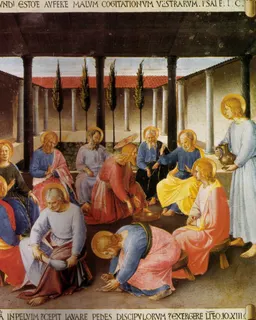
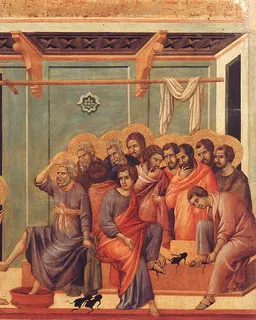
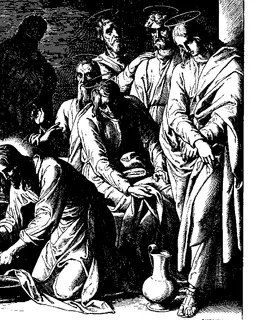
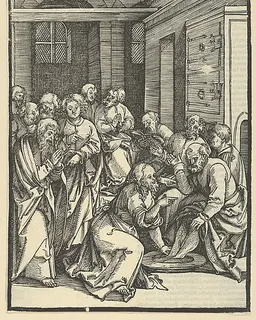
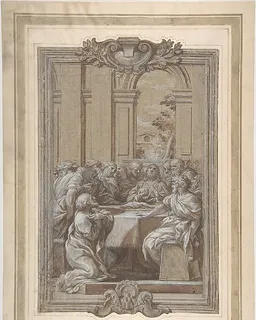
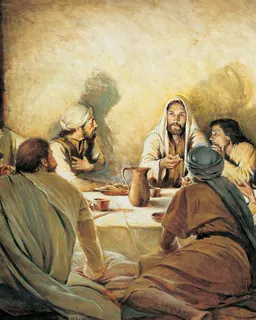
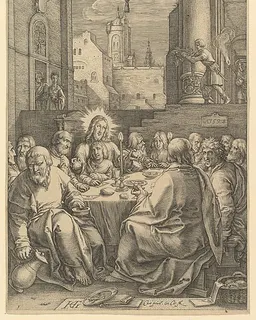
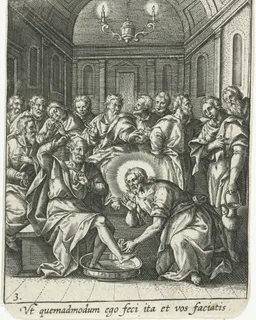
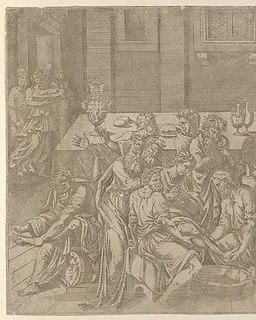
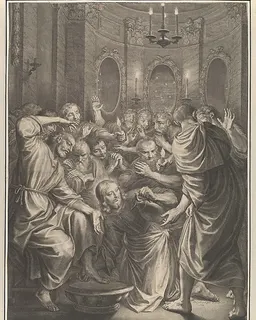
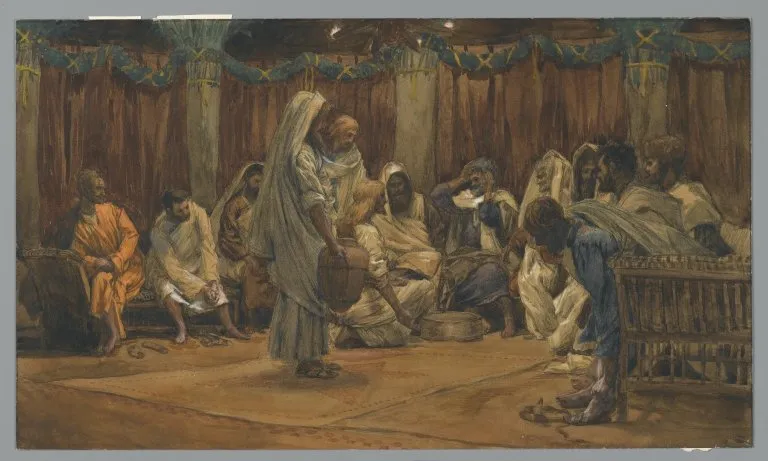
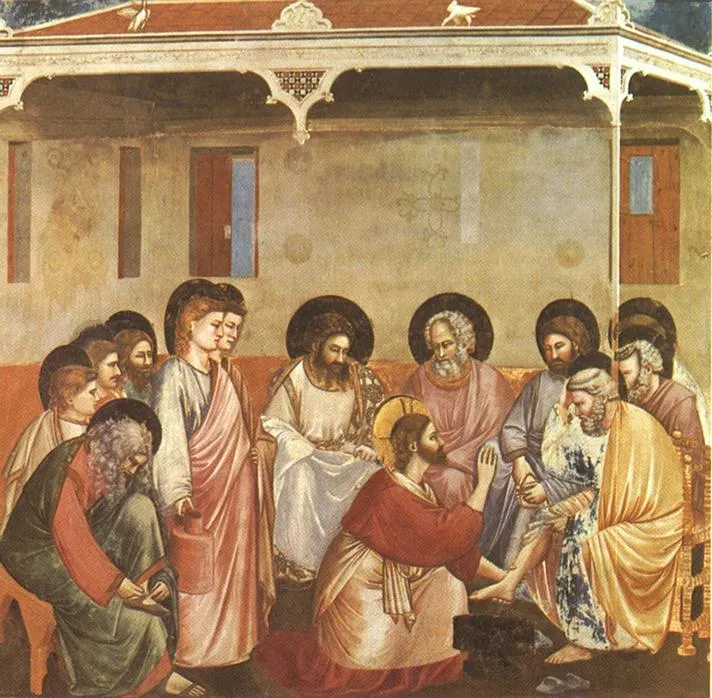
He rises from supper, lays aside His garments, takes a towel, girds Himself, and begins to wash the disciples' feet (vv. 4-5). The act belongs to the lowest slave of a household; the Master performs it. When He comes to Peter, Peter refuses in horror - Lord, dost thou wash my feet? - and Jesus presses past the resistance to the thing that matters: If I wash thee not, thou hast no part with me (v. 8).1
Tap any highlighted phrase to jump to the commentary that unpacks it.
John 13:1-17I Have Given You an Example
1Now before the feast of the passover, when Jesus knew that his hour was come that he should depart out of this world unto the Father, having loved his own which were in the world, he loved them unto the end. 2And supper being ended, the devil having now put into the heart of Judas Iscariot, Simon’s son, to betray him; 3Jesus knowing that the Father had given all things into his hands, and that he was come from God, and went to God; 4He riseth from supper, and laid aside his garments; and took a towel, and girded himself. 5After that he poureth water into a bason, and began to wash the disciples’ feet, and to wipe them with the towel wherewith he was girded. 6Then cometh he to Simon Peter: and Peter saith unto him, Lord, dost thou wash my feet? 7Jesus answered and said unto him, What I do thou knowest not now; but thou shalt know hereafter. 8Peter saith unto him, Thou shalt never wash my feet. Jesus answered him, If I wash thee not, thou hast no part with me. 9Simon Peter saith unto him, Lord, not my feet only, but also my hands and my head. 10Jesus saith to him, He that is washed needeth not save to wash his feet, but is clean every whit: and ye are clean, but not all. 11For he knew who should betray him; therefore said he, Ye are not all clean.
John opens the upper room with a sentence built to be remembered: when Jesus knew that his hour was come… having loved his own which were in the world, he loved them unto the end (v. 1). Every clause matters. He knew the hour - the betrayal, the arrest, the cross were not ambushing Him. He was about to depart out of this world unto the Father. And it is precisely here, on the edge of the worst night of His life, that John tells us His love did not waver but came to its fullness: he loved them unto the end. Then John adds two facts that make what follows almost unbearable to picture.
First, the devil having now put into the heart of Judas… to betray him (v. 2) - the betrayer is in the room, and Jesus knows it. Second, Jesus knowing that the Father had given all things into his hands (v. 3) - all authority, all things, are His. A man who held all things in His hands, and knew one of His friends was already sold, did with that knowledge the one thing no one expected.1
What He did with all power in His hands was to lay it down: He riseth from supper, and laid aside his garments; and took a towel, and girded himself. After that he poureth water into a basin, and began to wash the disciples' feet (vv. 4-5). Every motion is the motion of a household slave. Guests arrived with feet caked in the dust of unpaved roads, and the washing of those feet was the lowest task in the house, given to the least servant - so low that, by some accounts, a Hebrew slave could not be compelled to it.
No disciple had volunteered for it; the basin sat untouched while they reclined. So the Master rises, strips to the garment of a servant, ties the towel about His waist, kneels, and takes the dirty feet of His friends into His own hands - one pair after another, down the whole table. The verbs are deliberate and unhurried: laid aside… took… girded… poureth… began to wash… to wipe. John is slowing us down to watch. The One through whom all things were made is on the floor, washing feet.2
Peter cannot bear it: Lord, dost thou wash my feet? (v. 6). The word order in his question is almost a protest - Thou, my feet? It is the right instinct pointed the wrong way. Peter senses the staggering reversal - that the Master should do the slave's work - and his reverence rebels against it. So Jesus warns him to wait for understanding: What I do thou knowest not now; but thou shalt know hereafter (v. 7).
Peter will not wait. Thou shalt never wash my feet (v. 8) - an absolute refusal dressed as humility. But there is a kind of humility that is really pride: a refusal to be served, a determination to keep the upper hand even before God, an unwillingness to be the one who receives. Jesus meets it head-on with a line that turns the whole scene from etiquette to gospel: If I wash thee not, thou hast no part with me. The washing is not optional courtesy.
To refuse to be cleansed by Him is to refuse Him.
Peter overcorrects as fast as he refused: Lord, not my feet only, but also my hands and my head (v. 9). Having heard that refusing the washing means losing his part with Jesus, he now wants to be washed all over. Jesus answers with a saying that has been pondered ever since: He that is washed needeth not save to wash his feet, but is clean every whit: and ye are clean, but not all (v. 10).
The picture seems drawn from a guest who has bathed before a feast and then walks to the house; only his feet need washing on arrival, for the bath has already made him clean. Jesus distinguishes a deep, settled cleansing - clean every whit - from the ongoing washing of the dust gathered on the way. His disciples have already been made clean; what remains is the daily cleansing of feet that still pick up the road's grime.
But then comes the chilling exception: ye are clean, but not all. John explains: For he knew who should betray him (v. 11). One pair of feet at that table belonged to a man who would not be made clean - and Jesus washed them too.
12So after he had washed their feet, and had taken his garments, and was set down again, he said unto them, Know ye what I have done to you? 13Ye call me Master and Lord: and ye say well; for so I am. 14If I then, your Lord and Master, have washed your feet; ye also ought to wash one another’s feet. 15For I have given you an example, that ye should do as I have done to you. 16Verily, verily, I say unto you, The servant is not greater than his lord; neither he that is sent greater than he that sent him. 17If ye know these things, happy are ye if ye do them.
When He is finished, He takes His garments again, sits down, and asks them to understand what they have just watched: Know ye what I have done to you? (v. 12). Then He refuses to let them keep their titles for Him while declining His example. Ye call me Master and Lord: and ye say well; for so I am (v. 13). He confirms the titles - He is Master and Lord; the foot-washing is not a denial of His rank but the truest expression of it.
And from that confirmed lordship He draws the duty: If I then, your Lord and Master, have washed your feet; ye also ought to wash one another's feet (v. 14). The argument runs downhill from the greater to the lesser - if the One who is genuinely above you stooped this low, no follower of His can claim a service is beneath him. For I have given you an example, that ye should do as I have done to you (v. 15).
And He seals it with a proverb: The servant is not greater than his lord (v. 16). Whatever the Lord did, the servant is not too good to do. The blessing is reserved not for those who merely grasp this but for those who live it: If ye know these things, happy are ye if ye do them (v. 17).
John 13:18-30And It Was Night
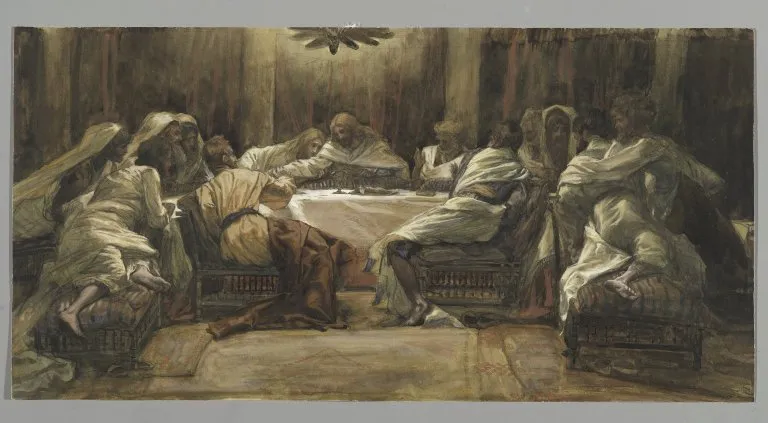
18I speak not of you all: I know whom I have chosen: but that the scripture may be fulfilled, He that eateth bread with me hath lifted up his heel against me. 19Now I tell you before it come, that, when it is come to pass, ye may believe that I am he. 20Verily, verily, I say unto you, He that receiveth whomsoever I send receiveth me; and he that receiveth me receiveth him that sent me. 21When Jesus had thus said, he was troubled in spirit, and testified, and said, Verily, verily, I say unto you, that one of you shall betray me. 22Then the disciples looked one on another, doubting of whom he spake. 23Now there was leaning on Jesus’ bosom one of his disciples, whom Jesus loved. 24Simon Peter therefore beckoned to him, that he should ask who it should be of whom he spake. 25He then lying on Jesus’ breast saith unto him, Lord, who is it? 26Jesus answered, He it is, to whom I shall give a sop, when I have dipped it. And when he had dipped the sop, he gave it to Judas Iscariot, the son of Simon.
Before He names the betrayal aloud, Jesus sets it inside Scripture: I speak not of you all: I know whom I have chosen: but that the scripture may be fulfilled, He that eateth bread with me hath lifted up his heel against me (v. 18). The line is from Psalm 41:9, David's lament over a trusted friend who turned on him.3 To eat a man's bread, in that world, was to be bound to him in friendship and loyalty; to share the table and then strike was the deepest treachery.
By citing it, Jesus shows He is not a victim of an accident He failed to foresee. He knows whom He has chosen; the betrayal does not catch Him unaware or thwart His purpose. And He tells them in advance for a reason: Now I tell you before it come, that, when it is come to pass, ye may believe that I am he (v. 19). The very horror about to unfold, foretold, will become a ground for faith rather than a reason for despair - when they remember He saw it coming and walked into it anyway, they will know who He is.
For all His foreknowledge, the betrayal costs Him: When Jesus had thus said, he was troubled in spirit, and testified, and said, Verily, verily, I say unto you, that one of you shall betray me (v. 21). This is no serene detachment. The same word for being troubled will return as He faces the cross. He has loved these men, washed their feet minutes before, and to say aloud that one of them is sold is an anguish.
The disciples are thrown into confusion: Then the disciples looked one on another, doubting of whom he spake (v. 22). Tellingly, no one points a finger; each seems unsure even of himself. Then John gives us the quiet picture of the disciple leaning on Jesus' bosom… whom Jesus loved (v. 23) - near enough to ask softly. Peter, too impulsive to ask directly after the rebuke he has just had, beckons to him; and that disciple, lying on Jesus' breast, asks for them all: Lord, who is it? (v. 25).
The intimacy of the scene only sharpens the coming treachery: this close, this loved, and one of them is leaving for the priests.
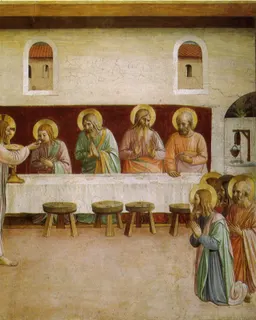
Jesus answers with a sign and, astonishingly, with a last gesture of honour to the betrayer: He it is, to whom I shall give a sop, when I have dipped it. And when he had dipped the sop, he gave it to Judas Iscariot, the son of Simon (v. 26). The sop is a morsel of bread dipped in the dish, and for a host to dip it and hand it to a guest was a mark of friendship and favour, a small act of welcome at the table.
So the identification of the traitor comes wrapped in a kindness: even now, even as Judas is set on his course, Jesus offers him the gesture of a friend. There is no cornering, no public denunciation - the others do not even understand what has passed (v. 28). The door is, in effect, held open to the last second. Judas takes the bread from the very hand that washed his feet, and chooses the night anyway.
Mercy was extended to the final moment; it was refused.1
27And after the sop Satan entered into him. Then said Jesus unto him, That thou doest, do quickly. 28Now no man at the table knew for what intent he spake this unto him. 29For some of them thought, because Judas had the bag, that Jesus had said unto him, Buy those things that we have need of against the feast; or, that he should give something to the poor. 30He then having received the sop went immediately out: and it was night.
And after the sop Satan entered into him (v. 27). John has already told us the devil put into the heart of Judas… to betray him (v. 2); now, at the moment Judas takes the bread and hardens his resolve, the text says Satan entered him. The two stand together: Judas is making a real choice for which he is answerable, and there is a darker power at work behind it that he is yielding himself to.
Scripture does not relieve Judas of his guilt by naming Satan, nor does it reduce him to a puppet; it shows a man surrendering his will to evil until evil possesses it. Then Jesus speaks, and the command is sovereign over the whole scene: That thou doest, do quickly. The betrayal is not happening to a helpless Jesus; He releases Judas to it in His own time and word. The hour has come, and He will not be dragged to it - He goes to meet it.
The others, hearing only a cryptic instruction, assume the keeper of the bag has been sent on an errand (vv. 28-29). They do not yet see what their Lord sees.
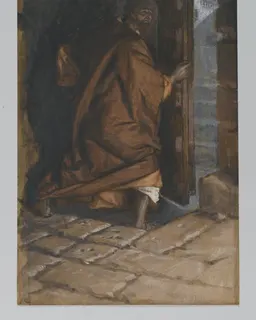
Then comes one of the shortest and heaviest sentences John ever wrote: He then having received the sop went immediately out: and it was night (v. 30). At the plain level it is a note of the hour - it was, in fact, night outside. But John, who has written from his first chapter about light shining in the darkness, never wastes a word like this. Judas leaves the room where the light of the world is reclining, steps out the door, and goes into the night - and the night is more than the dark sky.
It is the hour of betrayal, the deed done in shadow, the soul that has turned from the light to do its work in the dark. John lets the two meanings sit together without explaining them, and the effect is chilling. The chapter that began with love unto the end now watches one man walk out of that love and into the night by his own feet. The contrast is the whole point: inside, the One who is light prepares to give Himself for the world; outside, a man who chose the dark hurries to sell Him.
John 13:31-35By This Shall All Men Know
31Therefore, when he was gone out, Jesus said, Now is the Son of man glorified, and God is glorified in him. 32If God be glorified in him, God shall also glorify him in himself, and shall straightway glorify him. 33Little children, yet a little while I am with you. Ye shall seek me: and as I said unto the Jews, Whither I go, ye cannot come; so now I say to you. 34A new commandment I give unto you, That ye love one another; as I have loved you, that ye also love one another. 35By this shall all men know that ye are my disciples, if ye have love one to another.
The moment the betrayer is gone, Jesus speaks of glory: Therefore, when he was gone out, Jesus said, Now is the Son of man glorified, and God is glorified in him (v. 31). The timing is everything. It is precisely as the machinery of His death begins to turn - the betrayer dispatched into the night - that He says, Now is the glory. In this Gospel, the cross is the revealing of His glory. The deepest disclosure of who God is comes in love that lays itself down; the hour of self-offering is the hour of glory.
And the glory is mutual and certain: If God be glorified in him, God shall also glorify him in himself, and shall straightway glorify him (v. 32). Then His tone turns tender as a parent's: Little children, yet a little while I am with you (v. 33). He is leaving; where He goes - through death to the Father - they cannot yet follow. Into that gap, with His departure full in view, He places the one command that will hold them together when He is gone.
The command itself is the heart of the chapter: A new commandment I give unto you, That ye love one another; as I have loved you, that ye also love one another (v. 34). The command to love was not itself new - thou shalt love thy neighbour as thyself was written in the Law of old (Lev. 19:18).3 What is new is the measure. The old measure was as thyself; the new measure is as I have loved you. And He has just shown them, in basin and towel, what that love looks like - and will show them tomorrow, on the cross, its full extent.
So the standard is no longer the love a person naturally has for himself, real as that is; it is the self-giving, foot-washing, life-laying-down love of Jesus. It is new, too, in that it now flows from a new source: they are to love one another out of the love they have themselves received from Him. This is not a vague benevolence toward humanity in general but a concrete, costly love one another - toward the very people in the room, including the one who would deny Him before dawn.
Then Jesus attaches to this love a startling promise about how the world will recognize His own: By this shall all men know that ye are my disciples, if ye have love one to another (v. 35). The badge He names is their love for one another. The mark He chooses is one the watching world can actually see and weigh: a community whose members carry one another's burdens, forgive one another, serve one another, refuse to write one another off.
All men will know - the recognition is meant to reach outsiders, to be the visible evidence that something true has come into the world. This sets a sober question over every gathering of His people: a church can be right about much and still fail the one test Jesus names. Where His people love one another as He loved them, the world is given a sign it cannot easily explain away.
John 13:36-38The Cock Shall Not Crow
36Simon Peter said unto him, Lord, whither goest thou? Jesus answered him, Whither I go, thou canst not follow me now; but thou shalt follow me afterwards. 37Peter said unto him, Lord, why cannot I follow thee now? I will lay down my life for thy sake. 38Jesus answered him, Wilt thou lay down thy life for my sake? Verily, verily, I say unto thee, The cock shall not crow, till thou hast denied me thrice.
Peter has not let go of the word that troubled him - that Jesus is going where they cannot come. Lord, whither goest thou? (v. 36). He fixes on the leaving, not the love just commanded. Jesus answers with both a closed door and an open one: Whither I go, thou canst not follow me now; but thou shalt follow me afterwards. The now and the afterwards matter enormously, and Peter hears only the first half.
He cannot follow now - the road through death to the Father is one Jesus must walk alone; but he shall follow afterwards, a quiet promise that Peter's story does not end at the failure about to come. Peter, undaunted and self-assured, presses: Lord, why cannot I follow thee now? I will lay down my life for thy sake (v. 37). It is sincere - Peter means every word, and there is real courage in him.
But he has the order backwards. He offers to lay down his life for Jesus, when the gospel is that Jesus is about to lay down His life for him. And he trusts his own resolve at the precise point where it is weakest.
Jesus meets the boast with a question and a hard truth: Wilt thou lay down thy life for my sake? Verily, verily, I say unto thee, The cock shall not crow, till thou hast denied me thrice (v. 38). The question is not mockery; it is the gentle exposure of a confidence resting on the wrong foundation. Peter trusts Peter - his love, his nerve, his loyalty - and all of these, real as they are, will collapse before the rooster greets the morning.
Before this very night is out, the man who swore to die for Jesus will three times deny that he so much as knows Him. It is a sobering word about the self that overrates its own strength: the warmest sincerity, untethered from grace, cannot keep a single promise to Christ under fire. Yet notice what Jesus does not do. He does not cast Peter off. He has already said, thou shalt follow me afterwards (v. 36) - the failure is foreseen, and a future on the far side of it is already promised.
The same love that loved unto the end (v. 1) is loving Peter through a fall it can see coming.
Research trail
Sources & further study
These references support the historical, linguistic, manuscript, and contextual notes in this chapter. Scripture remains the primary text; external sources are provided so readers can inspect the research directly.
- John 13 - Translators' NotesThe NET Bible's detailed footnotes on John 13 - the meaning of loving unto the end (v. 1), the cultural weight of foot-washing as the task of the lowest slave (vv. 4-5), the difficult exchange about being washed and clean every whit (v. 10), and the sop given to the betrayer (v. 26).
- John 13 · Greek interlinear + lexiconThe Greek text of John 13 word by word, with parsing and lexical links - useful for eis telos (v. 1, “unto the end,” to the uttermost), for the verbs of laying aside and girding (vv. 4-5), and for entolen kainen (v. 34, “a new commandment”).
- John 13 ↔ Philippians 2 · Leviticus 19 · Psalm 41Traces the threads tying John 13 to the rest of Scripture - the servant who lays aside His garments (vv. 4-5) read beside the One who took upon him the form of a servant (Phil. 2:7); the new commandment (v. 34) beside thou shalt love thy neighbour as thyself (Lev. 19:18); and the betrayer at the table (v. 18) beside he that eateth bread with me hath lifted up his heel against me (Ps. 41:9).
Where this echoes in Scripture
I Have Given You an Example
- Philippians 2:5-8made himself of no reputation, and took upon him the form of a servant... and became obedient unto death, even the death of the cross.The self-emptying of the Lord who lays aside His garments (vv. 4-5) - the towel and the cross as one descent.
- Luke 22:27whether is greater, he that sitteth at meat, or he that serveth?... but I am among you as he that serveth.Spoken at this same supper - the King naming Himself the One who serves, as in verses 4-5, 14.
- Matthew 20:26-28whosoever will be great among you, let him be your minister... even as the Son of man came not to be ministered unto, but to minister.The kingdom's measure of greatness, lived out in the foot-washing and commanded in verses 14-15.
- 1 John 1:7-9the blood of Jesus Christ his Son cleanseth us from all sin... he is faithful and just to forgive us our sins.The cleansing only He can give (v. 8), and the daily washing of feet still needed (v. 10).
- 1 Peter 5:5be clothed with humility: for God resisteth the proud, and giveth grace to the humble.Peter, who fought the towel, later urging the church to gird themselves with humility as their Lord girded the towel (v. 4).
And It Was Night
- Psalm 41:9Yea, mine own familiar friend, in whom I trusted, which did eat of my bread, hath lifted up his heel against me.The Scripture Jesus quotes in verse 18 - the trusted friend at the table who turns to betray.
- John 1:5And the light shineth in darkness; and the darkness comprehended it not.The frame for “and it was night” (v. 30) - the darkness given its hour, yet never able to put out the light.
- Luke 22:53when I was daily with you in the temple, ye stretched forth no hands against me: but this is your hour, and the power of darkness.Jesus naming the hour of His arrest - the night Judas steps into when he goes out (v. 30).
- Luke 22:3Then entered Satan into Judas surnamed Iscariot, being of the number of the twelve.The same dark entering as verse 27 - a real choice and a darker power behind it together.
- Matthew 26:24The Son of man goeth as it is written of him: but woe unto that man by whom the Son of man is betrayed!Both truths held together as in verses 18-27 - the Scripture fulfilled, and the betrayer still answerable.
By This Shall All Men Know
- Leviticus 19:18thou shalt love thy neighbour as thyself: I am the LORD.The old measure of the command to love - lifted to a new measure (“as I have loved you”) in verse 34.
- John 15:12-13This is my commandment, That ye love one another, as I have loved you. Greater love hath no man than this...The same commandment restated later the same night, with its measure named - love that lays down its life.
- 1 John 3:16Hereby perceive we the love of God, because he laid down his life for us: and we ought to lay down our lives for the brethren.The apostolic working-out of verse 34 - His self-giving love becoming the pattern for ours.
- Ephesians 5:2And walk in love, as Christ also hath loved us, and hath given himself for us.The “as I have loved you” of verse 34 as the engine of the whole Christian life.
- 1 John 4:11Beloved, if God so loved us, we ought also to love one another.The flow of verse 34 - the love received from Him becoming love for one another.
The Cock Shall Not Crow
- John 21:15-17Simon, son of Jonas, lovest thou me?... Feed my sheep.The “afterwards” of verse 36 - the threefold denial met by a threefold restoration after the resurrection.
- Luke 22:31-32Satan hath desired to have you... but I have prayed for thee, that thy faith fail not: and when thou art converted, strengthen thy brethren.Spoken the same night - the fall foreseen (as in v. 38), yet held by the Lord's prayer and a future task.
- 1 Corinthians 10:12Wherefore let him that thinketh he standeth take heed lest he fall.The lesson of Peter's boast (v. 37) - confidence in self is weakest where it feels strongest.
- Proverbs 16:18Pride goeth before destruction, and an haughty spirit before a fall.The pattern behind verses 37-38 - the self-assured boast that precedes the fall.
- 2 Timothy 2:13If we believe not, yet he abideth faithful: he cannot deny himself.The ground of hope under verse 38 - His faithfulness outlasts our failure.