Matthew 20
People in this chapter
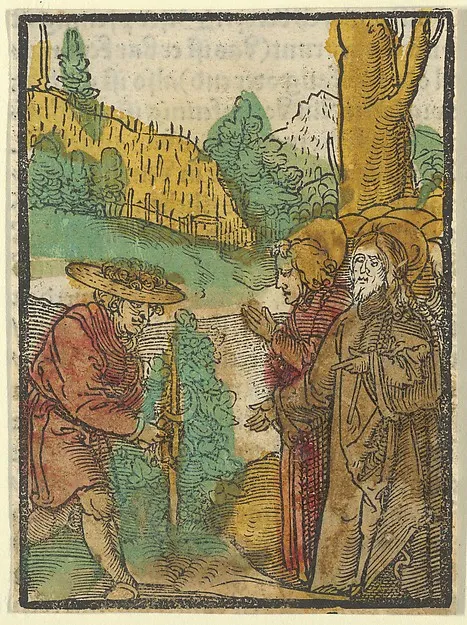
The kingdom of heaven, Jesus says, is like a householder who goes out at daybreak to hire labourers for his vineyard, agreeing with them for a penny a day. He goes out again at the third hour, the sixth, the ninth, and at last at the eleventh hour - an hour before sunset - and finds men still standing idle, and sends them in too. When evening comes he pays them beginning from the last unto the first, and every man, the eleventh-hour worker and the dawn worker alike, receives the same penny.
The early labourers murmur; the owner answers one of them, Friend, I do thee no wrong… Is it not lawful for me to do what I will with mine own? Is thine eye evil, because I am good? (vv. 13-15). The parable ends where the chapter will keep returning: So the last shall be first, and the first last.1
Tap any highlighted phrase to jump to the commentary that unpacks it.
Matthew 20:1-16Is Thine Eye Evil, Because I Am Good?
1For the kingdom of heaven is like unto a man that is an householder, which went out early in the morning to hire labourers into his vineyard. 2And when he had agreed with the labourers for a penny a day, he sent them into his vineyard. 3And he went out about the third hour, and saw others standing idle in the marketplace, 4And said unto them; Go ye also into the vineyard, and whatsoever is right I will give you. And they went their way. 5Again he went out about the sixth and ninth hour, and did likewise. 6And about the eleventh hour he went out, and found others standing idle, and saith unto them, Why stand ye here all the day idle? 7They say unto him, Because no man hath hired us. He saith unto them, Go ye also into the vineyard; and whatsoever is right, that shall ye receive.
The parable answers a question Peter has just asked - what shall we have therefore? (Matt. 19:27) - and it answers it by upending the whole idea of payment for service. The householder goes out at early in the morning and strikes a clear bargain: a penny a day, a denarius, the ordinary wage for a day's labour. So far this is plain commerce. But then he keeps going out - at the third hour (mid-morning), the sixth (noon), the ninth (mid-afternoon), and at last the eleventh hour, with barely an hour of daylight left.
To the later workers he makes no fixed bargain; he simply promises whatsoever is right. Notice who these later men are: not loafers, but the unhired, the passed-over, the ones who answer, Because no man hath hired us (v. 7). They stood idle all day not from laziness but because no one would take them. The householder seeks them out anyway. The picture is already tilting away from a marketplace of earned wages and toward something far more like a search - an owner who keeps coming back for the ones nobody else wanted.2
8So when even was come, the lord of the vineyard saith unto his steward, Call the labourers, and give them their hire, beginning from the last unto the first. 9And when they came that were hired about the eleventh hour, they received every man a penny. 10But when the first came, they supposed that they should have received more; and they likewise received every man a penny. 11And when they had received it, they murmured against the goodman of the house, 12Saying, These last have wrought but one hour, and thou hast made them equal unto us, which have borne the burden and heat of the day.
Everything turns on a single instruction: give them their hire, beginning from the last unto the first (v. 8). The owner could have paid the dawn workers first and sent them home content, never the wiser about what the latecomers got. Instead he stages the reckoning so the eleventh-hour men are paid first, and in full sight of the rest. Each receives a penny - the very wage the early workers had agreed to. And now the dawn crew does the arithmetic and supposed that they should have received more. When they too get a penny, they murmured - the same word used of Israel grumbling in the wilderness.
Hear their complaint exactly: These last have wrought but one hour, and thou hast made them equal unto us, which have borne the burden and heat of the day (v. 12). Every word of it is true. They had worked longer; they had borne the scorching weight of the day. Their grievance is not that they were cheated - they got precisely what they agreed to - but that someone else was treated as well as they were. The offense is not injustice.
The offense is generosity.
13But he answered one of them, and said, Friend, I do thee no wrong: didst not thou agree with me for a penny? 14Take that thine is, and go thy way: I will give unto this last, even as unto thee. 15Is it not lawful for me to do what I will with mine own? Is thine eye evil, because I am good? 16So the last shall be first, and the first last: for many be called, but few chosen.
The owner's reply is firm and unhurried, and it begins with a startling word: Friend. He has done no wrong - didst not thou agree with me for a penny? The early worker has exactly what he bargained for; the contract was honoured to the letter. The owner's freedom to be generous beyond contract takes nothing from the man who was paid in full: Take that thine is, and go thy way. Then comes the line the whole parable has been built to deliver: Is it not lawful for me to do what I will with mine own? Is thine eye evil, because I am good? (v. 15).
An evil eye, in the language of Scripture, is the begrudging, envious eye - the look that cannot bear another's good fortune. The early workers are not poorer for the owner's kindness to the latecomers; they are only smaller in spirit, unable to rejoice in goodness simply because it was shown to someone else. And so the chapter's refrain lands: the last shall be first, and the first last (v. 16). In a kingdom run on grace rather than merit, the bookkeeping of who-deserves-more is overturned entirely - and the deepest danger is not coming late, but coming early and resenting the latecomers their welcome.
Matthew 20:17-19Behold, We Go Up to Jerusalem
17And Jesus going up to Jerusalem took the twelve disciples apart in the way, and said unto them, 18Behold, we go up to Jerusalem; and the Son of man shall be betrayed unto the chief priests and unto the scribes, and they shall condemn him to death, 19And shall deliver him to the Gentiles to mock, and to scourge, and to crucify him: and the third day he shall rise again.
For the third time in Matthew, Jesus tells the twelve what is coming, and this time the detail is unsparing. The earlier warnings spoke of suffering and rising (Matt. 16:21; 17:22-23); now the road itself is named - we go up to Jerusalem - and the stages of the passion are laid out one after another like a sentence already passed. He will be betrayed unto the chief priests and unto the scribes; they will condemn him to death; He will be delivered to the Gentiles, and at their hands mocked, scourged, and crucified. This is the first time in the Gospel that the word crucify is spoken of His own death.
Nothing here is accident or ambush. Jesus walks toward the city with His eyes open, naming each blow before it falls. And He does not stop at the cross: the third day he shall rise again. The prediction holds death and resurrection together in a single breath, so that the suffering is never the last word but never minimized either. He goes to Jerusalem not as a victim overtaken by events but as One laying down a life He has already counted the cost of - which is exactly what He will say a few verses later.2
Matthew 20:20-28To Give His Life a Ransom for Many
20Then came to him the mother of Zebedee’s children with her sons, worshipping him, and desiring a certain thing of him. 21And he said unto her, What wilt thou? She saith unto him, Grant that these my two sons may sit, the one on thy right hand, and the other on the left, in thy kingdom. 22But Jesus answered and said, Ye know not what ye ask. Are ye able to drink of the cup that I shall drink of, and to be baptized with the baptism that I am baptized with? They say unto him, We are able. 23And he saith unto them, Ye shall drink indeed of my cup, and be baptized with the baptism that I am baptized with: but to sit on my right hand, and on my left, is not mine to give, but it shall be given to them for whom it is prepared of my Father.
No sooner has Jesus spoken of betrayal and crucifixion than the mother of Zebedee's sons - James and John - comes worshipping him and asks the chief seats of the kingdom for her boys: the one on thy right hand, and the other on the left. The right and left of a throne were the places of highest honour and authority. They have heard kingdom and pictured a coronation; Jesus has just told them what kind of king He will be.
His reply is searching, not scolding: Ye know not what ye ask. Then He sets before them, instead of a throne, a cup: Are ye able to drink of the cup that I shall drink of? (v. 22). In the prophets the cup is an image of a portion appointed to be drunk to the dregs - here, the suffering He is walking toward, the very cup He will pray over in the garden, O my Father, if it be possible, let this cup pass from me (Matt. 26:39).
They answer with quick confidence, We are able - not grasping what they are pledging. Jesus accepts it anyway, soberly: Ye shall drink indeed of my cup. They will suffer for His name. But the seats themselves are not His to dispense as favours; they shall be given to them for whom it is prepared of my Father. Honour in the kingdom is not awarded by lobbying. It is bound up with the cup - with sharing the path of the cross.2
24And when the ten heard it, they were moved with indignation against the two brethren. 25But Jesus called them unto him, and said, Ye know that the princes of the Gentiles exercise dominion over them, and they that are great exercise authority upon them. 26But it shall not be so among you: but whosoever will be great among you, let him be your minister; 27And whosoever will be chief among you, let him be your servant: 28Even as the Son of man came not to be ministered unto, but to minister, and to give his life a ransom for many.
The other ten are moved with indignation - not, it seems, because the request was wrong, but because two of them tried to seize what all twelve wanted. So Jesus gathers them and names the world's pattern plainly: the princes of the Gentiles exercise dominion over them, and they that are great exercise authority upon them (v. 25). This is greatness as the world has always understood it - greatness measured by how many you can command, how far your power reaches over others.
Then comes the great reversal, sharp as a hinge: But it shall not be so among you. In four words He severs His people from the whole machinery of domination. The way up, in His kingdom, is the way down: whosoever will be great among you, let him be your minister; and whosoever will be chief among you, let him be your servant (vv. 26-27). The Greek word for servant here is the lowest of the household - the bondservant, the one who has no rank to protect.
Greatness is not abolished; it is redefined. It is measured now not by who serves you but by whom you serve. And lest this sound like mere moral advice, Jesus grounds it in Himself and in what He is going to Jerusalem to do - the sentence the whole chapter has been building toward.
Matthew 20:29-34Thou Son of David, Have Mercy on Us
29And as they departed from Jericho, a great multitude followed him. 30And, behold, two blind men sitting by the way side, when they heard that Jesus passed by, cried out, saying, Have mercy on us, O Lord, thou son of David. 31And the multitude rebuked them, because they should hold their peace: but they cried the more, saying, Have mercy on us, O Lord, thou son of David. 32And Jesus stood still, and called them, and said, What will ye that I shall do unto you? 33They say unto him, Lord, that our eyes may be opened. 34So Jesus had compassion on them, and touched their eyes: and immediately their eyes received sight, and they followed him.
As Jesus leaves Jericho on the last leg of the road to Jerusalem, two blind men by the wayside hear that He is passing and cry out: Have mercy on us, O Lord, thou son of David (v. 30). The title is no small thing. Son of David is a confession of the promised King, the heir of David's throne - and it is these two blind beggars, not the seeing crowd, who name Him rightly.
They cannot see His face, but they see who He is. The multitude tries to silence them, telling them to hold their peace; the crowd has no time for two roadside beggars interrupting the procession. But the men will not be hushed. They cried the more - louder, more urgent, undeterred by the rebuke. Their faith is the kind that grows bolder when discouraged, that refuses to let the one chance pass. And the chapter quietly completes its own lesson here.
It has just spent twenty-eight verses redefining greatness as service to the lowly and lifting up the last over the first - and now the King who taught it stops the whole procession for two blind beggars whom everyone else wanted out of the way. The least are not in the way of His kingdom; they are exactly whom He came for.
Jesus stood still. The great multitude streams toward Jerusalem, but the King halts the march for two men the crowd had dismissed, and calls them to Him. His question is striking in its courtesy: What will ye that I shall do unto you? (v. 32). He who already knows their need invites them to name it - to put their longing into words and own it as their own. Their answer is simple and whole: Lord, that our eyes may be opened. And then the verse moves with the unhurried tenderness that marks Him all through this Gospel: So Jesus had compassion on them, and touched their eyes. He need not have touched them; a word would have sufficed.
But He reaches out and lays His hand on the eyes of two men no one else would come near. Immediately their eyes received sight - no process, no delay, sight given whole in an instant. And the closing words are the truest seal of the healing: and they followed him. They did not take their new sight and return to their old lives. The first thing they saw was Jesus, and they fell in behind Him on the road - the road that led to the very cross He had been describing.
The cry of faith was answered, and the answer made them disciples.
Research trail
Sources & further study
These references support the historical, linguistic, manuscript, and contextual notes in this chapter. Scripture remains the primary text; external sources are provided so readers can inspect the research directly.
- Matthew 20 ↔ Mark 10 · Isaiah 53 · 1 Timothy 2 · 1 Peter 1Traces the threads tying Matthew 20 to the rest of Scripture - the ransom saying (v. 28) beside Mark 10:45 and the servant who pours out his soul in Isaiah 53, and beside who gave himself a ransom for all (1 Tim. 2:6) and redeemed… with the precious blood of Christ (1 Pet. 1:18-19).
- Matthew 20 - Translators' NotesThe NET Bible's detailed footnotes on Matthew 20 - the denarius as a labourer's daily wage (vv. 2, 9-10), the third passion prediction (vv. 17-19), the cup as an image of suffering (vv. 22-23), and the much-discussed phrase a ransom for many in verse 28.
- Matthew 20 · Greek interlinear + lexiconThe Greek text of Matthew 20 word by word, with parsing and lexical links - useful for lutron (v. 28, the “ransom” or price of release), for diakoneo and diakonos (vv. 26-28, “minister” / “to minister”), and for the “evil eye” idiom of verse 15.
Where this echoes in Scripture
Is Thine Eye Evil, Because I Am Good?
- Luke 15:28-30he was angry, and would not go in... Lo, these many years do I serve thee... and yet thou never gavest me a kid.The same grievance as verses 11-12 - the elder brother resenting the grace shown to the latecomer.
- Ephesians 2:8-9by grace are ye saved through faith; and that not of yourselves: it is the gift of God: not of works.The economy of the parable - the wage of the kingdom received as gift, not earned as wage.
- Jonah 4:1-2it displeased Jonah exceedingly... for I knew that thou art a gracious God... slow to anger, and of great kindness.An evil eye toward God's mercy (v. 15) - a servant angry that God is good to those he thought undeserving.
- Romans 9:20-21Nay but, O man, who art thou that repliest against God?... Hath not the potter power over the clay?The owner's freedom in verse 15 - the Lord's right to do as He wills with what is His own.
- Matthew 19:30But many that are first shall be last; and the last shall be first.The refrain framing the parable (v. 16) - the reversal the kingdom works on every human ranking.
Behold, We Go Up to Jerusalem
- Isaiah 53:3-7He is despised and rejected of men... he was brought as a lamb to the slaughter... he opened not his mouth.The suffering foretold in verses 18-19 - the servant who bears mocking and death in silence.
- John 10:17-18I lay down my life... No man taketh it from me, but I lay it down of myself.Why Jesus can predict the passion so exactly (vv. 18-19) - the cross is freely chosen, not merely suffered.
- Matthew 16:21he must go unto Jerusalem, and suffer many things... and be killed, and be raised again the third day.The first of the passion predictions - the same death-and-rising now named a third time and in fuller detail.
- Psalm 22:16-18they pierced my hands and my feet... They part my garments among them, and cast lots upon my vesture.The crucifixion of verse 19 foreseen - the suffering of the righteous one described long beforehand.
To Give His Life a Ransom for Many
- Mark 10:43-45whosoever will be great among you, shall be your minister... For even the Son of man came not to be ministered unto, but to minister.The same teaching and the same ransom saying (v. 28), recorded word for word in the second Gospel.
- 1 Timothy 2:5-6one mediator between God and men, the man Christ Jesus; Who gave himself a ransom for all.The ransom of verse 28 named again - the life given as the price, held out for all.
- 1 Peter 1:18-19ye were not redeemed with corruptible things, as silver and gold... But with the precious blood of Christ.The price of the ransom (v. 28) named - not silver or gold, but the blood of Christ.
- John 13:4-5, 14-15he riseth from supper... and began to wash the disciples’ feet... I have given you an example.The servanthood of verses 26-28 enacted - the Lord taking the towel and the basin of the lowest servant.
- Philippians 2:5-8made himself of no reputation, and took upon him the form of a servant... he humbled himself... unto death.The pattern of verse 28 in full - the One who served by descending all the way to the cross.
Thou Son of David, Have Mercy on Us
- Mark 10:46-52Bartimaeus... began to cry out, and say, Jesus, thou son of David, have mercy on me... thy faith hath made thee whole.The same Jericho healing (vv. 29-34) - the blind beggar whose persistent cry of faith is rewarded with sight.
- Isaiah 35:5Then the eyes of the blind shall be opened, and the ears of the deaf shall be unstopped.The sign fulfilled in verse 34 - the opening of blind eyes that marks the coming of God's salvation.
- Romans 10:13For whosoever shall call upon the name of the Lord shall be saved.The promise behind the cry of verses 30-31 - the call for mercy that is never refused.
- Psalm 146:8The LORD openeth the eyes of the blind: the LORD raiseth them that are bowed down.The compassion of verse 34 - the LORD's own work of opening blind eyes and lifting the lowly.