Jonah 4
People in this chapter
Jonah preached; Nineveh repented; God spared the city. And the prophet is displeased… exceedingly and very angry (v. 1). He had wanted judgment to fall. The God he serves has done the one thing Jonah dreaded, by being exactly who He has always declared Himself to be: a gracious God, and merciful, slow to anger, and of great kindness, and repentest thee of the evil (v. 2). Here, at last, is why Jonah fled toward Tarshish back at the start: he feared God's pity.
The book's final chapter turns the camera away from the rescued city and onto the heart of the man who resents the rescue.1
Tap any highlighted phrase to jump to the commentary that unpacks it.
Jonah 4:1-5Doest Thou Well to Be Angry?
1But it displeased Jonah exceedingly, and he was very angry. 2And he prayed unto the LORD, and said, I pray thee, O LORD, was not this my saying, when I was yet in my country? Therefore I fled before unto Tarshish: for I knew that thou art a gracious God, and merciful, slow to anger, and of great kindness, and repentest thee of the evil. 3Therefore now, O LORD, take, I beseech thee, my life from me; for it is better for me to die than to live. 4Then said the LORD, Doest thou well to be angry? 5So Jonah went out of the city, and sat on the east side of the city, and there made him a booth, and sat under it in the shadow, till he might see what would become of the city.
The first verse of the chapter lands like a slap: But it displeased Jonah exceedingly, and he was very angry (v. 1). A whole city has just been spared; Heaven itself has relented; and the prophet through whom it happened is enraged. Read the verse against the one before it - God repented of the evil, that he had said that he would do unto them; and he did it not - and the jarring contrast is the entire point.
What moves God to mercy moves Jonah to fury. This is the hinge of the whole book, and it is worth pausing over. We tend to assume that a prophet, of all people, would rejoice when sinners turn and live. Jonah does the opposite. His anger is deep and settled - so settled that the next thing he does is pray to die. Something has gone wrong in him that the great fish and the storm and the three days in the deep have not touched - an obedience of the feet that never reached the heart.1
Now, at last, Jonah explains the flight that opened the book: was not this my saying, when I was yet in my country? Therefore I fled before unto Tarshish: for I knew that thou art a gracious God, and merciful, slow to anger, and of great kindness, and repentest thee of the evil (v. 2). This is the great irony of Jonah. He ran because he feared the mission would succeed. He knew his God too well.
The words he speaks are the LORD's own self-description given to Moses at Sinai, the very creed Israel sang to celebrate God's forgiving heart. Jonah can recite it perfectly. And he hates it at the precise moment it reaches the people he wants destroyed. Here is a sobering thing the chapter exposes: a man can hold flawless theology about the mercy of God and resent that mercy bitterly when it falls on the wrong person.
Jonah believes every true thing about God's grace except that it is good news when it touches his enemy.
So the prophet asks to die: Therefore now, O LORD, take, I beseech thee, my life from me; for it is better for me to die than to live (v. 3). It is a stunning request. Jonah would rather be dead than live in a world where Nineveh is forgiven. His sense of justice has curdled into something that cannot tolerate grace at all. And then comes the LORD's reply - a question, gently put: Doest thou well to be angry? (v. 4).
The gentleness of it is striking. God does not crush the sulking prophet; He probes him. The question is an invitation to self-examination: is your anger right? Is it just? Does it do you any good? Jonah does not answer - he stalks off east of the city, builds himself a little booth, and sits down to see what would become of the city (v. 5), still half-hoping, perhaps, that judgment might fall after all.
He would rather watch from a distance for fire than go home rejoicing over mercy.
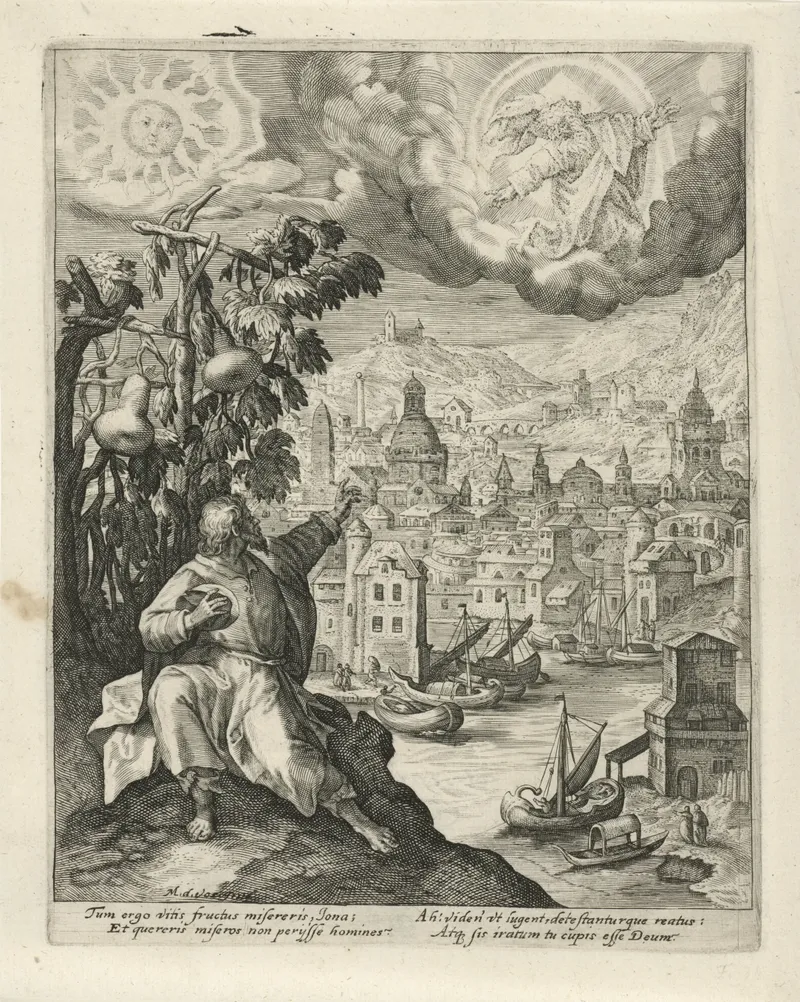
Jonah 4:6-11Should Not I Spare Nineveh?
6And the LORD God prepared a gourd, and made it to come up over Jonah, that it might be a shadow over his head, to deliver him from his grief. So Jonah was exceeding glad of the gourd. 7But God prepared a worm when the morning rose the next day, and it smote the gourd that it withered. 8And it came to pass, when the sun did arise, that God prepared a vehement east wind; and the sun beat upon the head of Jonah, that he fainted, and wished in himself to die, and said, It is better for me to die than to live. 9And God said to Jonah, Doest thou well to be angry for the gourd? And he said, I do well to be angry, even unto death. 10Then said the LORD, Thou hast had pity on the gourd, for the which thou hast not laboured, neither madest it grow; which came up in a night, and perished in a night: 11And should not I spare Nineveh, that great city, wherein are more than sixscore thousand persons that cannot discern between their right hand and their left hand; and also much cattle?
God now begins to teach His angry prophet, and He does it with kindness: the LORD God prepared a gourd, and made it to come up over Jonah, that it might be a shadow over his head, to deliver him from his grief. So Jonah was exceeding glad of the gourd (v. 6). The same God who prepared the great fish now prepares a plant - a broad-leafed, fast-growing vine that springs up over the booth and softens the brutal sun.
Notice the small grace in it: God is still caring for the man who has just asked to die. And notice Jonah's response - he is exceeding glad. The phrase is striking precisely because nothing else in the chapter has made Jonah glad. A spared city left him raging; a leafy weed delights him. Already the lesson is taking shape without a word of explanation. Jonah's affections have been quietly exposed: he can feel deep gladness over a personal comfort and deep fury over a divine mercy.
The gourd is a mirror God is gently holding up to the prophet's heart.
Then God withdraws the comfort He gave: But God prepared a worm when the morning rose the next day, and it smote the gourd that it withered (v. 7). The God who prepared the fish and the gourd now prepares a worm - the smallest of instruments, and enough to undo the prophet's shade overnight. And He prepares one thing more: a vehement east wind, the scorching desert blast, while the sun beat upon the head of Jonah, that he fainted, and wished in himself to die (v. 8).
For the second time Jonah begs to die, now over a plant. The repetition is deliberate; the book wants us to hear the death wish twice - once over the sparing of a city, once over the loss of a weed - and to feel how badly the prophet's sense of proportion has failed. Then God asks again the question of verse 4, narrowed now to the gourd: Doest thou well to be angry for the gourd? And Jonah, far from softening, digs in: I do well to be angry, even unto death (v. 9).
He defends his rage to the bitter end. He has chosen his ground, and he will die on it - furious over a vanished comfort, while a hundred thousand rescued souls mean nothing to him.
Now God draws the lesson out into the open, and the whole book has been building to it: Thou hast had pity on the gourd, for the which thou hast not laboured, neither madest it grow; which came up in a night, and perished in a night (v. 10). Every clause tightens the point. Jonah pitied a plant he did not plant, did not tend, did not grow - a thing that lived a single day.
His grief over it was real, but it was grief over something he had no part in and that had no lasting worth. Set that, God says, against Nineveh. If Jonah's small heart can ache over a withered vine, how much more does the heart of God ache over a vast city of living people? The argument runs from the lesser to the greater: you cared that much about so little; should not I care about so much more?
The prophet's misplaced pity becomes the very thing that exposes the rightness of God's pity. God has not denied that Jonah felt something true when the gourd died. He has only asked him to follow that feeling to its proper object - people, a city full of souls.1
And then the book ends - on a question, with no reply: And should not I spare Nineveh, that great city, wherein are more than sixscore thousand persons that cannot discern between their right hand and their left hand; and also much cattle? (v. 11). It is one of the most remarkable endings in all of Scripture. God's question hangs in the air with no reply. Sixscore thousand is more than a hundred thousand; that cannot discern between their right hand and their left hand most naturally describes the little children, the wholly innocent who could not even understand the danger they were in - though it also catches the deep moral confusion of the whole city, a people who scarcely knew good from evil.
And then, tenderly, also much cattle: even the animals fall within the reach of God's care. The God who made all this looks on the teeming, bewildered multitude and asks whether He should not have pity. The question is aimed at Jonah, but the prophet is given no answer to speak, because the answer is not really his to give. It is left open on purpose - so that it travels past Jonah and reaches whoever is reading.
The last word of the book is compassion, held out as a question that waits for you.
Research trail
Sources & further study
These references support the historical, linguistic, manuscript, and contextual notes in this chapter. Scripture remains the primary text; external sources are provided so readers can inspect the research directly.
- Jonah 4 - Translators' NotesThe NET Bible's detailed footnotes on Jonah 4 - the idiom for Jonah's burning anger in verses 1 and 4, the “gourd” or fast-growing plant of verse 6, the “vehement east wind” of verse 8, and the much-discussed final phrase about those who cannot discern between their right hand and their left.
- Jonah 4 · Hebrew + classical Jewish commentaryThe Hebrew text of Jonah 4 with Rashi, Ibn Ezra, and other classical commentators side by side - useful for the burning of Jonah's anger (charah, vv. 1, 4, 9), the searching question ha-heitev charah lach (“doest thou well to be angry?”), and the closing verb chus (v. 11, “spare” / “look on with pity”).
- Jonah 4 ↔ Exodus 34 · Luke 15 · Matthew 20Traces the threads tying Jonah 4 to the rest of Scripture - Jonah's creed in verse 2 drawn straight from The LORD… merciful and gracious, longsuffering (Exod. 34:6), and his resentment at grace shown to outsiders read beside the elder brother (Luke 15:25-32) and the labourers who grudged the householder's goodness (Matt. 20:1-16).
Where this echoes in Scripture
Doest Thou Well to Be Angry?
- Exodus 34:6The LORD, The LORD God, merciful and gracious, longsuffering, and abundant in goodness and truth.The creed Jonah quotes in verse 2 - God's own self-revelation, which Jonah knows by heart and resents.
- Jonah 1:3But Jonah rose up to flee unto Tarshish from the presence of the LORD.The flight verse 2 finally explains - Jonah ran because he feared God would show mercy.
- 1 Kings 19:4he requested for himself that he might die; and said, It is enough; now, O LORD, take away my life.Elijah's death wish set beside Jonah's (v. 3) - a prophet at the end of himself, asking God to take his life.
- Romans 2:4the riches of his goodness and forbearance and longsuffering; not knowing that the goodness of God leadeth thee to repentance.The very kindness Jonah names in verse 2 - the patience of God that draws even enemies to turn and live.
- Luke 15:28And he was angry, and would not go in: therefore came his father out, and intreated him.The elder brother's anger at grace shown to a wanderer - the same resentment that consumes Jonah in verses 1-3.
Should Not I Spare Nineveh?
- Matthew 9:36But when he saw the multitudes, he was moved with compassion on them... as sheep having no shepherd.God's pity for the bewildered city (v. 11) seen in the face of Christ, moved with compassion for the shepherdless crowd.
- Luke 15:25-32And he was angry, and would not go in... Son, thou art ever with me... It was meet that we should make merry.The elder brother's rage at grace shown to a wanderer - Jonah's anger (vv. 1-9) drawn as a parable.
- Matthew 20:13-15Friend, I do thee no wrong... Is it not lawful for me to do what I will with mine own? Is thine eye evil, because I am good?The labourers indignant at the householder's generosity - the same heart that resents God's mercy in verse 11.
- Luke 19:10For the Son of man is come to seek and to save that which was lost.The compassion behind God's closing question (v. 11) - the deliberate seeking of the lost.
- Ezekiel 33:11I have no pleasure in the death of the wicked; but that the wicked turn from his way and live.The heart behind the sparing of Nineveh (v. 11) - God's own delight in the repentance of the wicked and their turning to life.