1 Kings 19
People in this chapter
Hours earlier, fire fell from heaven at Carmel and a whole nation cried out that the LORD is God. Now the prophet who called that fire down is running for his life - from a single message sent by one furious queen. Elijah leaves his servant behind, walks a day into the wilderness, sits under a juniper tree, and asks God to let him die.
Tap any highlighted phrase to jump to the commentary that unpacks it.
1 Kings 19:1-3The Threat and the Flight
1And Ahab told Jezebel all that Elijah had done, and withal how he had slain all the prophets with the sword. 2Then Jezebel sent a messenger unto Elijah, saying, So let the gods do to me, and more also, if I make not thy life as the life of one of them by to morrow about this time. 3And when he saw that, he arose, and went for his life, and came to Beersheba, which belongeth to Judah, and left his servant there.
Ahab has just watched the sky open. He tells Jezebel none of it as good news. To him it is a report of disaster: the prophets of Baal are dead, the royal religion publicly humiliated. You would expect a king who saw fire fall to be shaken into reverence. Ahab walks home and hands the whole story to the one person guaranteed to make it worse.
Notice she does not send soldiers. She sends a sentence. A messenger, an oath sworn on her own gods, a deadline: by this time tomorrow you will be as dead as the prophets you slew. It is theatre as much as threat - a real assassin does not announce the hour. And it works. The man who outlasted four hundred and fifty knives at Carmel cannot outlast one woman's words. He runs.
There is something oddly comforting in how human he suddenly becomes. The fearless prophet of the mountaintop is gone; in his place is an exhausted man pushing south as fast as his legs will carry him, all the way to Beer-sheba at the bottom edge of Judah. There he leaves even his servant and pushes on alone. If you have ever felt invincible one week and hollowed out the next, you have stood where Elijah stands here.
1 Kings 19:4-8The Angel's Care
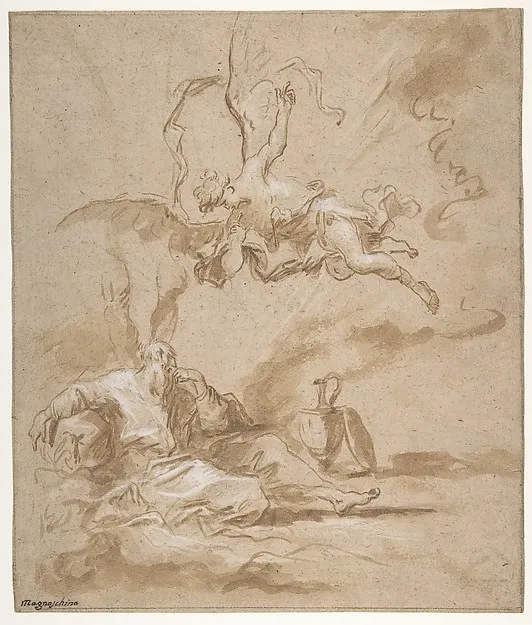
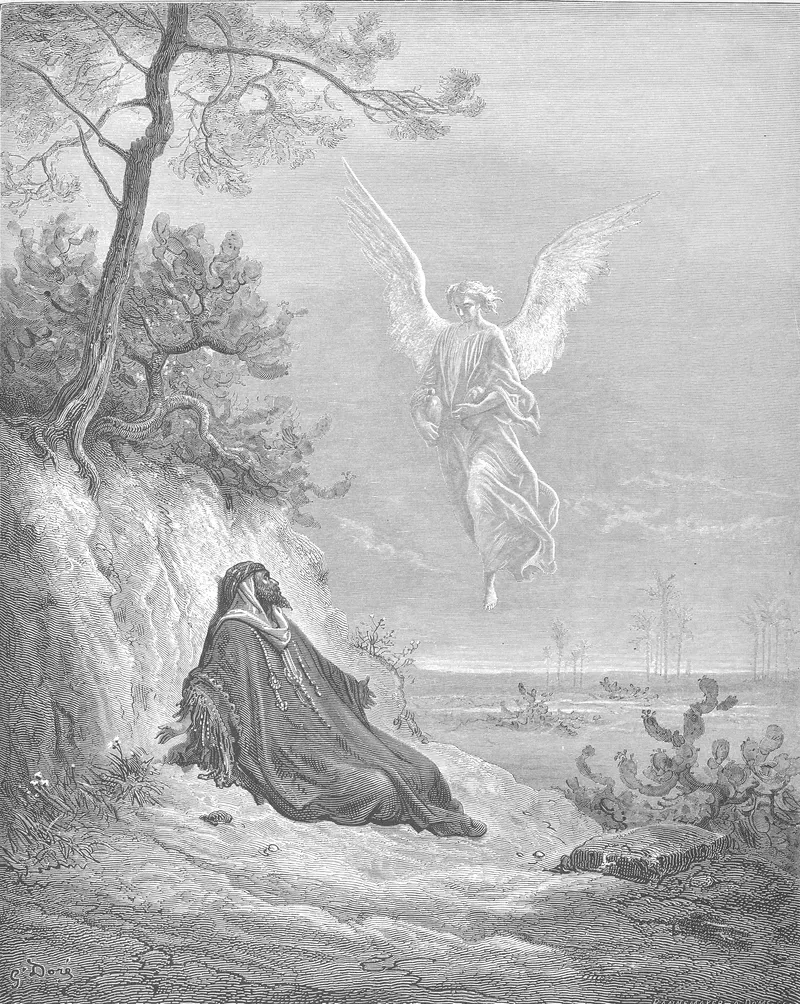
4But he himself went a day’s journey into the wilderness, and came and sat down under a juniper tree: and he requested for himself that he might die; and said, It is enough; now, O LORD, take away my life; for I am not better than my fathers. 5And as he lay and slept under a juniper tree, behold, then an angel touched him, and said unto him, Arise and eat. 6And he looked, and, behold, there was a cake baken on the coals, and a cruse of water at his head. And he did eat and drink, and laid him down again. 7And the angel of the LORD came again the second time, and touched him, and said, Arise and eat; because the journey is too great for thee. 8And he arose, and did eat and drink, and went in the strength of that meat forty days and forty nights unto Horeb the mount of God.
His prayer is the white flag of a man completely spent. He does not claim to be worse than the prophets before him, only that he is no better; he had hoped to be the one who finally turned the nation, and that hope has collapsed. So he asks the Lord to let him rest from it all. The man who commanded the sky at noon sits in the dark by evening with nothing left. Scripture rarely shows a servant of God worn down this honestly.
Heaven's first response to a prophet at the end of himself is breathtakingly low-key. No vision splits the sky. No voice thunders him awake. An angel simply reaches down and touches a sleeping man on the shoulder, the way you would wake a tired child, and says: get up and eat. There is no sermon in it, no correction, not one word about the running or the fear. The first word of God's care for the weary prophet is bread.
A second time the angel wakes him, and this time gives the reason: the road ahead is longer than Elijah's strength. God is already looking past the despair to the journey on the other side of it. He does not lecture the prophet out of his exhaustion; He feeds it. Grace here comes in the form of a nap and a second meal. Sometimes the most spiritual thing a worn-out servant can do is sleep and eat what God provides.
1 Kings 19:9-10The Question in the Cave
9And he came thither unto a cave, and lodged there; and, behold, the word of the LORD came to him, and he said unto him, What doest thou here, Elijah? 10And he said, I have been very jealous for the LORD God of hosts: for the children of Israel have forsaken thy covenant, thrown down thine altars, and slain thy prophets with the sword; and I, even I only, am left; and they seek my life, to take it away.
Forty days of walking land Elijah in a cave on the mountain of God, and the first thing the LORD does is ask him a question. Not an accusation, though He could have made one. The question is gentler and more searching than “why did you run?” It is simply: what are you doing here? It hands the prophet room to say out loud what he is feeling, which is often the first thing a hurting person needs - permission to tell the truth about where he is.
His answer pours out as a complaint with one phrase at its center: I, even I only, am left. There it is - the lie underneath the exhaustion. He is convinced he is the last faithful man in Israel, the whole cause resting on his single pair of shoulders, and those shoulders have given out. Despair almost always talks like this. It shrinks the world down to you alone, makes your failure total, and quietly hides every other faithful face from view.
1 Kings 19:11-13The Still Small Voice
11And he said, Go forth, and stand upon the mount before the LORD. And, behold, the LORD passed by, and a great and strong wind rent the mountains, and brake in pieces the rocks before the LORD; but the LORD was not in the wind: and after the wind an earthquake; but the LORD was not in the earthquake: 12And after the earthquake a fire; but the LORD was not in the fire: and after the fire a still small voice. 13And it was so, when Elijah heard it, that he wrapped his face in his mantle, and went out, and stood in the entering in of the cave. And, behold, there came a voice unto him, and said, What doest thou here, Elijah?
Here is the part most readers rush past too quickly. The wind that tears the mountains and shatters the rocks is genuinely the LORD passing by - and yet the LORD is not in it. The lesson is stranger than any simple preference for quiet. Every form of overwhelming power Elijah has known and even wielded comes marching past, and God refuses to be located in any of them. He is staging this. He has something to show a prophet who has only ever met Him in spectacle.
Then the ground itself convulses. An earthquake is the one force a person cannot stand against or run from; the very floor of the world betrays you. Surely God is in this - and yet the same answer comes back a second time, patient and absolute: the LORD is not in the earthquake either.
Then fire - and this one must have stopped Elijah's heart. Fire is how God answered him at Carmel just days ago; fire fell from heaven and vindicated him before the whole nation. If God were anywhere in this parade, surely He would be here, in the very sign that made Elijah a hero. He is not in the fire either. Gently, deliberately, God is unhooking His prophet from the only language he thinks God speaks.
And after all the noise, a still small voice. A thin whisper of silence. It is so quiet that Elijah has to stop, wrap his face in his cloak, and step to the mouth of the cave just to catch it - the same posture Moses took on this mountain when he hid his face from God. The God who had just torn the rocks apart now lowers His voice to the volume of intimacy, the volume you would use for someone you love who is hurting. He leans in close and speaks to the broken man alone.
1 Kings 19:14-18The Truth: You Are Not Alone
14And he said, I have been very jealous for the LORD God of hosts: because the children of Israel have forsaken thy covenant, thrown down thine altars, and slain thy prophets with the sword; and I, even I only, am left; and they seek my life, to take it away. 15And the LORD said unto him, Go, return on thy way to the wilderness of Damascus: and when thou comest, anoint Hazael to be king over Syria: 16And Jehu the son of Nimshi shalt thou anoint to be king over Israel: and Elisha the son of Shaphat of Abelmeholah shalt thou anoint to be prophet in thy room. 17And it shall come to pass, that him that escapeth the sword of Hazael shall Jehu slay: and him that escapeth from the sword of Jehu shall Elisha slay. 18Yet I have left me seven thousand in Israel, all the knees which have not bowed unto Baal, and every mouth which hath not kissed him.
Strikingly, after the wind and the fire and the whisper, Elijah gives the exact same speech he gave before, word for word. The encounter has not yet changed his mind. So this time God moves past comfort and answers the complaint head-on with two things the prophet is missing: a job to do, and a fact he has gotten badly wrong. His despair is real and human. It is also simply not true.
Then the correction Elijah never expected: he was off by seven thousand. All this time he has been certain he is the last one standing, and God names a hidden multitude who never bent the knee to Baal - a full and complete number, the opposite of his lonely one. They were faithful the whole while he despaired. He simply could not see them from inside his cave. Your eyes lie to you in the dark; God was keeping a people Elijah knew nothing about.
Notice the cure God prescribes for a man who wants to die: He gives him three names and sends him back to work. Anoint Hazael over Syria, Jehu over Israel, Elisha as the prophet to follow you. Far from winding the ministry down, God is multiplying it past Elijah's own lifetime - a foreign king, a king of Israel, and a successor who will carry the mantle when Elijah is gone. The most healing word to a servant convinced he has failed is sometimes a fresh assignment.
1 Kings 19:19-21The Call of Elisha
19So he departed thence, and found Elisha the son of Shaphat, who was plowing with twelve yoke of oxen before him, and he with the twelfth: and Elijah passed by him, and cast his mantle upon him. 20And he left the oxen, and ran after Elijah, and said, Let me, I pray thee, kiss my father and my mother, and then I will follow thee. And he said unto him, Go back again: for what have I done to thee? 21And he returned back from him, and took a yoke of oxen, and slew them, and boiled their flesh with the instruments of the oxen, and gave unto the people, and they did eat. Then he arose, and went after Elijah, and ministered unto him.
Twelve yoke of oxen is the detail to catch. This is no poor laborer looking for a way out; only a wealthy landowner plows behind a dozen teams. Elisha has security, status, a settled future in the soil under his feet. And God calls him while his hands are already busy and his back is already bent. The call rarely waits until you are free; it usually arrives mid-task, to someone who has plenty to lose.
No speech, no recruiting pitch, not even a pause in his stride. Elijah walks by and lets his cloak fall across the younger man's shoulders, and that is the whole summons. Remarkably, it is enough. Elisha reads the wordless gesture instantly, drops the reins, and runs. Some callings arrive as an argument; this one arrives as a weight settling on you that you somehow already understand.
His one request - to kiss his father and mother goodbye - is a son honoring the home he is leaving before he leaves it. Elijah's reply lands oddly on the ear: go back, for what have I done to you? It is less a command than a handing-back of the choice. The mantle has touched you, but no one will drag you. Whether you go now belongs to you.
What he does next makes the break impossible to reverse. He kills the oxen, splits up the wooden plow and yokes for firewood, cooks the meat over that fire, and feeds it to his neighbors. The tools of his old trade become the fuel for the farewell feast. He burns the bridge in front of everyone, then turns and follows.