1 Kings 18
People in this chapter
Three years without rain. The brooks are dry, the cattle dying, the people starving. Ahab has scoured every kingdom for the prophet who shut the sky, and now Elijah walks back into the open to meet him. The king spits the charge first: troubler of Israel. Elijah hands it back. You troubled Israel, you and your father's house, the day you traded the Lord for Baal.1
Tap any highlighted phrase to jump to the commentary that unpacks it.
1 Kings 18:1-7The Prophet Emerges
1And it came to pass after many days, that the word of the LORD came to Elijah in the third year, saying, Go, shew thyself unto Ahab; and I will send rain upon the earth. 2And Elijah went to shew himself unto Ahab. And there was a sore famine in Samaria. 3And Ahab called Obadiah, which was the governor of his house. (Now Obadiah feared the LORD greatly:
Three years of silence, and then four words break it: go, shew thyself. The God who hid Elijah by the brook and fed him at a widow's table now sends him straight at the king who wants him dead. Notice who else surfaces in the same breath. Ahab summons his palace steward, Obadiah, and the text pauses to tell you the one thing Ahab does not know about his own right-hand man: Obadiah feared the Lord greatly. A loyal servant of the crown, and secretly loyal to Heaven first.2
4For it was so, when Jezebel cut off the prophets of the LORD, that Obadiah took an hundred prophets, and hid them by fifty in a cave, and fed them with bread and water.) 5And Ahab said unto Obadiah, Go into the land, unto all fountains of water, and unto all brooks: peradventure we may find grass to save the horses and mules alive, that we lose not all the beasts. 6So they divided the land between them to pass throughout it: Ahab went one way by himself, and Obadiah went another way by himself. 7And as Obadiah was in the way, behold, Elijah met him: and he knew him, and fell on his face, and said, Art thou that my lord Elijah?
Two men serving opposite masters meet in the wilderness. Obadiah, the king's governor, has spent years in secret faithfulness - hiding the prophets of the Lord, feeding them in caves, risking everything. Elijah, the prophet on the run, has been hidden by God. Now they meet face-to-face. Obadiah sees in Elijah what he has been protecting all these years: the living word of the Lord.
1 Kings 18:8-10I Am: Elijah Is Here
8And he answered him, I am: go, tell thy lord, Behold, Elijah is here. 9And he said, What have I sinned, that thou wouldest deliver thy servant into the hand of Ahab, to slay me? 10As the LORD thy God liveth, there is no nation or kingdom, whither my lord hath not sent to seek thee: and when they said, He is not there; he took an oath of the kingdom and nation, that they found thee not.
1 Kings 18:11-13The Governor's Protest
11And now thou sayest, Go, tell thy lord, Behold, Elijah is here. 12And it shall come to pass, as soon as I am gone from thee, that the Spirit of the LORD shall carry thee whither I know not; and so when I come and tell Ahab, and he cannot find thee, he shall slay me: but I thy servant fear the LORD from my youth. 13Was it not told my lord what I did when Jezebel slew the prophets of the LORD, how I hid an hundred men of the LORD’s prophets by fifty in a cave, and fed them with bread and water?
Obadiah is terrified. He has hidden the prophets. But what good is hiding if it means death? His protest is over the consequence alone - Elijah's word he accepts: the Spirit will lift Elijah away; Ahab will slay him. The fear is the cost of faithfulness. Yet in that moment, Obadiah must choose: hide the truth forever, or risk everything by speaking it.
1 Kings 18:14-16Obadiah's Hidden Prophets
14And now thou sayest, Go, tell thy lord, Behold, Elijah is here: and he shall slay me. 15And Elijah said, As the LORD of hosts liveth, before whom I stand, I will surely shew myself unto him to day. 16So Obadiah went to meet Ahab, and told him: and Ahab went to meet Elijah.
The famine is severe. Ahab and Obadiah are searching for grass, for any water, to keep the kingdom's horses alive. In this desolation, Obadiah encounters the man he has prayed for, feared for, hoped for - Elijah, the prophet of the Lord. And Obadiah is afraid. He knows what Elijah is and what his appearance means. He fears Ahab's response, fears the prophet will vanish as mysteriously as he came, leaving Obadiah to bear the king's wrath.
1 Kings 18:17-29How Long Halt Ye Between Two Opinions?
17And it came to pass, when Ahab saw Elijah, that Ahab said unto him, Art thou he that troubleth Israel? 18And he answered, I have not troubled Israel; but thou, and thy father’s house, in that ye have forsaken the commandments of the LORD, and thou hast followed Baalim. 19Now therefore send, and gather to me all Israel unto mount Carmel, and the prophets of Baal four hundred and fifty, and the prophets of the groves four hundred, which eat at Jezebel’s table. 20So Ahab sent unto all the children of Israel, and gathered the prophets together unto mount Carmel.
The king blinks first. Ahab could have arrested Elijah on the spot; instead he does exactly what the prophet says, sending word through all Israel and gathering the crowds to Carmel. Even a king who hates the word of the Lord ends up bending to it. The whole apparatus of Baal - hundreds of state-funded prophets, the queen's patronage, the royal table - assembles on the mountain at the command of one hunted man who answers to a higher throne.
21And Elijah came unto all the people, and said, How long halt ye between two opinions? if the LORD be God, follow him: but if Baal, then follow him. And the people answered him not a word. 22Then said Elijah unto the people, I, even I only, remain a prophet of the LORD; but Baal’s prophets are four hundred and fifty men. 23Let them therefore give us two bullocks; and let them choose one bullock for themselves, and cut it in pieces, and lay it on wood, and put no fire under: and I will dress the other bullock, and lay it on wood, and put no fire under: 24And call ye on the name of your gods, and I will call on the name of the LORD: and the God that answereth by fire, let him be God. And all the people answered and said, It is well spoken.
The test is set. Elijah proposes it with stunning simplicity: prepare two bullocks, lay them on wood without fire underneath. The prophets of Baal will call on their god, Elijah will call on the Lord. Whichever god answers by fire is the true God. The stakes could not be higher, the terms could not be clearer. And the people respond: "It is well spoken." They have accepted the challenge. Now it will be shown to all Israel, without ambiguity, whose god is real and whose god is empty.
25And Elijah said unto the prophets of Baal, Choose you one bullock for yourselves, and dress it first; for ye are many; and call on the name of your gods, but put no fire under. 26And they took the bullock which was given them, and they dressed it, and called on the name of Baal from morning even until noon, saying, O Baal, hear us. But there was no voice, nor any that answered. And they leaped upon the altar which was made. 27And it came to pass at noon, that Elijah mocked them, and said, Cry aloud: for he is a god; either he is talking, or he is pursuing, or he is in a journey, or peradventure he sleepeth, and must be awaked. 28And they cried aloud, and cut themselves after their manner with knives and lancets, till the blood gushed out upon them. 29And it came to pass, when midday was past, and they prophesied until the time of the offering of the evening sacrifice, that there was neither voice, nor any to answer, nor any that regarded.
Watch the king try to pin the disaster on the messenger. To Ahab's eyes the drought arrived with the prophet, so the prophet must be its cause - the troubler of Israel. Elijah will not absorb the lie for a second. He hands the charge straight back, names the real treason by its address - thou, and thy father's house - and points to the actual sin: forsaking the Lord's commandments to chase the Baals. The man on the run speaks to the man with the army, and it is the king who flinches.
The whole crisis of the chapter is hiding in one verb. The people have not rejected the Lord outright; they are limping along on two unequal legs, keeping Baal for the rain and the Lord for old times' sake, refusing to put their whole weight on either. Elijah will not let them stay there. If the Lord is God, follow him. If Baal, follow him. Pick a leg to stand on. And the silence that answers is the loudest line in the scene - the people answered him not a word. They cannot defend the divided heart out loud, because said plainly it is indefensible.
If you have ever wanted to keep your options open with God, this is your face in the crowd.
Four hundred and fifty prophets of Baal and four hundred prophets of the groves eat at Jezebel's table - they are fed, supported, sustained by the kingdom itself. Elijah stands alone. The numerical disadvantage is stark, intentional. When the miracle comes, it will be unmistakable: the power of God displayed against every advantage of human organization and numbers.
The prophets of Baal cry from morning till noon. Nothing. At noon, Elijah mocks them with prophetic humor that exposes the emptiness of false worship. "Cry aloud: for he is a god; either he is talking, or he is pursuing, or he is in a journey, or peradventure he sleepeth, and must be awaked." He may be talking, he may be on a journey, he may be sleeping. In other words, he is absent. And they are calling into a void. Then they cut themselves with knives, their blood flowing, yet still no answer comes. The void answers nothing.
1 Kings 18:30-32Elijah Repairs the Altar
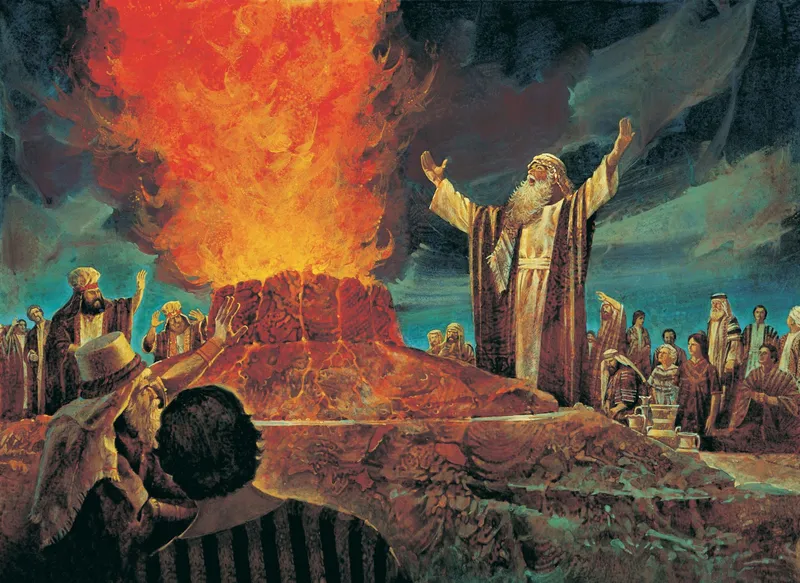
30And Elijah said unto all the people, Come near unto me. And all the people came near unto him. And he repaired the altar of the LORD that was broken down. 31And Elijah took twelve stones, according to the number of the tribes of the sons of Jacob, unto whom the word of the LORD came, saying, Israel shall be thy name: 32And with the stones he built an altar in the name of the LORD: and he made a trench about the altar, as great as would contain two measures of seed.
1 Kings 18:33-35Drenched in Water, Three Times
33And he put the wood in order, and cut the bullock in pieces, and laid him on the wood, and said, Fill four barrels with water, and pour it on the burnt sacrifice, and on the wood. 34And he said, Do it the second time. And they did it the second time. And he said, Do it the third time. And they did it the third time. 35And the water ran round about the altar; and he filled the trench also with water.
Elijah first repairs the broken altar - a symbolic act of restoration. He uses twelve stones for the twelve tribes, creating a monument that speaks of Israel's original identity and covenant. He builds the altar, places the wood, cuts the bullock. Then - remarkably - he orders water poured on the sacrifice. Not once, but three times. In a land gripped by drought, where water is precious beyond measure, Elijah drenches the wood and the meat. The water runs around the altar, fills the trench.
He is making the coming miracle inarguable: fire cannot easily consume wet wood. Only the power of God can.
1 Kings 18:36-39Fire Falls, the People Confess
36And it came to pass at the time of the offering of the evening sacrifice, that Elijah the prophet came near, and said, LORD God of Abraham, Isaac, and of Israel, let it be known this day that thou art God in Israel, and that I am thy servant, and that I have done all these things at thy word. 37Hear me, O LORD, hear me, that this people may know that thou art the LORD God, and that thou hast turned their heart back again. 38Then the fire of the LORD fell, and consumed the burnt sacrifice, and the wood, and the stones, and the dust, and licked up the water that was in the trench. 39And when all the people saw it, they fell on their faces: and they said, The LORD, he is the God; the LORD, he is the God.
Elijah's prayer before the fire falls contains no boasting, no self-glorification. "I am thy servant, and that I have done all these things at thy word." The prophet attributes everything to God's word alone. He asks only that the people may know that the Lord is God and that their hearts might be turned back to Him. And then fire falls - consuming not only the sacrifice and the wood, but the stones themselves, and the dust, and even the water in the trench.
Everything is consumed. There is no ambiguity. The people see what cannot be explained by natural means, and they fall on their faces, confessing: "The Lord, he is the God." The confession is repeated, urgent, decisive. Israel has remembered.
1 Kings 18:40-46The Cloud the Size of a Man's Hand
40And Elijah said unto them, Take the prophets of Baal; let not one of them escape. And they took them: and Elijah brought them down to the brook Kishon, and slew them there. 41And Elijah said unto Ahab, Get thee up, eat and drink; for there is a sound of abundance of rain. 42So Ahab went up to eat and to drink. And Elijah went up to the top of Carmel; and he cast himself down upon the earth, and put his face between his knees, 43And said to his servant, Go up now, look toward the sea. And he went up, and looked, and said, There is nothing. And he said, Go again seven times.
After the fire falls and the people confess, Elijah orders the prophets of Baal taken down to the brook Kishon and slain. These were the men who had led Israel into Baal worship and hunted the Lord's own prophets; removing them clears the way back to the covenant. Then Elijah tells Ahab to eat and drink, for he hears the sound of abundance of rain. The drought is about to break. While Ahab descends the mountain to eat, Elijah goes to the top of Carmel and casts himself down upon the earth, his face between his knees, a posture of deep intercession.
He is not standing in power; he is bowing in prayer. He sends his servant to look toward the sea, and the servant returns: nothing. Elijah sends him again. And again. Seven times.
44And it came to pass at the seventh time, that he said, Behold, there ariseth a little cloud out of the sea, like a man’s hand. And he said, Go up, say unto Ahab, Prepare thy chariot, and get thee down, that the rain stop thee not. 45And it came to pass in the mean while, that the heaven was black with clouds and wind, and there was a great rain. And Ahab rode, and went to Jezreel. 46And the hand of the LORD was on Elijah; and he girded up his loins, and ran before Ahab to the entrance of Jezreel.
On the seventh time, the servant sees it: a little cloud out of the sea, like a man's hand. So small you could cover it with your palm. Yet from this tiny cloud, the heavens break open. The rain comes in torrents. The sky, which has been silent for three years, finally speaks. Ahab flees in his chariot ahead of the deluge. And Elijah, the hand of the Lord upon him, girds up his loins and runs before the king to the entrance of Jezreel.
The prophet moves with supernatural strength. The victory is complete. The land has water. The people have confessed. And the hand of the Lord is upon His servant.
Research trail
Sources & further study
These references support the historical, linguistic, manuscript, and contextual notes in this chapter. Scripture remains the primary text; external sources are provided so readers can inspect the research directly.
Where this echoes in Scripture
Fire Falls, the People Confess
- Isaiah 53:5-6he was wounded for our transgressions... and the LORD hath laid on him the iniquity of us all.The judgment everyone earned, laid on a single substitute - the pattern the fire on the bullock acts out.
- Leviticus 9:24there came a fire out from before the LORD, and consumed upon the altar the burnt offering.Fire from the Lord falling on the offering, the sign that the sacrifice is received - as on Carmel.
- 1 Peter 2:24Who his own self bare our sins in his own body on the tree.The substitute bearing what the guilty owed, so the guilty go free - the shape of the consumed sacrifice.
- Hebrews 9:14how much more shall the blood of Christ... purge your conscience from dead works.The once-for-all offering toward which every consumed sacrifice pointed.