Painter of the Bible
Luca Giordano
Luca Giordano — called Luca Fa-Presto (Luke Works-Quickly) by his Neapolitan contemporaries for his extraordinary speed of execution — was the leading Neapolitan painter of the second half of the seventeenth century and …

Their faith
Why Luca Giordano painted Christ
Luca Giordano, a prominent figure in the Baroque art movement, was deeply rooted in his Christian faith, which shaped his prolific artistic career. Born in Naples in 1634 to a humble painter, Giordano's early exposure to the world of art was intertwined with a reverence for divine subjects. He trained under notable artists like Jusepe de Ribera and Pietro da Cortona, who influenced his style but did not diminish his own spiritual vision. Giordano's commitment to his faith is evident in his extensive body of work, which includes numerous altarpieces and frescoes dedicated to biblical narratives. His ability to create profound religious art at an astonishing speed earned him the nickname 'Luca Fa-Presto,' reflecting not only his technical prowess but also his devotion to serving God through his craft.
Giordano's faith is powerfully expressed in works such as 'The Crucifixion' altarpiece in San Filippo Neri and 'The Adoration of the Shepherds.' These paintings reveal his ability to convey deep spiritual truths through vibrant colors and dynamic compositions. In 'The Crucifixion,' the dramatic chiaroscuro illuminates the sacrifice of Christ, inviting viewers to reflect on the depth of His love and suffering. Similarly, 'The Adoration of the Shepherds' captures the joy and reverence of the Nativity, showcasing Giordano's skill in portraying sacred moments with emotional intensity. Through these masterpieces, Giordano's devotion continues to resonate, inviting viewers to experience the beauty of faith and the divine presence in art.
Life & work
Luca Giordano — called Luca Fa-Presto (Luke Works-Quickly) by his Neapolitan contemporaries for his extraordinary speed of execution — was the leading Neapolitan painter of the second half of the seventeenth century and one of the most prolific Italian Baroque masters. Born in Naples in 1634 to a poor painter named Antonio Giordano, trained briefly in his father's workshop and then under Jusepe de Ribera and Pietro da Cortona, he became the principal painter of Naples in his late twenties and continued producing altarpieces, ceiling frescoes, and easel paintings at staggering volume across northern and southern Italy and Spain. He served the Spanish Habsburg court at Madrid from 1692 to 1702, painting the great fresco programs of the Escorial monastery, before returning to Naples where he died in 1705.
His Christian religious work is enormous and is concentrated in altarpieces, ceiling frescoes, and large-format devotional canvases. The Saint Michael Archangel (Berlin), the Christ Driving the Money Changers from the Temple (multiple versions), the Massacre of the Innocents (Naples), the Cure of the Possessed (Capodimonte), the Adoration of the Shepherds (Capodimonte), the Crucifixion altarpieces in San Filippo Neri in Naples and the Madonna del Carmine cycle, the great Treasury Chapel ceiling frescoes in the Cathedral of Naples (1704–1705), and the Escorial monastery frescoes (1692–1702) fill the principal Italian and Spanish Baroque collections.
His personal style — built on Pietro da Cortona's Roman ceiling-fresco vocabulary and Ribera's dramatic Caravaggesque chiaroscuro, with a particular Neapolitan brilliance of color and a virtuoso painterly speed — defined the late Italian Baroque grand-manner. The Escorial frescoes in particular are widely held to be among the supreme Spanish Baroque ceiling decorations and are still the largest single collection of his frescoed work.
He worked at extraordinary commercial speed — his late biographer Bernardo De Dominici records him completing major altarpieces in days rather than weeks — and his prolific output gave him an international reach matched by few of his Italian contemporaries. He died in Naples having painted, by his own count, over five thousand finished works.
Notable works in detail
met-436502
The Annunciation, painted by Luca Giordano around 1672 in oil on canvas and now in the Metropolitan Museum of Art in New York, depicts the moment from Luke 1 in which the angel Gabriel appears to the Virgin in her chamber to announce the conception of Christ. Giordano stages the scene with characteristic Neapolitan Baroque dramatic intensity: the Virgin kneels at her prayer-desk on the right, her face lifted in attentive recognition, the angel descends from the upper left in a luminous burst of light with the lily of purity in one hand, the Holy Spirit appears as a small dove on a beam of golden light. The chromatic palette of warm flesh, deep crimson, and luminous gold against the soft chalky background is the unmistakable mature Giordano Naples signature.
met-436503
The Flight into Egypt, painted by Luca Giordano in 1701 in oil on canvas during his late Naples years (after his return from Madrid) and now in the Metropolitan Museum of Art in New York, depicts the apocryphal subject of the Holy Family fleeing from King Herod's persecution as recorded in Matthew 2. Giordano stages the scene as a dramatic outdoor encounter: the Virgin riding on the small donkey holding the swaddled Christ Child, Joseph leading the donkey on foot while looking back over his shoulder for pursuit, a small attending angel guiding them across an Italian landscape. The chromatic palette and the broad confident brushwork are the unmistakable late Giordano signature, painted in the years immediately before his death in Naples in 1705.
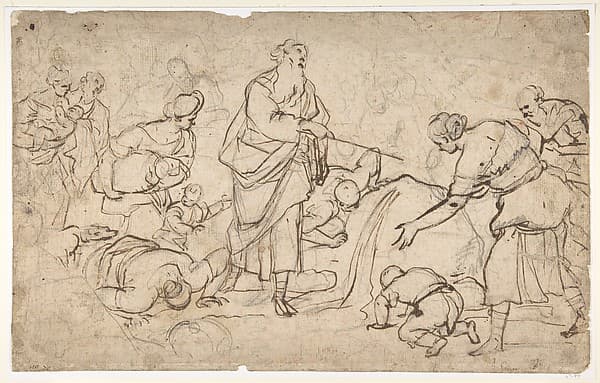
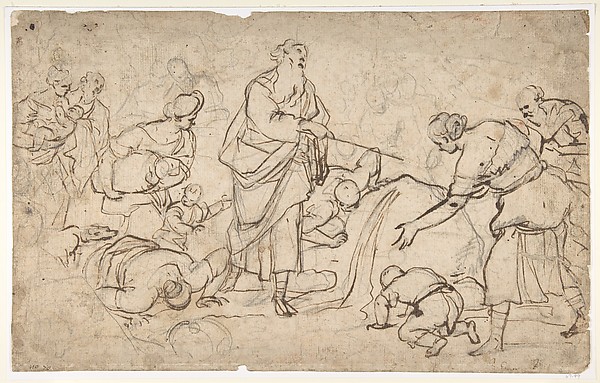
Moses Striking the Rock, drawn by Luca Giordano around 1634 in pen and brown ink with wash on paper and now in the Metropolitan Museum of Art in New York, illustrates the episode from Exodus 17 in which Moses, in answer to the Israelites' complaint of thirst at Rephidim, strikes the rock with his staff and brings forth water for the people. Giordano stages the scene as a dense crowd composition: Moses standing on the right with his staff raised in the moment of the miracle, the Israelites and their cattle pressing in from every side toward the spring of water. The drawing demonstrates the rapid confident pen-and-wash technique that Giordano used as his standard preparatory currency and that earned him the nickname Luca Fa-Presto (Luke Works-Quickly) from his Neapolitan contemporaries.
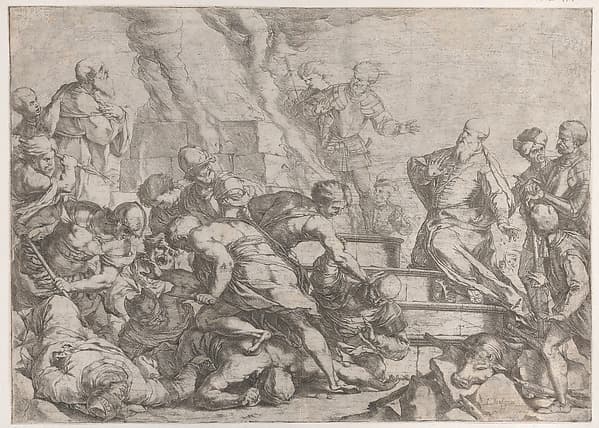
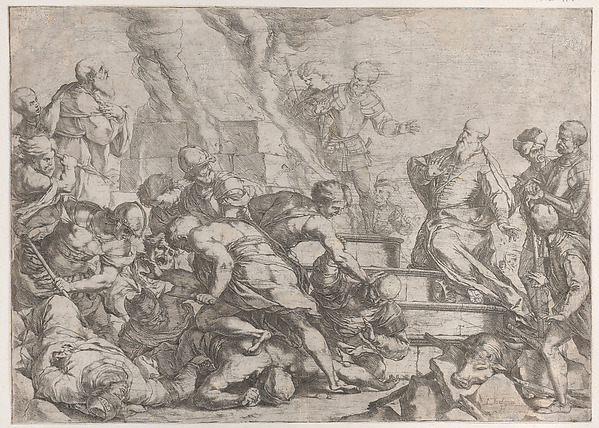
The Sacrifice of Elijah, painted by Luca Giordano around 1648 in oil on canvas and now in the Metropolitan Museum of Art in New York, depicts the climactic episode from 1 Kings 18 in which the prophet Elijah, in his contest with the prophets of Baal on Mount Carmel, calls down fire from heaven to consume the sacrifice and demonstrate the supremacy of the Lord. Giordano stages the scene as a dramatic outdoor encounter: Elijah standing in the foreground with his arms raised in supplication, the bull and the wood of the sacrifice arranged on the small stone altar, the descending fire from heaven illuminating the entire composition with a single shaft of golden light. The chromatic palette and the dramatic Caravaggesque chiaroscuro are characteristic of the early Giordano Naples manner before his middle and late careers softened the dramatic light into the broader painterly handling of his mature style.
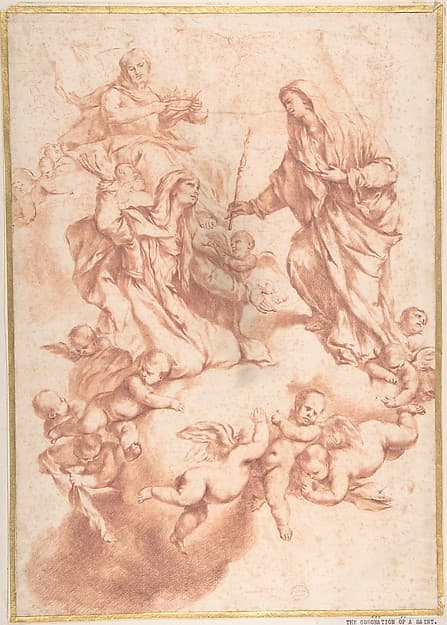
Saint Anne Received in Heaven by Christ and the Virgin
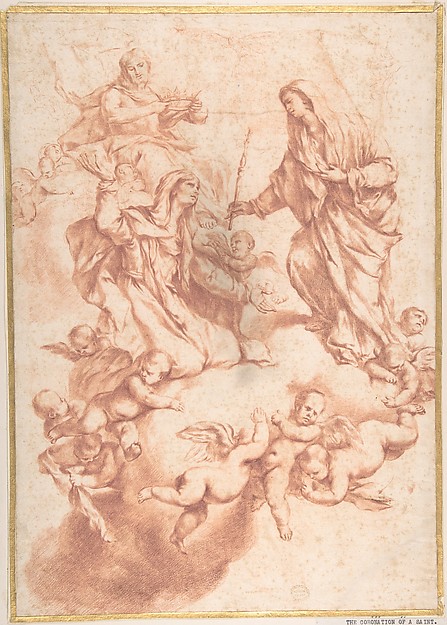
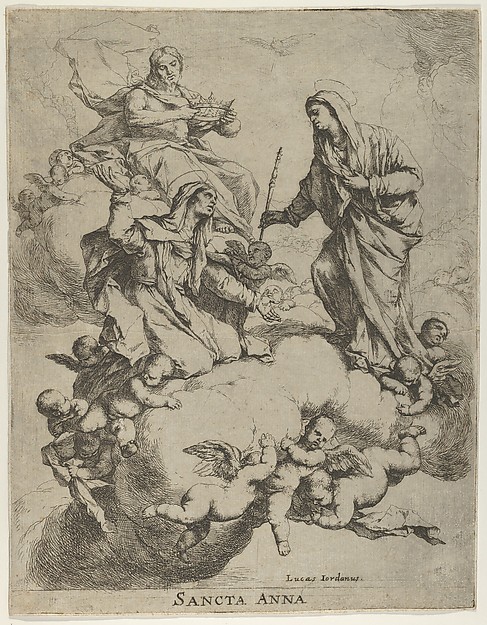
Saint Anne Received in Heaven by Christ and the Virgin, drawn by Luca Giordano around 1634 in pen and brown ink with wash on paper, depicts the iconographic subject from late-medieval Marian devotional tradition in which Saint Anne — the mother of the Virgin Mary, according to the apocryphal Marian narratives — is received into heaven by her daughter and grandson at her death and assumption. The drawing shows Anne kneeling at the lower right in postures of grateful arrival, with the Virgin and Christ together at the upper left receiving her into glory; small attendant angels and the saints fill the background. The drawing demonstrates Giordano's characteristic ability to compose a complex multi-figure heavenly assembly with the rapid confident pen-and-wash technique that defined his entire drawn output.
Bible scenes Luca Giordano painted
Luke
Exodus
1 Kings
John