Leviticus 9
People in this chapter
Leviticus 9 is the eighth day - the morning after the seven days of consecration in chapter 8. For a week Aaron and his sons have been washed, robed, anointed, and kept at the door of the tabernacle, set apart but not yet serving. Now Moses gathers them and the elders of Israel, and the long preparation gives way to the thing it was all for. Aaron is commanded to take a young calf for a sin offering, and a ram for a burnt offering (v. 2), and the reason is stated outright: for to day the LORD will appear unto you (v. 4).
Everything in the book so far - every regulation about blood and fat and fire - has been leading to this single promised morning.1
Tap any highlighted phrase to jump to the commentary that unpacks it.
Leviticus 9:1-7For To Day the LORD Will Appear Unto You
1And it came to pass on the eighth day, that Moses called Aaron and his sons, and the elders of Israel; 2And he said unto Aaron, Take thee a young calf for a sin offering, and a ram for a burnt offering, without blemish, and offer them before the LORD. 3And unto the children of Israel thou shalt speak, saying, Take ye a kid of the goats for a sin offering; and a calf and a lamb, both of the first year, without blemish, for a burnt offering; 4Also a bullock and a ram for peace offerings, to sacrifice before the LORD; and a meat offering mingled with oil: for to day the LORD will appear unto you. 5And they brought that which Moses commanded before the tabernacle of the congregation: and all the congregation drew near and stood before the LORD. 6And Moses said, This is the thing which the LORD commanded that ye should do: and the glory of the LORD shall appear unto you. 7And Moses said unto Aaron, Go unto the altar, and offer thy sin offering, and thy burnt offering, and make an atonement for thyself, and for the people: and offer the offering of the people, and make an atonement for them; as the LORD commanded.
The chapter opens on a deliberately marked morning: And it came to pass on the eighth day (v. 1). The seven days of consecration in chapter 8 are finished. For a full week Aaron and his sons have been washed, clothed, anointed, and kept at the door of the tent - set apart, but not yet serving. The number is not incidental. Seven is the number of completion, the full week of God's own making; the eighth day stands one step beyond it, the morning after the finished week, the start of something new.
So the priesthood does not begin in the middle of ordinary time. It begins on a day the text takes pains to single out - a fresh beginning, the first day of a life of service that the long preparation was always reaching toward.2
Moses lays out a full slate of offerings, and together they cover the whole range of what it means to come before God. There is a sin offering - the calf and the kid - which deals with guilt and clears what stands between the worshipper and the holy. There is a burnt offering, wholly consumed on the altar, which says that everything belongs to God and nothing is held back. There is a meat offering mingled with oil, the grain offering, the gift of the fruit of human labour.
And there are peace offerings, the only sacrifice the worshipper shares in as a meal - the communion, the reconciliation sealed at a table. Each one answers a different need; all of them stand between the people and the moment named at the end of verse 4: for to day the LORD will appear unto you. The whole machinery of sacrifice is bent toward one promised end - that God Himself will be seen.
The most arresting detail of the section is the order Moses gives Aaron: Go unto the altar, and offer thy sin offering, and thy burnt offering, and make an atonement for thyself, and for the people (v. 7). The high priest of Israel must begin with himself. Before he can stand between God and the nation, he has to deal with his own guilt at the same altar, with the same blood, as everyone else.
He is not exempt; he is not already clean by virtue of his office. The robe, the anointing, the consecration of the past seven days do not lift him above the need for atonement. He approaches as one who needs what he is about to administer. This is the quiet limitation written into the whole Aaronic priesthood: the mediator is himself a sinner, and the help he brings to others he must first receive for himself.
Leviticus 9:8-21First for Himself, Then for the People
8Aaron therefore went unto the altar, and slew the calf of the sin offering, which was for himself. 9And the sons of Aaron brought the blood unto him: and he dipped his finger in the blood, and put it upon the horns of the altar, and poured out the blood at the bottom of the altar: 10But the fat, and the kidneys, and the caul above the liver of the sin offering, he burnt upon the altar; as the LORD commanded Moses. 11And the flesh and the hide he burnt with fire without the camp. 12And he slew the burnt offering; and Aaron’s sons presented unto him the blood, which he sprinkled round about upon the altar. 13And they presented the burnt offering unto him, with the pieces thereof, and the head: and he burnt them upon the altar. 14And he did wash the inwards and the legs, and burnt them upon the burnt offering on the altar.
Aaron does exactly as he was told, and the text dwells on the fact that he starts with himself: Aaron therefore went unto the altar, and slew the calf of the sin offering, which was for himself (v. 8). Watch the priestly hands at work. His sons bring him the blood; he dipped his finger in the blood, and put it upon the horns of the altar, and poured out the blood at the bottom (v. 9).
Blood on the horns - the raised corners that were the altar's highest, most prominent points - and blood at the base; the whole structure is marked by the life that was given. The fat and the inner parts go up in smoke upon the altar, while the flesh and the hide are burned without the camp (vv. 10-11), carried outside the place of worship entirely. Then comes his own burnt offering, slain, its blood sprinkled round about upon the altar, its pieces and head and washed inner parts all sent up in fire (vv. 12-14).
The priest who will stand for the nation has now stood, first, for himself - his guilt covered, his life laid wholly on the altar - before he turns to anyone else.
15And he brought the people’s offering, and took the goat, which was the sin offering for the people, and slew it, and offered it for sin, as the first. 16And he brought the burnt offering, and offered it according to the manner. 17And he brought the meat offering, and took an handful thereof, and burnt it upon the altar, beside the burnt sacrifice of the morning. 18He slew also the bullock and the ram for a sacrifice of peace offerings, which was for the people: and Aaron’s sons presented unto him the blood, which he sprinkled upon the altar round about, 19And the fat of the bullock and of the ram, the rump, and that which covereth the inwards, and the kidneys, and the caul above the liver: 20And they put the fat upon the breasts, and he burnt the fat upon the altar: 21And the breasts and the right shoulder Aaron waved for a wave offering before the LORD; as Moses commanded.
Only now, his own offering finished, does Aaron turn to the people: And he brought the people's offering (v. 15). He works through their sacrifices in the same order as his own - the goat for their sin offering offered it for sin, as the first; their burnt offering according to the manner; their meat offering, of which he burns a handful on the altar; and finally the bullock and ram for their peace offerings (vv. 15-18).
The sequence is itself a teaching. Sin is dealt with first, for nothing else can rightly proceed until guilt is covered; then the burnt offering of whole-hearted surrender; then the grain offering of daily labour; and only at the last the peace offering, the shared meal of fellowship restored. A worshipper does not begin with the feast. The table of communion comes at the end of a path that runs through atonement and surrender.
Reconciliation with God is real, but it is not cheap, and the order of the offerings preserves the cost.
A single phrase keeps surfacing through the whole account, like a steady drumbeat under the action: as the LORD commanded Moses (vv. 10), as the first and according to the manner (vv. 15-16), as Moses commanded (v. 21). Every gesture - where the blood goes, what is burned on the altar and what outside the camp, how the fat is handled, how the breast is waved before the LORD - follows what was given. Aaron walks the prescribed way precisely, and that precise obedience is the channel through which the promised presence comes.
The lesson is quiet but firm: the access we have to God is His gift and on His terms, and He alone redesigns it.
Leviticus 9:22-24The Glory of the LORD Appeared
22And Aaron lifted up his hand toward the people, and blessed them, and came down from offering of the sin offering, and the burnt offering, and peace offerings. 23And Moses and Aaron went into the tabernacle of the congregation, and came out, and blessed the people: and the glory of the LORD appeared unto all the people. 24And there came a fire out from before the LORD, and consumed upon the altar the burnt offering and the fat: which when all the people saw, they shouted, and fell on their faces.
With the offerings complete, Aaron does the priest's last and gentlest act: Aaron lifted up his hand toward the people, and blessed them, and came down (v. 22). The work of the altar ends in a blessing spoken over the people's heads. Then Moses and Aaron go into the tabernacle - the first ministry inside the newly consecrated tent - and when they came out, they bless the people again (v. 23). The doubled blessing frames the climax.
Before any fire falls, before any glory is seen, the people stand under words of blessing lifted toward them by raised hands. This is what the priesthood is finally for: to bring God's favour to rest on His people and to send them away blessed. The Aaronic blessing that the LORD would put in just these words - The LORD bless thee, and keep thee… and give thee peace (Num. 6:24-26) - is the shape of the hands lifted here.
Then the promise of verse 4 is kept before the people's eyes: the glory of the LORD appeared unto all the people (v. 23). Note the timing with care. The glory appears at the end - after the sin has been atoned for, after the offerings have all been made, after the blessing has been spoken. The order is the whole point. Where atonement has been made and the way of approach faithfully kept, there the presence of God is unveiled.
The glory is revealed where sin has been dealt with and the offering received. And it appears unto all the people - not to the priests alone behind a veil, but to the whole gathered congregation, every one of them an eyewitness to the God who said He would appear and now does.
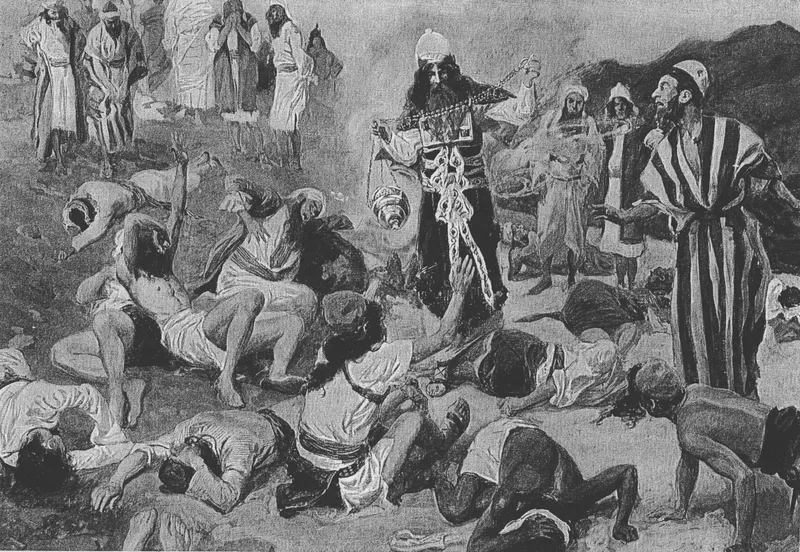
The climax is fire: there came a fire out from before the LORD, and consumed upon the altar the burnt offering and the fat (v. 24). In every other scene in Leviticus, it is the priest who attends the altar - the priest who slays, sprinkles, arranges, burns. Here the LORD Himself acts. The fire is not struck by human hands; it comes out from before the LORD, straight from the place of His presence, and in an instant it takes up what Aaron has laid on the altar.
This is the divine yes - God's own visible answer that the offering is received, the atonement accepted, the worship welcomed. Everything the chapter has built toward is sealed in that flash of fire: the work of the priest is met and ratified by the act of God. What was offered from below is answered from above, and the altar that men prepared is set ablaze by heaven.
The people's response is immediate and whole-bodied: which when all the people saw, they shouted, and fell on their faces (v. 24). It is the overflow of reverent joy. They shouted - a great cry breaking out from the whole congregation at the sight of the fire and the glory - and in the same motion they fell on their faces, flat before the manifest presence of God. The two go together: gladness and awe, the shout and the prostration.
This is what the unveiled presence of God draws out of those who behold it: a cry of joy and a face to the ground. The chapter ends on exactly the right note. When God shows that He has accepted the offering and reveals His glory in the midst of His people, the only fitting answer is worship that takes hold of the whole person, body and voice together.
Research trail
Sources & further study
These references support the historical, linguistic, manuscript, and contextual notes in this chapter. Scripture remains the primary text; external sources are provided so readers can inspect the research directly.
- Leviticus 9 - Translators' NotesThe NET Bible's detailed footnotes on Leviticus 9 - the significance of the eighth day in verse 1, the sequence of the five offerings, the meaning of making an atonement in verse 7, and the fire that comes out from before the LORD to consume the offering in verse 24.
- Leviticus 9 · Hebrew + classical Jewish commentaryThe Hebrew text of Leviticus 9 with Rashi, Ibn Ezra, and other classical commentators side by side - useful for yom ha-shemini (v. 1, “the eighth day”), for kavod (vv. 6, 23, the “glory” that appears), and for the long-debated question of why the priest must offer for himself before he offers for the people.
- Leviticus 9 ↔ Hebrews 7 · Luke 24 · 1 Peter 1Traces the threads tying Leviticus 9 to the rest of Scripture - the priest who must offer first for his own sins (v. 7) read beside the High Priest who needeth not daily… to offer up sacrifice, first for his own sins (Heb. 7:27), and the priestly blessing of verses 22-23 read alongside the One who lifted up his hands, and blessed them at His ascension (Luke 24:50-51).
Where this echoes in Scripture
For To Day the LORD Will Appear Unto You
- Hebrews 7:26-27who needeth not daily... to offer up sacrifice, first for his own sins, and then for the people’s: for this he did once, when he offered up himself.The contrast with verse 7 - Aaron must atone for himself first; the great High Priest, sinless, did not.
- Leviticus 8:33-35ye shall not go out of the door of the tabernacle of the congregation in seven days... seven days shall he consecrate you.The seven days of consecration that precede the eighth day of verse 1.
- Hebrews 5:1-3he ought, as for the people, so also for himself, to offer for sins.The principle behind verse 7 - an earthly high priest, beset with weakness, must offer for his own sins too.
- Leviticus 12:3And in the eighth day the flesh of his foreskin shall be circumcised.The eighth day (v. 1) as Israel knew it - the day a child was marked as belonging to the covenant.
- Exodus 29:43-45there I will meet with the children of Israel... And I will dwell among the children of Israel, and will be their God.The promise now kept - the LORD said He would appear and dwell, and on the eighth day He does.
First for Himself, Then for the People
- Leviticus 1:3-4he shall offer it... and it shall be accepted for him to make atonement for him.The burnt offering Aaron presents in verses 12-14 - wholly given, accepted for atonement.
- Hebrews 13:11-12the bodies of those beasts... are burned without the camp. Wherefore Jesus also... suffered without the gate.The flesh burned without the camp in verse 11 - read as a shadow of Christ suffering outside the gate.
- Leviticus 3:1-5And if his oblation be a sacrifice of peace offering... it is the food of the offering made by fire.The peace offerings of verses 18-21 - the sacrifice of fellowship, shared as a meal.
- Romans 12:1present your bodies a living sacrifice, holy, acceptable unto God, which is your reasonable service.The whole burnt offering of verses 12-14 brought forward - the worshipper's whole life laid on the altar.
- John 4:23-24the true worshippers shall worship the Father in spirit and in truth... they that worship him must worship him in spirit and in truth.The truth behind verse 21 - worship is offered on God's terms, following the way He has given.
The Glory of the LORD Appeared
- Luke 24:50-51he lifted up his hands, and blessed them. And it came to pass, while he blessed them, he was parted from them, and carried up into heaven.The raised hands of verses 22-23 fulfilled - the risen Christ blessing His own as He ascends.
- Exodus 40:34-35a cloud covered the tent of the congregation, and the glory of the LORD filled the tabernacle.The same kavod as verse 23 - the weighty glory filling the finished tabernacle.
- 1 Peter 1:21God, that raised him up from the dead, and gave him glory; that your faith and hope might be in God.The pattern of verses 23-24 - the offering accepted, and glory following where atonement was made.
- Numbers 6:24-26The LORD bless thee, and keep thee: the LORD make his face shine upon thee... and give thee peace.The shape of Aaron's blessing in verse 22 - the words the priest lifts over the people.
- 2 Chronicles 7:1-3the fire came down from heaven, and consumed the burnt offering... and all the children of Israel... bowed themselves... and worshipped.The same scene as verse 24 at Solomon's temple - fire from God, and the people on their faces in worship.