Leviticus 8
People in this chapter
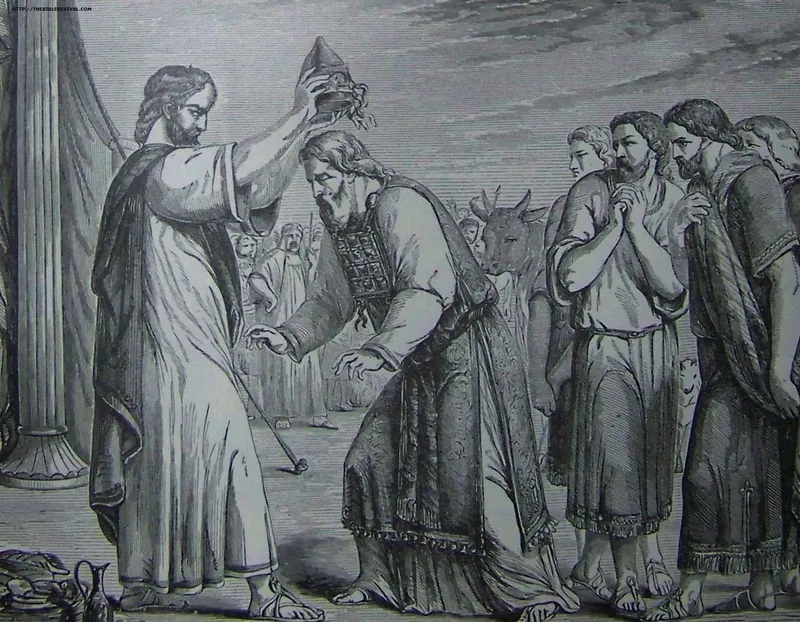
Leviticus 8 is the enactment of Exodus 29. Where Exodus commanded the priesthood, Leviticus shows it happening. Aaron and his sons are brought to the door of the tabernacle, washed, dressed, anointed, and marked with blood - on the right ear to hear God's word, on the right thumb to work His will, on the right big toe to walk His path. The chapter is ritual made visible, each movement a sign of what it means to be set apart.
Tap any highlighted phrase to jump to the commentary that unpacks it.
Leviticus 8:1-4The Summons
1And the LORD spake unto Moses, saying, 2Take Aaron and his sons with him, and the garments, and the anointing oil, and a bullock for the sin offering, and two rams, and a basket of unleavened bread; 3And gather thou all the congregation together unto the door of the tabernacle of the congregation. 4And Moses did as the LORD commanded him; and the assembly was gathered together unto the door of the tabernacle of the congregation.
The door of the tabernacle is the threshold between the ordinary and the holy. Nothing sacred in Israel's life happens in secret or in shadow. The people gather to see Aaron and his sons being set apart. The priesthood is a public marking, witnessed by the whole assembly.
Leviticus 8:5-9Washed and Clothed
5And Moses said unto the congregation, This is the thing which the LORD commanded to be done. 6And Moses brought Aaron and his sons, and washed them with water. 7And he put upon him the coat, and girded him with the girdle, and clothed him with the robe, and put the ephod upon him, and he girded him with the curious girdle of the ephod, and bound it unto him therewith. 8And he put the breastplate upon him: also he put in the breastplate the Urim and the Thummim. 9And he put the mitre upon his head; also upon the mitre, even upon his forefront, did he put the golden plate, the holy crown; as the LORD commanded Moses.
Water in Scripture is always a sign of separation - the Red Sea dividing, the Jordan crossing, baptism. Aaron and his sons are washed at the threshold, their ordinary life rinsed away. They cross from the assembly into a new vocation. The water marks their setting-apart, the crossing from ordinary life into a new vocation.
Leviticus 8:10-13Anointed
10And Moses took the anointing oil, and anointed the tabernacle and all that was therein, and sanctified them. 11And he sprinkled thereof upon the altar seven times, and anointed the altar and all his vessels, both the laver and his foot, to sanctify them. 12And he poured of the anointing oil upon Aaron’s head, and anointed him, to sanctify him. 13And Moses brought Aaron’s sons, and put coats upon them, and girded them with girdles, and put bonnets upon them; as the LORD commanded Moses.
The anointing oil is poured first on the tabernacle and its furniture, then on Aaron. The place sanctifies the priest; Aaron steps into a holiness already established. He joins a priesthood of God's ordering. The oil on the altar seven times is the number of completion - the place where God meets His people is fully marked as His.
Leviticus 8:14-21The Bull and the Rams
14And he brought the bullock for the sin offering: and Aaron and his sons laid their hands upon the head of the bullock for the sin offering. 15And he slew it; and Moses took the blood, and put it upon the horns of the altar round about with his finger, and purified the altar, and poured the blood at the bottom of the altar, and sanctified it, to make reconciliation upon it. 16And he took all the fat that was upon the inwards, and the caul above the liver, and the two kidneys, and their fat, and Moses burned it upon the altar. 17But the bullock, and his hide, his flesh, and his dung, he burnt with fire without the camp; as the LORD commanded Moses.
Moses brings the bull of the sin offering, and Aaron and his sons lay their hands on its head. Its blood is put on the horns of the altar to purify it, its fat is burned upon the altar, and the rest of the bull is carried outside the camp and burned. The priests are cleansed before they serve.
18And he brought the ram for the burnt offering: and Aaron and his sons laid their hands upon the head of the ram. 19And he killed it; and Moses sprinkled the blood upon the altar round about. 20And he cut the ram into pieces; and Moses burnt the head, and the pieces, and the fat. 21And he washed the inwards and the legs in water; and Moses burnt the whole ram upon the altar: it was a burnt sacrifice for a sweet savour, and an offering made by fire unto the LORD; as the LORD commanded Moses.
The bull carries the priests' sin. They lay their hands on its head - a gesture of transfer, of laying their failure on the animal. The blood is applied to the horns of the altar, the place of God's power and judgment. The fat and inwards are burned; the rest is burned outside the camp, away from the holy place. Sin must be disposed of completely, outside the community. Nothing of the sin offering is eaten; the entire animal is destroyed.
The first ram is a burnt offering - wholly given to God, a sweet savor. Every part goes up in smoke. It is the priests' gift, their whole life rising to God. The inwards and legs are washed, a detail that appears nowhere else. The priests will handle bloody work; the washing speaks of cleanness and care even in that work.
Leviticus 8:22-30The Ram of Consecration - Ear, Thumb, Toe
22And he brought the other ram, the ram of consecration: and Aaron and his sons laid their hands upon the head of the ram. 23And he slew it; and Moses took of the blood of it, and put it upon the tip of Aaron’s right ear, and upon the thumb of his right hand, and upon the great toe of his right foot. 24And he brought Aaron’s sons, and Moses put of the blood upon the tip of their right ear, and upon the thumbs of their right hands, and upon the great toes of their right feet: and Moses sprinkled the blood upon the altar round about. 25And he took the fat, and the rump, and all the fat that was upon the inwards, and the caul above the liver, and the two kidneys, and their fat, and the right shoulder:
Moses has done the work. Now Aaron and his sons share the holy meat - covenant made visible.
26And out of the basket of unleavened bread, that was before the LORD, he took one unleavened cake, and a cake of oiled bread, and one wafer, and put them on the fat, and upon the right shoulder: 27And he put all upon Aaron’s hands, and upon his sons’ hands, and waved them for a wave offering before the LORD. 28And Moses took them from off their hands, and burnt them on the altar upon the burnt offering: they were consecrations for a sweet savour: it is an offering made by fire unto the LORD. 29And Moses took the breast, and waved it for a wave offering before the LORD: for of the ram of consecration it was Moses’ part; as the LORD commanded Moses. 30And Moses took of the anointing oil, and of the blood which was upon the altar, and sprinkled it upon Aaron, and upon his garments, and upon his sons, and upon his sons’ garments with him; and sanctified Aaron, and his garments, and his sons, and his sons’ garments with him.
Blood on the right ear, right thumb, right big toe. Three members, three capacities. The ear hears. The thumb works - it is the strongest digit, what grips and wields. The big toe walks - what grounds and carries you forward. The whole person - what you hear, what you do, where you go - is marked as belonging to God. And every mark is on the right side, the side of strength and blessing in biblical imagery.
Leviticus 8:31-36Waiting at the Door
31And Moses said unto Aaron and to his sons, Boil the flesh at the door of the tabernacle of the congregation: and there eat it with the bread that is in the basket of consecrations, as I commanded, saying, Aaron and his sons shall eat it. 32And that which remaineth of the flesh and of the bread shall ye burn with fire. 33And ye shall not go out of the door of the tabernacle of the congregation in seven days, until the days of your consecration be at an end: for seven days shall he consecrate you. 34As he hath done this day, so the LORD hath commanded to do, to make an atonement for you. 35Therefore shall ye abide at the door of the tabernacle of the congregation day and night seven days, and keep the charge of the LORD, that ye die not: for so I am commanded. 36So Aaron and his sons did all things which the LORD commanded by the hand of Moses.
The priests do not step into the Holy Place on the first day. They wait seven days at the threshold. Seven is the number of completion in Scripture; the seventh day is rest, the day God stopped working. By making Aaron and his sons wait seven full days before fully entering their office, God is saying: your consecration is complete, but you must wait. The waiting itself is part of the work. They remain at the door, tending the fire, keeping watch, eating the meal of the offering, until the time is fully finished.
"Keep the charge of the Lord, that ye die not." The language is stark. To step beyond what God has commanded, or before the appointed time, is death. The priesthood is not play. It is not casual. Every boundary exists because something alive and true is at stake. Aaron and his sons obey. They do not try to enter early. They do not negotiate with the waiting.
Research trail
Sources & further study
These references support the historical, linguistic, manuscript, and contextual notes in this chapter. Scripture remains the primary text; external sources are provided so readers can inspect the research directly.