Leviticus 10
People in this chapter
Leviticus 10 opens one day after the priests have been consecrated and the fire of the Lord has come down and consumed the burnt offering at the altar. It is the moment the priesthood is supposed to begin in earnest. Instead, a man and his two sons step forward with something God did not command, and they are consumed by fire from God themselves. This is the chapter the American church has learned to skip.
Tap any highlighted phrase to jump to the commentary that unpacks it.
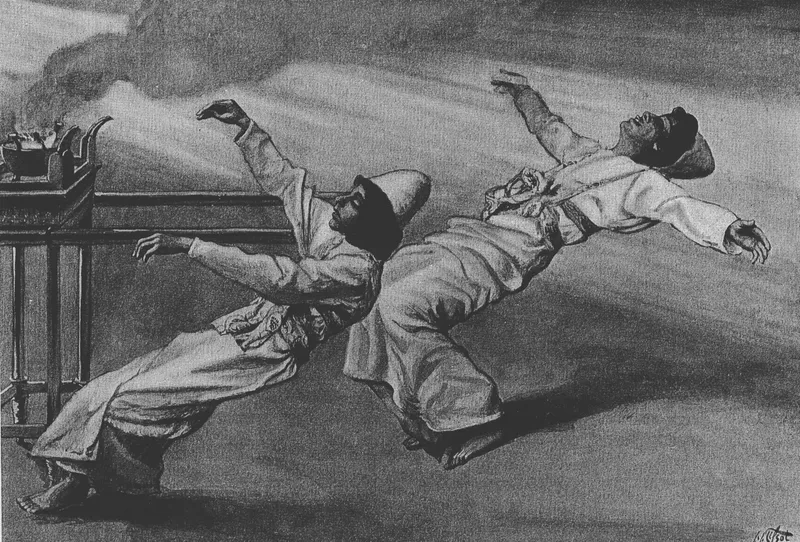
Leviticus 10:1-2Strange Fire
1And Nadab and Abihu, the sons of Aaron, took either of them his censer, and put fire therein, and put incense thereon, and offered strange fire before the LORD, which he commanded them not. 2And there went out fire from the LORD, and devoured them, and they died before the LORD.
Nadab and Abihu are Aaron's eldest sons. Just the chapter before, they were at the pinnacle of their calling - chosen among all Israel to approach the altar, to bear the people's prayers to God. They have seen the glory of God descend. Their moment has arrived. And in that moment, they reach for something God did not command. The commentaries offer guesses: they were drunk, they were presumptuous, they improvised beyond their office. Leviticus does not say. What matters is this: they did something beautiful in the wrong way, and holiness killed them for it.
Leviticus 10:3And Aaron Held His Peace
3Then Moses said unto Aaron, This is it that the LORD spake, saying, I will be sanctified in them that come nigh me, and before all the people I will be glorified. And Aaron held his peace.
God is saying: I will be made holy - separated, set apart - in those who are closest to me, by their acknowledgment of my holiness. The way those near the altar live tells the world what God is. Their obedience, their carefulness, their willingness to let God be God - that is how God's holiness gets a face in the world.
Notice: this is happening in front of everyone. The whole assembly is watching. God's holiness is not private business. When God acts to protect the holiness of His presence, He is teaching the entire people something about what He is. Do not domesticate Him. Do not assume the comfort you have known will shield you from His nature.
Leviticus 10:4-7No Weeping Before the People
4And Moses called Mishael and Elzaphan, the sons of Uzziel the uncle of Aaron, and said unto them, Come near, carry your brethren from before the sanctuary out of the camp. 5So they went near, and carried them in their coats out of the camp; as Moses had said. 6And Moses said unto Aaron, and unto Eleazar and unto Ithamar, his sons, Uncover not your heads, neither rend your clothes; lest ye die, and lest wrath come upon all the people: but let your brethren, the whole house of Israel, bewail the burning which the LORD hath kindled. 7And ye shall not go out from the door of the tabernacle of the congregation, lest ye die: for the anointing oil of the LORD is upon you. And they did according to the word of Moses.
Aaron is told: do not tear your robes. Do not uncover your head in the sign of mourning. Stay at your post. Keep the priesthood moving. There is no rest here for the father who has just lost his sons. The work does not pause. The people still need the altar. And the priest must be the one to tend it - the very priest whose hands are still warm from the bodies of his sons, whose eyes have just seen the fire take them.
But notice: someone gets to mourn. Moses commands the whole assembly to bewail what happened. The people will hold the grief that Aaron cannot hold in front of them. There is a mercy in this, even if it is hidden. Aaron cannot weep, but he will not weep alone. All Israel will weep for his sons. His sorrow is not erased - it is witnessed.
Leviticus 10:8-11Sober and Clear
8And the LORD spake unto Aaron, saying, 9Do not drink wine nor strong drink, thou, nor thy sons with thee, when ye go into the tabernacle of the congregation, lest ye die: it shall be a statute for ever throughout your generations: 10And that ye may put difference between holy and unholy, and between unclean and clean; 11And that ye may teach the children of Israel all the statutes which the LORD hath spoken unto them by the hand of Moses.
The first law of sobriety in scripture is given to priests, because a priest near the altar must have a mind clear enough to know the difference between the holy and the common. One moment of confusion, one second of haze, and the work at the altar becomes dangerous not only to the priest, but to the people. What happened to Nadab and Abihu is not named as a cause here - the text does not say they were drunk.
But the law that follows suggests that the priests are now being called to a kind of radical clarity that has no room for even the smallest cloud on the mind.
The whole role of a priest is to stand in the doorway between two worlds. To distinguish what is set apart for God from what is common. To teach the people what that boundary looks like. But you cannot teach what you do not see clearly. A fuzzy priest teaches a fuzzy people.
This is the priest's actual job: to teach, to show the people the architecture of holiness. To say, again and again: this is different. This matters differently. God is in this moment in a way He is not in that one. The people cannot learn that from someone who is not paying attention.
Leviticus 10:12-15Eat the Sin Offering
12And Moses spake unto Aaron, and unto Eleazar and unto Ithamar, his sons that were left, Take the meat offering that remaineth of the offerings of the LORD made by fire, and eat it without leaven beside the altar: for it is most holy: 13And ye shall eat it in the holy place, because it is thy due, and thy sons’ due, of the sacrifices of the LORD made by fire: for so I am commanded. 14And the wave breast and heave shoulder shall ye eat in a clean place; thou, and thy sons, and thy daughters with thee: for they be thy due, and thy sons’ due, which are given out of the sacrifices of peace offerings of the children of Israel. 15The heave shoulder and the wave breast shall they bring with the offerings made by fire of the fat, to wave it for a wave offering before the LORD; and it shall be thine, and thy sons’ with thee, by a statute for ever; as the LORD hath commanded.
The priests are given a portion of the sacrifice to eat - the breast and the shoulder. It is not a luxury; it is their inheritance, the way they are sustained. They are commanded to eat. But Aaron does not eat. The reader knows this from verse 19 - he will explain why. For now, Moses gives the command, and Aaron will refuse it. Watch what happens when obedience itself becomes an obstacle to sorrow.
Leviticus 10:16-20Aaron's Answer
16And Moses diligently sought the goat of the sin offering, and, behold, it was burnt: and he was angry with Eleazar and Ithamar, the sons of Aaron which were left alive, saying, 17Wherefore have ye not eaten the sin offering in the holy place, seeing it is most holy, and God hath given it you to bear the iniquity of the congregation, to make atonement for them before the LORD? 18Behold, the blood of it was not brought in within the holy place: ye should indeed have eaten it in the holy place, as I commanded. 19And Aaron said unto Moses, Behold, this day have they offered their sin offering and their burnt offering before the LORD; and such things have befallen me: and if I had eaten the sin offering to day, should it have been accepted in the sight of the LORD? 20And when Moses heard that, he was content.
The goat has been burned instead of eaten. Aaron's surviving sons have failed to do what the law commanded. Moses is angry - not that they are grieving, but that they have not followed the law. It is a collision between obedience and sorrow, and both are real. Both demand a response.
Moses is right. The law is clear. Aaron knows the law. He wrote it. But knowledge of what is right is not the same as the power to do it when your hands are still shaking and your eyes are still full.
Aaron's answer is a question: should it have been accepted? He is asking: if I had eaten this offering while grieving like this, would it have been a true offering? Would God have received it as whole and holy? Or would it have been rotten from the inside, a performance of obedience over a grave? Aaron is saying: I know the rule. But I also know my heart. And my heart cannot make a holy offering right now. So I have let the offering burn.
Research trail
Sources & further study
These references support the historical, linguistic, manuscript, and contextual notes in this chapter. Scripture remains the primary text; external sources are provided so readers can inspect the research directly.