2 Chronicles 7
People in this chapter
Solomon stops praying, and heaven answers before the people can move. Fire falls and eats the sacrifice off the altar. The glory of the Lord pours into the house so thickly the priests cannot walk back in. The whole nation drops to the pavement, faces down, and the only words anyone can find are the old ones: For he is good; for his mercy endureth for ever.1
Tap any highlighted phrase to jump to the commentary that unpacks it.
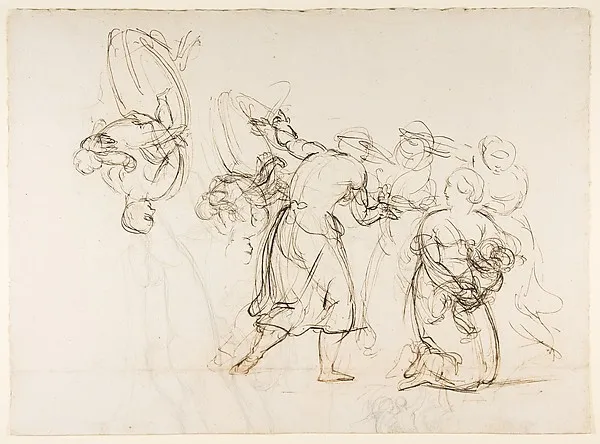
2 Chronicles 7:1-3Fire from Heaven
1Now when Solomon had made an end of praying, the fire came down from heaven, and consumed the burnt offering and the sacrifices; and the glory of the LORD filled the house. 2And the priests could not enter into the house of the LORD, because the glory of the LORD had filled the LORD’s house. 3And when all the children of Israel saw how the fire came down, and the glory of the LORD upon the house, they bowed themselves with their faces to the ground upon the pavement, and worshipped, and praised the LORD, saying, For he is good; for his mercy endureth for ever.
This fire has fallen before. When the tabernacle was dedicated, fire from the Lord consumed the offering and the people shouted and fell on their faces (Leviticus 9:24). When Elijah needed God to prove Himself on Carmel, fire fell and licked up even the water in the trench (1 Kings 18:38). Each time, the fire says the same thing: God sees, God accepts, God is here. And notice how Solomon got it. No incantation, no clever ritual. He prayed, and the sky answered.
The Hebrew word behind “glory” - kavod - means weight, the felt heaviness of God's presence and honor. This is no figure of speech. The priests, the very men whose whole life was walking in and out of that house, suddenly cannot get through the door. You could not stand in it either. The temple was finished by human hands, but it is sanctified by God moving in.1
Watch what the crowd does. Nobody debates whether the sign is real. Nobody stays on their feet. A whole nation goes face-down on the stone pavement and reaches for the oldest line in their worship: For he is good; for his mercy endureth for ever. That is what the nearness of God draws out of a human heart: an awe that puts you on the ground. The fire could have scattered them. Instead it bowed them.
2 Chronicles 7:4-10The Great Festival of Dedication
4Then the king and all the people offered sacrifices before the LORD. 5And king Solomon offered a sacrifice of twenty and two thousand oxen, and an hundred and twenty thousand sheep: so the king and all the people dedicated the house of God. 6And the priests waited on their offices: the Levites also with instruments of musick of the LORD, which David the king had made to praise the LORD, because his mercy endureth for ever, when David praised by their ministry; and the priests sounded trumpets before them, and all Israel stood.
The fire has fallen; now the people respond in kind. The king leads, the priests take their stations, and the Levites pick up the very instruments David built for this. Worship here is not improvised - it is the whole nation, organized and unhurried, giving God its best.
7Moreover Solomon hallowed the middle of the court that was before the house of the LORD: for there he offered burnt offerings, and the fat of the peace offerings, because the brasen altar which Solomon had made was not able to receive the burnt offerings, and the meat offerings, and the fat. 8Also at the same time Solomon kept the feast seven days, and all Israel with him, a very great congregation, from the entering in of Hamath unto the river of Egypt. 9And in the eighth day they made a solemn assembly: for they kept the dedication of the altar seven days, and the feast seven days. 10And on the three and twentieth day of the seventh month he sent the people away into their tents, glad and merry in heart for the goodness that the LORD had shewed unto David, and to Solomon, and to Israel his people.
The numbers are staggering. Twenty-two thousand oxen. One hundred twenty thousand sheep. These numbers are acts of total commitment. The king and the people have emptied their flocks to offer before the Lord. Each animal represents a covenant acknowledgment - "You are God, and we are Yours. All that we have comes from Your hand." The sheer scale of the offering shows that this is a nation turning its entire attention toward heaven.
The priests wait on their offices. The Levites stand with instruments of music - the very instruments that David had made and appointed for the praise of the Lord. Music is integral to worship. The trumpets sound. The people worship with both their bodies (standing still, listening) and their ears (hearing the praise). Worship is multisensory, and all of it points toward God.
They keep the feast for seven days - the traditional period of dedication and consecration in Israel. On the eighth day, a solemn assembly. Seven days for the dedication of the altar, and seven days for the feast itself. The doubling of the number shows the importance of the moment. It is a season set apart, a full week of the nation turning toward God together.
When it is finally over, the people go home “glad and merry in heart.” This is the easy thing to miss about real worship: real worship leaves you happy. They had not just watched a building project wrap up. They had seen the goodness of God made visible, and they carried that gladness back to every tent in Israel. Awe on the pavement becomes joy on the road home.
2 Chronicles 7:11-14The Night the Lord Spoke: "If My People"
11Thus Solomon finished the house of the LORD, and the king’s house: and all that came into Solomon’s heart to make in the house of the LORD, and in his own house, he prosperously effected. 12And the LORD appeared to Solomon by night, and said unto him, I have heard thy prayer, and have chosen this place to myself for an house of sacrifice. 13If I shut up heaven that there be no rain, or if I command the locusts to devour the land, or if I send pestilence among my people; 14If my people, which are called by my name, shall humble themselves, and pray, and seek my face, and turn from their wicked ways; then will I hear from heaven, and will forgive their sin, and will heal their land.
Everything is done. The Lord's house, the palace, every project Solomon dreamed up - all of it built, and built well. This is the high-water mark of his reign, the moment a lesser story would fade out on. Instead, this is exactly when God shows up at night to talk. The timing preaches its own sermon: finishing the building was never the point. What the people do inside it now is.
Drought, locusts, plague - God names them not as fits of temper but as what a broken covenant produces. Turn from Him and the land turns dry. That is simply how it works. But the sentence does not stop at the curse. It pivots on the most hopeful word in the chapter: if my people… shall humble themselves, and pray, and seek my face, and turn from their wicked ways; then will I… heal their land. The door never gets locked. However far the people wander, the way back is standing open, and on the far side of it is healing.
Notice the four movements: humble (recognize dependence on God), pray (voice the recognition aloud), seek my face (turn attention toward God Himself), and turn from wicked ways (change behavior as well as emotion). Repentance is a progression - a turning of the heart, a turning toward God, and a turning away from sin. All four elements are necessary.
2 Chronicles 7:15-16Eyes Open, Ears Attentive
15Now mine eyes shall be open, and mine ears attent unto the prayer that is made in this place. 16For now have I chosen and sanctified this house, that my name may be there for ever: and mine eyes and mine heart shall be there perpetually.
Then comes the tenderness. Eyes open, ears attentive - God describes Himself the way you would describe a parent listening for a child in the next room. He is not distant here, not busy with bigger matters. The house becomes the place where heaven leans in close to catch what the people say. Every prayer whispered there has the full attention of the One who made the heavens.
2 Chronicles 7:17-20The Covenant Promise and the Warning
17And as for thee, if thou wilt walk before me, as David thy father walked, and do according to all that I have commanded thee, and shalt observe my statutes and my judgments; 18Then will I stablish the throne of thy kingdom, according as I have covenanted with David thy father, saying, There shall not fail thee a man to be ruler in Israel. 19But if ye turn away, and forsake my statutes and my commandments, which I have set before you, and shall go and serve other gods, and worship them; 20Then will I pluck them up by the roots out of my land which I have given them; and this house, which I have sanctified for my name, will I cast out of my sight, and will make it to be a proverb and a byword among all nations.
Now the word turns personal, from “my people” to “thee.” Building the temple was not enough. Offering the sacrifices was not enough. Solomon himself has to walk the way his father walked. And David is a strange model to hold up - an adulterer, a man with blood on his hands - except that David always came back. He kept returning to God after every fall. That is the pattern set before the son. The open question of the whole reign is whether Solomon will do the same.
If Solomon obeys, the Lord will establish his throne according to the covenant made with David. There shall not fail a man to be ruler in Israel. This is the Davidic promise - an endless line of successors, a kingdom that will endure. But it is conditional on obedience. The promise stands, but only for those who walk in the way.
The alternative is devastation. "If ye turn away, and forsake my statutes...and shall go and serve other gods." Idolatry is the breaking point, a fundamental repudiation of the covenant. And the consequences are total. The Lord will pluck the people up by the roots out of the land. The house that has been sanctified will be cast out of God's sight. It will become "a proverb and a byword among all nations." What was meant to be the glory of Israel becomes a monument to national shame.
2 Chronicles 7:21-22The Ruins Will Preach
21And this house, which is high, shall be an astonishment to every one that passeth by it; so that he shall say, Why hath the LORD done thus unto this land, and unto this house? 22And it shall be answered, Because they forsook the LORD God of their fathers, which brought them forth out of the land of Egypt, and laid hold on other gods, and worshipped them, and served them: therefore hath he brought all this evil upon them.
God even writes the epitaph in advance. Centuries on, strangers will stand in the rubble and ask, “Why hath the Lord done thus unto this land, and unto this house?” And the answer is already drafted: Because they forsook the Lord God of their fathers… and laid hold on other gods. No mystery, no bad luck. A nation turned away and the covenant broke. The ruins would one day be real, and so would the long road back from them.2
2 Chronicles 7Fire, Promise, and Repentance
The chapter moves through three moments. First, the visible affirmation: fire from heaven, the glory of the Lord, the people's worship. It is a moment of clarity, of undeniable divine presence. Second, the conditional promise: if the people humble themselves, pray, seek God's face, and turn from wickedness, then God will hear, forgive, and heal. It is an open door, always available. Third, the warning: if they turn away and serve other gods, the consequences will be total. The temple will fall. The nation will be displaced. What was meant to be glory becomes ruin.
This chapter writes the entire pattern of Israel's later history in advance. They will turn away. They will be taken captive. And yet, the promise of 2 Chronicles 7:14 will echo through the prophets: if they return, God will restore. It is the fundamental structure of covenant, ever-renewable. Breaking is always possible. Return is always possible. Healing is always available.
Research trail
Sources & further study
These references support the historical, linguistic, manuscript, and contextual notes in this chapter. Scripture remains the primary text; external sources are provided so readers can inspect the research directly.
Where this echoes in Scripture
Eyes Open, Ears Attentive
- Philippians 2:8He humbled himself, and became obedient unto death, even the death of the cross.The first movement of verse 14, “humble themselves,” carried to its limit in Christ.
- Luke 22:42Saying, Father, if thou be willing, remove this cup from me: nevertheless not my will, but thine, be done.Seeking the Father's face in prayer (verse 14) at the hardest possible hour.
- Acts 10:43To him give all the prophets witness, that through his name whosoever believeth in him shall receive remission of sins.The forgiveness promised in verse 14 opened to everyone through His name.
- 2 Corinthians 5:21For he hath made him to be sin for us, who knew no sin; that we might be made the righteousness of God in him.How the One who never had a wicked way to turn from stands in for those who did.
Fire, Promise, and Repentance
- Hebrews 1:8But unto the Son he saith, Thy throne, O God, is for ever and ever: a sceptre of righteousness is the sceptre of thy kingdom.The Davidic throne God promised to establish (verse 18) named as everlasting in the Son.
- Hebrews 10:19-20Having therefore, brethren, boldness to enter into the holiest by the blood of Jesus, by a new and living way, which he hath consecrated for us, through the veil.The barrier of glory that kept the priests out (verses 2) now a door opened through Christ.