Acts 10
People in this chapter
A Roman officer in Caesarea is praying when an angel tells him to send for a fisherman in Joppa. Up the coast, that fisherman is on a rooftop, hungry, when heaven opens and a sheet of forbidden animals descends with a voice: kill and eat. Peter refuses; he has kept the dietary laws1 since childhood. The voice answers anyway: what God has cleansed, do not call common. Three times. Then Cornelius's men reach the gate.
Tap any highlighted phrase to jump to the commentary that unpacks it.
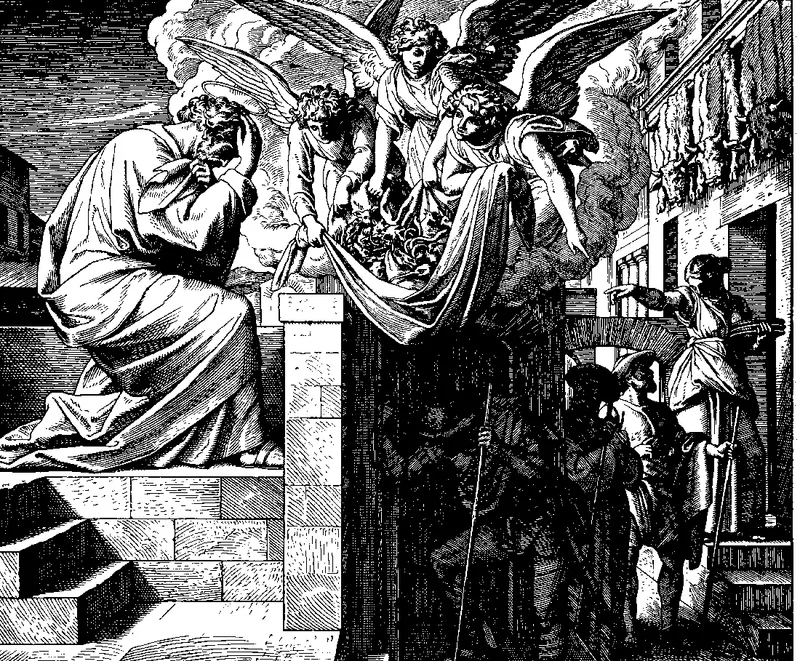
Acts 10:1-2A Devout Man in Caesarea
1There was a certain man in Caesarea called Cornelius, a centurion of the band called the Italian band, 2A devout man, and one that feared God with all his house, which gave much alms to the people, and prayed to God alway.
Cornelius is a Roman soldier2, a foreigner, a man who has never been circumcised, never kept the Jewish law. By the standards of Jewish purity, he is outside the covenant. Yet he prays. He fears God. He gives alms. The first thing Luke wants you to know about the moment the gospel reaches the Gentiles is that a Gentile is already seeking God before Peter ever arrives.
Acts 10:3-4An Angel at the Ninth Hour
3He saw in a vision evidently about the ninth hour of the day an angel of God coming in to him, and saying unto him, Cornelius. 4And when he looked on him, he was afraid, and said, What is it, Lord? And he said unto him, Thy prayers and thine alms are come up for a memorial before God.
A memorial before God - the phrase echoes the language of the altar in Leviticus, where an offering was burned and remembered. The angel uses that sacrificial word for the prayers of an uncircumcised Roman. Cornelius has no temple, no priesthood, no lamb to slaughter. Yet his prayer and his charity rise like an offering, and God remembers them. The Spirit is already declaring that a sincere heart counts as worship, even outside the boundaries of the law.
Acts 10:5-6Send for Simon Peter
5And now send men to Joppa, and call for one Simon, whose surname is Peter: 6He lodgeth with one Simon a tanner, whose house is by the sea side: he shall tell thee what thou oughtest to do.
Acts 10:9-11Peter's Trance on the Rooftop
9On the morrow, as they went on their journey, and drew nigh unto the city, Peter went up upon the housetop to pray about the sixth hour: 10And he became very hungry, and would have eaten: but while they made ready, he fell into a trance, 11And saw heaven opened, and a certain vessel descending unto him, as it had been a great sheet knit at the four corners, and let down to the earth:
The servants of Cornelius are approaching Joppa. Peter is on the rooftop, praying at midday, hungry. He is on the threshold of something that will change him forever. But he does not know it yet.
The Spirit comes over him and opens his inner eye. Peter is lifted out of ordinary seeing and shown something that will break his oldest assumptions about clean and unclean. Notice the detail that he is hungry; his body is awake and alert. This is no dream born of an empty stomach. It is a vision, and in Scripture a vision is nearer to reality than waking life is.
Acts 10:12-14Kill, and Eat
12Wherein were all manner of fourfooted beasts of the earth, and wild beasts, and creeping things, and fowls of the air. 13And there came a voice to him, Rise, Peter; kill, and eat. 14But Peter said, Not so, Lord; for I have never eaten any thing that is common or unclean.
There is nothing gentle in the command. It asks Peter to do the one thing he has never done in his life: eat what the law forbids. And the law was no small thing to him. Keeping it was how he obeyed God, how he knew himself a son of the covenant. The horror of the moment is that the voice from heaven is telling him to break the very law heaven gave. No wonder he says no.
Peter's refusal is faithfulness to what he has been taught. His word - "Not so, Lord" - is the word of a man who believes the law is holy and righteous. He is defending the boundary that made him who he is - the dietary laws1 that marked a Jew as set apart. The vision will come three times. It takes that persistence to crack the stone.
Acts 10:15-16What God Hath Cleansed
15And the voice spake unto him again the second time, What God hath cleansed, that call not thou common. 16This was done thrice: and the vessel was received up again into heaven.
Acts 10:17-23The Men at the Gate
17Now while Peter doubted in himself what this vision which he had seen should mean, behold, the men which were sent from Cornelius had made enquiry for Simon’s house, and stood before the gate, 19While Peter thought on the vision, the Spirit said unto him, Behold, three men seek thee. 20Arise therefore, and get thee down, and go with them, doubting nothing: for I have sent them. 23Then called he them in, and lodged them. And on the morrow Peter went away with them, and certain brethren from Joppa accompanied him.
Three men, sent by a Gentile, stand at the gate of a Jewish house. They are asking for Simon Peter. Normally, such a request would be impossible. A man of the law does not go with Gentiles. Does not enter their house. Does not eat at their table. The very idea violates centuries of custom and covenant.
The Spirit speaks immediately, without delay or ambiguity. The vision has not yet been understood, but the Spirit moves while Peter is still confused. "Three men seek thee. Go with them." Peter has been given the vision. Now he is given the command. The Spirit asks for obedience before understanding arrives.
Peter invites them in. He gives them a place to sleep. This is already an act of table-fellowship, a crossing of the boundary 3. Peter is beginning to obey before he fully understands. And in that obedience, he is learning.
Acts 10:24-33Peter Enters a Gentile House
24And the morrow after they entered into Caesarea. And Cornelius waited for them, and had called together his kinsmen and near friends. 25And as Peter was coming in, Cornelius met him, and fell down at his feet, and worshipped him. 26But Peter took him up, saying, Stand up; I myself also am a man. 28And he said unto them, Ye know how that it is an unlawful thing for a man that is a Jew to keep company, or come unto one of another nation; but God hath shewed me that I should not call any man common or unclean. 34Then Peter opened his mouth, and said, Of a truth I perceive that God is no respecter of persons:
Peter has spent the night in the house of a Gentile. This alone is a breaking of the law. But he goes through with it. He enters Caesarea4 - a Roman port city. He is walking into a room full of Gentiles - Cornelius's kinsmen and friends. Not one of them is circumcised. Not one of them has kept the law. Yet Peter enters the house.
Cornelius falls at Peter's feet. This is the posture of a worshipper toward a god. The angel had told him to send for Peter, and now Peter has come. Cornelius's faith is running ahead of understanding. He knows this man has been sent by God.
But Peter stops him. "Stand up. I am a man." Peter is not a god. He has no power except the power God gives him. This is one of the most human moments in Acts. Peter, who will soon be called the leader of the church, cannot accept worship. He is a vessel, nothing more.
Peter speaks to the house. He is explaining what his presence here means. For a Jew to enter a Gentile house was not just improper. It was unlawful - against the law. Peter is naming the boundary he has just crossed. He is making it explicit. And he is saying that God has shown him he should not call any man common or unclean.
Peter says the word aloud: koinos. Common. Unclean. He says it to a room full of people who have been called by that name their whole lives. He is declaring that the word no longer divides the world. The vision has become understanding. The vision has become theology.
Peter came carrying a vision he did not fully grasp. He came in plain obedience. Now, standing in a Gentile house with the room turned toward him, the meaning lands. God does not keep two kinds of people, the clean and the unclean, the inside and the outside. He keeps one kind, and they are all beloved.
Acts 10:34-37God Is No Respecter of Persons
34Then Peter opened his mouth, and said, Of a truth I perceive that God is no respecter of persons: 35But in every nation he that feareth him, and worketh righteousness, is accepted with him. 36The word which God sent unto the children of Israel, preaching peace by Jesus Christ: (he is Lord of all:) 37That word, I say, ye know, which was published throughout all Judaea, and began from Galilee, after the baptism which John preached;
Peter announces the principle that has just broken open his own heart: in every nation, he that fears God and works righteousness is accepted with Him. Cornelius is the proof. He had no Scripture, no law of Moses, no temple. But he feared God and gave alms. He was accepted. The boundary was already broken before Peter arrived.
Jesus is Lord of all. Not Lord of the Jews alone. Not Lord of those who have kept the law. Lord of all. The word God sent to Israel preached peace - reconciliation, a mending of the breach between God and creation, between Jew and Gentile, between the clean and the unclean.
Acts 10:38-43Anointed with Power to Heal
38How God anointed Jesus of Nazareth with the Holy Ghost and with power: who went about doing good, and healing all that were oppressed of the devil; for God was with him. 39And we are witnesses of all things which he did both in the land of the Jews, and in Jerusalem; whom they slew and hanged on a tree: 40Him God raised up the third day, and shewed him openly; 43To him give all the prophets witness, that through his name whosoever believeth in him shall receive remission of sins.
Notice how Peter sums up the whole public life of Jesus in a single line: He went about doing good, and healing all who were oppressed of the devil. That is the resume of the Messiah: mercy on the move. And Peter says it as an eyewitness. He was there. He watched the oppressed go free with his own eyes, and now he hands that testimony to a roomful of Gentiles who have only just heard the name.
Acts 10:44-48The Spirit Falls on Gentiles
44While Peter yet spake these words, the Holy Ghost fell on all them which heard the word. 45And they of the circumcision which believed were astonished, as many as came with Peter, because that on the Gentiles also was poured out the gift of the Holy Ghost. 46For they heard them speak with tongues, and magnify God. Then answered Peter, 47Can any man forbid water, that these should not be baptized, which have received the Holy Ghost as well as we? 48And he commanded them to be baptized in the name of the Lord. Then prayed they him to tarry certain days.
The Spirit falls while Peter is still speaking. Not after, not later - but in the very moment of the word. The same Spirit that fell at Pentecost5, filling the house with wind and fire, now falls on Gentiles in a house in Caesarea. There is no hesitation in the Spirit. No checking of credentials. No waiting to see if they keep the law. The Spirit falls on them because they have heard the word and believed.
The Jewish believers who came with Peter are astonished. They have just watched the impossible. The gift - the doron, the grace - has been poured out on Gentiles, and it is the same gift, poured the same way. There is no junior version of the Spirit for outsiders. The very presence that filled the first church, the same presence that makes you a believer, is now filling this Gentile house.
Peter does not hesitate. His question is rhetorical. Can anyone forbid water? The answer is no. If they have received the Spirit, if they speak in tongues just as we did, if they magnify God just as we do - who am I to say they should not be baptized? Peter is reading the signs. The Spirit has already chosen. He is only confirming what the Spirit has done.
The Gospel at the UttermostThe Word Goes to All Nations
In Acts 1:8, Jesus told the disciples they would be witnesses in Jerusalem, in Judea and Samaria, and to the uttermost parts of the earth. Acts 2 showed them being witnesses in Jerusalem - on Pentecost, three thousand were baptized in the city. Acts 8 pushed them into Samaria and beyond - Philip baptized the Ethiopian eunuch on the desert road, and Peter and John laid hands on believers in Samaria. Now, in Acts 10, the gospel crosses its greatest boundary.
It reaches the Gentile world. The centurion Cornelius, a Roman soldier, is filled with the Spirit and baptized. The movement toward Rome has begun. And the rest of Acts will be the unfolding of that movement - Paul will carry the gospel to the uttermost parts of the earth, and everywhere he goes, both Jews and Gentiles will hear the word.
Research trail
Sources & further study
These references support the historical, linguistic, manuscript, and contextual notes in this chapter. Scripture remains the primary text; external sources are provided so readers can inspect the research directly.
- Leviticus 11Hebrew text and English translation of the dietary laws that Peter had kept his whole life - the boundary the vision breaks.
- CenturionMilitary rank and role in the Roman occupation force; Cornelius commanded a hundred soldiers in the Italian Cohort.
- Breaking Boundaries: Gentile InclusionHistorical analysis of how the early church overcame cultural and legal boundaries to include Gentile converts without circumcision.
- CaesareaThe port city where Cornelius was stationed; ongoing excavations reveal temples, theaters, and the harbor of Herod's engineering.
- Acts 2:1-4 ↔ Acts 10:44-46Side-by-side comparison of the Jewish Pentecost and the Gentile Pentecost - the same Spirit falling on both.