2 Chronicles 6
People in this chapter
The Temple is finished. The ark is in its place. The cloud of God's presence has filled the house. Then the king climbs a bronze platform before everyone, kneels, spreads his hands toward heaven, and asks the question every builder of every shrine has had to swallow: “Will God in very deed dwell with men on the earth?” Solomon has just raised the grandest building on earth, and his own prayer admits it cannot hold God.1
Tap any highlighted phrase to jump to the commentary that unpacks it.
2 Chronicles 6:1-11Solomon's Blessing of God
1Then said Solomon, The LORD hath said that he would dwell in the thick darkness. 2But I have built an house of habitation for thee, and a place for thy dwelling for ever.
It is a strange first line for a dedication. The cloud has just filled the house, and Solomon's opening word is darkness. He is reaching back to Sinai, where God answered Moses out of the thick cloud, and saying in effect: the God you cannot see clearly has agreed to be found here. The Temple does not switch a floodlight on the mystery. It marks the one spot where the hidden God has promised to meet you.
Centuries later, when exile threatened to extinguish the whole story, that promise would prove more durable than the building itself.2
3And the king turned his face, and blessed the whole congregation of Israel: and all the congregation of Israel stood. 4And he said, Blessed be the LORD God of Israel, who hath with his hands fulfilled that which he spake with his mouth to my father David, saying, 5Since the day that I brought forth my people out of the land of Egypt I chose no city among all the tribes of Israel to build an house in, that my name might be there; neither chose I any man to be a ruler over my people Israel: 6But I have chosen Jerusalem, that my name might be there; and have chosen David to be over my people Israel.
Before he asks God for anything, Solomon traces the promise back to its beginning. A word spoken privately to David - your son will build my house - now stands in front of the whole nation in stone and gold and cedar. What God said with His mouth, He has done with His hand. The anointing of a forgotten shepherd boy has become a skyline. Solomon is teaching the people to read their own history as a record of God keeping His word.1
7Now it was in the heart of David my father to build an house for the name of the LORD God of Israel. 8But the LORD said to David my father, Forasmuch as it was in thine heart to build an house for my name, thou didst well in that it was in thine heart: 9Notwithstanding thou shalt not build the house; but thy son which shall come forth out of thy loins, he shall build the house for my name. 10The LORD therefore hath performed his word that he hath spoken: for I am risen up in the room of David my father, and am set on the throne of Israel, as the LORD promised, and have built the house for the name of the LORD God of Israel.
The phrase "I am risen up in the room of David my father" is stunning. Solomon does not say "I am better than my father" or "I have surpassed him." He says he has taken up his father's place, inherited his calling. Solomon is the one fulfilling what David could not do. This is how succession works in God's kingdom: through the completion of the father's unfinished longing. What David could not build, his son builds. What David could not accomplish, Solomon accomplishes - standing in the room David vacated.
2 Chronicles 6:12-18The Bronze Platform and the Great Question
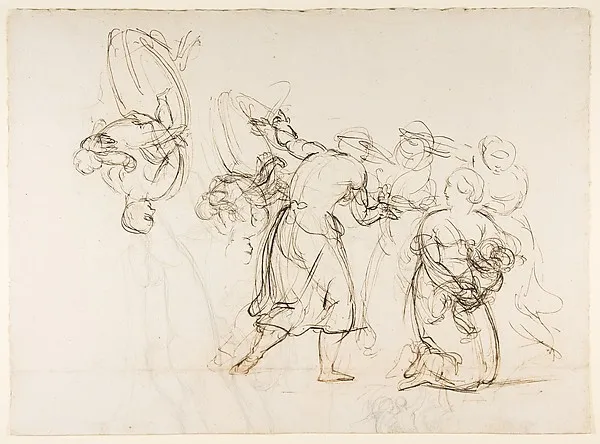
12And he stood before the altar of the LORD in the presence of all the congregation of Israel, and spread forth his hands: 13For Solomon had made a brasen scaffold of five cubits long, and five cubits broad, and three cubits high, and had set it in the midst of the court: and upon it he stood, and kneeled down upon his knees before all the congregation of Israel, and spread forth his hands toward heaven,
The Chronicler adds this detail that 1 Kings does not give us: Solomon stands on a bronze platform - a raised pulpit, visible to all Israel. Its base is a perfect square, five cubits on each side, and it rises three cubits high (roughly 7.5 feet square and 4.5 feet tall). Bronze, the metal of judgment and covenant, holds him as he stands. And from this place, Solomon does something extraordinary - he kneels. The king, the wisest of all men, kneels before the people and before God.
His hands are spread toward heaven. This is the posture of the intercessor, the priest, the one who stands between God and the people.
14And said, O LORD God of Israel, there is no God like thee in the heaven, nor in the earth; which keepest covenant, and shewest mercy unto thy servants, that walk before thee with all their hearts: 15Thou which hast kept with thy servant David my father that which thou hast promised him; and spakest with thy mouth, and hast fulfilled it with thine hand, as it is this day. 16Now therefore, O LORD God of Israel, keep with thy servant David my father that which thou hast promised him, saying, There shall not fail thee a man in my sight to sit upon the throne of Israel; yet so that thy children take heed to their way to walk in my law, as thou hast walked before me.
Solomon opens his prayer with adoration. There is no God like the God of Israel. Not just more powerful, but utterly unique in covenant-keeping and mercy. He has kept His word to David. Everything He spoke, He fulfilled. And now Solomon asks God to keep the covenant - to ensure that David's descendants will sit upon the throne, on one condition: "if thy children take heed to their way to walk in my law." The covenant is conditional. Blessing flows from obedience.
17Now then, O LORD God of Israel, let thy word be verified, which thou hast spoken unto thy servant David. 18But will God in very deed dwell with men on the earth? behold, heaven and the heaven of heavens cannot contain thee; how much less this house which I have built!
This is the hinge the whole chapter turns on, and the wonder of it is that Solomon raises it himself, at the proudest moment of his reign. He has finished the grandest building on earth, and instead of admiring it he measures it against God and watches it shrink. The heaven of heavens cannot hold Him; what hope has a room of cedar and gold? And then comes the word that should stop you: yet.
God will not be contained, and God comes anyway. He is never found because the place was big enough to deserve Him. He is found because He decided to be.
2 Chronicles 6:19-30Hear from Heaven, Thy Dwelling Place
19Have respect therefore to the prayer of thy servant, and to his supplication, O LORD my God, to hearken unto the cry and the prayer which thy servant prayeth before thee: 20That thine eyes may be open upon this house day and night, upon the place whereof thou hast said that thou wouldest put thy name there; to hearken unto the prayer which thy servant prayeth toward this place.
Solomon asks God to keep His eyes open toward the Temple "night and day." This is the language of constant watchfulness, of attentiveness. When the people pray toward this place, Solomon asks, God will hear. But then Solomon adds something crucial: "hear thou in heaven thy dwelling place." God's true and ultimate dwelling place is heaven. The Temple is where the people turn when they cry out. This house is where God has said His name shall be. But God dwells in heaven. And from His heavenly throne, He hears the prayers that rise from earth.
21Hearken therefore unto the supplications of thy servant, and of thy people Israel, which they shall make toward this place: hear thou from thy dwelling place, even from heaven; and when thou hearest, forgive.
22If a man sin against his neighbour, and an oath be laid upon him to make him swear, and the oath come before thine altar in this house; 23Then hear thou from heaven, and do, and judge thy servants, by requiting the wicked, by recompensing his way upon his own head; and by justifying the righteous, by giving him according to his righteousness.
24And if thy people Israel be put to the worse before the enemy, because they have sinned against thee; and shall return and confess thy name, and pray and make supplication before thee in this house; 25Then hear thou from the heavens, and forgive the sin of thy people Israel, and bring them again unto the land which thou gavest to them and to their fathers.
2 Chronicles 6:26-39Every Plague, Every Human Need
26When the heaven is shut up, and there is no rain, because they have sinned against thee; yet if they pray toward this place, and confess thy name, and turn from their sin, when thou dost afflict them; 27Then hear thou from heaven, and forgive the sin of thy servants, and of thy people Israel, when thou hast taught them the good way, wherein they should walk; and send rain upon thy land, which thou hast given unto thy people for an inheritance.
28If there be dearth in the land, if there be pestilence, if there be blasting, or mildew, locusts, or caterpillers; if their enemies besiege them in the cities of their land; whatsoever sore or whatsoever sickness there be: 29Then what prayer or what supplication soever shall be made of any man, or of all thy people Israel, when every one shall know his own sore and his own grief, and shall spread forth his hands in this house: 30Then hear thou from heaven thy dwelling place, and forgive, and render unto every man according unto all his ways, whose heart thou knowest; (for thou only knowest the hearts of the children of men:)
Solomon names every grief a nation can suffer: drought and famine, pestilence and plague, blight and mildew, locusts and caterpillars, siege and war, sickness of every kind. The catalogue is exhaustive. And to each, Solomon adds the same response: if the people pray toward this place, confess their name, and turn from their sin, then God will hear and forgive. The Temple becomes a house of mercy for every kind of human suffering. And notice the condition: "when every one shall know his own sore" - when a person has encountered their own failure, their own grief, their own limitation.
The prayers that rise from this house are the prayers of those who have felt the weight of their own need.
31That they may fear thee, to walk in thy ways, so long as they live in the land which thou gavest unto our fathers. 32Moreover concerning the stranger, which is not of thy people Israel, but is come from a far country for thy great name’s sake, and thy mighty hand, and thy stretched out arm; if they come and pray in this house;
Solomon even prays for disputes between neighbors - when one man has sworn an oath against another, and the dispute comes to the Temple altar. The scope of the prayer is comprehensive. No human conflict is too small for God's attention. The Temple is not only a sanctuary for the nation; it is a place where personal grievance, neighborhood conflict, individual failure - all find an audience with heaven.
2 Chronicles 6:32-39The Stranger from a Far Country
32Moreover concerning the stranger, which is not of thy people Israel, but is come from a far country for thy great name’s sake, and thy mighty hand, and thy stretched out arm; if they come and pray in this house; 33Then hear thou from the heavens, even from thy dwelling place, and do according to all that the stranger calleth to thee for; that all people of the earth may know thy name, and fear thee, as doth thy people Israel, and may know that this house which I have built is called by thy name.
Here is one of the most extraordinary moments in Solomon's prayer. He prays not only for Israel, but for the stranger - "not of thy people Israel, but is come from a far country for thy name's sake." This foreigner has heard of God's great name and strong hand. He comes seeking. And Solomon prays: Hear him. Do according to all that he calls for. "That all people of the earth may know thy name, to fear thee, as do thy people Israel."
The Temple, in this moment of its dedication, is unveiled as a house where all nations may come and find God. This is mission embedded in prayer.
2 Chronicles 6:40-42"Remember the Mercies of David Thy Servant"
40Now, my God, let, I beseech thee, thine eyes be open, and let thine ears be attent unto the prayer that is made in this place. 41Now therefore arise, O LORD God, into thy resting place, thou, and the ark of thy strength: let thy priests, O LORD God, be clothed with salvation, and let thy saints rejoice in goodness. 42O LORD God, turn not away the face of thine anointed: remember the mercies of David thy servant.
Notice what Solomon asks God to remember. The mercies. The grace David needed in his sin, his exile, his unfinished longing to build the very house Solomon is now dedicating. Solomon stakes the whole future of the dynasty on God's habit of being kind to people who did not earn it. And the last word of the prayer reaches past Solomon and his sons toward an heir not yet born, in whom mercy itself would take a throne.
2 Chronicles 6 OverviewThe Prayer That Shapes a Nation
The dedication of the Temple marks the apex of Israel's glory under Solomon. The ark is brought up. The cloud fills the house. Solomon, standing on a bronze platform like a priest-king, spreads his hands toward heaven and speaks a theology that will echo through the centuries. God dwells in thick darkness, so transcendent that even heaven of heavens cannot contain Him. Yet He chooses to dwell in the Temple. He chooses to hear the prayers of the righteous and the repentant, the native-born and the stranger.
And He asks for one thing: that the people walk before Him with all their hearts. The dedication is the threshold of another story - the story of whether Israel will keep the covenant or break it, of whether the Temple will remain a place of God's presence or become a place of hollow ritual. Solomon prays as if he already knows this story will unfold in heartbreak and exile. But he also prays with absolute confidence that even in exile, even in the darkest hour, God will hear the prayer of a repentant people and bring them home.
The prayer carries a people whose future will be tested, broken, and restored. And in that restoration lies the deepest truth of Solomon's vision: God's covenant rests on divine mercy. And that mercy is extended even to the stranger, even to the one who comes from a far country seeking God's name.
Research trail
Sources & further study
These references support the historical, linguistic, manuscript, and contextual notes in this chapter. Scripture remains the primary text; external sources are provided so readers can inspect the research directly.
Where this echoes in Scripture
The Bronze Platform and the Great Question
- John 1:1In the beginning was the Word, and the Word was with God, and the Word was God.The One who answers Solomon's question was there before any temple was built.
- Matthew 1:23they shall call his name Emmanuel, which being interpreted is, God with us.Solomon's “will God dwell with men” given a name at the manger.
- Exodus 40:34-35a cloud covered the tent of the congregation, and the glory of the LORD filled the tabernacle.The same glory-cloud that fills the Temple here once filled the tent in the wilderness.
- Isaiah 66:1-2The heaven is my throne, and the earth is my footstool: where is the house that ye build unto me?God's own echo of verse 18 - no house can contain Him, yet He looks to the humble.
- Acts 7:48-49the most High dwelleth not in temples made with hands.Stephen quotes the very logic of Solomon's prayer on his way to martyrdom.
The Stranger from a Far Country
- Acts 2:38Repent, and be baptized every one of you in the name of Jesus Christ for the remission of sins.The forgiveness Solomon begged for the stranger, now offered to every nation in Jerusalem.
- Isaiah 56:6-7mine house shall be called an house of prayer for all people.The prophets carry forward the welcome Solomon prays here in verses 32-33.
- Mark 11:17Is it not written, My house shall be called of all nations the house of prayer?Jesus clears the temple courts citing the very purpose Solomon dedicated them for.
- Ephesians 2:13-14ye who sometimes were far off are made nigh by the blood of Christ.The “far country” distance of verse 32 closed at the cross.
- Revelation 7:9a great multitude... of all nations, and kindreds, and people, and tongues, stood before the throne.Solomon's single stranger multiplied into a worshipping crowd from everywhere.
"Remember the Mercies of David Thy Servant"
- Matthew 1:1The book of the generation of Jesus Christ, the son of David, the son of Abraham.Solomon's prayer for David's line reaches its heir in the Gospel's first line.
- Luke 1:54-55He hath holpen his servant Israel, in remembrance of his mercy.Mary sings the same plea Solomon prays - God remembering His mercy to David's house.
- Romans 3:25Whom God hath set forth to be a propitiation through faith in his blood.The mercy seat of verse 41's “resting place” made personal in Christ.
- Psalm 132:8-10Arise, O LORD, into thy rest... For thy servant David's sake turn not away the face of thine anointed.The psalm Solomon is quoting nearly word for word in verses 41-42.
- Acts 13:34I will give you the sure mercies of David.Paul names “the mercies of David” of verse 42 as fulfilled in the risen Christ.
The Prayer That Shapes a Nation
- 1 Corinthians 6:19know ye not that your body is the temple of the Holy Ghost which is in you?Paul moves God's dwelling from Solomon's house into the believer.
- Ephesians 2:21-22an holy temple in the Lord... builded together for an habitation of God through the Spirit.The scattered nations Solomon prayed for, framed together into one living house.
- John 2:19-21Destroy this temple, and in three days I will raise it up... he spake of the temple of his body.Jesus fulfills the whole temple system in Himself.
- Revelation 21:3Behold, the tabernacle of God is with men, and he will dwell with them.Solomon's question of verse 18 answered with a final, unqualified yes.
- 2 Corinthians 6:16ye are the temple of the living God... I will dwell in them, and walk in them.The dwelling-and-walking of the prayer made the church's own identity.