Matthew 1
People in this chapter
Matthew begins the New Testament the way the Old Testament so often marks a new beginning - with a genealogy. The book of the generation of Jesus Christ, the son of David, the son of Abraham (v. 1). The opening words echo the recurring phrase of Genesis, the generations of, deliberately setting this account inside the long story of God's dealings with His people. And the very first line names the two figures the whole list is built to connect: Abraham and David.
To Abraham came the promise that in thee shall all families of the earth be blessed (Gen. 12:3); to David, the oath that his house and throne should be established for ever (2 Sam. 7:16). Matthew is making an argument before he tells a single story: the child whose birth he is about to describe is the heir of both promises, the seed of Abraham and the son of David in one.1
Tap any highlighted phrase to jump to the commentary that unpacks it.
Matthew 1:1The Son of David, the Son of Abraham
1The book of the generation of Jesus Christ, the son of David, the son of Abraham.
The first words of the New Testament reach back into the old: The book of the generation of Jesus Christ (v. 1). The phrase deliberately echoes a refrain that runs all through Genesis - these are the generations of… - the formula that opens each new chapter of the human story, from the heavens and the earth, to Adam, to Noah, to the families of the nations. By using it, Matthew quietly announces that what follows is not a fresh and unconnected tale but the next, decisive movement of a story already long underway.
And in the same breath he names the two figures the whole genealogy exists to join: the son of David, the son of Abraham. The order is striking. David is named first, then Abraham - as if to sound the royal note at once, son of David, the title the crowds would later cry out to Jesus in the street. Everything in the list to come is bent toward proving that this single claim is true: that the child born at its end is the rightful heir of Israel's deepest promises.1
Matthew 1:2-6From Abraham to David the King
2Abraham begat Isaac; and Isaac begat Jacob; and Jacob begat Judas and his brethren; 3And Judas begat Phares and Zara of Thamar; and Phares begat Esrom; and Esrom begat Aram; 4And Aram begat Aminadab; and Aminadab begat Naasson; and Naasson begat Salmon; 5And Salmon begat Booz of Rachab; and Booz begat Obed of Ruth; and Obed begat Jesse; 6And Jesse begat David the king; and David the king begat Solomon of her that had been the wife of Urias;
Into this register of fathers Matthew threads four mothers - something an ancient genealogy would almost never do, and so a thing meant to be noticed. They are Thamar (v. 3), Rachab and Ruth (v. 5), and the woman named only as her that had been the wife of Urias (v. 6). Look at who they are. Tamar bore Judah's twins through a desperate and tangled deception. Rahab was a harlot of Jericho, a Canaanite of a doomed city, who hid Israel's spies and cast her lot with their God.
Ruth was a Moabitess, a foreigner from a people long at odds with Israel, who clung to Naomi and to Naomi's God and became great-grandmother to David. And the last is not even named in her own right but by the husband David wronged - Bathsheba, a standing reminder of the king's gravest sin. These are not the ancestors a proud house would advertise. Three were Gentiles or married into scandal; every one of their stories carries an edge of shame or sorrow or the outsider's precarious place.
Yet Matthew writes them in, deliberately, at the head of his Gospel. Before Jesus is born, the family tree is already preaching: the line that produced the Saviour is shot through with the foreign, the failing, and the forgiven. Grace is not a thing He brought late to a clean inheritance; it was woven into the inheritance itself.
Matthew 1:7-11From Solomon to the Babylonian Exile
7And Solomon begat Roboam; and Roboam begat Abia; and Abia begat Asa; 8And Asa begat Josaphat; and Josaphat begat Joram; and Joram begat Ozias; 9And Ozias begat Joatham; and Joatham begat Achaz; and Achaz begat Ezekias; 10And Ezekias begat Manasses; and Manasses begat Amon; and Amon begat Josias; 11And Josias begat Jechonias and his brethren, about the time they were carried away to Babylon:
Matthew 1:12-16From the Exile to Joseph, the Husband of Mary
12And after they were brought to Babylon, Jechonias begat Salathiel; and Salathiel begat Zorobabel; 13And Zorobabel begat Abiud; and Abiud begat Eliakim; and Eliakim begat Azor; 14And Azor begat Sadoc; and Sadoc begat Achim; and Achim begat Eliud; 15And Eliud begat Eleazar; and Eleazar begat Matthan; and Matthan begat Jacob; 16And Jacob begat Joseph the husband of Mary, of whom was born Jesus, who is called Christ.
The line itself moves through the whole sweep of Israel's history, and its three movements tell a story even in their shape. From Abraham it climbs through the patriarchs and down into Egypt, then up again to David the king (v. 6) - the ascent of a people toward its golden age. From David it runs through the kings of Judah, a descent that ends in catastrophe: the carrying away into Babylon, the loss of the land, the throne emptied.
And from the exile it presses on through a string of names many readers will not recognize - Salathiel, Zorobabel, Abiud, and the rest - the quiet, hidden generations in which it must have seemed the great promises had gone silent. Yet the line never breaks. Through rise and ruin and the long obscurity afterward, God keeps the thread unbroken all the way to Joseph the husband of Mary, of whom was born Jesus, who is called Christ (v. 16).
The careful change of wording there repays attention: every link before it reads begat, father to son; but of Jesus, Matthew does not say Joseph begat Him. He says Jesus was born of Mary - the first hint, dropped into the genealogy itself, that this birth will be unlike every other in the list.
Matthew 1:17Three Fourteens, Abraham to Christ
17So all the generations from Abraham to David are fourteen generations; and from David until the carrying away into Babylon are fourteen generations; and from the carrying away into Babylon unto Christ are fourteen generations.
Matthew closes the genealogy by counting it out for us: So all the generations from Abraham to David are fourteen generations; and from David until the carrying away into Babylon are fourteen generations; and from the carrying away into Babylon unto Christ are fourteen generations (v. 17). The triple fourteen is no idle arithmetic. By gathering the long centuries into three even spans, Matthew presents the whole of Israel's history as a measured, deliberate movement - a descent appointed and ordered, not a chain of accidents.
The number itself would not have been lost on his first readers: in Hebrew the letters of the name David sum to fourteen, so that the very pattern of the list spells out, again and again, the name of the king whose greater Son this child is. The hinges Matthew chooses are telling too - the height of the kingdom under David, and the depth of its loss in the exile. The story rises to a throne, falls into captivity, and then, in the third span, comes at last to Christ. Whatever else the careful structure says, it says this plainly: the coming of Jesus is the point the whole arrangement has been moving toward from the first name.
He is the destination, not an afterthought.2
Matthew 1:18-21Thou Shalt Call His Name JESUS
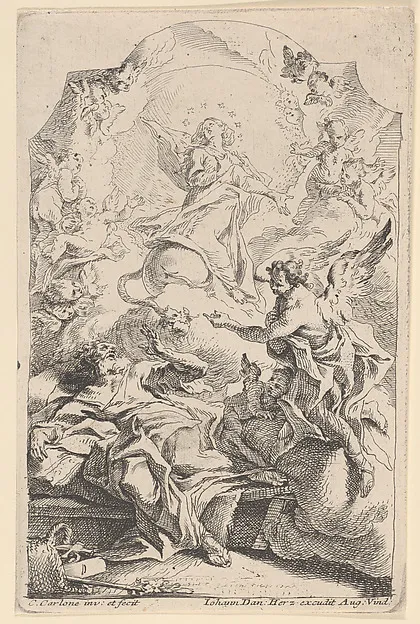
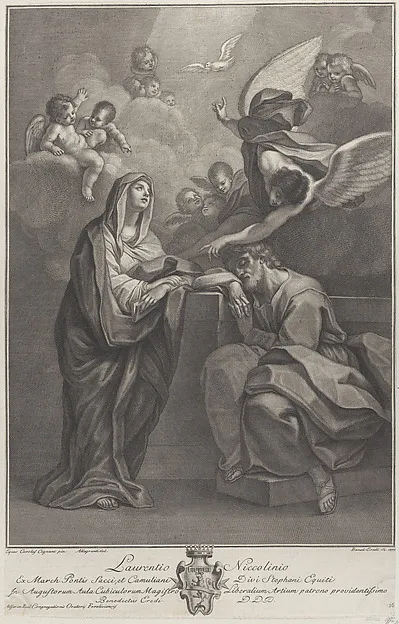
18Now the birth of Jesus Christ was on this wise: When as his mother Mary was espoused to Joseph, before they came together, she was found with child of the Holy Ghost. 19Then Joseph her husband, being a just man, and not willing to make her a publick example, was minded to put her away privily. 20But while he thought on these things, behold, the angel of the LORD appeared unto him in a dream, saying, Joseph, thou son of David, fear not to take unto thee Mary thy wife: for that which is conceived in her is of the Holy Ghost. 21And she shall bring forth a son, and thou shalt call his name JESUS: for he shall save his people from their sins.
Having traced the line all the way to Joseph, Matthew now pauses on the one link that does not work like the others. He has just written, with deliberate care, that Joseph was the husband of Mary, of whom was born Jesus (v. 16) - not that Joseph begat Him. Now he tells us why. The genealogy gave Jesus His legal place in the house of David, for Joseph was a son of David and would name the child as his own; but the child's coming into the world owed nothing to Joseph.
This is the seam where the long human descent of the first seventeen verses meets something that descends from elsewhere. Every name before this point answers the question, from whom? - and the answer was always a human father. With Jesus the question is answered differently, and Matthew slows down to say so plainly.
Matthew states the central fact without flourish or apology: Mary was found with child of the Holy Ghost (v. 18). The plain sense of the words is what Matthew means by them. Mary and Joseph were espoused - in that culture a binding bond, more than a modern engagement, so that Joseph could already be called her husband - but they had not yet come together as man and wife. Before they came together, she is found to be carrying a child, and the child is of the Holy Ghost. Matthew does not argue the point or brace it with explanation; he simply records it as the thing that happened, and lets it stand.
The conception is the direct work of the Spirit of God. What the genealogy hinted at in its careful wording is here said outright: this birth has no human father, and the life within Mary was brought into being by God Himself. Everything that follows in Matthew's Gospel rests on this quiet, astonishing sentence.3
Before the angel ever speaks, Matthew shows us the kind of man Joseph was, and it is a small portrait of grace. He calls him a just man - righteous, faithful to the law of God - and in the same breath, not willing to make her a publick example (v. 19). Those two things sit in tension, and the tension is the point. The law gave a wronged betrothed husband every right to a public reckoning; a strictly legal righteousness could have exposed Mary to open shame, even to worse.
Joseph's justice bent toward mercy. He was minded to put her away privily - to end the betrothal as quietly as the law would allow, shielding her from disgrace even at cost to himself, even when by every appearance she had wronged him. Here is righteousness that would rather shield than expose - and it is precisely this gentle, just man whom God chooses to entrust with His Son. Joseph is described before he obeys, so that we see his character is already the soil in which obedience can grow.
Into Joseph's painful deliberation God speaks: while he thought on these things, behold, the angel of the Lord appeared unto him in a dream (v. 20). The address is chosen with care - Joseph, thou son of David - reaching back to the genealogy and reminding him, at the very moment he is tempted to step away, that he too stands in the royal line and has a part to play in the promise. The first word is fear not. Joseph's fear was understandable; the situation looked, from the outside, like the ruin of everything.
But the angel overturns the appearance with the truth Mary herself could not have proven to him: that which is conceived in her is of the Holy Ghost. What looked like scandal was the work of God. And so Joseph is told not to draw back but to draw near - fear not to take unto thee Mary thy wife. The path that had seemed closed by shame is opened by revelation. God does not merely clear Mary's name in Joseph's eyes; He calls Joseph into the story as the child's guardian and the giver of his name.
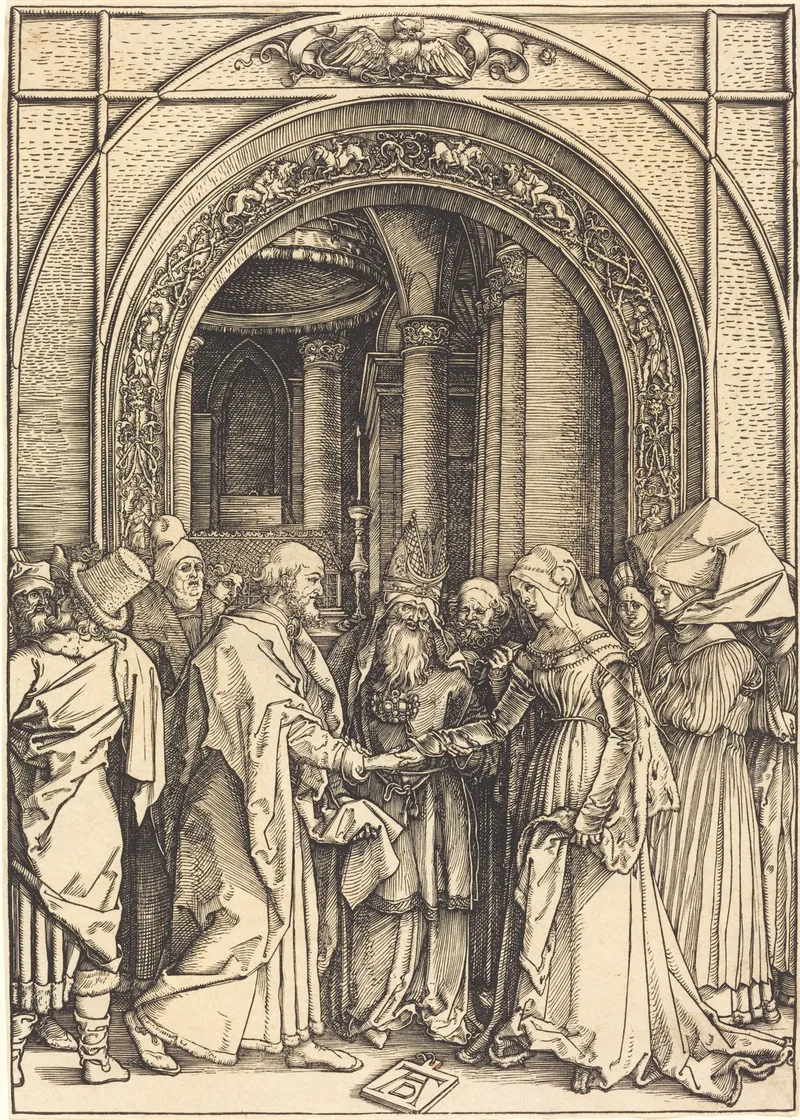
Matthew 1:22-25Emmanuel - God With Us
22Now all this was done, that it might be fulfilled which was spoken of the Lord by the prophet, saying, 23Behold, a virgin shall be with child, and shall bring forth a son, and they shall call his name Emmanuel, which being interpreted is, God with us. 24Then Joseph being raised from sleep did as the angel of the Lord had bidden him, and took unto him his wife: 25And knew her not till she had brought forth her firstborn son: and he called his name JESUS.
Matthew pauses the narrative to point at something larger than the moment: Now all this was done, that it might be fulfilled which was spoken of the Lord by the prophet (v. 22). It is the first of many such notes in his Gospel, and it sets the key for everything that follows. What is unfolding in this obscure betrothal in Nazareth answers a word God had spoken centuries before through Isaiah. The phrase which was spoken of the Lord by the prophet is careful - the words came through the prophet, but they were the LORD's own.
So the virgin birth is not presented as a wonder standing on its own, but as the keeping of an ancient promise, the moment a long-held word came true. Matthew wants his reader to feel the whole weight of Scripture leaning in behind this child, confirming Him.
The word Matthew reaches for is from Isaiah: Behold, a virgin shall be with child, and shall bring forth a son, and they shall call his name Emmanuel, which being interpreted is, God with us (v. 23). Long before, in a time of national terror, that sign had been given to the house of David as a pledge that God had not abandoned His people. Now Matthew sees its deepest fulfilment here. And he does for his readers what the verse most needs - he translates the name.
Emmanuel is not left as a foreign sound; Matthew opens it up: God with us. That is the wonder he wants no one to miss. The child conceived of the Spirit and laid in Mary's arms is the presence of God drawn near to His people - God with us, sharing our flesh and our world. The name Jesus tells what He came to do; the name Emmanuel tells who has come to do it.
Salvation from sin, and the nearness of God in person, are the two truths Matthew sets at the threshold of his Gospel.
The chapter ends not with a sign in the sky but with a quiet act of obedience. Then Joseph being raised from sleep did as the angel of the Lord had bidden him, and took unto him his wife (v. 24). The man who had been minded to step away now steps in. Without a recorded word of his own, Joseph simply does what he was told: he takes Mary home as his wife, shielding her and the child, lending the boy his name and his place in David's line.
The closing verse holds two plain statements together. The first - that Joseph knew her not till she had brought forth her firstborn son - underscores once more what Matthew has insisted on throughout: that the conception of this child owed nothing to Joseph, that the birth came of the Spirit and not of man. The second is the seal on Joseph's obedience: and he called his name JESUS. The angel had said, thou shalt call his name JESUS; and so he does.
The first chapter of the New Testament closes on a faithful man doing the small, exact thing God asked of him - and in that quiet obedience the Saviour is named and received into the world.
Research trail
Sources & further study
These references support the historical, linguistic, manuscript, and contextual notes in this chapter. Scripture remains the primary text; external sources are provided so readers can inspect the research directly.
- Matthew 1 - Translators' NotesThe NET Bible's detailed footnotes on Matthew 1 - the structure of the threefold genealogy and its counting (v. 17), the meaning of the name Jesus (v. 21), the betrothal customs behind Joseph's situation (vv. 18-19), and the citation of Isaiah 7:14 in verse 23.
- Matthew 1 ↔ Genesis · 2 Samuel 7 · Isaiah 7 · Ruth 4Traces the Old Testament threads gathered into Matthew 1 - the promise to Abraham (Gen. 12:3) and the throne sworn to David (2 Sam. 7), the four women drawn from Genesis and Ruth, and the sign of Emmanuel in Isaiah 7:14 that verse 23 names as fulfilled.
- Matthew 1 · Greek interlinear & word studyThe Greek text of Matthew 1 word by word, with parsing and lexical entries - useful for Iesous (vv. 21, 25, the Greek form of the older name meaning “the LORD saves”), for Emmanouel (v. 23, “God with us”), and for the participle behind found with child in verse 18.
Where this echoes in Scripture
Three Fourteens, Abraham to Christ
- Genesis 12:3in thee shall all families of the earth be blessed.The promise to Abraham that verse 1 names Jesus the heir of - blessing for every nation through the seed.
- 2 Samuel 7:12-16I will set up thy seed after thee... and I will stablish the throne of his kingdom for ever.The everlasting throne sworn to David, the second promise gathered into the title “son of David” (v. 1).
- Galatians 3:16to Abraham and his seed were the promises made... which is Christ.The apostle names the true heir of the Abrahamic promise - the “son of Abraham” of verse 1.
- Ruth 4:18-22Salmon begat Boaz, and Boaz begat Obed, and Obed begat Jesse, and Jesse begat David.The Old Testament genealogy Matthew draws on (vv. 5-6) - including Ruth the Moabitess in David's line.
- Luke 1:32-33the Lord God shall give unto him the throne of his father David... and of his kingdom there shall be no end.The Davidic promise of verse 1 spoken over this very child - the throne that does not end.
Thou Shalt Call His Name JESUS
- Luke 1:31thou shalt conceive in thy womb, and bring forth a son, and shalt call his name JESUS.The same name commanded to Mary as the angel here commands to Joseph (v. 21) - two messengers, one name.
- Acts 4:12there is none other name under heaven given among men, whereby we must be saved.The meaning of the name JESUS - “the LORD saves” (v. 21) - carried to its full reach.
- Luke 19:10For the Son of man is come to seek and to save that which was lost.The mission folded into His name in verse 21 - He came to save His people.
- Psalm 130:8And he shall redeem Israel from all his iniquities.The salvation from sins promised of old (v. 21) - the LORD redeeming His people from their iniquity.
- 1 Timothy 1:15Christ Jesus came into the world to save sinners.The angel's word distilled (v. 21) - the purpose of His coming was to save.
Emmanuel - God With Us
- Isaiah 7:14Behold, a virgin shall conceive, and bear a son, and shall call his name Immanuel.The prophet's sign that verse 23 names as fulfilled - the virgin's son called “God with us.”
- John 1:14And the Word was made flesh, and dwelt among us, (and we beheld his glory...).The wonder of “God with us” (v. 23) told another way - the Word taking flesh and dwelling among us.
- Matthew 28:20lo, I am with you alway, even unto the end of the world.The name Emmanuel (v. 23) carried to the Gospel's last verse - God with us, and with us still.
- Isaiah 9:6For unto us a child is born, unto us a son is given... and his name shall be called... The mighty God.The child of promise named in terms that reach beyond the human (cf. v. 23) - God come among His people.
- 1 Timothy 3:16God was manifest in the flesh, justified in the Spirit, seen of angels.The mystery of “God with us” (v. 23) confessed by the early church - God made manifest in the flesh.