Genesis 12
Genesis 12 turns the corner of the entire Bible. The first eleven chapters trace a world coming apart: the garden is lost, the first brothers end in blood, the earth grows so violent that a flood washes it clean, and the survivors build a tower to make a name for themselves - only to be scattered across the face of the earth, their one language shattered into many. Babel ends with the human family broken into nations that can no longer understand one another. Then, against that dark backdrop, God speaks to one man: Now the LORD had said unto Abram, Get thee out of thy country, and from thy kindred, and from thy father's house, unto a land that I will shew thee. Where Babel scattered, God now begins to gather - and He begins with a single call.3
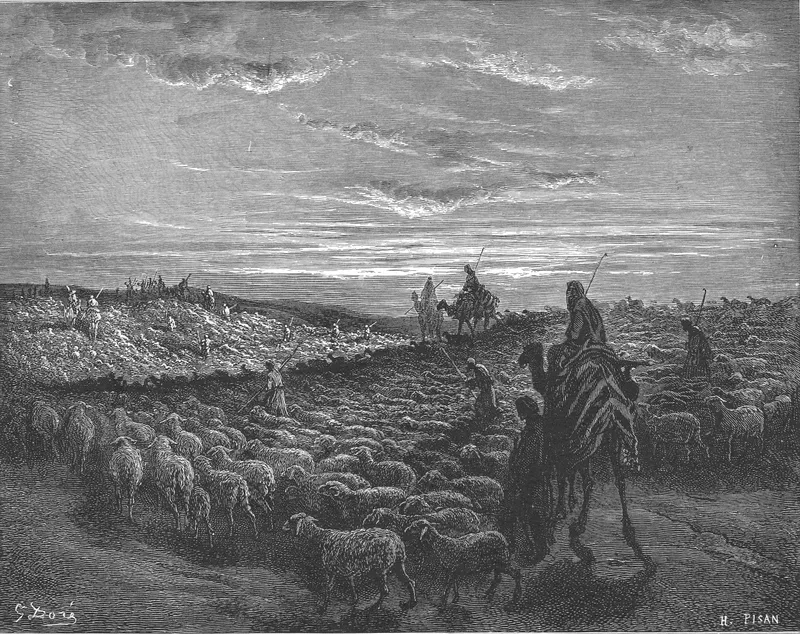
The command comes bound to a promise that runs in a rising line: I will make of thee a great nation, and I will bless thee, and make thy name great… and in thee shall all families of the earth be blessed. The men of Babel had tried to seize a great name for themselves; here God freely gives one. And the promise does not stop at Abram or even at his nation - it reaches outward to all families of the earth, the very families Babel had broken apart. It sounds impossible. Abram is old, his wife Sarai is barren, and he owns no land. Yet he goes. As he passes from Mesopotamia through Canaan to Egypt, altars rise behind him like mile-markers of trust, and at each one he calls on the name of the LORD.
For a reader on this side of the cross, there is another name written faintly beneath Abram's. The blessing of all the families of the earth will not finally come through a teeming dynasty but through one descendant; the apostle Paul reads this very chapter and says the gospel itself was preached here in advance.2 And the road Abram walks - leaving the known for a land he cannot yet see, learning to trust a God whose promises outrun his eyesight - becomes the road every believer is called to travel. This chapter is not a quaint origin tale. It is the first chapter of a rescue that runs all the way to the end of the Book.
Tap any highlighted phrase to jump to the commentary that unpacks it.
Genesis 12:1-3Get Thee Out · In Thee Shall All Families Be Blessed
1Now the LORD had said unto Abram, Get thee out of thy country, and from thy kindred, and from thy father's house, unto a land that I will shew thee: 2And I will make of thee a great nation, and I will bless thee, and make thy name great; and thou shalt be a blessing: 3And I will bless them that bless thee, and curse him that curseth thee: and in thee shall all families of the earth be blessed.
Everything turns on the first three words God speaks: Get thee out. The call asks Abram to leave in three widening circles, each harder than the last - thy country, the land and culture that formed him; thy kindred, his wider clan and people; and thy father's house, the innermost circle of all, the household and inheritance that anchored a man's whole identity in the ancient world. And the destination is left deliberately blank: unto a land that I will shew thee. Not a land named, mapped, or described - simply a land God promises to point out later, once Abram is already moving. The command is total and the information is minimal. This is the shape the call of God so often takes: clear about what to leave, sparing about where it leads, asking for a first step before the whole road is shown. Abram is being asked to trade everything certain for a Person and a promise.3
The promise unfolds in a rising series - readers have long counted seven distinct clauses across these verses, a fullness fitting for the covenant that will carry the whole Bible. I will make of thee a great nation; I will bless thee; I will make thy name great; thou shalt be a blessing; I will bless them that bless thee; I will curse him that curseth thee; and in thee shall all families of the earth be blessed. Listen to how the verbs stack: nation, blessing, name, then blessing poured outward through him to others. There is a quiet rebuke of Babel buried here. At Babel the people said, let us make us a name (Gen. 11:4), and were scattered for it; here God says, I will make thy name great - the very thing humanity grasped at by force is now given freely as a gift. A great name is not seized; it is received. And note the last and widest clause especially: Abram is blessed not as a dead end but as a conduit - thou shalt be a blessing - chosen for the sake of everyone else.
The promise climbs to a summit that lifts it far above one man and one family: in thee shall all families of the earth be blessed (v. 3). This is the line the whole chapter has been building toward, and it changes the scale of everything. Babel had just broken the human race into scattered families that could no longer understand one another; now God names all families of the earth as the final reach of His blessing. Abram is not chosen instead of the nations but for their sake. The narrowing down to one man is, paradoxically, how God means to reach everyone - the single thread by which the whole scattered world will be drawn back. Everything Abram is promised - land, descendants, a name - serves this last clause. He is blessed to be a blessing, set apart so that, in the end, no family anywhere is left out. The promise that began with get thee out ends with the whole earth in view.2
Genesis 12:4-9So Abram Departed · He Builded an Altar unto the LORD
4So Abram departed, as the LORD had spoken unto him; and Lot went with him: and Abram was seventy and five years old when he departed out of Haran. 5And Abram took Sarai his wife, and Lot his brother's son, and all their substance that they had gathered, and the souls that they had gotten in Haran; and they went forth to go into the land of Canaan; and into the land of Canaan they came. 6And Abram passed through the land unto the place of Sichem, unto the plain of Moreh. And the Canaanite was then in the land. 7And the LORD appeared unto Abram, and said, Unto thy seed will I give this land: and there builded he an altar unto the LORD, who appeared unto him. 8And he removed from thence unto a mountain on the east of Beth-el, and pitched his tent, having Beth-el on the west, and Hai on the east: and there he builded an altar unto the LORD, and called upon the name of the LORD. 9And Abram journeyed, going on still toward the south.
The whole weight of the call lands on three plain words: So Abram departed. There is no recorded argument, no bargaining, no request for more details - only obedience set down as bare fact. So Abram departed, as the LORD had spoken unto him; and Lot went with him. He takes Sarai, his nephew Lot, the wealth they had gathered, and the souls that they had gotten in Haran - the household and servants who had become part of his company - and he goes. The text dwells for a beat on the destination reached: they went forth to go into the land of Canaan; and into the land of Canaan they came. The doubling is quiet but deliberate - they set out for the land, and they arrived at the land. Obedience that began as a leap into the unknown is rewarded with arrival. The verse that follows the command is not Abram's hesitation but Abram's feet already on the road.3
One detail the text refuses to let slip past: Abram was seventy and five years old when he departed out of Haran. In a world where life was hard and often short, seventy-five is not the threshold of a great adventure; it is well past the age when a man's story is thought to be settled and his future largely behind him. Yet this is precisely when God calls Abram into the venture that will define the rest of Scripture. The number is not incidental. It quietly insists that God's timetable does not bow to ours, that a call can come long after a person has concluded the defining chapters are over. Sarai, too, is past the years of childbearing, which makes the promise of a great nation read as humanly impossible from the start. That is the point. From the very first step, this is a promise that will have to be carried by God's power and not by Abram's prospects - an old man, a barren wife, and a word from heaven.
Abram passes through the land to the place of Sichem, unto the plain of Moreh - an ancient site marked by a great tree, the kind of landmark visible from far off where significant meetings and covenants would later be made. Then the text adds a short, sobering line: And the Canaanite was then in the land. The land God has promised is not empty and waiting; it is already occupied, settled by peoples with their own cities, their own gods, their own claims. Abram arrives not as a conqueror taking possession but as a stranger passing through - a tent-dweller moving among the established. The promise of the land and the present reality of the land stand in open tension: he is told the country is his, and he can see with his own eyes that it belongs, for now, to others. To hold a promise that the visible facts seem to contradict, and to keep walking anyway, is the daily texture of Abram's faith from this moment on.3
At Sichem the LORD appears and narrows the promise to a single, electrifying line: Unto thy seed will I give this land. Not to thee - Abram himself will die owning almost none of it - but to thy seed, to the offspring he does not yet have. And Abram's response is immediate: there builded he an altar unto the LORD, who appeared unto him. He builds a second altar between Beth-el and Hai, and there he called upon the name of the LORD. This becomes the rhythm of his life in the land - move, worship, move again; pitch a tent, raise an altar, journey on. The Canaanites had fixed sanctuaries carved into the landscape; Abram has only a tent and the altars he builds as he goes. The altars say something the eye cannot yet confirm: that this God is real, that He has appeared here, that this ground is holy because He has met Abram on it. To build an altar on land you do not yet own, in trust that the promise will hold, is worship in its purest form - staking a marker of faith in the very place where the fulfillment is still entirely future.
Genesis 12:10-20A Famine, a Half-Truth, and the LORD Who Kept the Promise
10And there was a famine in the land: and Abram went down into Egypt to sojourn there; for the famine was grievous in the land. 11And it came to pass, when he was come near to enter into Egypt, that he said unto Sarai his wife, Behold now, I know that thou art a fair woman to look upon: 12Therefore it shall come to pass, when the Egyptians shall see thee, that they shall say, This is his wife: and they will kill me, but they will save thee alive. 13Say, I pray thee, thou art my sister: that it may be well with me for thy sake; and my soul shall live because of thee. 14And it came to pass, that, when Abram was come into Egypt, the Egyptians beheld the woman that she was very fair. 15The princes also of Pharaoh saw her, and commended her before Pharaoh: and the woman was taken into Pharaoh's house.
No sooner has Abram arrived in the promised land than the ground itself seems to fail him: And there was a famine in the land… for the famine was grievous in the land. The land God pledged cannot, at the moment, even feed him. It is the first hard test of the promise, and it comes fast on the heels of the altars. Abram went down into Egypt to sojourn there - the text says down, the direction Scripture will use again and again for the move to Egypt, and not only in elevation. The chapter says nothing about whether Abram sought the LORD before going; it simply records the famine and the descent. Hunger is real, and going toward food is not in itself a sin. But the man who had been building altars and calling on the name of the LORD now steps, without a word of guidance recorded, into the land that will later become the house of bondage. The promise has met its first famine, and the way Abram meets it will not be his finest hour.
On the border of Egypt, fear takes the wheel. Abram reasons it out to Sarai: she is beautiful, the Egyptians will want her, and a husband is an obstacle to be removed - they will kill me, but they will save thee alive. So he asks her to say what is technically true and wholly deceptive: Say, I pray thee, thou art my sister. Sarai was, by a later detail, his half-sister - but the words are framed to conceal that she is his wife, and the aim is plainly self-protection: that it may be well with me for thy sake; and my soul shall live because of thee. It should be named for what it is. To save his own life, Abram is willing to surrender his wife's honor and safety, exposing her to be taken by another man. The half-truth is a real failure of faith - the same man who trusted God enough to leave everything now does not trust God to keep him alive through a famine, and reaches for a scheme instead. The text does not soften this, and neither should we. Yet it does not pile on, either; it reports the fear and the failure with sober restraint, and then turns our eyes to what God will do.
16And he entreated Abram well for her sake: and he had sheep, and oxen, and he asses, and menservants, and maidservants, and she asses, and camels. 17And the LORD plagued Pharaoh and his house with great plagues because of Sarai Abram's wife. 18And Pharaoh called Abram, and said, What is this that thou hast done unto me? why didst thou not tell me that she was thy wife? 19Why saidst thou, She is my sister? so I might have taken her to me to wife: now therefore behold thy wife, take her, and go thy way. 20And Pharaoh commanded his men concerning him: and they sent him away, and his wife, and all that he had.
The scheme appears to work - for a moment. Pharaoh treats Abram well for her sake, and Abram grows rich in livestock and servants, his wealth gained at the cost of his wife. But the promise of Genesis 12:3 is already in force: And the LORD plagued Pharaoh and his house with great plagues because of Sarai Abram's wife. God Himself intervenes to pry Sarai loose before the worst can happen, and it is the pagan king, not the man of faith, who ends up speaking the language of conscience: What is this that thou hast done unto me? why didst thou not tell me that she was thy wife? The rebuke stings precisely because it is just, and it comes from Pharaoh's lips rather than Abram's. Abram is given no speech in reply; he is simply sent away - they sent him away, and his wife, and all that he had. He leaves Egypt with Sarai restored and his life intact, but with his silence hanging over the scene. What saved the promise was not Abram's cleverness; his cleverness nearly forfeited it. What saved it was the LORD.
Further study
- The Hebrew text of Genesis 12 with Rashi, Ibn Ezra, Ramban, and other classical commentators side by side - useful for the striking imperative lech-lecha (v. 1, “get thee out”), for the sevenfold promise of verses 2-3, and for the verb behind “be blessed” (nivrechu, v. 3) that the apostle later weighs so closely.
- Genesis 12 ↔ Galatians 3 · Hebrews 11 · Acts 3 · Romans 4Intertextual BibleTraces the threads tying Genesis 12 to the rest of Scripture - the all-families promise of verse 3 read alongside in thee shall all nations be blessed (Gal. 3:8) and the singular seed, which is Christ (Gal. 3:16), and the call to go out of verse 1 read beside by faith Abraham… obeyed; and he went out, not knowing whither he went (Heb. 11:8).
- Genesis 12 - Translators' NotesNET BibleThe NET Bible's detailed footnotes on Genesis 12 - the grammar of the call and the sevenfold promise in verses 1-3, the geography of Sichem and the plain of Moreh (v. 6), the altars and the phrase “called upon the name of the LORD” (vv. 7-8), and the difficult episode of the half-truth about Sarai in verses 10-20.
Where this echoes in Scripture
Get Thee Out · In Thee Shall All Families Be Blessed
- Genesis 11:4let us build us a city and a tower... and let us make us a name, lest we be scattered abroad upon the face of the whole earth.The grasping of Babel answered in verse 2 - the great name humanity seized by force, now freely given by God.
- Galatians 3:8the scripture... preached before the gospel unto Abraham, saying, In thee shall all nations be blessed.The apostle’s reading of verse 3 - the all-families promise named as the gospel announced in advance.
- Galatians 3:16He saith not, And to seeds, as of many; but as of one, And to thy seed, which is Christ.The single Seed through whom the blessing of verse 3 reaches the whole world.
- Acts 3:25in thy seed shall all the kindreds of the earth be blessed.Peter pointing Israel back to the promise of verse 3 as fulfilled in the risen Christ.
- Revelation 7:9a great multitude... of all nations, and kindreds, and people, and tongues, stood before the throne.The end of the promise begun in verse 3 - all the families of the earth gathered and blessed at last.
So Abram Departed · He Builded an Altar unto the LORD
- Hebrews 11:8-10By faith Abraham, when he was called to go out... obeyed; and he went out, not knowing whither he went.The going of verse 4 named as the very pattern of faith - obedience that moves before it sees.
- Acts 7:2-4The God of glory appeared unto our father Abraham... and said unto him, Get thee out of thy country... and come into the land which I shall shew thee.Stephen’s retelling of the call of verses 1-4 - the appearing and the going that began the whole story.
- Genesis 13:15all the land which thou seest, to thee will I give it, and to thy seed for ever.The promise of verse 7 enlarged - the land pledged to Abram’s seed for ever.
- Genesis 22:18in thy seed shall all the nations of the earth be blessed; because thou hast obeyed my voice.The seed-promise of verse 7 carried forward and joined again to the blessing of the nations.
- Hebrews 13:14For here have we no continuing city, but we seek one to come.The pilgrim stance of verses 6-9 made the church’s own - strangers in the land, seeking the city to come.
A Famine, a Half-Truth, and the LORD Who Kept the Promise
- Genesis 20:2And Abraham said of Sarah his wife, She is my sister: and Abimelech king of Gerar sent, and took Sarah.The same fear and the same half-truth repeated years later (vv. 11-13) - and again God intervenes to protect.
- Romans 5:6For when we were yet without strength, in due time Christ died for the ungodly.The mercy of verse 17 named at the heart of the gospel - God acting for us in the moment of our weakness.
- 2 Timothy 2:13If we believe not, yet he abideth faithful: he cannot deny himself.Why the promise survived Abram’s failure in verses 10-20 - it rests on God’s faithfulness, not ours.
- Exodus 12:31-32And he called for Moses and Aaron... and said, Rise up, and get you forth from among my people... and be gone.A later Pharaoh, plagued by God, sending Israel away - the pattern first traced in verses 17-20.
- Psalm 105:14-15He suffered no man to do them wrong: yea, he reproved kings for their sakes; saying, Touch not mine anointed.Israel’s own memory of verse 17 - the LORD rebuking a king to guard the people of the promise.