Genesis 11
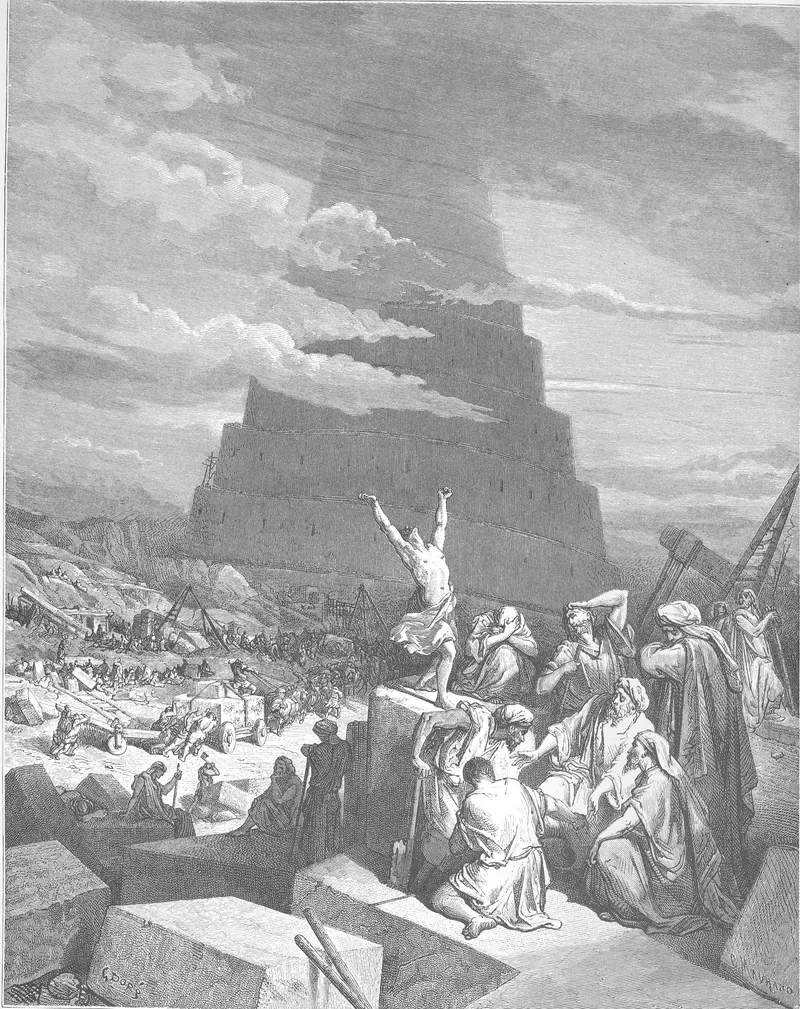
Genesis 11 closes the prehistory. The whole earth is of one language, and of one speech (v. 1) - gathered again, moving as one, after the flood had reduced humanity to a single family. And with that unity they dream an audacious dream. They settle on a plain in the land of Shinar, master the craft of baked brick, and resolve: Go to, let us build us a city and a tower, whose top may reach unto heaven; and let us make us a name, lest we be scattered abroad upon the face of the whole earth (v. 4). The ambition is not small, and it is not aimed at God. It is a monument to themselves, raised against the very scattering God had commanded.3
The first nine verses are a judgment; the rest is a genealogy, and the two belong together. The LORD comes down to see the tower that was meant to reach heaven, names the danger of a humanity that, unified, can attempt anything it imagines, and confounds their speech so that they cannot understand one another. He scatters them across the face of the earth, and the place is called Babel. Then the lens tightens. From all the scattered nations the text follows one line - the generations of Shem down to Terah, and the generations of Terah down to Abram - and the chapter ends with Terah leading his household out of Ur of the Chaldees, toward a land called Canaan.
This is where the Bible begins to narrow. The first eleven chapters have spanned creation, the garden, the flood, the table of the nations - the whole human story painted in broad strokes. After Genesis 11 the lens closes down to one family, through whom all families of the earth will be blessed (Gen. 12:3). The chapter sets two ways of seeking a name side by side: the builders who seize at one and are scattered, and the God who, in the very next breath, freely promises to make thy name great (Gen. 12:2) to a single man of faith. Genesis 11 is the hinge on which the whole story turns.2
Tap any highlighted phrase to jump to the commentary that unpacks it.

Genesis 11:1-9Let Us Make Us a Name
1And the whole earth was of one language, and of one speech. 2And it came to pass, as they journeyed from the east, that they found a plain in the land of Shinar; and they dwelt there. 3And they said one to another, Go to, let us make brick, and burn them throughly. And they had brick for stone, and slime had they for morter. 4And they said, Go to, let us build us a city and a tower, whose top may reach unto heaven; and let us make us a name, lest we be scattered abroad upon the face of the whole earth. 5And the LORD came down to see the city and the tower, which the children of men builded. 6And the LORD said, Behold, the people is one, and they have all one language; and this they begin to do: and now nothing will be restrained from them, which they have imagined to do. 7Go to, let us go down, and there confound their language, that they may not understand one another's speech. 8So the LORD scattered them abroad from thence upon the face of all the earth: and they left off to build the city. 9Therefore is the name of it called Babel; because the LORD did there confound the language of all the earth: and from thence did the LORD scatter them abroad upon the face of all the earth.
The story opens on a note of perfect unity: the whole earth was of one language, and of one speech (v. 1). After the flood had splintered the world down to one family, humanity is whole again, speaking in unison, able to plan and labour as one. And they move with purpose: as they journeyed from the east… they found a plain in the land of Shinar; and they dwelt there (v. 2). Shinar is the broad alluvial flatland of lower Mesopotamia - the country, the previous chapter has just told us, where Babel and the proud kingdom of Nimrod first rose (Gen. 10:10). They do not pass through; they dwell there. The detail matters, because God had told the survivors of the flood to be fruitful, and multiply, and replenish the earth (Gen. 9:1) - to spread out and fill it. Here, instead, the whole earth gathers in one place and settles down. Unity is being put to work, but not toward the end God named. What looks like strength at the start of the chapter is, underneath, a quiet refusal to go where God has sent them.3
The work is real and impressive: Go to, let us make brick, and burn them throughly. And they had brick for stone, and slime had they for morter (v. 3). This is genuine technique. In the river-plain of Shinar there is no building stone and no natural mortar, so they manufacture both - firing clay into hard, durable brick and using slime, bitumen seeping up from the ground, in place of mortar. It is exactly how the great towers of that land were in fact built. The narrator is not mocking their skill; he is showing what human beings can accomplish when they pool their resources and their will. And that is precisely where the danger lies. The problem at Babel is never the craft, the ingenuity, or the ambition in itself - it is the heart that drives them. The same hands that could build a tabernacle build a monument to themselves. Notice too the chilling little phrase that opens both their resolves: Go to - come, let us. It is the language of a people stirring one another up, talking themselves into a project, with God nowhere in the conversation.
When the LORD speaks, He does not name a petty ambition; He names a real danger: Behold, the people is one, and they have all one language; and this they begin to do: and now nothing will be restrained from them, which they have imagined to do (v. 6). This is not flattery and it is not fear. It is a sober assessment. A humanity perfectly unified, with no friction, no diversity of voice, no check on its collective will, is a humanity that can carry out anything it imagines - and the chapter has already shown where its imagination tends: away from God, toward its own glory. So the LORD acts, and the action is measured. He does not destroy them as the flood destroyed; He does not strike the tower down. He simply confuses their speech, and they left off to build the city (v. 8). The judgment is the scattering itself - the breaking of a unity that had set itself against heaven. What the builders most feared, to be scattered abroad (v. 4), is exactly what comes upon them; the very outcome they built to prevent, their building brings about.
There is a deliberate, almost gentle irony in verse 5: And the LORD came down to see the city and the tower. The builders had set out to raise a tower whose top may reach unto heaven (v. 4) - and the tower meant to pierce the sky is so small that the LORD must come down to look at it. All their baked brick and bitumen, all their pooled strength and soaring ambition, amounts to something God has to stoop to see. The phrase also answers their words with His own. They said, let us build, let us make us a name; the LORD says, in turn, let us go down, and there confound their language (v. 7). The same God who speaks of Himself in the plural at the making of humanity - let us make man in our image (Gen. 1:26) - speaks so again here, where humanity's proud plural is undone. Heaven is not stormed by engineering. The distance between the builders and the God they meant to reach is not a distance any tower could close.
Genesis 11:10-26The Generations of Shem
10These are the generations of Shem: Shem was an hundred years old, and begat Arphaxad two years after the flood: 11And Shem lived after he begat Arphaxad five hundred years, and begat sons and daughters. 12And Arphaxad lived five and thirty years, and begat Salah: 13And Arphaxad lived after he begat Salah four hundred and three years, and begat sons and daughters. 14And Salah lived thirty years, and begat Eber: 15And Salah lived after he begat Eber four hundred and three years, and begat sons and daughters. 16And Eber lived four and thirty years, and begat Peleg: 17And Eber lived after he begat Peleg four hundred and thirty years, and begat sons and daughters.
After the nations are scattered abroad, the text does something quietly decisive: it stops sweeping over the whole earth and follows a single thread. These are the generations of Shem (v. 10). Of all the families now spread across the world - the long table of nations just laid out in Genesis 10 - the narrative now traces only one line, the line of Shem, Noah's son. The rhythm is the steady drumbeat last heard in Genesis 5: a man lived so many years and begat a son; he lived so many more and begat sons and daughters; and the next name steps forward. It can read like a dry register of names and numbers. But this is not a list of the forgotten - it is the opposite of Babel. Where the builders grasped at a name and were scattered, here God is quietly preserving a name, generation by generation, carrying one family forward through the scattered centuries. The point is not the length of any single life but the unbroken handing-on: each father begets the son who will carry the promise, and the line does not fail. The camera is closing in, and it is closing in on purpose.
One name in the list carries quiet weight: Eber (vv. 14-17), from whom the Hebrews would take their very name. He stands near the middle of the line like a hinge, and his own son's name - Peleg, “division” - recalls the scattering of the nations just described, for in his days was the earth divided (Gen. 10:25). So the genealogy keeps both stories in view at once: the earth divided into its many peoples, and a single line drawn straight through the division, unbroken. Notice, too, what is beginning to happen to the numbers. Shem lives six hundred years; Arphaxad, four hundred and thirty-eight; Salah, four hundred and thirty-three; Eber, four hundred and sixty-four - and from Peleg on, the lifespans fall sharply. The world after the flood and after Babel is a diminished world, the long ages of the ancients receding. Yet as the years shrink, the line holds. What endures across the generations is not the vigour of any one man but the promise being passed from hand to hand, undimmed by the fading of human strength.
18And Peleg lived thirty years, and begat Reu: 19And Peleg lived after he begat Reu two hundred and nine years, and begat sons and daughters. 20And Reu lived two and thirty years, and begat Serug: 21And Reu lived after he begat Serug two hundred and seven years, and begat sons and daughters. 22And Serug lived thirty years, and begat Nahor: 23And Serug lived after he begat Nahor two hundred years, and begat sons and daughters. 24And Nahor lived nine and twenty years, and begat Terah: 25And Nahor lived after he begat Terah an hundred and nineteen years, and begat sons and daughters. 26And Terah lived seventy years, and begat Abram, Nahor, and Haran.
The line runs on - Peleg, Reu, Serug, Nahor - each name a generation, each generation a step. And then the list arrives where it has been heading all along: And Nahor lived nine and twenty years, and begat Terah (v. 24), and Terah lived seventy years, and begat Abram, Nahor, and Haran (v. 26). The genealogy that began with all the generations of Shem narrows, at its close, to a single household in a single city. The whole long descent has been a funnel, and Terah's family is where it opens out into the rest of the Bible. The reader who has waded through the names and the numbers now sees why they were there. This was never a tedious appendix; it was the bridge. From the scattered nations of Babel the text has drawn one unbroken line down to the doorstep of the man through whom God will begin again. Everything the rest of Genesis will tell - and everything that flows from it - is about to come through this house.
Genesis 11:27-32Out of Ur, Toward Canaan
27Now these are the generations of Terah: Terah begat Abram, Nahor, and Haran; and Haran begat Lot. 28And Haran died before his father Terah in the land of his nativity, in Ur of the Chaldees. 29And Abram and Nahor took them wives: the name of Abram's wife was Sarai; and the name of Nahor's wife, Milcah, the daughter of Haran, the father of Milcah, and the father of Iscah. 30But Sarai was barren; she had no child. 31And Terah took Abram his son, and Lot the son of Haran his son's son, and Sarai his daughter in law, his son Abram's wife; and they went forth with them from Ur of the Chaldees, to go into the land of Canaan; and they came unto Haran, and dwelt there. 32And the days of Terah were two hundred and five years: and Terah died in Haran.
The genealogy gives way to a family story: Terah begat Abram, Nahor, and Haran; and Haran begat Lot (v. 27). The names are loaded with what is coming. Haran dies young, before his father Terah, in his homeland (v. 28), leaving a son, Lot, who will travel with Abram and shadow his story for chapters to come. Nahor stays behind; his line will matter later, when a bride is sought for Abram's son. But the eye of the narrative settles on Abram. He is named first, though Scripture often loves the younger and the unlikely, and from this ordinary household in Ur he will be drawn out to become the father of a nation and a blessing to all the earth. There is nothing here yet to mark him as chosen - no vision recorded, no word from God, only a man with a wife and a settled life in a great city. The chapter is simply setting the pieces in place. The God who has been narrowing the line for ten generations is about to speak to one man, and the whole story is leaning toward him.
One short sentence falls across the family like a shadow: But Sarai was barren; she had no child (v. 30). After a long chapter of begetting - son after son, generation after generation, the line marching forward - the narrative stops cold on a woman who cannot conceive. The contrast is deliberate and the timing pointed. The line of promise has just been traced unbroken from Shem to Abram, and now, at the very threshold of the covenant, the way forward is closed. Abram is the man through whom God will build a nation; Sarai is the wife who cannot bear him even one child. This is no accident of the narrative; it is the shape of how God will work. The promise about to be made will not be fulfilled by human capacity, good timing, or natural increase. The child, when at last he comes, will be unmistakably a gift - not the achievement of a strong man and a fruitful wife, but the work of God in a place where human possibility has run out. Babel built upward by its own strength and was scattered. The covenant will be built on a barren womb, by the strength of God alone.
The chapter ends in motion: And Terah took Abram his son, and Lot the son of Haran his son's son, and Sarai his daughter in law… and they went forth with them from Ur of the Chaldees, to go into the land of Canaan; and they came unto Haran, and dwelt there (v. 31). Ur was one of the great cities of the ancient world - old, wealthy, sophisticated, a center of the very civilization Babel represents. And Terah leaves it, turning his household toward Canaan, a land he has never seen. Yet the journey stops short: they reach Haran, far up the river, and settle, and there Terah died, two hundred and five years old, never reaching the land he set out for (v. 32). It is the picture of a beginning that does not quite arrive - a move made, but stalled halfway. The full call, the clear word, the command to get thee out of thy country, is still to come (Gen. 12:1). What this chapter shows is a family already on the road before the word is fully spoken, and a father who started toward the promise but stopped along the way. The story of Abram's own going - all the way, in answer to God's voice - begins in the next breath.
Further study
- The Hebrew text of Genesis 11 with Rashi, Ibn Ezra, and other classical commentators side by side - useful for shem (v. 4, the “name” the builders grasp at), for the verb balal (vv. 7, 9, “confound”) and its play on the name Babel, and for the generations of Shem and of Terah (vv. 10-32).
- Genesis 11 ↔ Acts 2 · Luke 14 · Genesis 12 · Revelation 7Intertextual BibleTraces the threads tying Genesis 11 to the rest of Scripture - the confusion of tongues (vv. 7-9) read against the gift of tongues at Pentecost (Acts 2:5-11), the pride brought low (v. 4) beside every one that exalteth himself shall be abased (Luke 14:11), and the line narrowing to Abram (vv. 26-32) beside the promise to make thy name great (Gen. 12:2).
- Genesis 11 - Translators' NotesNET BibleThe NET Bible's detailed footnotes on Genesis 11 - the building materials of verse 3 (brick for stone, bitumen for mortar), the wordplay binding Babel to the verb “to confuse” in verse 9, and the shape and shortening lifespans of the genealogy in verses 10-32.
Where this echoes in Scripture
Let Us Make Us a Name
- Genesis 9:1And God blessed Noah and his sons, and said unto them, Be fruitful, and multiply, and replenish the earth.The command the builders defy - they gather and settle (vv. 2-4) rather than spread out and fill the earth.
- Luke 14:11For whosoever exalteth himself shall be abased; and he that humbleth himself shall be exalted.The principle behind Babel - the self-exaltation of verse 4 brought low in verses 8-9.
- Acts 2:5-6there were dwelling at Jerusalem Jews, devout men, out of every nation under heaven... every man heard them speak in his own language.The reversal of Babel - the confusion of tongues (vv. 7-9) answered by understanding at Pentecost.
- James 4:6God resisteth the proud, but giveth grace unto the humble.The two postures the chapter sets against each other - the proud builders scattered, grace given to the lowly.
- Revelation 7:9a great multitude... of all nations, and kindreds, and people, and tongues, stood before the throne.The scattered tongues of verse 9 gathered home at last, reunited before God.
The Generations of Shem
- Genesis 10:25unto Eber were born two sons: the name of one was Peleg; for in his days was the earth divided.The name Peleg (v. 18) tied to the scattering - the divided nations and the unbroken line held together.
- Genesis 5:1-32This is the book of the generations of Adam... and he begat sons and daughters... and he died.The same steady rhythm as verses 10-26 - the line of promise carried generation by generation.
- Luke 3:34-36Which was the son of Thara, which was the son of Nachor... Saruch... Ragau... Phalec... Heber... Sala... Arphaxad... Sem.This very genealogy carried forward - Shem to Terah set within the line that runs to Christ.
- 1 Chronicles 1:24-27Shem, Arphaxad, Shelah, Eber, Peleg, Reu, Serug, Nahor, Terah, Abram; the same is Abraham.The same line of Shem (vv. 10-26) recorded again, kept and remembered down the generations.
- Hebrews 11:13These all died in faith, not having received the promises, but having seen them afar off.The faith of a line that handed the promise forward (vv. 10-26) without living to see it fulfilled.
Out of Ur, Toward Canaan
- Genesis 12:1-3Get thee out of thy country... and I will make of thee a great nation... and make thy name great... and in thee shall all families of the earth be blessed.The promise that answers Babel - the name (v. 4) the builders seized is freely given to Abram.
- Hebrews 11:8-10By faith Abraham... went out, not knowing whither he went... for he looked for a city which hath foundations, whose builder and maker is God.Abram leaving Ur (v. 31) - the city of man left behind to seek the city God builds.
- Joshua 24:2Your fathers dwelt on the other side of the flood in old time, even Terah... and they served other gods.The Ur that Terah’s house left (vv. 28-31) - the world out of which God called Abram.
- Romans 4:18-21Who against hope believed in hope... he considered not his own body now dead... neither yet the deadness of Sara’s womb.The barren womb of verse 30 - the place where the promise would prove to be God’s gift, not human strength.
- Galatians 3:8In thee shall all nations be blessed.The blessing through Abram’s line (vv. 26-31) reaching the very nations Babel scattered.