Luke 3
People in this chapter
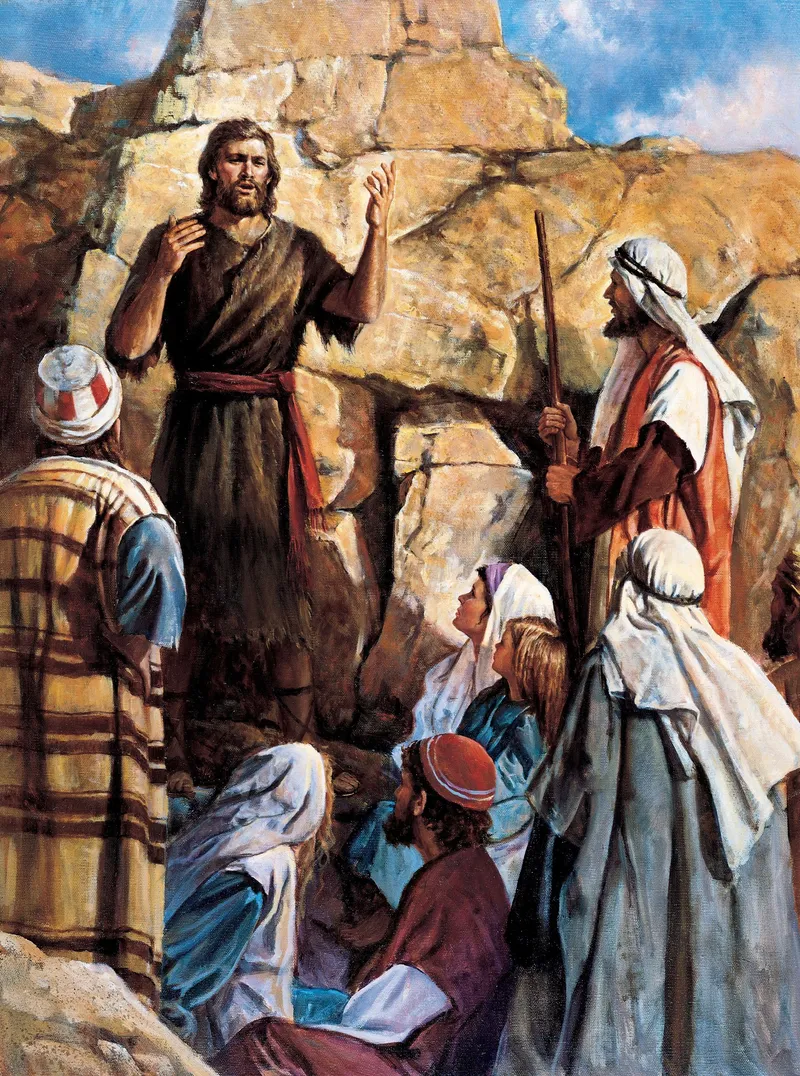
Luke opens the chapter like a historian dating a charter. Now in the fifteenth year of the reign of Tiberius Caesar, Pontius Pilate being governor of Judaea, and Herod being tetrarch of Galilee… Annas and Caiaphas being the high priests (vv. 1-2) - emperor, governor, tetrarchs, high priests, the whole apparatus of worldly and religious power named in a row. And then the sentence turns, and the weight falls in the most unexpected place: the word of God came unto John the son of Zacharias in the wilderness. Not to the throne, not to the temple, but to a man in the desert.
John comes preaching the baptism of repentance for the remission of sins, and Luke hears in him the ancient promise: The voice of one crying in the wilderness, Prepare ye the way of the Lord… and all flesh shall see the salvation of God (vv. 4-6).1
Tap any highlighted phrase to jump to the commentary that unpacks it.
Luke 3:1-6The Word of God Came unto John in the Wilderness
1Now in the fifteenth year of the reign of Tiberius Caesar, Pontius Pilate being governor of Judaea, and Herod being tetrarch of Galilee, and his brother Philip tetrarch of Ituraea and of the region of Trachonitis, and Lysanias the tetrarch of Abilene, 2Annas and Caiaphas being the high priests, the word of God came unto John the son of Zacharias in the wilderness. 3And he came into all the country about Jordan, preaching the baptism of repentance for the remission of sins; 4As it is written in the book of the words of Esaias the prophet, saying, The voice of one crying in the wilderness, Prepare ye the way of the Lord, make his paths straight. 5Every valley shall be filled, and every mountain and hill shall be brought low; and the crooked shall be made straight, and the rough ways shall be made smooth; 6And all flesh shall see the salvation of God.
Luke dates this moment the way a careful historian dates a treaty, and the list is worth reading slowly: the fifteenth year of the reign of Tiberius Caesar, with Pontius Pilate… governor of Judaea, Herod… tetrarch of Galilee, his brother Philip over Ituraea and Trachonitis, Lysanias over Abilene, and Annas and Caiaphas as high priests (vv. 1-2). An emperor, a Roman governor, three regional rulers, and the heads of the temple - the entire structure of worldly and sacred power, named in a single sweep.
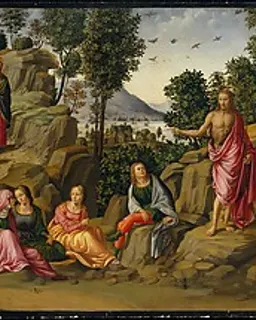
And then the sentence pivots, and the whole weight of it lands somewhere no one would have looked: the word of God came unto John the son of Zacharias in the wilderness. Not to Rome, not to the governor's palace, not even to the temple courts, but to a man out in the desert. The very phrase - the word of God came unto - is the language used of the old prophets, Jeremiah and Ezekiel and the rest; it marks John as a true successor in that line.
He did not appoint himself; he was summoned. And the placement of the names makes a quiet point that the whole chapter will press: the people who appear to run the world are not where God is doing His deepest work.1
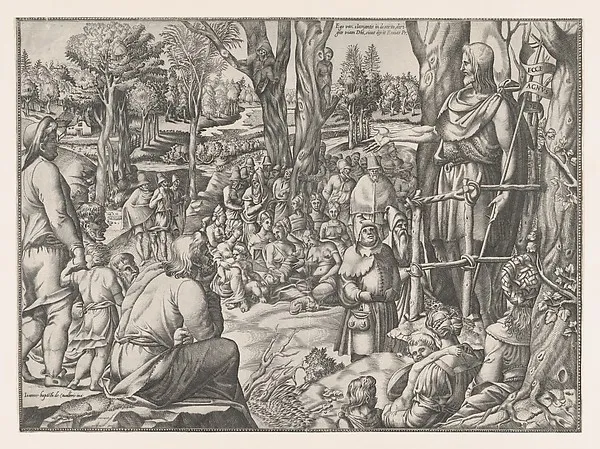
John comes into all the country about Jordan, preaching the baptism of repentance for the remission of sins (v. 3). The phrase ties three things together. There is repentance - a real turning, an about-face of heart and life. There is a baptism - a washing in the Jordan that marks that turning openly, publicly, with the whole body. And there is the goal: the remission of sins, the lifting away of what has been carried.
John's baptism is not a private feeling but a visible act of return, and the people stream out of the towns and into the wilderness to receive it. The text does not stop to debate the manner or the mechanics of the washing; it simply shows a prophet calling a nation back to God and a crowd answering. What the verse holds out is the thing every reader recognizes: the longing to be clean, to start again, to have what is wrong taken away.
That longing is exactly what John's preaching meets - and exactly what the One coming after him will finally satisfy.
Luke reaches for the prophet Isaiah to say who John is: The voice of one crying in the wilderness, Prepare ye the way of the Lord, make his paths straight (v. 4; Isa. 40:3). In the ancient world a king's coming was announced by laborers sent ahead to build a road - filling the gullies, levelling the hills, straightening the bends, smoothing the rough ground - so the royal procession could pass with honour. John is that advance crew, and the road he is clearing is for the LORD Himself.
Every valley shall be filled, and every mountain and hill shall be brought low; and the crooked shall be made straight, and the rough ways shall be made smooth (v. 5). It is a picture of repentance: the proud places brought down, the empty places filled, the crooked dealings made straight, the hard heart made smooth - so that the King may come in. And Luke, alone among the Gospels, runs the Isaiah quotation one verse further, to its widest promise: And all flesh shall see the salvation of God (v. 6).
Not one nation only. All flesh. From the very first chapter of John's ministry, Luke has the whole world in view.2
Luke 3:7-14Bring Forth Fruits Worthy of Repentance
7Then said he to the multitude that came forth to be baptized of him, O generation of vipers, who hath warned you to flee from the wrath to come? 8Bring forth therefore fruits worthy of repentance, and begin not to say within yourselves, We have Abraham to our father: for I say unto you, That God is able of these stones to raise up children unto Abraham. 9And now also the axe is laid unto the root of the trees: every tree therefore which bringeth not forth good fruit is hewn down, and cast into the fire. 10And the people asked him, saying, What shall we do then? 11He answereth and saith unto them, He that hath two coats, let him impart to him that hath none; and he that hath meat, let him do likewise. 12Then came also publicans to be baptized, and said unto him, Master, what shall we do? 13And he said unto them, Exact no more than that which is appointed you. 14And the soldiers likewise demanded of him, saying, And what shall we do? And he said unto them, Do violence to no man, neither accuse any falsely; and be content with your wages.
John does not flatter the crowds that come out to him. He looks at the multitude and calls them O generation of vipers, who hath warned you to flee from the wrath to come? (v. 7) - a startling greeting for people who have walked into the desert to be baptized. The image is of snakes fleeing a brush fire, scattering before the flames; John asks, in effect, who told you the fire was coming? It is a warning that the coming of God is not only comfort but reckoning.
And he refuses to let anyone presume on their heritage: begin not to say within yourselves, We have Abraham to our father (v. 8). It was the great assumption of the day - that descent from Abraham secured a person's standing with God. John dismantles it in one stroke: God is able of these stones to raise up children unto Abraham. Belonging to the right family, holding the right pedigree, sitting in the right pew - none of it is the thing.
The thing is fruit: Bring forth therefore fruits worthy of repentance. A turning that is real will show; and the prophet's eye is on the showing, not the saying.1
John presses the urgency with a second image, and it is sharper than the first: And now also the axe is laid unto the root of the trees: every tree therefore which bringeth not forth good fruit is hewn down, and cast into the fire (v. 9). Notice where the axe is laid - not to the branches, where pruning happens, but to the root. This is not maintenance; it is decision. And the axe is already in position: now… is laid. The time for fruitless religion is running out.
The test the axe applies is the same one John has been pressing all along: not the species of the tree, not its age, not whose orchard it stands in, but whether it bears good fruit. A tree that produces nothing is cut down and burned, however impressive its leaves. The warning is severe, but it is not cruel - it is, in fact, a mercy, because it comes before the axe falls, while there is still time to bear fruit.
John is not announcing that the trees have already been cut; he is telling the orchard, with the blade resting against the bark, that the season for fruit has come.
The preaching lands, and the crowd asks the only question that matters: What shall we do then? (v. 10). It is the right response to true repentance - not “what shall we feel?” but what shall we do? And John's answers are striking for how ordinary and concrete they are. He does not send anyone into the desert to fast or command grand religious feats. To the people: He that hath two coats, let him impart to him that hath none; and he that hath meat, let him do likewise (v. 11) - plain generosity, sharing what you already have with someone who has nothing.
To the publicans, the tax collectors despised for lining their own pockets: Exact no more than that which is appointed you (v. 13) - not, notice, “quit your job,” but stop using it to cheat. To the soldiers, who could intimidate civilians with impunity: Do violence to no man, neither accuse any falsely; and be content with your wages (v. 14) - stop the bullying, stop the false charges, stop the shakedown. The fruit John asks for is not exotic.
It is honesty and mercy and contentment, worked out in the exact place each person already stands - their money, their work, their power over others. Repentance, it turns out, comes home to the ordinary details of a life.
Luke 3:15-20One Mightier than I Cometh
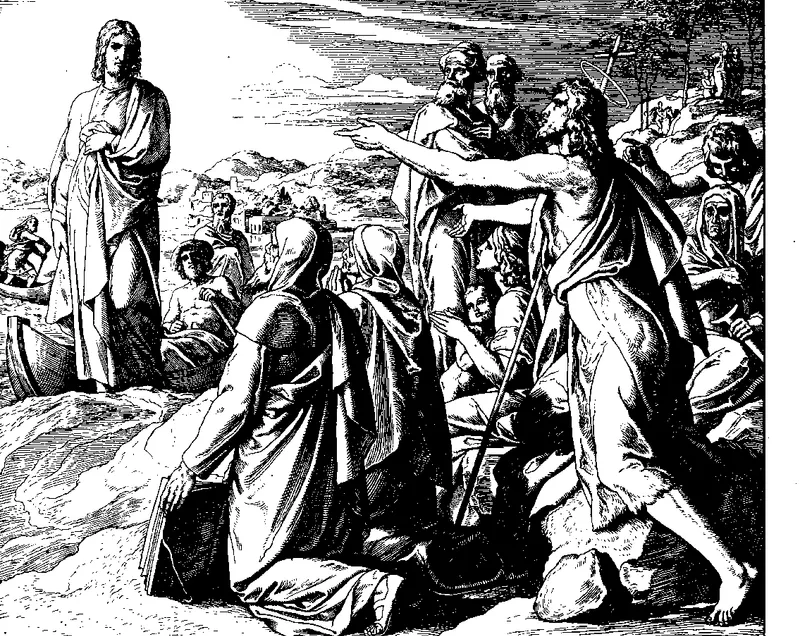
15And as the people were in expectation, and all men mused in their hearts of John, whether he were the Christ, or not; 16John answered, saying unto them all, I indeed baptize you with water; but one mightier than I cometh, the latchet of whose shoes I am not worthy to unloose: he shall baptize you with the Holy Ghost and with fire: 17Whose fan is in his hand, and he will throughly purge his floor, and will gather the wheat into his garner; but the chaff he will burn with fire unquenchable. 18And many other things in his exhortation preached he unto the people. 19But Herod the tetrarch, being reproved by him for Herodias his brother Philip’s wife, and for all the evils which Herod had done, 20Added yet this above all, that he shut up John in prison.
John's ministry has grown so striking that the people begin to wonder out loud: as the people were in expectation, and all men mused in their hearts of John, whether he were the Christ, or not (v. 15). The expectation in the air was real - an old hope that God's anointed deliverer would come - and here was a prophet of obvious power drawing the whole country into the desert. It would have been the easiest thing in the world for John to let the question hang, to bask in the musing, to accept the role the crowd was ready to hand him.
Many a leader has. John does the opposite. He answers them all at once and turns every eye away from himself: I indeed baptize you with water; but one mightier than I cometh (v. 16). The contrast he draws is total. His baptism is with water; the Coming One's will be with the Holy Ghost and with fire. And he measures the distance between them with a single unforgettable image: the latchet of whose shoes I am not worthy to unloose. Untying a master's sandals was the work of the lowest slave in the house.
John says he is not fit even for that. The greater a man knows the One coming after him to be, the smaller he is content to become.
John describes the work of the Coming One with the picture of a threshing floor at harvest: Whose fan is in his hand, and he will throughly purge his floor, and will gather the wheat into his garner; but the chaff he will burn with fire unquenchable (v. 17). The fan is the winnowing fork; the farmer tosses the threshed grain into the wind so the heavy kernels fall back to the floor while the light, worthless husks blow away.
It is an image of separation - the real from the empty, the fruitful from the fruitless - and it answers the warning of verse 9 about the tree that bears no fruit. But notice the two outcomes held side by side. The wheat is gathered… into his garner, brought safely home, valued, kept. That is the great hope of the picture, and it is the dominant note: the Coming One is, above all, a gatherer of His own.
The chaff is what is left when the wheat is taken in. The same One who comes in mercy to gather also comes in judgment to purge, and the chapter does not soften either side. John's whole message has been pressing toward this question: when the wind of God blows across the floor, will a person prove to be wheat that is gathered, or chaff that is carried off?
Luke closes John's public ministry with a hard scene that shows what his faithfulness cost. Many other things in his exhortation preached he unto the people (v. 18) - and one of those things was a rebuke aimed straight at the throne. Herod the tetrarch, being reproved by him for Herodias his brother Philip's wife, and for all the evils which Herod had done (v. 19). John did not flinch from naming a ruler's sin to his face.
The man who would not let the crowd inflate him would not let a king intimidate him either; the same humility that refused false glory also refused false silence. And the cost came swiftly: Herod added yet this above all, that he shut up John in prison (v. 20). Luke tells it almost in passing, setting the imprisonment here before the baptism account so that John's story is, in a sense, wrapped up before Jesus' story opens - the forerunner stepping off the stage as the One he announced steps on.
The voice that cried Prepare ye the way is silenced in a cell; but the way has been prepared, and nothing Herod can do will stop the One it was prepared for.
Luke 3:21-38Thou Art My Beloved Son · The Line Back to Adam
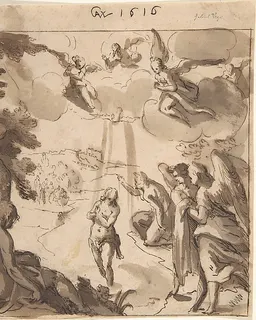
21Now when all the people were baptized, it came to pass, that Jesus also being baptized, and praying, the heaven was opened, 22And the Holy Ghost descended in a bodily shape like a dove upon him, and a voice came from heaven, which said, Thou art my beloved Son; in thee I am well pleased.
The road John cleared now reaches its destination. Now when all the people were baptized, it came to pass, that Jesus also being baptized, and praying, the heaven was opened (v. 21). The little phrase also… with all the people is the first thing to weigh. Jesus does not come apart from the crowd or above it; He steps into the water in the midst of the very people John had been calling to repentance, taking His place among them.
He had no sins of His own to be washed away - yet here He stands in the sinners' river, identifying Himself with the people He came to save, the first public act of a life that will end with Him numbered among the transgressors. Luke alone notes that He was praying as it happened; throughout this Gospel the great moments find Jesus at prayer. And as He prays, heaven answers. The heaven was opened - the barrier between God and earth drawn back, the long-closed sky split open over this one Man in the water.
Everything in the scene says that the One John announced has now stepped forward, and that heaven itself is about to testify who He is.1
What follows is the heart of the chapter, and it must be read just as it stands, letting each part be what the text says it is. And the Holy Ghost descended in a bodily shape like a dove upon him, and a voice came from heaven, which said, Thou art my beloved Son; in thee I am well pleased (v. 22). Three are present at once at the river. The Son stands in the water.
The Holy Ghost comes down upon Him - not as a vague influence but in a bodily shape like a dove, visible, gentle, settling on Him. And the voice speaks from the opened heaven, the Father naming the Son. The dove may recall the bird that hovered over the waters at the world's first making, and the one that brought back the olive leaf when the flood receded - an old sign of new beginning and peace.
And the words from heaven gather up the Scriptures into one sentence: Thou art my beloved Son echoes the royal Son of Psalm 2, and in thee I am well pleased echoes the chosen Servant of Isaiah 42 on whom God puts His Spirit. The text does not explain the relation of the three; it simply shows them together at the Jordan - Father, Son, and Spirit - and lets the reader stand on the bank and behold it.
23And Jesus himself began to be about thirty years of age, being (as was supposed) the son of Joseph, which was the son of Heli, 31Which was the son of Melea, which was the son of Menan, which was the son of Mattatha, which was the son of Nathan, which was the son of David, 32Which was the son of Jesse, which was the son of Obed, which was the son of Booz, which was the son of Salmon, which was the son of Naasson, 34Which was the son of Jacob, which was the son of Isaac, which was the son of Abraham, which was the son of Thara, which was the son of Nachor, 38Which was the son of Enos, which was the son of Seth, which was the son of Adam, which was the son of God.
Having heard heaven call Jesus the Son, Luke now traces His human line, and he does it in a way all his own. The list begins, Jesus himself began to be about thirty years of age, being (as was supposed) the son of Joseph, which was the son of Heli (v. 23). That careful parenthesis - as was supposed - quietly guards what the opening chapters of Luke have already told the reader about how this child came to be.
From Joseph the line runs back through familiar names: which was the son of David (v. 31), heir of the great king to whom an everlasting throne was promised; which was the son of… Abraham (v. 34), heir of the man through whom all families of the earth would be blessed. So far, this is the expected story - Jesus set firmly within the covenant line of Israel, the son of David, the son of Abraham.
But Luke does not stop where a genealogy of Israel would stop. Where another writer traces the King back to Abraham and rests, Luke keeps going - back through Noah, back through the long generations before the flood, back past every nation and covenant - until he reaches the first man of all.2
The line runs all the way to its source and lands on a phrase that changes the whole shape of the list: which was the son of Seth, which was the son of Adam, which was the son of God (v. 38). Luke has carried the genealogy past Abraham, past the founding of Israel, back to the head of the entire human race - and then one step further, to God Himself. The placement is deliberate, and it speaks directly to the verses just before it.
The voice from heaven has just said, Thou art my beloved Son (v. 22); now the genealogy ends with the first man named the son of God as well. Adam was the son of God in that he came directly from God's own hand and bore His image; and Jesus, standing at the far end of the line, is the Son of God in the fullest sense the heavenly voice has just declared. By running the line back not to Abraham but to Adam, Luke ties Jesus not merely to one chosen people but to all flesh - the same all-flesh the chapter opened by promising would see the salvation of God (v. 6).
The Saviour whose road John prepared belongs to the whole human family, because He is bound by this line to its very first father.
Research trail
Sources & further study
These references support the historical, linguistic, manuscript, and contextual notes in this chapter. Scripture remains the primary text; external sources are provided so readers can inspect the research directly.
- Luke 3 - Translators' NotesThe NET Bible's detailed footnotes on Luke 3 - the historical synchronisms of verses 1-2, the force of John's call to repentance and its fruits (vv. 7-14), the baptism of Jesus and the heavenly voice (vv. 21-22), and the shape and purpose of the genealogy (vv. 23-38).
- Luke 3 ↔ Isaiah 40 · Genesis 5 · Romans 5 · 1 Corinthians 15Traces the threads tying Luke 3 to the rest of Scripture - the voice in the wilderness and all flesh shall see the salvation of God (vv. 4-6) read against Isaiah 40:3-5, the genealogy back to Adam (v. 38) read beside Genesis 5 and the second Adam of Romans 5 and 1 Corinthians 15.
- Luke 3 · Greek interlinear + parsingThe Greek text of Luke 3 word by word, with parsing and lexical glosses side by side - useful for metanoia (vv. 3, 8, the “repentance” that is a change of mind bearing fruit), for hetoimazo (v. 4, “prepare” the way), and for the wording of the heavenly voice in verse 22.
Where this echoes in Scripture
The Word of God Came unto John in the Wilderness
- Isaiah 40:3-5The voice of him that crieth in the wilderness, Prepare ye the way of the LORD... and all flesh shall see it together.The prophecy Luke quotes in verses 4-6 - the road made ready for the coming of the LORD, seen by all flesh.
- Luke 1:17he shall go before him in the spirit and power of Elias... to make ready a people prepared for the Lord.John's commission spoken before his birth - the forerunner of verse 4, preparing a people for the Lord.
- Malachi 3:1Behold, I will send my messenger, and he shall prepare the way before me.The messenger sent ahead - the prophetic backdrop to John's work in verses 3-4.
- Luke 2:30-31For mine eyes have seen thy salvation, which thou hast prepared before the face of all people.The salvation of God (v. 6) named as a Person - the child Simeon held, prepared for all people.
- John 1:23I am the voice of one crying in the wilderness, Make straight the way of the Lord, as said the prophet Esaias.John's own confession of who he is - the voice of verse 4, and nothing more.
Bring Forth Fruits Worthy of Repentance
- Matthew 3:7-10O generation of vipers... bring forth therefore fruits meet for repentance... the axe is laid unto the root of the trees.The parallel account of John's preaching - the same vipers, the same fruit, the same axe of verses 7-9.
- John 15:5I am the vine, ye are the branches... for without me ye can do nothing.How the fruit John demands (v. 8) finally comes - not by effort alone but by abiding in Christ.
- James 2:17Even so faith, if it hath not works, is dead, being alone.The principle behind verse 8 - a living faith shows itself in fruit, not in claims.
- Micah 6:8to do justly, and to love mercy, and to walk humbly with thy God.The shape of the fruit John asks for in verses 11-14 - justice and mercy in ordinary dealings.
- Luke 19:8Behold, Lord, the half of my goods I give to the poor; and if I have taken any thing... I restore him fourfold.A publican who actually bore the fruit John names in verse 13 - repentance worked out in money and honesty.
One Mightier than I Cometh
- John 3:30He must increase, but I must decrease.The heart of John's humility in verses 15-16 - gladly growing smaller so that Christ grows greater.
- Acts 1:5For John truly baptized with water; but ye shall be baptized with the Holy Ghost not many days hence.The promise of verse 16 fulfilled - the Spirit-baptism John pointed forward to, given by the risen Christ.
- Acts 2:3-4And there appeared unto them cloven tongues like as of fire... And they were all filled with the Holy Ghost.The Holy Ghost and fire of verse 16 poured out at Pentecost, just as John foretold.
- Malachi 3:2-3for he is like a refiner's fire... and he shall purify the sons of Levi, and purge them as gold and silver.The purging fire and separating work behind verse 17 - the Coming One who refines and divides.
- Matthew 14:3-4For Herod had laid hold on John... For John said unto him, It is not lawful for thee to have her.The rebuke and imprisonment Luke records in verses 19-20 - the cost of John's faithfulness to a king.
Thou Art My Beloved Son · The Line Back to Adam
- Psalm 2:7Thou art my Son; this day have I begotten thee.The royal Son echoed in the heavenly voice of verse 22 - the anointed King acknowledged by God.
- Isaiah 42:1Behold my servant... mine elect, in whom my soul delighteth; I have put my spirit upon him.The chosen Servant behind the words of verse 22 - the One the Father delights in, on whom the Spirit rests.
- Romans 5:19For as by one man's disobedience many were made sinners, so by the obedience of one shall many be made righteous.The second-Adam truth behind verse 38 - the obedience of Christ set over against the fall of the first man.
- 1 Corinthians 15:45The first man Adam was made a living soul; the last Adam was made a quickening spirit.The first and last Adam - the line of verse 38 read as the contrast Paul draws between Adam and Christ.
- Luke 4:18The Spirit of the Lord is upon me, because he hath anointed me to preach the gospel to the poor.Where the anointing of verses 21-22 leads - the Spirit-filled Son sent out to His mission.