Matthew 3
People in this chapter
Four centuries of prophetic silence break in the most unlikely place - out in the open desert. In those days came John the Baptist, preaching in the wilderness of Judaea, and saying, Repent ye: for the kingdom of heaven is at hand (vv. 1-2). Matthew immediately tells us who this is: the figure Isaiah saw long before, The voice of one crying in the wilderness, Prepare ye the way of the Lord, make his paths straight (v. 3).
John dresses and lives like the prophets of old - raiment of camel's hair, and a leathern girdle about his loins; and his meat was locusts and wild honey - and the whole country streams out to him: Jerusalem, and all Judaea, and all the region round about Jordan, baptized in the river confessing their sins.1
Tap any highlighted phrase to jump to the commentary that unpacks it.
Matthew 3:1-6The Voice in the Wilderness
1In those days came John the Baptist, preaching in the wilderness of Judaea, 2And saying, Repent ye: for the kingdom of heaven is at hand. 3For this is he that was spoken of by the prophet Esaias, saying, The voice of one crying in the wilderness, Prepare ye the way of the Lord, make his paths straight. 4And the same John had his raiment of camel’s hair, and a leathern girdle about his loins; and his meat was locusts and wild honey. 5Then went out to him Jerusalem, and all Judaea, and all the region round about Jordan, 6And were baptized of him in Jordan, confessing their sins.
After four hundred years in which no prophet's voice had been heard in Israel, the silence breaks - and it breaks in the desert. In those days came John the Baptist, preaching in the wilderness of Judaea, and saying, Repent ye: for the kingdom of heaven is at hand (vv. 1-2). Notice where God begins: out in the barren country east of the city, where there is nothing to lean on but the word being spoken.
The wilderness is the place Israel was first formed as a people, the place they met God after the sea; and it is here, in that same emptiness, that the new word comes. John's single great theme is announced in his first breath: Repent. And he ties it to news that explains the urgency - the kingdom of heaven is at hand. The reign of God is no longer a distant hope; it has drawn near, near enough to touch, and the only fitting response is to turn.
The desert preacher is not offering an idea to consider at leisure. He is sounding an alarm: the King is coming, the road must be made ready, and readiness begins with a turned-around life.1
Matthew does not leave us guessing who this strange desert figure is. He reaches back seven centuries and names him from the prophet: For this is he that was spoken of by the prophet Esaias, saying, The voice of one crying in the wilderness, Prepare ye the way of the Lord, make his paths straight (v. 3). The words are from Isaiah 40, the great opening of comfort to a people in exile, where a herald goes ahead of the coming LORD to level the road for His arrival, as servants once smoothed the highway before a king came through.
By placing those words on John, Matthew makes a stunning claim: the road John is preparing is the road for the LORD Himself, now drawing near in the One who comes after. And John is content to be only a voice, the sound that goes ahead announcing Him. His dress underscores it: raiment of camel's hair, and a leathern girdle about his loins; and his meat was locusts and wild honey (v. 4). This is the look of the old prophets, and especially of Elijah, who was an hairy man, and girt with a girdle of leather about his loins (2 Kings 1:8).
The reader is meant to feel the long-prophesied messenger has finally stepped onto the stage.2
The response to John's preaching is enormous: Then went out to him Jerusalem, and all Judaea, and all the region round about Jordan, and were baptized of him in Jordan, confessing their sins (vv. 5-6). The whole country empties out into the desert. People leave the capital and the towns and the farms and travel to a man with no office, no temple, no credential but the word he speaks - and they come as penitents, wading into the river confessing their sins. Two things stand out.
First, the sheer hunger of it: a generation that had grown numb under religious routine pours out at the sound of a real summons to turn. Second, the shape of their response. They do not merely listen; they confess - naming aloud what they have done wrong - and they submit to baptism as the outward act of that turning. John's baptism is a baptism of repentance: a visible washing that says, plainly and publicly, “I have sinned, and I am turning.” The crowds at the Jordan are doing exactly what the desert voice called for - preparing the way of the Lord by getting their own hearts ready, owning their sin and naming it plainly, and stepping into the water as people who mean to live differently.
Matthew 3:7-12Fruits Meet for Repentance · The Mightier One
7But when he saw many of the Pharisees and Sadducees come to his baptism, he said unto them, O generation of vipers, who hath warned you to flee from the wrath to come? 8Bring forth therefore fruits meet for repentance: 9And think not to say within yourselves, We have Abraham to our father: for I say unto you, that God is able of these stones to raise up children unto Abraham. 10And now also the axe is laid unto the root of the trees: therefore every tree which bringeth not forth good fruit is hewn down, and cast into the fire. 11I indeed baptize you with water unto repentance: but he that cometh after me is mightier than I, whose shoes I am not worthy to bear: he shall baptize you with the Holy Ghost, and with fire: 12Whose fan is in his hand, and he will throughly purge his floor, and gather his wheat into the garner; but he will burn up the chaff with unquenchable fire.
The tone changes sharply when a particular crowd appears: But when he saw many of the Pharisees and Sadducees come to his baptism, he said unto them, O generation of vipers, who hath warned you to flee from the wrath to come? (v. 7). These were the most respected religious authorities of the day, and John meets them with a startling charge - generation of vipers, a brood of snakes. The image is deliberately venomous: it pictures people who look devout but carry poison, who put on the appearance of seeking God while their hearts remain unchanged.
John's question cuts even deeper. He does not assume their coming is sincere; he asks who tipped them off to flee from the wrath to come, as if they are scrambling to escape a danger without ever meaning to change. The point is searching and timeless: it is possible to go through the outward motions of religion - to come to the baptism, to be seen at the river - while using it as a hiding place and never arriving at a turning point.
John will not let them. He treats their souls as too important to flatter, refusing to confuse the costume of repentance with the reality.
John presses straight to the false security underneath their religion: Bring forth therefore fruits meet for repentance: and think not to say within yourselves, We have Abraham to our father: for I say unto you, that God is able of these stones to raise up children unto Abraham (vv. 8-9). First the demand: real repentance bears fruit - visible, weighable change in how a person actually lives. A turning that produces nothing was never a turning at all.
Then he names the lie they were leaning on: We have Abraham to our father. They assumed their bloodline guaranteed their standing - that being descendants of Abraham meant they were safe regardless of how they lived. John demolishes that in a single stroke. Pointing, perhaps, at the bare stones along the riverbank, he says God could raise up children to Abraham from those if He wished. Heritage is not the point; a heart turned toward God is.
No inherited status, no religious pedigree, no membership by birth can stand in for the fruit of an actually changed life. The warning lands on every reader who has ever mistaken belonging to the right group for belonging to God.
Then comes one of the most arresting images in the Gospels: And now also the axe is laid unto the root of the trees: therefore every tree which bringeth not forth good fruit is hewn down, and cast into the fire (v. 10). The picture is of a woodsman who has already swung the axe to the base of the tree - not idly leaning it against the trunk, but with the blade set at the root, the cut about to fall.
The word now sharpens the urgency: the reckoning is present, already here. And the test is simple and unsparing - fruit. A tree that bears good fruit stands; a tree that does not is cut down and burned. John is preaching that a life genuinely turned toward God will show it, and that the time for pretending is over. The image refuses the comfortable middle ground his hearers wanted. They could not keep coasting on heritage and appearance while the axe lay at the root.
The kingdom has drawn near, and its arrival is also a sifting: it asks of every life the one question religion can never fake - is there fruit?1
Now John defines the exact limit of his own work and points past it to Another: I indeed baptize you with water unto repentance: but he that cometh after me is mightier than I, whose shoes I am not worthy to bear: he shall baptize you with the Holy Ghost, and with fire (v. 11). He draws the contrast as plainly as he can. His baptism is with water, and it is unto repentance - an outward washing that marks a turning.
What he cannot do is the very thing the people most need: he cannot put the Spirit of God within them. That belongs to the One coming after, who is mightier. And John measures the distance between them with a vivid picture of self-abasement: he is not worthy even to carry that One's sandals - the task of the lowest servant in a household. The forerunner could hardly stoop lower. The promise itself is immense: the Mightier One shall baptize you with the Holy Ghost, and with fire. Where John's water touches only the outside, the One he announces will work from the inside - pouring out the Spirit and refining like fire.
The whole comparison keeps John small and the Coming One large, exactly as a herald should: the sign-giver bows so the substance-giver can be seen.
John seals the announcement with a harvest image: Whose fan is in his hand, and he will throughly purge his floor, and gather his wheat into the garner; but he will burn up the chaff with unquenchable fire (v. 12). The fan is a winnowing fork. After threshing, a farmer would toss the grain into the air on a breezy threshing-floor; the heavy kernels fell back to be saved, while the light, worthless husks - the chaff - blew aside to be swept up and burned.
It is a picture of separation. The One coming holds the fork already in his hand; the sorting is His to do, and He will do it throughly - completely, leaving nothing half-finished. The wheat He gathers into the garner, the storehouse, safe and kept; the chaff He burns. The image gathers up everything John has been saying. The kingdom drawing near is gift and sifting at once - the gathering of what is real and the clearing away of what is empty.
And it lands as a question: when the One mightier than John takes the fork in hand, will a life be found as wheat to be kept, or as chaff with nothing of substance to it? John's whole ministry has been pleading with people not to be left as chaff - to turn, and bear fruit, and be ready.
Matthew 3:13-17This Is My Beloved Son
13Then cometh Jesus from Galilee to Jordan unto John, to be baptized of him. 14But John forbad him, saying, I have need to be baptized of thee, and comest thou to me? 15And Jesus answering said unto him, Suffer it to be so now: for thus it becometh us to fulfil all righteousness. Then he suffered him. 16And Jesus, when he was baptized, went up straightway out of the water: and, lo, the heavens were opened unto him, and he saw the Spirit of God descending like a dove, and lighting upon him: 17And lo a voice from heaven, saying, This is my beloved Son, in whom I am well pleased.
After all the preparation, the One the chapter has been pointing to steps onto the scene: Then cometh Jesus from Galilee to Jordan unto John, to be baptized of him (v. 13). The quiet of the sentence is striking. He does not arrive with fanfare; He walks down from Galilee like one more figure in the crowd streaming to the river. And John, who has spent his whole ministry insisting that One mightier is coming, is thrown into confusion: But John forbad him, saying, I have need to be baptized of thee, and comest thou to me? (v. 14).
John's protest is exactly right as far as it goes. His baptism is a baptism of repentance, a turning from sin - and he knows perfectly well that Jesus has no sin to turn from. The roles seem backward to him. The one without fault is asking the washing meant for the faulty; the lesser is being asked to baptize the greater. Everything in John recoils from it: surely it is he who needs what Jesus has, not the reverse.
The reader feels the rightness of John's instinct - and is set up, by that very rightness, to be astonished at Jesus' answer.
Jesus does not deny John's logic; He answers from a higher purpose: And Jesus answering said unto him, Suffer it to be so now: for thus it becometh us to fulfil all righteousness. Then he suffered him (v. 15). Suffer it to be so now - allow it, for the present, even though it seems out of order. And then the reason: thus it becometh us to fulfil all righteousness. He steps in to stand where the people stand.
The whole country has been coming to this river confessing sin and being baptized; and the sinless One chooses to take His place among them, in the very water of their repentance, identifying Himself fully with the people He came to save. Notice the word us - not “for me,” but it becometh us: He folds Himself into the company of those He joins. To fulfil all righteousness is to do the whole will of God, leaving nothing of obedience undone; and at the very threshold of His ministry, that obedience takes the form of solidarity - stepping down into the place of sinners.
Then he suffered him: John yields, and the One who needed no baptism is baptized, taking up His place among the guilty as His first public act.
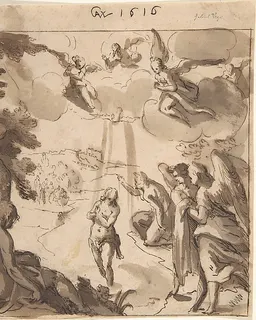
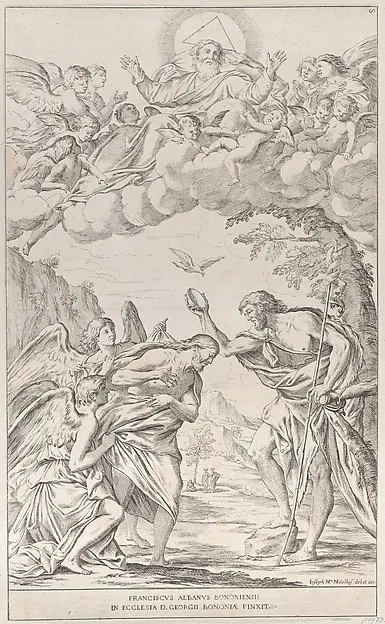
What happens as Jesus comes up is the unveiling the whole chapter has been moving toward: And Jesus, when he was baptized, went up straightway out of the water: and, lo, the heavens were opened unto him, and he saw the Spirit of God descending like a dove, and lighting upon him (v. 16). The little word lo calls the reader to stop and look. The heavens - long closed over a people who had heard no prophet for centuries - are opened, as if a door long shut swings wide at this moment and over this Man.
And the Spirit of God comes down, visibly, like a dove, and rests upon him. The gentleness of the image is deliberate: a dove descending and alighting, settling on Jesus and remaining. The Spirit is not seized or summoned; the Spirit is given, lighting on Him as He rises from the water. Whatever else is happening here, the plain sense is unmistakable: heaven is opened over this One, and the Spirit of God comes to rest on Him as His ministry begins.
The river that had received the confessions of a whole nation now becomes the place where the sky tears open and the Spirit descends.
And then, with a second lo to make us listen, comes the voice: And lo a voice from heaven, saying, This is my beloved Son, in whom I am well pleased (v. 17). After the opened heaven and the descending Spirit, there is now a word - and it is the highest word that could be spoken over anyone. The voice from heaven names Jesus as my beloved Son, and declares the Father's full delight in Him: in whom I am well pleased. Take the weight of the timing.
This is said before Jesus has preached a sermon, gathered a disciple, healed a sickness, or worked a single miracle. The approval rests on who He is. He is the beloved Son, and the Father is already well pleased. The words echo the Scriptures the people knew - the King addressed as God's Son in the second Psalm, and the chosen Servant in whom God's soul delights in Isaiah - gathering both the royal and the suffering threads into this one Man at the water's edge.
At the threshold of everything that follows, the river holds the whole scene together: the Father's voice from heaven, the Spirit resting like a dove, and the beloved Son standing in the Jordan - named, anointed, and sent.
Research trail
Sources & further study
These references support the historical, linguistic, manuscript, and contextual notes in this chapter. Scripture remains the primary text; external sources are provided so readers can inspect the research directly.
- Matthew 3 - Translators' NotesThe NET Bible's detailed footnotes on Matthew 3 - the wilderness setting and prophetic dress of John (vv. 1-4), the force of “fruits meet for repentance” (v. 8), the imagery of the winnowing fan and unquenchable fire (v. 12), and the much-discussed exchange at the river (vv. 14-15).
- Matthew 3 ↔ Isaiah 40 · Malachi 3 · Isaiah 53Traces the threads tying Matthew 3 to the rest of Scripture - the voice in the wilderness (v. 3) read against Prepare ye the way of the LORD (Isa. 40:3) and the messenger of Mal. 3:1, and the sinless One baptized among sinners (vv. 13-15) read beside the servant numbered with the transgressors (Isa. 53:12).
- Matthew 3 · Greek interlinear + lexiconThe Greek text of Matthew 3 word by word, with parsing and lexical entries - useful for metanoeo (vv. 2, 8, 11, the “repent” that is a change of mind and turning), for the “kingdom of heaven” phrasing of verse 2, and for agapetos (v. 17, the “beloved” Son).
Where this echoes in Scripture
The Voice in the Wilderness
- Isaiah 40:3The voice of him that crieth in the wilderness, Prepare ye the way of the LORD, make straight in the desert a highway for our God.The prophecy Matthew applies to John in verse 3 - a herald clearing the road for the coming of the LORD.
- Malachi 3:1Behold, I will send my messenger, and he shall prepare the way before me.The promised forerunner of verses 1-3 - the messenger sent ahead of the LORD's own coming.
- 2 Kings 1:8He was an hairy man, and girt with a girdle of leather about his loins. And he said, It is Elijah the Tishbite.The prophet's dress that John wears in verse 4 - marking him as the Elijah-like messenger foretold.
- Matthew 4:17From that time Jesus began to preach, and to say, Repent: for the kingdom of heaven is at hand.Jesus takes up the very call of verse 2 - the same word of repentance, the same nearness of the kingdom.
- Acts 19:4John verily baptized with the baptism of repentance, saying unto the people, that they should believe on him which should come after him.The meaning of John's baptism in verse 6 - a baptism of repentance pointing ahead to the One coming after.
Fruits Meet for Repentance · The Mightier One
- Luke 3:10-14He answereth and saith unto them, He that hath two coats, let him impart to him that hath none.The fruits meet for repentance of verse 8 made concrete - John tells each group exactly how their turning should show.
- John 3:30He must increase, but I must decrease.The heart of John's self-effacement in verse 11 - the herald gladly growing smaller so the Mightier One is seen.
- Acts 1:5John truly baptized with water; but ye shall be baptized with the Holy Ghost not many days hence.The promise of verse 11 confirmed by Jesus - the baptism with the Holy Ghost that only the Mightier One can give.
- Matthew 7:19Every tree that bringeth not forth good fruit is hewn down, and cast into the fire.Jesus repeats the very image of verse 10 - the unfruitful tree cut down, the life tested by what it bears.
- Romans 2:28-29For he is not a Jew, which is one outwardly... But he is a Jew, which is one inwardly.The truth behind verse 9 - that descent and outward marks cannot substitute for a heart turned to God.
This Is My Beloved Son
- Isaiah 53:12He hath poured out his soul unto death: and he was numbered with the transgressors; and he bare the sin of many.The Servant who stands among the guilty - the prophetic shape of Jesus stepping into the sinner's baptism in verse 15.
- 2 Corinthians 5:21For he hath made him to be sin for us, who knew no sin; that we might be made the righteousness of God in him.The fulfillment foreshadowed in verse 15 - the sinless One taking the sinner's place so that we might be made righteous.
- Psalm 2:7I will declare the decree: the LORD hath said unto me, Thou art my Son; this day have I begotten thee.The royal Son addressed by God - one of the Scriptures gathered up in the voice of verse 17.
- Isaiah 42:1Behold my servant, whom I uphold; mine elect, in whom my soul delighteth; I have put my spirit upon him.The chosen Servant, delighted in and Spirit-anointed - echoed in the descending Spirit and the voice of verses 16-17.
- Matthew 17:5This is my beloved Son, in whom I am well pleased; hear ye him.The same declaration as verse 17, sounded again at the transfiguration - the Father's settled delight in the beloved Son.