Matthew 17
People in this chapter
Matthew 17 opens with a date stamp that is doing real work: And after six days. Six days after what? After the great turning point in chapter 16, where Peter confessed Jesus to be the Christ, the Son of the living God - and where Jesus, for the first time, told His followers plainly that He must go unto Jerusalem, and suffer many things… and be killed, and be raised again the third day (Matt. 16:16, 21).
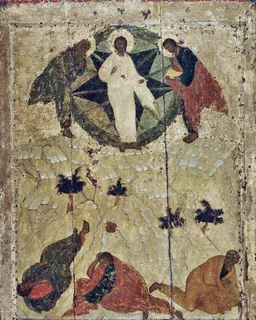
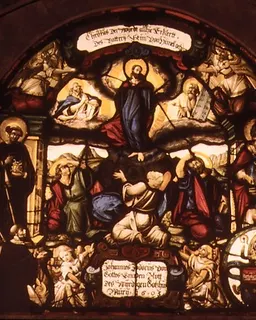
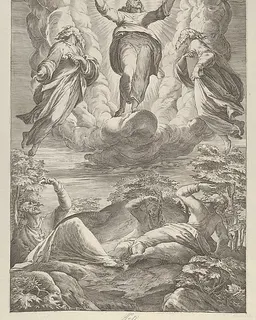
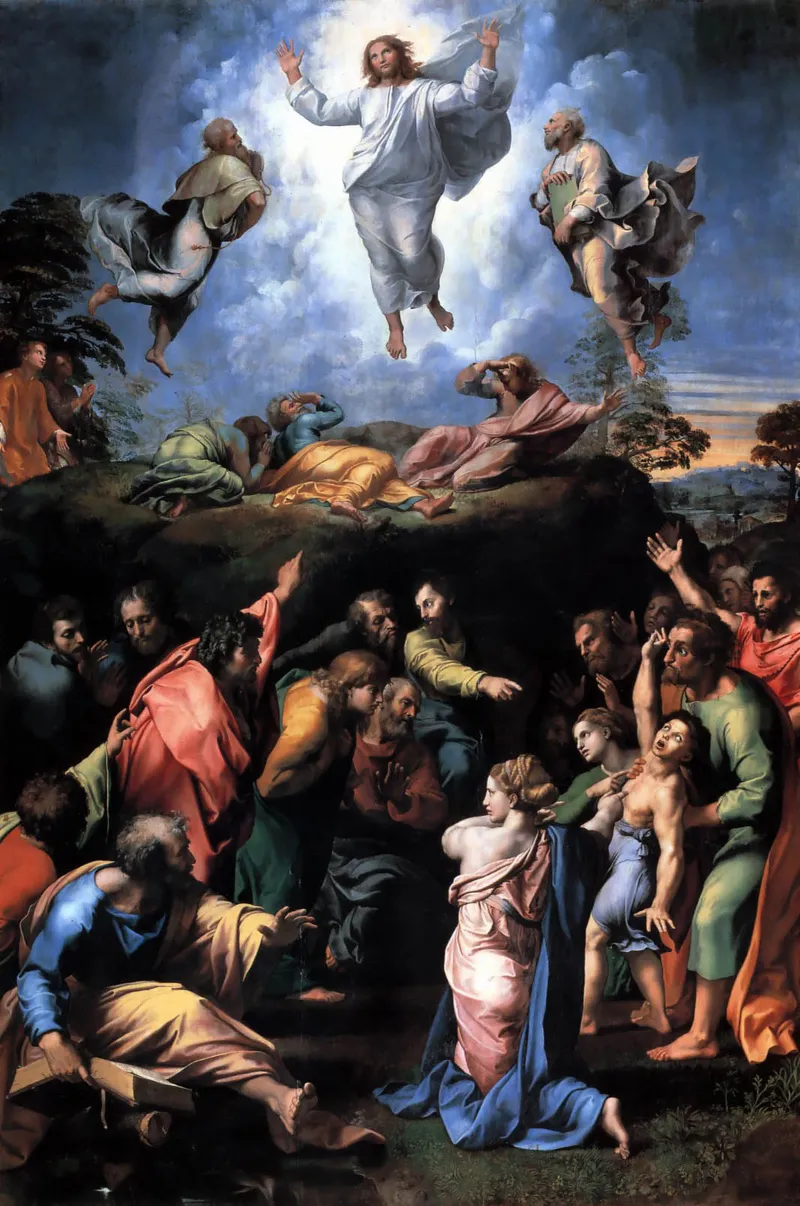
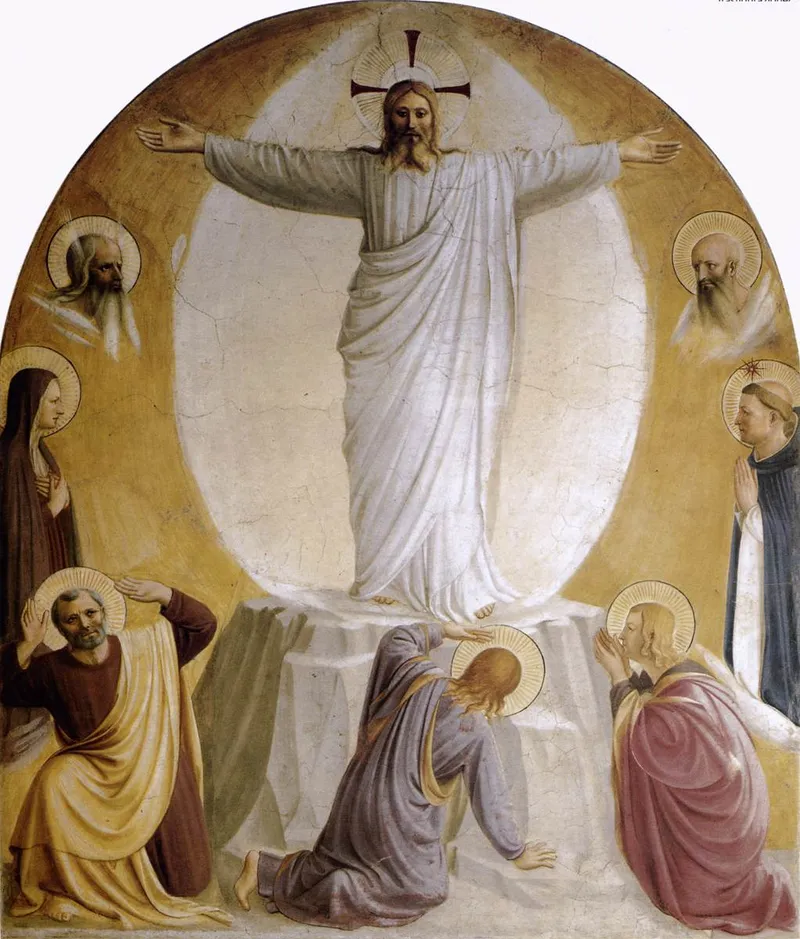
It is into the shadow of that announcement, with the cross now spoken aloud and the disciples reeling, that Jesus takes Peter, James, and John up a high mountain. And there the curtain is drawn back. He was transfigured before them: and his face did shine as the sun, and his raiment was white as the light (v. 2). Moses and Elias appear and talk with Him; a bright cloud overshadows them; and a voice from the cloud says the words the whole chapter turns on: This is my beloved Son, in whom I am well pleased; hear ye him (v. 5).1
Tap any highlighted phrase to jump to the commentary that unpacks it.
Matthew 17:1-13This Is My Beloved Son: Hear Ye Him
1And after six days Jesus taketh Peter, James, and John his brother, and bringeth them up into an high mountain apart, 2And was transfigured before them: and his face did shine as the sun, and his raiment was white as the light. 3And, behold, there appeared unto them Moses and Elias talking with him. 4Then answered Peter, and said unto Jesus, Lord, it is good for us to be here: if thou wilt, let us make here three tabernacles; one for thee, and one for Moses, and one for Elias. 5While he yet spake, behold, a bright cloud overshadowed them: and behold a voice out of the cloud, which said, This is my beloved Son, in whom I am well pleased; hear ye him. 6And when the disciples heard it, they fell on their face, and were sore afraid. 7And Jesus came and touched them, and said, Arise, and be not afraid. 8And when they had lifted up their eyes, they saw no man, save Jesus only.
The chapter opens with a deliberate marker: And after six days Jesus taketh Peter, James, and John his brother, and bringeth them up into an high mountain apart (v. 1). The six days reach back to the hinge of the previous chapter, where Peter had confessed Jesus to be the Christ, the Son of the living God, and where Jesus had then said, for the first time and plainly, that He must go to Jerusalem to suffer and be killed and on the third day rise (Matt. 16:16, 21).
That announcement had landed hard; Peter had even rebuked Him for it. So the timing matters. It is into the long shadow of the cross, just spoken aloud, that Jesus leads the inner three up the mountain. He takes only three - the same three He will take farther than the rest in Gethsemane - and goes apart, away from the crowds, to a high and lonely place. What they are about to see is given to steady them.
Before the disciples must watch their Master walk deliberately toward humiliation and death, they are granted one unforgettable sight of who He has been all along.2
Then the curtain is drawn back: And was transfigured before them: and his face did shine as the sun, and his raiment was white as the light (v. 2). The change is not a costume or a trick of light; the very word means a transformation of form, a becoming-visible of what was inwardly true. His face shines - not with a borrowed brightness, as Moses' face once shone after he had been with God, but as the sun shines, with light that is its own.
His clothing turns dazzling white, white as the light itself. For one astonishing moment the disciples are looking at the glory that had always been there beneath the ordinary appearance of the carpenter from Nazareth, the glory of the One whom an eyewitness on this very mountain would later call full of majesty (2 Pet. 1:16). It is crucial to see what this is and is not. Jesus is not being upgraded into something He was not.
The brightness is an unveiling, not an addition. The disciples are not watching a man become divine; they are being permitted, for a few moments, to see the glory of the One who had veiled it in flesh to dwell among them.3
Into this blaze of light step two figures: And, behold, there appeared unto them Moses and Elias talking with him (v. 3). Moses and Elias - Elijah - are not chosen at random. Between them they stand for the whole of the older Scriptures: Moses for the law, Elijah for the prophets, the two great streams of revelation that ran through all of Israel's history. And here they are, in conversation with Jesus, plainly at home in His presence and plainly subordinate to Him.
The deep current of the scene is unmistakable: everything the law promised and everything the prophets foretold has been pointing toward this Person. They are not His rivals or His equals; they are His witnesses. Peter, overwhelmed and not knowing what to say, reaches for the only response he can think of: Lord, it is good for us to be here: if thou wilt, let us make here three tabernacles; one for thee, and one for Moses, and one for Elias (v. 4).
His instinct is reverent - he wants to honor the moment, to build, to stay. But there is a flaw buried in it: three tabernacles, as though the three were peers to be housed side by side. The cloud is about to correct him.
Before Peter can finish, heaven answers: While he yet spake, behold, a bright cloud overshadowed them: and behold a voice out of the cloud, which said, This is my beloved Son, in whom I am well pleased; hear ye him (v. 5). The bright cloud is the old sign of God's own presence - the cloud that filled the tabernacle, that settled on Sinai, that led Israel through the wilderness. And out of it comes the Father's voice.
The first half of what He says is what was spoken at Jesus' baptism: This is my beloved Son, in whom I am well pleased. But now a command is added that answers Peter directly: hear ye him. Not hear these three - hear him. Peter had wanted to set Jesus alongside Moses and Elijah; the Father sets Jesus above them and silences every other voice in His favor. Moses gave the law and is to be honored; Elijah spoke for God and is to be honored; but the Son is to be heard. If the disciples are stunned at His glory, they are to be even more arrested by His words.
The vision fades; the command remains.1
The disciples cannot bear it: And when the disciples heard it, they fell on their face, and were sore afraid (v. 6). It is the voice, more than the light, that flattens them - the terror of hearing God speak. And then the most tender thing in the whole scene: And Jesus came and touched them, and said, Arise, and be not afraid (v. 7). The One who a moment before shone like the sun now stoops down, reaches out a hand, and touches three trembling men.
The glory does not make Him unapproachable; it is the glory of the very One who has been walking beside them, eating with them, teaching them. Arise, and be not afraid - the same word He speaks again and again to frightened people throughout the Gospels. Then they lift their eyes: And when they had lifted up their eyes, they saw no man, save Jesus only (v. 8). Moses is gone. Elijah is gone. The dazzling cloud is gone.
What is left, and what is meant to be left, is Jesus only. The law and the prophets have done their work of pointing; now they step back, and the One they pointed to stands alone before His disciples. That is the picture the whole chapter is built to leave: not Moses, not Elijah, not even the glory itself for its own sake - Jesus only.
9And as they came down from the mountain, Jesus charged them, saying, Tell the vision to no man, until the Son of man be risen again from the dead. 10And his disciples asked him, saying, Why then say the scribes that Elias must first come? 11And Jesus answered and said unto them, Elias truly shall first come, and restore all things. 12But I say unto you, That Elias is come already, and they knew him not, but have done unto him whatsoever they listed. Likewise shall also the Son of man suffer of them. 13Then the disciples understood that he spake unto them of John the Baptist.
Coming down, Jesus binds the vision in silence for a season: Tell the vision to no man, until the Son of man be risen again from the dead (v. 9). The glory is real, but it is not yet to be proclaimed; it would be misread by a people hungry for a conquering Messiah and blind to a suffering one. Only on the far side of the resurrection will the mountain make sense. Notice too how naturally Jesus speaks of His own rising as a settled fact - the cross is in full view, and so is what lies beyond it.
The disciples, still turning over the sight of Elijah, raise the scribes' teaching: Why then say the scribes that Elias must first come? (v. 10). They knew the closing promise of the prophets, that Elijah would come before the great day of the LORD. Jesus affirms it - Elias truly shall first come, and restore all things - and then unfolds it: That Elias is come already, and they knew him not, but have done unto him whatsoever they listed (vv. 11-12).
The promised forerunner had come in the person and spirit of John the Baptist, and had been ignored, rejected, and finally killed. Then the disciples understood that he spake unto them of John the Baptist (v. 13). And the sober line at the center of it - Likewise shall also the Son of man suffer of them - ties the forerunner's fate to the Master's. The world that did not know the messenger will not receive the One he announced.
The road down from the mountain of glory leads, unmistakably, toward a cross.
Matthew 17:14-21Faith as a Grain of Mustard Seed
14And when they were come to the multitude, there came to him a certain man, kneeling down to him, and saying, 15Lord, have mercy on my son: for he is lunatick, and sore vexed: for ofttimes he falleth into the fire, and oft into the water. 16And I brought him to thy disciples, and they could not cure him. 17Then Jesus answered and said, O faithless and perverse generation, how long shall I be with you? how long shall I suffer you? bring him hither to me. 18And Jesus rebuked the devil; and he departed out of him: and the child was cured from that very hour. 19Then came the disciples to Jesus apart, and said, Why could not we cast him out? 20And Jesus said unto them, Because of your unbelief: for verily I say unto you, If ye have faith as a grain of mustard seed, ye shall say unto this mountain, Remove hence to yonder place; and it shall remove; and nothing shall be impossible unto you. 21Howbeit this kind goeth not out but by prayer and fasting.
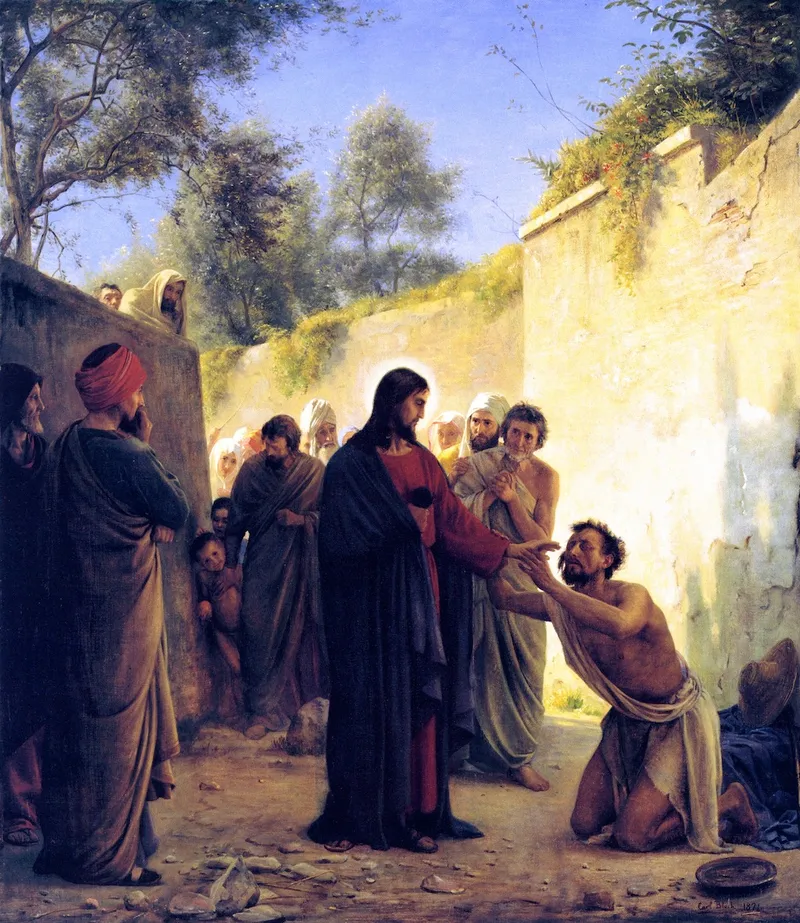
The contrast could not be sharper. They come down from the radiance of the mountain straight into a scene of human helplessness: And when they were come to the multitude, there came to him a certain man, kneeling down to him (v. 14). A father kneels - the posture of someone out of options - and pours out his trouble: Lord, have mercy on my son: for he is lunatick, and sore vexed: for ofttimes he falleth into the fire, and oft into the water (v. 15).
The old word lunatick describes affliction that came and went in fits, leaving the boy convulsing and in danger, flung toward fire and water by a power he could not control. It is a portrait of suffering at its most frightening to a parent: a child repeatedly thrown into harm, and a father unable to save him. And then the wound within the wound: And I brought him to thy disciples, and they could not cure him (v. 16).
The man had done the right thing. He had brought his son to the followers of Jesus - the very men who had earlier been given authority over unclean spirits - and they had failed. The crowd had watched them fail. Whatever power they once exercised had, in this moment, deserted them, and a desperate father was left still desperate.2
Jesus' response cuts in like a sudden grief: O faithless and perverse generation, how long shall I be with you? how long shall I suffer you? (v. 17). The words are sharp, and it is worth asking who they are aimed at. Not, in the first place, the suffering father - he has come in hope. The lament takes in the whole unbelieving setting: a generation slow to trust, disciples who could not bring their faith to bear, a crowd quick to gawk and slow to believe.
There is real sorrow in it - the ache of One who sees, more clearly than anyone, how unbelief paralyzes and how little His own people grasp of what is standing in front of them. But the sorrow does not curdle into refusal. In the same breath He says, bring him hither to me. However faithless the generation, the boy is not turned away. And Jesus rebuked the devil; and he departed out of him: and the child was cured from that very hour (v. 18).
What the disciples could not do, Jesus does instantly, with a word. The deliverance the father had despaired of is accomplished in a moment - and the boy who had been thrown toward fire and water is whole.
Afterward, privately, the disciples ask the honest question: Why could not we cast him out? (v. 19). They had done such things before; why not now? Jesus' answer is direct and unsparing: Because of your unbelief (v. 20). The failure was not that the case was too hard, nor that Jesus had withheld power; it was that their trust had grown thin. Perhaps they had begun to lean on the memory of past success, or on a technique, rather than on living dependence upon God.
The diagnosis is uncomfortable precisely because it is so personal - the obstacle was not out in the boy, it was in them. But then comes verse 21 in the King James text: Howbeit this kind goeth not out but by prayer and fasting. Far from contradicting the charge of unbelief, this names what living faith looks like in practice. Prayer and fasting are not magic words that supply extra force; they are the posture of a soul that has stopped relying on itself and is leaning wholly on God.
The disciples had the title and the memory of authority, but not the dependence that keeps faith alive. Real trust is not a stored-up credential. It is cultivated, daily, in the place of prayer.2
Then Jesus turns the rebuke into one of His most freeing promises: for verily I say unto you, If ye have faith as a grain of mustard seed, ye shall say unto this mountain, Remove hence to yonder place; and it shall remove; and nothing shall be impossible unto you (v. 20). The mustard seed was a byword for the smallest thing imaginable - a speck barely visible in the palm. And moving a mountain was a vivid figure for doing the humanly impossible.
Put the two together and the point is startling: the issue was never the size of their faith. Jesus does not say, “If only you had great, heroic, mountainous faith.” He says that faith the size of the tiniest seed is enough, if it is real. What had failed in the disciples was not that their faith was too small in quantity but that it was not genuinely there - not trust in God at all, but reliance on themselves.
A grain of true faith outweighs a mountain of self-confidence, because faith's power is never in itself; it is in its object. Tiny faith joined to a great God moves what mighty doubt cannot. The encouragement for every ordinary, struggling believer is enormous: you do not need to manufacture a towering faith before God will act. You need only a real, living trust - even mustard-seed small - aimed at the One for whom nothing is impossible.
Matthew 17:22-27Betrayed and Raised · A Coin in the Fish's Mouth
22And while they abode in Galilee, Jesus said unto them, The Son of man shall be betrayed into the hands of men: 23And they shall kill him, and the third day he shall be raised again. And they were exceeding sorry. 24And when they were come to Capernaum, they that received tribute money came to Peter, and said, Doth not your master pay tribute? 25He saith, Yes. And when he was come into the house, Jesus prevented him, saying, What thinkest thou, Simon? of whom do the kings of the earth take custom or tribute? of their own children, or of strangers? 26Peter saith unto him, Of strangers. Jesus saith unto him, Then are the children free. 27Notwithstanding, lest we should offend them, go thou to the sea, and cast an hook, and take up the fish that first cometh up; and when thou hast opened his mouth, thou shalt find a piece of money: that take, and give unto them for me and thee.
With the mountain behind them, Jesus tells His disciples a second time, plainly, where all of this is going: And while they abode in Galilee, Jesus said unto them, The Son of man shall be betrayed into the hands of men: and they shall kill him, and the third day he shall be raised again (vv. 22-23). This is the second of the great passion predictions, and its placement is deliberate. They have just seen His glory blaze on the mountain; now, before that sight can harden into the wrong expectations, He says it again - betrayed, killed, and on the third day raised.
The word betrayed carries the chill of treachery: He will be handed over, given up into the hands of men. The glory and the suffering belong to the same Person and the same road. Note carefully that the resurrection is named every time the death is named - the third day he shall be raised again. Jesus never speaks of the cross as defeat. The dark word and the bright word come together, deliberately, every time: He is going to die, and He is going to rise.
He knows the whole arc, and walks into it with His eyes open.
The disciples hear it, and this time the text records their response simply: And they were exceeding sorry (v. 23). There is something both tender and revealing in that line. Tender, because they had come to love Him, and the plain announcement of His death pierced them with real grief. But revealing too, because their sorrow stops at the death and does not seem to reach the promise tucked into the very same sentence - the third day he shall be raised again. They grasped the loss; they could not yet take in the hope.
It is an honest picture of how grief works: the wound in front of us fills the whole field of vision, and the promise on the far side of it, though spoken just as clearly, fails to land. Their exceeding sorrow is the sorrow of people who heard half of what Jesus said. And it stands as a gentle warning to every reader who knows the cross but lets it eclipse the empty tomb. Jesus never separated the two.
The same breath that foretold His death foretold His rising, and the disciples' sorrow, however understandable, was a sorrow that had not yet learned to hear the whole word.
The chapter closes with one of the most unexpected episodes in the Gospels - recorded by Matthew alone. And when they were come to Capernaum, they that received tribute money came to Peter, and said, Doth not your master pay tribute? (v. 24). The tax in view is the annual half-shekel given by every Israelite for the upkeep of the temple - not a Roman levy but a religious due, gathered for the house of God.
Peter answers quickly, Yes, and then Jesus, before Peter can even raise it, meets him with a question: What thinkest thou, Simon? of whom do the kings of the earth take custom or tribute? of their own children, or of strangers? (v. 25). Peter gives the obvious answer: of strangers. And Jesus draws the conclusion: Then are the children free (v. 26). The logic is quietly staggering. A king does not tax his own family.
If this tax supports the house of God - the Father's house - then the Father's own Son is under no obligation to pay it. With a single household analogy Jesus has just claimed, almost in passing, a unique sonship to the God whose temple this is. He is not a stranger to that house. He is the Son in it, and sons go free.
And then, having established that He owes nothing, Jesus pays it anyway: Notwithstanding, lest we should offend them, go thou to the sea, and cast an hook, and take up the fish that first cometh up; and when thou hast opened his mouth, thou shalt find a piece of money: that take, and give unto them for me and thee (v. 27). Two things shine out of this. First, the willingness. Jesus has just shown that the Son of the temple's God is exempt - and He sets His right aside lest we should offend them, choosing not to stand on His freedom where standing on it would needlessly trip others over a tax that looked, to outsiders, like simple impiety.
It is the same heart that will later teach His followers to surrender their own liberties for the sake of others. Second, the way the money comes. He does not reach into a purse; He sends Peter to the sea, to a hook, to the first fish that rises, and tells him the coin will be waiting in its mouth. The One whose glory had just shone like the sun, and who owes this tax to no one, provides it from the depths of the sea by a quiet, almost playful exercise of total authority over creation.
Notice too the generous arithmetic: the single coin is for me and thee - enough for Jesus and for Peter both. The Lord of the temple pays the temple's tax, and covers His servant's share as well.3
Research trail
Sources & further study
These references support the historical, linguistic, manuscript, and contextual notes in this chapter. Scripture remains the primary text; external sources are provided so readers can inspect the research directly.
- Matthew 17 ↔ Exodus 24 · Deuteronomy 18 · 2 Peter 1 · Daniel 7Traces the threads tying Matthew 17 to the rest of Scripture - the shining face and the cloud on the mountain (vv. 2, 5) read against Sinai (Exod. 24, 34), the Father's hear ye him (v. 5) against the prophet like unto Moses whom Israel must heed (Deut. 18:15), and the eyewitness recollection of the mountain in 2 Peter 1:16-18.
- Matthew 17 - Translators' NotesThe NET Bible's detailed footnotes on Matthew 17 - the timing and setting of the Transfiguration (vv. 1-2), the textual question at verse 21, the boy described as lunatick in verse 15, and the half-shekel temple tax and the coin in verses 24-27.
- Matthew 17 · Greek interlinear + lexiconThe Greek text of Matthew 17 word by word, with parsing and lexical links - useful for metemorphothe (v. 2, “was transfigured”), for akouete autou (v. 5, “hear ye him”), and for the verb kolloboi/didrachma behind the temple-tax exchange in verses 24-27.
Where this echoes in Scripture
This Is My Beloved Son: Hear Ye Him
- 2 Peter 1:16-18we... were eyewitnesses of his majesty... This is my beloved Son, in whom I am well pleased. And this voice which came from heaven we heard, when we were with him in the holy mount.One of the three on the mountain, decades later, staking his witness on what he saw and heard in verses 2-5.
- John 1:14And the Word was made flesh, and dwelt among us, (and we beheld his glory, the glory as of the only begotten of the Father,) full of grace and truth.The glory unveiled in verse 2 named - the glory of the only begotten, briefly shown.
- Exodus 34:29-30the skin of his face shone while he talked with him... they were afraid to come nigh him.Moses' face shone with a reflected, fading light - set beside the Son's own light shining out (v. 2).
- Deuteronomy 18:15The LORD thy God will raise up unto thee a Prophet from the midst of thee, of thy brethren, like unto me; unto him ye shall hearken.The promise behind the Father's command - the Prophet like Moses whom Israel must hear (v. 5).
- Hebrews 1:1-2God, who at sundry times... spake in time past unto the fathers by the prophets, hath in these last days spoken unto us by his Son.Why Moses and Elijah fade and Jesus remains (v. 8) - the Son is God's final word.
Faith as a Grain of Mustard Seed
- Mark 9:23-24If thou canst believe, all things are possible to him that believeth... Lord, I believe; help thou mine unbelief.The same scene in Mark - the father's cry that catches exactly the kind of faith Jesus commends in verse 20.
- Luke 1:37For with God nothing shall be impossible.The ground beneath the promise of verse 20 - faith lays hold of the God with whom nothing is impossible.
- Matthew 21:21If ye have faith, and doubt not... ye shall say unto this mountain, Be thou removed... it shall be done.The mountain-moving promise of verse 20 repeated - real, undoubting trust in God.
- Luke 17:6If ye had faith as a grain of mustard seed, ye might say unto this sycamine tree, Be thou plucked up... and it should obey you.The mustard-seed saying again - the smallness of the seed is the point, as in verse 20.
- Hebrews 11:6without faith it is impossible to please him: for he that cometh to God must believe that he is.Why unbelief left the disciples powerless (v. 20) - faith is the hand that takes hold of God.
Betrayed and Raised · A Coin in the Fish's Mouth
- Philippians 2:7-8made himself of no reputation, and took upon him the form of a servant... and became obedient unto death, even the death of the cross.The descent of verses 22-23 named in full - the One in glory walking the road to the cross.
- Matthew 16:21From that time forth began Jesus to shew unto his disciples, how that he must... suffer many things... and be killed, and be raised again the third day.The first passion prediction, six days before the mountain - the shadow over the whole chapter (vv. 22-23).
- Hebrews 12:2who for the joy that was set before him endured the cross, despising the shame.Why the resurrection is always named with the death (v. 23) - the cross endured for the joy beyond it.
- John 5:18...said also that God was his Father, making himself equal with God.The sonship Jesus claims in passing in verse 26 - the Son in His Father's house, not a stranger to it.
- 2 Corinthians 8:9though he was rich, yet for your sakes he became poor, that ye through his poverty might be rich.The pattern of the coin in the fish (v. 27) writ large - the King paying for His people out of His own fullness.