Luke 17
People in this chapter
The chapter opens with a saying as heavy as anything Jesus speaks. It is impossible but that offences will come: but woe unto him, through whom they come! (v. 1). To set a stumbling-block before one of these little ones is so grave that it were better for him that a millstone were hanged about his neck, and he cast into the sea (v. 2). Then, without softening, He turns the same seriousness onto how His followers treat one another: If thy brother trespass against thee, rebuke him; and if he repent, forgive him (v. 3) - and not once, but as often as he turns: if he trespass against thee seven times in a day, and seven times in a day turn again to thee, saying, I repent; thou shalt forgive him (v. 4).
The demand is so far beyond the natural heart that the apostles answer with a cry: Lord, increase our faith (v. 5).1
Tap any highlighted phrase to jump to the commentary that unpacks it.
Luke 17:1-10Forgive Him Seven Times · Faith as a Grain of Mustard Seed
1Then said he unto the disciples, It is impossible but that offences will come: but woe unto him, through whom they come! 2It were better for him that a millstone were hanged about his neck, and he cast into the sea, than that he should offend one of these little ones. 3Take heed to yourselves: If thy brother trespass against thee, rebuke him; and if he repent, forgive him. 4And if he trespass against thee seven times in a day, and seven times in a day turn again to thee, saying, I repent; thou shalt forgive him.
Jesus opens with a sober realism about the world His disciples must live in: It is impossible but that offences will come (v. 1). The word translated offences means stumbling-blocks - the things, and the people, that trip others up and pull them down into sin. He does not pretend they can be avoided; in a fallen world they are certain to come. But certainty is not the same as innocence, and He immediately fixes responsibility: but woe unto him, through whom they come! The fact that a thing is inevitable does not excuse the one who does it.
And then He measures the weight of it in an image no listener could shrug off: It were better for him that a millstone were hanged about his neck, and he cast into the sea, than that he should offend one of these little ones (v. 2). A millstone is the great round stone an animal dragged to grind grain - nothing a person could ever lift off, nothing to swim against. To be dropped into the sea with one tied to your neck is to sink past all hope of rescue.
Jesus says that is the lighter fate. To set a stumbling-block before one of these little ones - the small, the new, the vulnerable in faith - is reckoned by Heaven as something graver than drowning. The tenderness God feels toward the little ones is matched by the severity He feels toward those who would harm them.1
From the danger of causing sin, Jesus turns at once to the response when sin is done to us: Take heed to yourselves: If thy brother trespass against thee, rebuke him; and if he repent, forgive him (v. 3). Notice that He does not counsel a pretense that nothing happened. There is a place for honest rebuke - for naming the wrong plainly to the one who did it. But the aim of the rebuke is to reach repentance, and where there is repentance the door swings wide: if he repent, forgive him. Then He stretches that forgiveness past every natural limit: if he trespass against thee seven times in a day, and seven times in a day turn again to thee, saying, I repent; thou shalt forgive him (v. 4).
Seven times in a single day is not a tally to keep but a number meant to break the keeping of tallies altogether. By the seventh offence in one day the natural heart has long since hardened, certain the repentance cannot be sincere. Jesus cuts that calculation off. As often as the brother turns - really turns, saying, I repent - forgiveness is to meet him. The turning must be real each time; this is a command laid on the offended: to keep the door open as many times as it is knocked upon.
It is the forgiveness we have received, made into the forgiveness we extend.
5And the apostles said unto the Lord, Increase our faith. 6And the Lord said, If ye had faith as a grain of mustard seed, ye might say unto this sycamine tree, Be thou plucked up by the root, and be thou planted in the sea; and it should obey you. 7But which of you, having a servant plowing or feeding cattle, will say unto him by and by, when he is come from the field, Go and sit down to meat? 8And will not rather say unto him, Make ready wherewith I may sup, and gird thyself, and serve me, till I have eaten and drunken; and afterward thou shalt eat and drink? 9Doth he thank that servant because he did the things that were commanded him? I trow not. 10So likewise ye, when ye shall have done all those things which are commanded you, say, We are unprofitable servants: we have done that which was our duty to do.
The apostles hear the impossible demand to forgive without ceiling and respond with the only honest prayer available to them: Increase our faith (v. 5). They assume what most of us assume - that to do the hard thing they need a larger supply of faith, more of it, a deeper reservoir. Jesus gently overturns the assumption. If ye had faith as a grain of mustard seed, ye might say unto this sycamine tree, Be thou plucked up by the root, and be thou planted in the sea; and it should obey you (v. 6).
The mustard seed was a byword for the tiniest of seeds; the sycamine, a tree whose roots were known to run deep and hold fast. The picture is deliberately absurd - a deep-rooted tree obeying a word and replanting itself in the sea - precisely to make the point. The power lives in the One the faith lays hold of, and a faith no bigger than a seed, if it is real and rests on God, is enough.
They asked for more; He pointed them to the right place. Faith is a hand laid, however weakly, on the strength of God - and even the smallest such hand connects to limitless power.2
Lest the disciples imagine that great faith or hard obedience puts God in their debt, Jesus closes with a homely scene from ordinary working life. A servant comes in from plowing or feeding cattle, and the master does not drop everything to wait on him; the servant's day is not finished, and he serves the table before he sits at it (vv. 7-8). Nor does the master heap thanks on him for simply doing what was commanded: Doth he thank that servant because he did the things that were commanded him? I trow not (v. 9).
Then comes the application, and it is bracing: So likewise ye, when ye shall have done all those things which are commanded you, say, We are unprofitable servants: we have done that which was our duty to do (v. 10). The point is not that our service is worthless to God - He delights in it - nor that we should despise ourselves. The word unprofitable means we have given God nothing He did not already have a right to; we have run up no credit, earned no claim, placed Him under no obligation.
Even our fullest obedience is only the rendering of what was owed. This guards the heart against the oldest of spiritual diseases - the quiet bookkeeping that imagines God owes us for our goodness. There is freedom in it. The servant who knows he cannot put the Master in his debt is set free from anxious scorekeeping and left simply to serve, and to receive whatever the Master gives as the gift it always was.
Luke 17:11-19Were There Not Ten Cleansed?
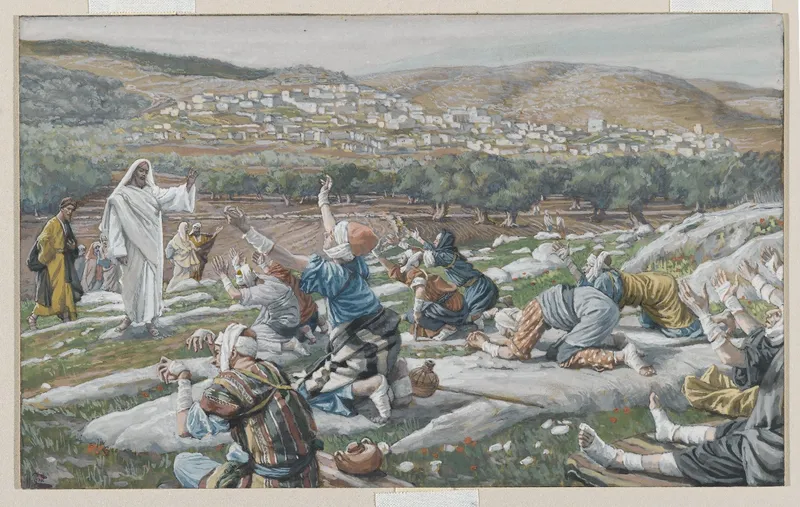
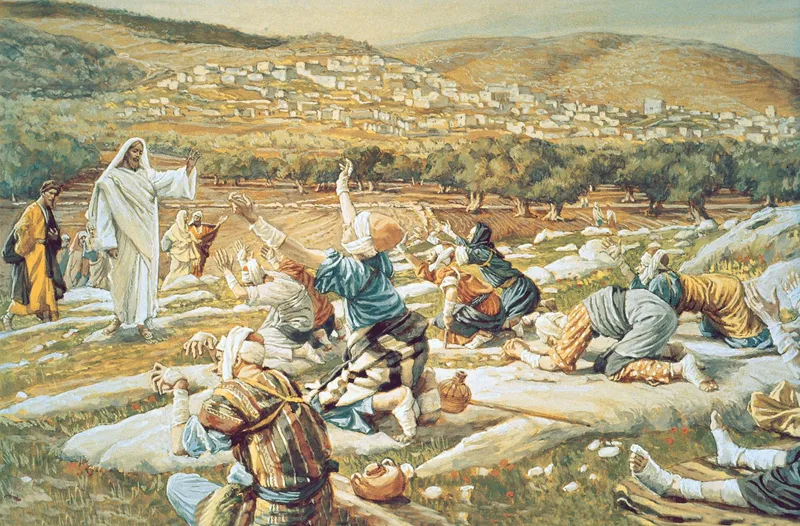
11And it came to pass, as he went to Jerusalem, that he passed through the midst of Samaria and Galilee. 12And as he entered into a certain village, there met him ten men that were lepers, which stood afar off: 13And they lifted up their voices, and said, Jesus, Master, have mercy on us. 14And when he saw them, he said unto them, Go shew yourselves unto the priests. And it came to pass, that, as they went, they were cleansed. 15And one of them, when he saw that he was healed, turned back, and with a loud voice glorified God, 16And fell down on his face at his feet, giving him thanks: and he was a Samaritan.
As Jesus travels toward Jerusalem along the border country through the midst of Samaria and Galilee, ten lepers meet Him at the edge of a village (vv. 11-12). The detail that they stood afar off is not incidental; leprosy made a person ritually unclean and socially exiled, required by the Law to keep their distance and cry a warning to any who approached. These ten knew their place at the far margin of the community - and from that distance they lifted the only cry left to them: Jesus, Master, have mercy on us (v. 13).
It is the cry of people who have nothing to bargain with, who can only ask for mercy. And Jesus answers in a way that asks something of them before they see any change: Go shew yourselves unto the priests (v. 14). Under the Law it was the priest who certified a leper clean and readmitted him to the community - but these men were sent to the priest while they were still covered in the disease.
To set out for the priest was itself an act of faith, obeying before there was anything to show. And it came to pass, that, as they went, they were cleansed. The healing met them on the road, in the act of obedience, coming as they moved.
All ten were cleansed; the gift fell on every one of them alike. But here the scene narrows to a single figure. One of them, when he saw that he was healed, turned back, and with a loud voice glorified God, and fell down on his face at his feet, giving him thanks (vv. 15-16). Trace what he does: he saw, he turned back, he glorified God aloud, he fell at Jesus' feet, he gave thanks. Every other man had received exactly the same healing; what set this one apart was that he saw it for what it was and let the seeing turn him around.
The others were occupied, rightly enough, with getting to the priests and back to their lives; this one interrupted his own restoration to come back to its Source. And then Luke lands the detail he has been holding: and he was a Samaritan. The one who returned was the outsider - a member of the despised people, the half-stranger to Israel's worship. The nine who took the gift and kept walking were, presumably, sons of the covenant.
It is the outsider who sees and gives thanks. Gratitude, Luke quietly shows, is a matter of whether a person stops long enough to recognize what they have been given, and turns back to the Giver, something that runs quite apart from pedigree or position.
17And Jesus answering said, Were there not ten cleansed? but where are the nine? 18There are not found that returned to give glory to God, save this stranger. 19And he said unto him, Arise, go thy way: thy faith hath made thee whole.
Jesus puts into words the ache that hangs over the whole scene: Were there not ten cleansed? but where are the nine? (v. 17). It is not the complaint of someone cheated of thanks for His own sake; it is grief over what the nine have missed. There are not found that returned to give glory to God, save this stranger (v. 18). The word stranger - literally one of another race - sharpens the irony Luke has been building: the only one who came back to glorify God was the one least expected to, the Samaritan outsider.
The nine were not wicked men; they were simply absorbed in their own restored lives, hurrying on to the priests and to all the ordinary blessings that healing reopened to them. That is exactly how ingratitude usually works. It is rarely a deliberate insult; it is the heart so taken up with the gift that it forgets the Giver, so busy with the new life that it never turns back to say thank you. Jesus' question is left hanging on purpose.
Where are the nine? They are out living the lives He gave them, and never coming back. The asking of it quietly searches every reader: of the countless mercies received, how many are met with a turning-back, and how many are simply spent?
Luke 17:20-25The Kingdom of God Is Within You
20And when he was demanded of the Pharisees, when the kingdom of God should come, he answered them and said, The kingdom of God cometh not with observation: 21Neither shall they say, Lo here! or, lo there! for, behold, the kingdom of God is within you. 22And he said unto the disciples, The days will come, when ye shall desire to see one of the days of the Son of man, and ye shall not see it. 23And they shall say to you, See here; or, see there: go not after them, nor follow them. 24For as the lightning, that lighteneth out of the one part under heaven, shineth unto the other part under heaven; so shall also the Son of man be in his day. 25But first must he suffer many things, and be rejected of this generation.
The Pharisees come with a question that assumes a particular kind of answer: when the kingdom of God should come (v. 20). They are looking for a date, a sequence of signs, a visible national arrival they could watch for and calculate. Jesus refuses the premise: The kingdom of God cometh not with observation. Neither shall they say, Lo here! or, lo there! (vv. 20-21). The word translated observation is the careful watching of one who scans the sky for signs; the kingdom, He says, does not announce itself that way, will not be charted by sign-watchers or located in this place or that.
And then the reason: for, behold, the kingdom of God is within you. The phrase has been pondered for centuries, and the Greek can be heard in more than one way - within you, as the King James renders it, the reign of God taking hold inwardly in the human heart; or in the midst of you, among you, the kingdom already present in their company because the King was standing in front of them. The two senses are not finally far apart, and the immediate setting tips the weight: Jesus is addressing the very Pharisees who reject Him, in whom the kingdom could hardly be said to dwell - so the force is that the kingdom they keep asking about when it will come is in fact already there, present in the Person standing among them, if only they had eyes to see Him.
They scan the horizon for the kingdom; the King is in the room.1
Turning from the Pharisees to His own disciples, Jesus speaks of a day still to come, and of the danger between now and then. The days will come, when ye shall desire to see one of the days of the Son of man, and ye shall not see it (v. 22). There would be stretches of waiting, of longing for His presence and not seeing it - and in that waiting, false reports: they shall say to you, See here; or, see there: go not after them, nor follow them (v. 23).
His warning is plain: do not chase the rumors, do not run after every claimant who points to a hidden Messiah in the desert or the inner room. For when the day of the Son of man does come, no one will need to be told where to look: as the lightning, that lighteneth out of the one part under heaven, shineth unto the other part under heaven; so shall also the Son of man be in his day (v. 24).
Lightning is not local, not hidden, not something one has to be tipped off about - it splits the whole sky from edge to edge, seen by everyone at once. So the coming of the Son of man will be unmistakable and universal; there will be no secret arrival that requires an insider to point it out. But before that day of open glory comes a darker necessity, and Jesus names it without flinching: But first must he suffer many things, and be rejected of this generation (v. 25).
The road to the glory runs through the cross. The same generation now asking about the kingdom will reject the King; the lightning-bright day lies on the far side of His suffering.
Luke 17:26-37Remember Lot's Wife
26And as it was in the days of Noe, so shall it be also in the days of the Son of man. 27They did eat, they drank, they married wives, they were given in marriage, until the day that Noe entered into the ark, and the flood came, and destroyed them all. 28Likewise also as it was in the days of Lot; they did eat, they drank, they bought, they sold, they planted, they builded; 29But the same day that Lot went out of Sodom it rained fire and brimstone from heaven, and destroyed them all. 30Even thus shall it be in the day when the Son of man is revealed.
To show what the suddenness of His day will be like, Jesus reaches back to two of the oldest catastrophes in Scripture. As it was in the days of Noe, so shall it be also in the days of the Son of man (v. 26). What marked the days before the flood was not lurid wickedness, in this telling, but ordinary distraction: They did eat, they drank, they married wives, they were given in marriage, until the day that Noe entered into the ark (v. 27).
And then the flood came and destroyed them all. Notice what Jesus emphasizes: not that the people were committing monstrous crimes in that moment, but that they were utterly absorbed in the ordinary business of living - eating, drinking, marrying - and gave no thought to what was coming. He draws the same picture from Lot's day: they did eat, they drank, they bought, they sold, they planted, they builded - the normal round of commerce and life - but the same day that Lot went out of Sodom it rained fire and brimstone from heaven, and destroyed them all (vv. 28-29).
Twice the same shape: life going on exactly as usual, no alarm, no readiness, and then the day breaking suddenly upon a world that was not watching. Even thus shall it be in the day when the Son of man is revealed (v. 30). The danger Jesus warns against is the sleep of the ordinary - being so consumed by eating and trading and building that the soul is caught entirely unprepared.3
31In that day, he which shall be upon the housetop, and his stuff in the house, let him not come down to take it away: and he that is in the field, let him likewise not return back. 32Remember Lot’s wife. 33Whosoever shall seek to save his life shall lose it; and whosoever shall lose his life shall preserve it. 34I tell you, in that night there shall be two men in one bed; the one shall be taken, and the other shall be left. 35Two women shall be grinding together; the one shall be taken, and the other left. 36Two men shall be in the field; the one shall be taken, and the other left. 37And they answered and said unto him, Where, Lord? And he said unto them, Wheresoever the body is, thither will the eagles be gathered together.
Jesus presses the point toward decision. In that day, he which shall be upon the housetop, and his stuff in the house, let him not come down to take it away: and he that is in the field, let him likewise not return back (v. 31). When the day breaks, it will be no time to go back for one's possessions; the heart that clings to what it must leave behind will be lost in the clinging.
And then, in three of the most arresting words in the Gospels, He fixes it in memory: Remember Lot's wife (v. 32). She had been led out of Sodom by the very hand of mercy, set on the road to safety - and she looked back, longing for the city she was leaving, and became a pillar of salt at the threshold of her rescue. She is the picture of the half-saved heart: delivered in body, but still attached in soul to what was behind, unwilling to let it go - and lost within sight of safety.
Jesus offers no long sermon on her; the bare command does the work. Remember her, and do not be like her. When God's deliverance comes, the one thing fatal is to keep facing backward, to love the old life so much that you cannot move forward into the new. The warning is against the divided heart that has been offered rescue but keeps glancing back at what it is being saved from.
At the center of the warning stands the great paradox of the kingdom: Whosoever shall seek to save his life shall lose it; and whosoever shall lose his life shall preserve it (v. 33). The grasping that tries to hold life tightly - to secure it, hoard it, refuse to surrender it - is exactly what forfeits it; while the hand that lets life go, releasing it into God's keeping, is the hand that finally keeps it.
It is the same truth Lot's wife embodies: she tried to hold the old life and lost everything. Then Jesus describes the strange dividing of that day: in that night there shall be two men in one bed; the one shall be taken, and the other shall be left. Two women shall be grinding together; the one shall be taken, and the other left (vv. 34-35). The division runs right through the most ordinary pairings - two in a bed, two at the same mill - people side by side, doing the same thing, indistinguishable to any onlooker, and yet separated in that day.
Outward nearness is no guarantee; you can share a bed or a task with someone and not share their standing before God. The disciples ask, Where, Lord? - where will this happen, or where are these taken? - and Jesus answers with a proverb whose meaning is left deliberately spare: Wheresoever the body is, thither will the eagles be gathered together (v. 37). As surely as gathering birds reveal where the carcass lies, the day of the Son of man will arrive at its appointed reality; it cannot be evaded by asking for its coordinates.
The lesson is not a map but a posture: be ready, for the day will find each person exactly where they are.
Research trail
Sources & further study
These references support the historical, linguistic, manuscript, and contextual notes in this chapter. Scripture remains the primary text; external sources are provided so readers can inspect the research directly.
- Luke 17 - Translators' NotesThe NET Bible's detailed footnotes on Luke 17 - the millstone of verse 2, the “unprofitable servants” of verse 10, the Samaritan made “whole” in verse 19, and the difficult phrase in verse 21 describing where the kingdom of God is.
- Luke 17 · Greek interlinear, parsing & lexiconThe Greek text of Luke 17 word by word, with parsing and lexical links - useful for skandalon (vv. 1-2, the “offence” or stumbling-block), for eucharistēsas (v. 16, the Samaritan who “gave thanks”), and for the much-discussed entos humōn (v. 21, “within you” / “in the midst of you”).
- Luke 17 ↔ Genesis · Matthew 18 & 24 · 2 PeterTraces how Luke 17 reaches back and forward across Scripture - the days of Noe and of Lot (vv. 26-32) read alongside Genesis 7 and 19, the forgiveness of the brother (vv. 3-4) beside Matthew 18:21-22, and the suddenness of the Son of man's day beside the watchfulness texts of Matthew 24.
Where this echoes in Scripture
Forgive Him Seven Times · Faith as a Grain of Mustard Seed
- Matthew 18:21-22Lord, how oft shall my brother sin against me, and I forgive him? till seven times? ... Until seventy times seven.The same boundless forgiveness as verses 3-4 - a number meant to end all counting.
- Matthew 17:20If ye have faith as a grain of mustard seed, ye shall say unto this mountain, Remove hence... and nothing shall be impossible unto you.The mustard-seed saying of verse 6 - the power lying in the object of faith, whatever the size of the seed.
- Ephesians 2:8-9For by grace are ye saved through faith... not of works, lest any man should boast.The truth behind the unprofitable servant of verse 10 - no service places God in our debt.
- Matthew 6:12And forgive us our debts, as we forgive our debtors.The forgiven forgive - the prayer that grounds the command of verses 3-4.
- Romans 4:4Now to him that worketh is the reward not reckoned of grace, but of debt.The opposite of the servant's confession in verse 10 - reward as debt versus reward as grace.
Were There Not Ten Cleansed?
- Luke 18:13God be merciful to me a sinner.The same cry for mercy as verse 13 - the prayer of those who have nothing to bring but need.
- Luke 7:50And he said to the woman, Thy faith hath saved thee; go in peace.The word spoken to the Samaritan in verse 19 - faith that reaches past healing to wholeness.
- Luke 10:33But a certain Samaritan, as he journeyed, came where he was: and when he saw him, he had compassion on him.Luke's recurring surprise - the Samaritan outsider who does what the insiders fail to do (v. 16).
- Psalm 103:2Bless the LORD, O my soul, and forget not all his benefits.The remedy for the nine of verse 17 - the turning-back that refuses to forget the Giver.
- Leviticus 14:2-3This shall be the law of the leper in the day of his cleansing: He shall be brought unto the priest.Why Jesus sends them to the priests in verse 14 - the Law's appointed certifying of a cleansed leper.
The Kingdom of God Is Within You
- Luke 11:20But if I with the finger of God cast out devils, no doubt the kingdom of God is come upon you.The kingdom present in the King - the same truth as verse 21, the reign of God arriving where Jesus is.
- Matthew 24:26-27if they shall say unto you, Behold, he is in the desert; go not forth... For as the lightning cometh out of the east... so shall also the coming of the Son of man be.The lightning of verse 24 - the open, unmistakable coming, against every false “see here.”
- Revelation 1:7Behold, he cometh with clouds; and every eye shall see him.The universal visibility of the day in verse 24 - no hidden arrival to be pointed out.
- Luke 9:22The Son of man must suffer many things, and be rejected of the elders... and be slain, and be raised the third day.The necessity Jesus names in verse 25 - the cross that lies before the glory.
- John 18:36My kingdom is not of this world: if my kingdom were of this world, then would my servants fight.Why the kingdom comes not “with observation” (v. 20) - a reign not of the kind the Pharisees were watching for.
Remember Lot's Wife
- Genesis 19:26But his wife looked back from behind him, and she became a pillar of salt.The warning of verse 32 in full - the heart that is rescued but cannot stop facing backward.
- Luke 9:24For whosoever will save his life shall lose it: but whosoever will lose his life for my sake, the same shall save it.The paradox of verse 33 - life kept by being let go for His sake.
- John 12:24-25Except a corn of wheat fall into the ground and die... He that loveth his life shall lose it.The deeper ground of verse 33 - the Lord who lost His own life to bring forth much fruit.
- Matthew 24:37-39But as the days of Noe were, so shall also the coming of the Son of man be... and knew not until the flood came.The days of Noe of verses 26-27 - the world absorbed in the ordinary, caught unaware.
- 2 Peter 3:10But the day of the Lord will come as a thief in the night.The suddenness of the day in verses 24-30 - the call to readiness rather than date-setting.