Luke 16
People in this chapter
After the three great parables of the lost in Luke 15 - sheep, coin, son - Jesus turns to His disciples with a story about money, and it is one of His most puzzling. A rich man's steward, the manager of his estate, is accused of wasting his goods and is called to give account: thou mayest be no longer steward (v. 2). Knowing his position is gone, the man acts fast. I cannot dig; to beg I am ashamed (v. 3) - so he summons his master's debtors and slashes their bills, one from a hundred measures of oil to fifty, another from a hundred measures of wheat to fourscore, buying himself a network of grateful friends for the lean days ahead.
The twist that has unsettled readers ever since is the master's response: the lord commended the unjust steward, because he had done wisely (v. 8). Not because he was honest - he plainly was not - but because he was shrewd, reading the future clearly and acting on it.1
Tap any highlighted phrase to jump to the commentary that unpacks it.
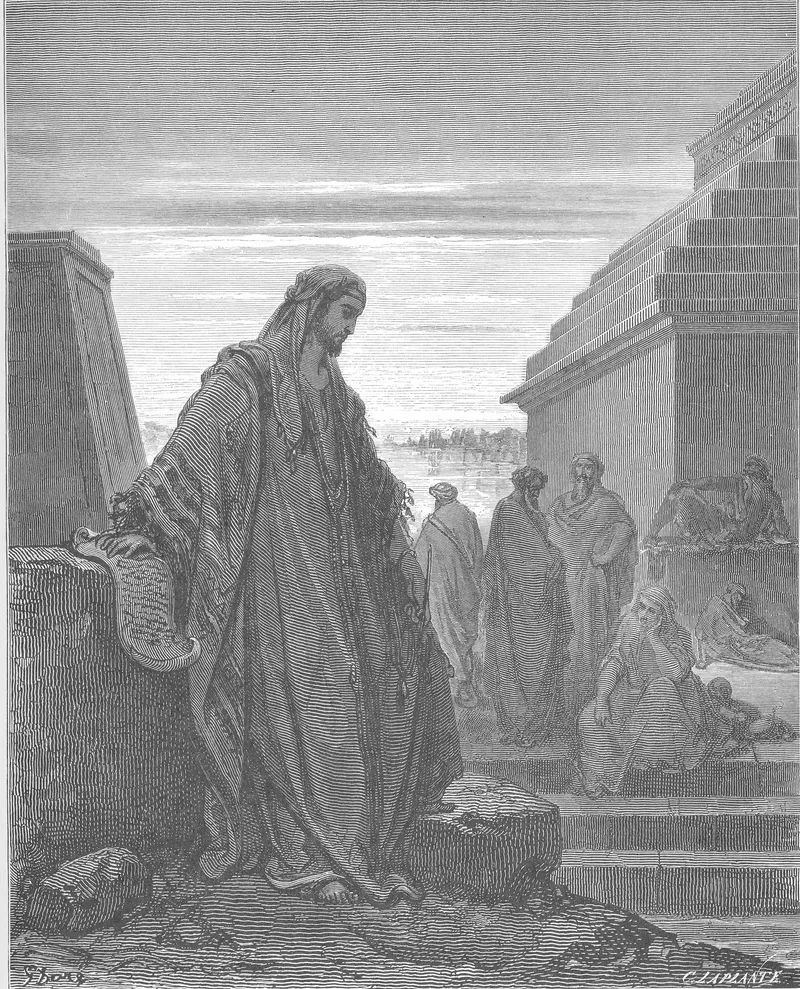
Luke 16:1-13Ye Cannot Serve God and Mammon
1And he said also unto his disciples, There was a certain rich man, which had a steward; and the same was accused unto him that he had wasted his goods. 2And he called him, and said unto him, How is it that I hear this of thee? give an account of thy stewardship; for thou mayest be no longer steward. 3Then the steward said within himself, What shall I do? for my lord taketh away from me the stewardship: I cannot dig; to beg I am ashamed. 4I am resolved what to do, that, when I am put out of the stewardship, they may receive me into their houses. 5So he called every one of his lord’s debtors unto him, and said unto the first, How much owest thou unto my lord? 6And he said, An hundred measures of oil. And he said unto him, Take thy bill, and sit down quickly, and write fifty. 7Then said he to another, And how much owest thou? And he said, An hundred measures of wheat. And he said unto him, Take thy bill, and write fourscore. 8And the lord commended the unjust steward, because he had done wisely: for the children of this world are in their generation wiser than the children of light.
The story is plain enough on its surface. A steward - the trusted manager of a wealthy man's estate, with authority to run the household and the books - is reported for wasting his master's goods, and is summoned to settle accounts before he is dismissed (vv. 1-2). He has no illusions about his prospects: I cannot dig; to beg I am ashamed (v. 3). Manual labour is beyond him and begging is beneath him, so he hits on a third way.
While he still holds the office and the seal, he calls in his master's debtors and writes down their bills - a hundred measures of oil cut to fifty, a hundred measures of wheat to fourscore (vv. 5-7). The exact mechanics have been debated for centuries; what the parable underlines is the man's aim, stated openly in verse 4: that… they may receive me into their houses. He is trading the wealth still passing through his hands for a future welcome.
When the books close he will be out of a job, but he will have a circle of grateful friends who owe him a favour. It is calculated, forward-looking self-interest.1
Then comes the line that has unsettled readers ever since: And the lord commended the unjust steward, because he had done wisely (v. 8). It is vital to hear exactly what is praised. The man is still called the unjust steward - his dishonesty is never softened or excused. What earns the commendation is his shrewdness: he read his situation clearly, grasped that his comfortable days were ending, and acted decisively, while he still could, to secure his future.
Jesus draws the contrast Himself: the children of this world are in their generation wiser than the children of light. Worldly people, He observes, are often startlingly clever and energetic about their own short-term advantage - far more clever than God's people tend to be about what matters most and lasts longest. The point is a rebuke aimed at spiritual sleepiness, not an invitation to imitate the man's crookedness in any other way: if a dishonest manager will move heaven and earth to provide for a few years of earthly comfort, how much more should those who say they believe in eternity act with the same urgency and foresight toward it.
9And I say unto you, Make to yourselves friends of the mammon of unrighteousness; that, when ye fail, they may receive you into everlasting habitations. 10He that is faithful in that which is least is faithful also in much: and he that is unjust in the least is unjust also in much. 11If therefore ye have not been faithful in the unrighteous mammon, who will commit to your trust the true riches? 12And if ye have not been faithful in that which is another man’s, who shall give you that which is your own? 13No servant can serve two masters: for either he will hate the one, and love the other; or else he will hold to the one, and despise the other. Ye cannot serve God and mammon.
Now Jesus turns the parable into a charge for His own hearers: Make to yourselves friends of the mammon of unrighteousness; that, when ye fail, they may receive you into everlasting habitations (v. 9). The phrase mammon of unrighteousness is not a claim that money is inherently evil; it names wealth as it belongs to this passing, fallen order - the world's currency, tainted and temporary. The striking instruction is to use it - to spend it now, while it is in hand, in ways that make “friends” for the world to come.
The steward made friends who would receive him into their houses; Jesus speaks of everlasting habitations, a welcome that outlasts every earthly door. The word when ye fail is sobering and clarifying: a day is coming when money can do nothing for you, when it slips entirely out of reach. The wise person sees that day coming, as the steward saw his, and converts what cannot be kept into something that cannot be lost - mercy shown, needs met, the poor remembered, the kingdom served.
It is the same wisdom Jesus urges elsewhere: lay up treasure where it does not perish.2
From the single act Jesus draws a principle that reaches into every corner of life: He that is faithful in that which is least is faithful also in much: and he that is unjust in the least is unjust also in much (v. 10). Character is not divided into “small matters,” where it supposedly does not count, and “great matters,” where it suddenly does. The way a person handles a little money quietly reveals what they would do with much; faithfulness and faithlessness are whole-cloth, the same in the trifle and in the trust.
He sharpens it twice. First: If therefore ye have not been faithful in the unrighteous mammon, who will commit to your trust the true riches? (v. 11) - earthly wealth is the lesser, testing thing; the true riches, the spiritual and eternal good, are entrusted only to those proved trustworthy with the lesser. Second: if ye have not been faithful in that which is another man's, who shall give you that which is your own? (v. 12).
All our wealth is in a real sense another man's - entrusted to us by God, never finally owned by us. How we manage what belongs to Him now determines what He will give us to call truly our own. Money, in this teaching, is a test before it is a possession.
The section closes with a verdict that admits no compromise: No servant can serve two masters: for either he will hate the one, and love the other; or else he will hold to the one, and despise the other. Ye cannot serve God and mammon (v. 13). The picture is of a household slave, who belongs wholly to one master; divided ownership is simply impossible. Jesus applies it to the deepest allegiance of the heart.
The trouble is not that wealth is one good thing among many to be kept in balance; it is that wealth, served, becomes a rival lord that demands the whole self - your trust, your security, your waking thought, the basis on which you decide. A person can use money in the service of God, as verse 9 has just urged. But the moment money becomes the thing one truly serves, it has displaced God, for both lay total claim and neither will share the throne.
There is no neutral middle where a heart quietly serves both. One is loved and the other despised. The question every reader is left to answer is not whether they have money, but which of the two is actually their master.
Luke 16:14-18That Which Is Highly Esteemed Among Men
14And the Pharisees also, who were covetous, heard all these things: and they derided him. 15And he said unto them, Ye are they which justify yourselves before men; but God knoweth your hearts: for that which is highly esteemed among men is abomination in the sight of God. 16The law and the prophets were until John: since that time the kingdom of God is preached, and every man presseth into it. 17And it is easier for heaven and earth to pass, than one tittle of the law to fail. 18Whosoever putteth away his wife, and marrieth another, committeth adultery: and whosoever marrieth her that is put away from her husband committeth adultery.
Luke now lets us see who is listening at the edge of the crowd, and how they take it: And the Pharisees also, who were covetous, heard all these things: and they derided him (v. 14). The little note who were covetous is the hinge. Jesus has just said no one can serve God and mammon, and the men who pride themselves on serving God turn out to love money - so they sneer. The word derided is strong; literally it pictures turning up the nose, a contemptuous scoffing.
They cannot answer the teaching, so they ridicule the teacher. It is a revealing reaction, the way a charge that lands often provokes mockery rather than repentance. And it exposes the very split Jesus has been describing: outwardly devout, inwardly bound to wealth, they are living proof that a heart can claim God with the lips while serving mammon underneath. Their scorn is not the calm dismissal of people untouched by what they heard; it is the defensive laughter of people stung by it.
Jesus answers the scoffing by going straight past the performance to the heart: Ye are they which justify yourselves before men; but God knoweth your hearts (v. 15). Here is the difference between a reputation and a reality. The Pharisees were experts at justifying themselves before men - managing appearances, collecting the approval of the crowd, looking righteous in every public way. But appearances are exactly what God sees through: God knoweth your hearts. Then comes one of the most overturning sentences in the Gospels: that which is highly esteemed among men is abomination in the sight of God. It says the world's scale of worth can be precisely inverted before God - that the very things people prize and applaud, the wealth and status and self-made righteousness that win human esteem, can be detestable to Him.
It is a warning to anyone who measures a life by what impresses others. The crowd's admiration is no evidence of God's approval; the two judgments run on entirely different currencies, and they can point in opposite directions.
The next sayings can feel abrupt, but they hold together around the authority of God's word against the self-justifying religion Jesus has just exposed. The law and the prophets were until John: since that time the kingdom of God is preached, and every man presseth into it (v. 16). A great turning point has come: the long era of the law and the prophets pointing forward has given way to the announced arrival of the kingdom, and crowds are pressing eagerly into it.
But lest anyone hear “the law was until John” as if God's standard had simply expired, Jesus immediately guards it: it is easier for heaven and earth to pass, than one tittle of the law to fail (v. 17). A tittle is the smallest stroke of a Hebrew letter; sooner will the entire universe collapse than the least detail of God's word fall to the ground. The kingdom does not abolish God's righteousness; it fulfils and upholds it.
Then He gives a pointed example in verse 18, on the permanence and seriousness of the marriage bond - a place where the self-justifying were skilled at finding loopholes the law never truly gave. The thread running through all three verses is one rebuke: you cannot use clever religion to evade the abiding claim of what God has said.
Luke 16:19-31The Rich Man and Lazarus
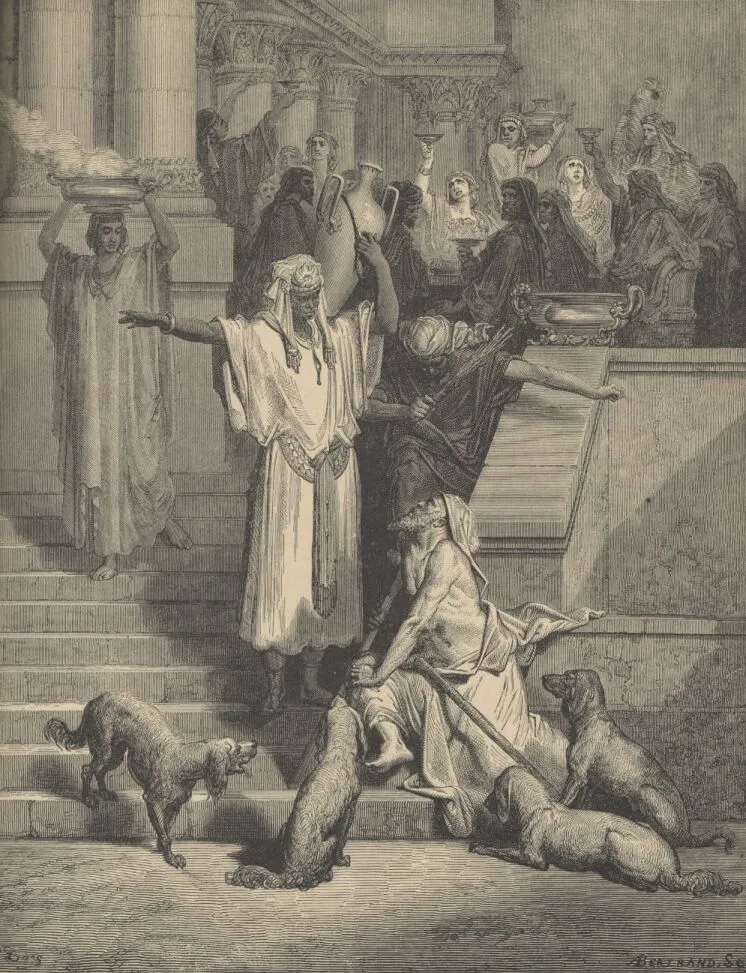
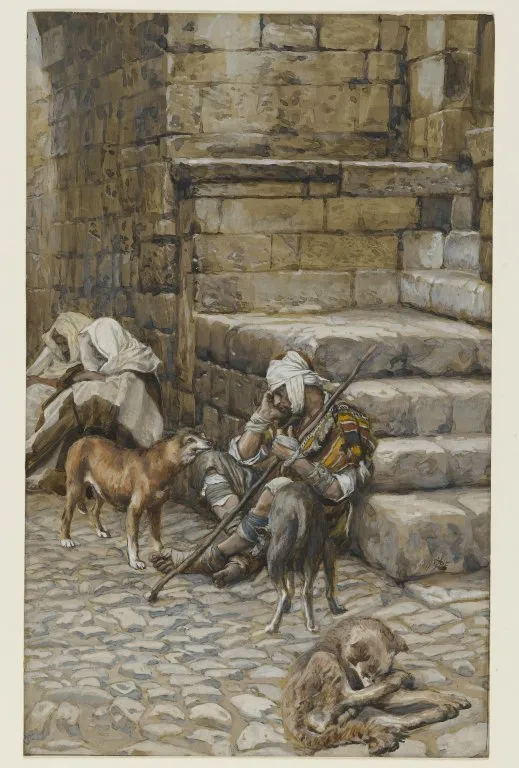
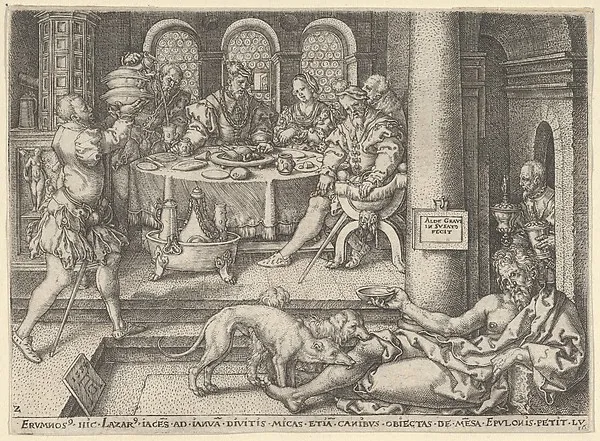
19There was a certain rich man, which was clothed in purple and fine linen, and fared sumptuously every day: 20And there was a certain beggar named Lazarus, which was laid at his gate, full of sores, 21And desiring to be fed with the crumbs which fell from the rich man’s table: moreover the dogs came and licked his sores. 22And it came to pass, that the beggar died, and was carried by the angels into Abraham’s bosom: the rich man also died, and was buried; 23And in hell he lift up his eyes, being in torments, and seeth Abraham afar off, and Lazarus in his bosom.
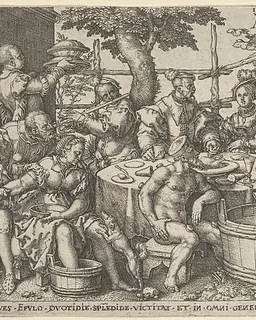
The parable opens on a portrait of two lives lived a few feet apart and a world away from each other. The rich man is clothed in purple and fine linen, and fared sumptuously every day (v. 19). Purple was the costliest of dyes, the colour of royalty; fine linen was luxury underclothing; and the feasting is not occasional but every day - a life of unbroken, effortless indulgence. At his very gate lies the other man: a certain beggar named Lazarus… full of sores, and desiring to be fed with the crumbs which fell from the rich man's table: moreover the dogs came and licked his sores (vv. 20-21).
The detail is deliberate and devastating. Lazarus is named - the only character in any of Jesus' parables to be given a name - while the rich man, for all his splendour, is anonymous. The beggar longs merely for the scraps; he is so helpless he cannot even drive off the dogs. And the gate is the point: the rich man did not have to travel to find suffering. It lay at his own doorstep, daily, and he stepped past it.
The parable never says he was cruel to Lazarus. His sin is quieter and more familiar than cruelty - he simply did not see, or chose not to, the man dying within reach of his table.
Then, in a single verse, everything turns: And it came to pass, that the beggar died, and was carried by the angels into Abraham's bosom: the rich man also died, and was buried (v. 22). Death comes to both, as it comes to all, and on the far side of it the two positions are exactly reversed. The beggar, who had no one in life, is carried by the angels - escorted, honoured, gathered up - into Abraham's bosom, an image of the most intimate welcome and rest, the place of nearness at a feast, gathered to the father of the faithful.
The rich man, who had everything, is given one bare phrase: he died, and was buried. No angels are named; he simply goes down. And in hell he lift up his eyes, being in torments, and seeth Abraham afar off, and Lazarus in his bosom (v. 23). The man who had looked past Lazarus at his gate now sees him plainly, and sees him comforted and near, while he himself is in torment and afar off. The reversal is total.
The gate that once separated the feasting man from the dying man has become a far greater divide, and now it is the rich man who is outside, looking in. Jesus does not pause to chart the geography of the world beyond; he simply lets the picture land with its full weight - that how we live now, toward God and toward the beggar at our gate, carries an eternal seriousness we ignore at our peril.
24And he cried and said, Father Abraham, have mercy on me, and send Lazarus, that he may dip the tip of his finger in water, and cool my tongue; for I am tormented in this flame. 25But Abraham said, Son, remember that thou in thy lifetime receivedst thy good things, and likewise Lazarus evil things: but now he is comforted, and thou art tormented. 26And beside all this, between us and you there is a great gulf fixed: so that they which would pass from hence to you cannot; neither can they pass to us, that would come from thence.
From his torment the rich man calls out, and even now his words reveal him: Father Abraham, have mercy on me, and send Lazarus, that he may dip the tip of his finger in water, and cool my tongue (v. 24). He still sees Lazarus as a servant to be dispatched on his errands - the old order of his mind unchanged. Abraham's reply is firm but not cruel; he calls him Son, and answers with quiet justice: remember that thou in thy lifetime receivedst thy good things, and likewise Lazarus evil things: but now he is comforted, and thou art tormented (v. 25).
The word remember is heavy. The rich man is asked to look back on a lifetime in which he had everything and Lazarus had nothing, and to see the reversal as the righting of a long imbalance. Then Abraham names a second, deeper reason nothing can be sent across: between us and you there is a great gulf fixed: so that they which would pass from hence to you cannot; neither can they pass to us, that would come from thence (v. 26).
The divide is fixed - settled, permanent, impassable from either side. The parable presses one solemn note here without drawing any map beyond it: there is a finality to be reckoned with, a point past which the choices of a lifetime can no longer be revised. The urgency the whole chapter has been building toward is exactly this - that the time to hear and turn is now, on this side of the gulf.1
27Then he said, I pray thee therefore, father, that thou wouldest send him to my father’s house: 28For I have five brethren; that he may testify unto them, lest they also come into this place of torment. 29Abraham saith unto him, They have Moses and the prophets; let them hear them. 30And he said, Nay, father Abraham: but if one went unto them from the dead, they will repent. 31And he said unto him, If they hear not Moses and the prophets, neither will they be persuaded, though one rose from the dead.
The rich man's last plea is, on its face, almost sympathetic: I pray thee therefore, father, that thou wouldest send him to my father's house: for I have five brethren; that he may testify unto them, lest they also come into this place of torment (vv. 27-28). He wants his brothers warned before it is too late for them - and behind the request lies the unspoken complaint that he himself was somehow not warned, that a spectacular sign might have changed his course.
Abraham's answer cuts straight through it: They have Moses and the prophets; let them hear them (v. 29). The brothers already have the Scriptures - the law and the prophets that speak, on page after page, of God, of justice, of mercy to the poor, of the life that pleases Him. The rich man protests that ordinary Scripture is not enough: Nay, father Abraham: but if one went unto them from the dead, they will repent (v. 30).
He is sure a miracle would do what the word could not. And here the parable delivers its final, piercing verdict: If they hear not Moses and the prophets, neither will they be persuaded, though one rose from the dead (v. 31).
That closing line is the key to the whole chapter, and it must be heard carefully. The problem with the rich man and his brothers was never a shortage of evidence; it was a heart that would not listen to what God had already plainly said. They have Moses and the prophets; let them hear them. God's own word is sufficient to lead a person to repentance - the trouble is always an unwilling hearer, never a weak word.
And the diagnosis is sobering: a heart set against the Scriptures it already has will not be turned even by a man rising from the dead. The spectacular does not soften what the steady word of God could not soften; a will that has refused the light it has will explain away the light it is given. There is a deep and deliberate irony folded into that last sentence, which Jesus speaks knowing what lies ahead of Him.
He Himself is the One who would rise from the dead - and Moses and the prophets, He would later show His own disciples, were writing about Him all along (Luke 24:27, 44). The line quietly foretells the tragedy that even a resurrection would be met, by many, not with faith but with refusal. The call of the parable is therefore as simple as it is urgent: do not wait for a sign you would only explain away.
Hear the word of God now, and let it turn you, while it is still today.
Research trail
Sources & further study
These references support the historical, linguistic, manuscript, and contextual notes in this chapter. Scripture remains the primary text; external sources are provided so readers can inspect the research directly.
- Luke 16 - Translators' NotesThe NET Bible's detailed footnotes on Luke 16 - the dishonest steward's scheme and the much-discussed commendation in verse 8, the meaning of “mammon” and “everlasting habitations” (v. 9), and the imagery of Abraham's bosom, torment, and the fixed gulf in the parable of the rich man and Lazarus.
- Luke 16 ↔ Matthew 6 · Luke 1 & 6 · DeuteronomyTraces the threads tying Luke 16 to the rest of Scripture - the impossibility of two masters (v. 13) read beside where your treasure is (Matt. 6:21), the great reversal of the rich and the poor (vv. 19-25) read alongside the song of Mary (Luke 1:53) and the woes of Luke 6:24, and Moses and the prophets (vv. 29-31) read with the law's own warnings.
- Luke 16 · Greek interlinear + lexiconThe Greek text of Luke 16 word by word, each term linked to its lexicon entry - useful for mamonas (vv. 9, 11, 13, “mammon”), the oikonomos and oikonomia of the steward and his stewardship (vv. 1-4), and chasma (v. 26), the “great gulf” fixed between the two men.
Where this echoes in Scripture
Ye Cannot Serve God and Mammon
- Matthew 6:19-21Lay not up for yourselves treasures upon earth... But lay up for yourselves treasures in heaven... For where your treasure is, there will your heart be also.The wisdom of verse 9 spelled out - storing what we have where it cannot perish, because the heart follows the treasure.
- Matthew 6:24No man can serve two masters... Ye cannot serve God and mammon.The same verdict as verse 13 - the impossibility of a heart divided between God and wealth.
- Luke 12:33-34Sell that ye have, and give alms; provide yourselves bags which wax not old, a treasure in the heavens that faileth not.The “everlasting habitations” of verse 9 - treasure moved into the world to come, beyond the reach of failure.
- Matthew 25:21Well done, thou good and faithful servant: thou hast been faithful over a few things, I will make thee ruler over many things.The principle of verse 10 - faithfulness in the least proving the soul for much.
- 1 Timothy 6:9-10They that will be rich fall into temptation and a snare... for the love of money is the root of all evil.Why mammon makes such a dangerous master (v. 13) - the love of it pierces and ensnares.
That Which Is Highly Esteemed Among Men
- Luke 1:51-53He hath put down the mighty from their seats, and exalted them of low degree. He hath filled the hungry with good things; and the rich he hath sent empty away.The reversal of human esteem in verse 15 - sung at the Gospel's start and pictured at its center.
- 1 Samuel 16:7For the LORD seeth not as man seeth; for man looketh on the outward appearance, but the LORD looketh on the heart.The truth behind verse 15 - God reads the heart, looking past the reputation men admire.
- Luke 18:9-14God be merciful to me a sinner... this man went down to his house justified rather than the other.The self-justification of verse 15 answered - the one who would not justify himself is the one God justifies.
- Matthew 5:17-18Think not that I am come to destroy the law, or the prophets... one jot or one tittle shall in no wise pass from the law, till all be fulfilled.The permanence of the law in verse 17 - upheld and fulfilled by the kingdom.
- Malachi 2:16For the LORD, the God of Israel, saith that he hateth putting away.The seriousness of the marriage bond in verse 18 - a place the self-justifying sought loopholes God never gave.
The Rich Man and Lazarus
- Luke 6:20-24Blessed be ye poor: for yours is the kingdom of God... But woe unto you that are rich! for ye have received your consolation.The reversal of the parable (vv. 22-25) announced as a blessing and a woe.
- James 5:1-5Go to now, ye rich men, weep and howl for your miseries... Ye have lived in pleasure on the earth, and been wanton.The peril of the man who fared sumptuously every day (v. 19) - pleasure spent now, a reckoning to come.
- Luke 24:27And beginning at Moses and all the prophets, he expounded unto them in all the scriptures the things concerning himself.The “Moses and the prophets” of verses 29 and 31 - the Scriptures that spoke of the One who would rise.
- John 12:9-11But the chief priests consulted that they might put Lazarus also to death.The irony of verse 31 lived out - another Lazarus raised, met by the hardened with plots rather than faith.
- Deuteronomy 15:7-11Thou shalt open thine hand wide unto thy brother, to thy poor, and to thy needy, in thy land.What Moses and the prophets already said (v. 29) - the care for the poor the rich man stepped past at his gate.