Matthew 25
People in this chapter
Matthew 25 is the last movement of Jesus' final great discourse, spoken to His disciples on the Mount of Olives as the cross drew near. The previous chapter ended with a charge to watch, because the Son of man comes at an hour no one expects; now that single word unfolds into three pictures, each turning the same truth a different way. The first is a wedding. Then shall the kingdom of heaven be likened unto ten virgins, which took their lamps, and went forth to meet the bridegroom (v. 1).
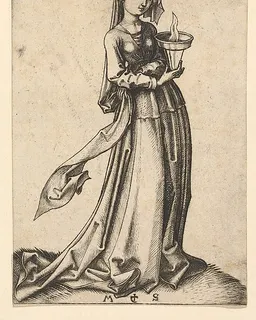
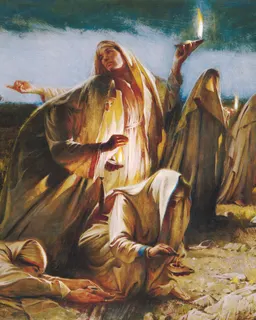
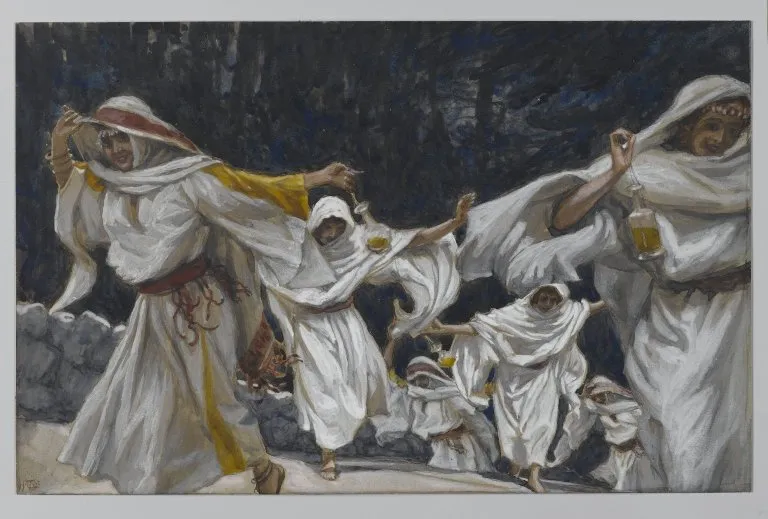
Five are wise and carry oil in their vessels; five are foolish and carry none. The bridegroom tarries, all of them sleep, and at midnight a cry splits the dark: Behold, the bridegroom cometh; go ye out to meet him (v. 6). The wise are ready; the foolish are not; and the door was shut.1
Tap any highlighted phrase to jump to the commentary that unpacks it.
Matthew 25:1-13Behold, the Bridegroom Cometh
1Then shall the kingdom of heaven be likened unto ten virgins, which took their lamps, and went forth to meet the bridegroom. 2And five of them were wise, and five were foolish. 3They that were foolish took their lamps, and took no oil with them: 4But the wise took oil in their vessels with their lamps. 5While the bridegroom tarried, they all slumbered and slept. 6And at midnight there was a cry made, Behold, the bridegroom cometh; go ye out to meet him. 7Then all those virgins arose, and trimmed their lamps. 8And the foolish said unto the wise, Give us of your oil; for our lamps are gone out. 9But the wise answered, saying, Not so; lest there be not enough for us and you: but go ye rather to them that sell, and buy for yourselves. 10And while they went to buy, the bridegroom came; and they that were ready went in with him to the marriage: and the door was shut. 11Afterward came also the other virgins, saying, Lord, Lord, open to us. 12But he answered and said, Verily I say unto you, I know you not. 13Watch therefore, for ye know neither the day nor the hour wherein the Son of man cometh.
The picture is an ordinary one to the first hearers and strange to us, so it helps to see it as they did. A wedding in that world centered on the night the bridegroom came in procession to bring his bride to the marriage feast, and the young women of the wedding party went out with lamps to meet him and escort him in by torchlight. Ten of them wait here. Five of them were wise, and five were foolish (v. 2), and the whole parable turns on a single, almost invisible difference between them.
It is not that the foolish had no lamps - they did. It is not that they had no intention of meeting the bridegroom - they went out for that very purpose. The difference is one detail: They that were foolish took their lamps, and took no oil with them: but the wise took oil in their vessels with their lamps (vv. 3-4). The wise made provision for a delay they could not see coming; the foolish assumed the night would go as planned.
From the outside, before midnight, the two groups looked identical. The gap between them showed only when the test came.1
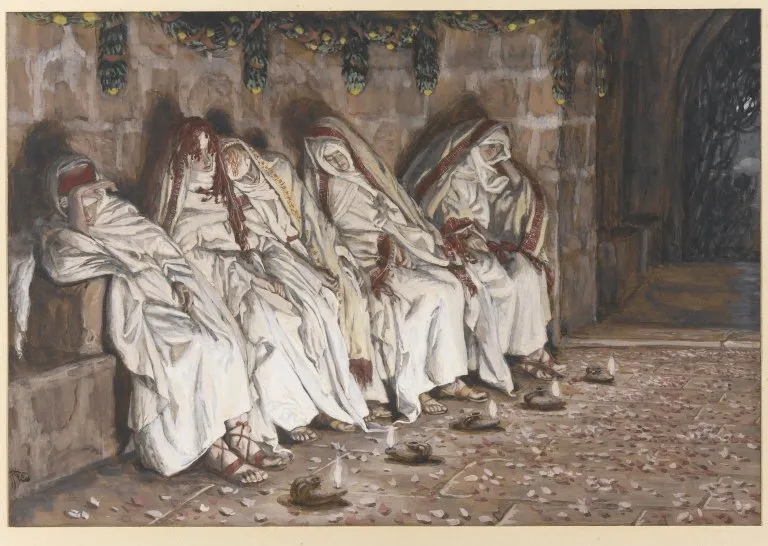
The next note is easy to pass over but carries the weight of the parable: While the bridegroom tarried, they all slumbered and slept (v. 5). The bridegroom is late - later than anyone expected - and all of them, wise and foolish alike, grow drowsy and fall asleep. The parable does not scold the sleeping. The fault is never that they slept; both groups did. The delay is part of the design, and so is the night.
Then, with no warning, the dark is torn open: And at midnight there was a cry made, Behold, the bridegroom cometh; go ye out to meet him (v. 6). Midnight is the hour of deepest sleep, the least likely hour, the hour no one stays awake bracing for. That is exactly the point. The summons does not come at a convenient moment after long notice; it comes suddenly, in the middle of the night, when half the party is unready.
And in that instant the quiet provision made hours earlier - the oil in the vessels - becomes the only thing that matters.
Now the difference that was hidden all evening comes to light. Then all those virgins arose, and trimmed their lamps. And the foolish said unto the wise, Give us of your oil; for our lamps are gone out (vv. 7-8). The foolish are not careless about the bridegroom at the end - they are frantic to be ready. But readiness, the parable says plainly, cannot be transferred at the last minute. Not so; lest there be not enough for us and you (v. 9): this is the wise being honest about the plain limits of what can be shared.
Some things genuinely cannot be lent. A character formed over years, a faith that has put down roots, a life that has actually been lived toward God - these cannot be borrowed in the panic of the final hour from someone who has them. So the foolish run to buy, and in their absence the one thing they feared happens: the bridegroom came; and they that were ready went in with him to the marriage: and the door was shut (v. 10).
The shut door is the hardest image in the parable. There is a moment after which the answer to Lord, Lord, open to us is the dreadful I know you not (vv. 11-12) - the same words by which, earlier in this Gospel, Jesus warns that not everyone who says Lord, Lord enters the kingdom. The point is not cruelty; it is urgency. There is such a thing as too late, and love warns about it precisely because it is love.
Jesus draws the lesson Himself, and it governs all three pictures in the chapter: Watch therefore, for ye know neither the day nor the hour wherein the Son of man cometh (v. 13). The command is to be the kind of person who is ready whenever the day comes, the day the parable has just shown cannot be calculated. Notice what watching turns out to mean. To watch, in the parable's own terms, is to have made provision - to have the oil already in the vessel before the cry goes up.
It is a readiness built into ordinary life ahead of time, so that whenever the summons comes, at whatever hour, nothing essential is missing. The unknown hour is not a threat to frighten but a mercy that keeps the heart awake. A servant who knew the exact day might grow careless until the eve of it; a servant who does not know lives ready always. That is the whole counsel of the ten virgins: keep the lamp trimmed and the oil laid in, today, while it is still only an ordinary evening.
Matthew 25:14-30Well Done, Thou Good and Faithful Servant
14For the kingdom of heaven is as a man travelling into a far country, who called his own servants, and delivered unto them his goods. 15And unto one he gave five talents, to another two, and to another one; to every man according to his several ability; and straightway took his journey. 16Then he that had received the five talents went and traded with the same, and made them other five talents. 17And likewise he that had received two, he also gained other two. 18But he that had received one went and digged in the earth, and hid his lord’s money. 19After a long time the lord of those servants cometh, and reckoneth with them. 20And so he that had received five talents came and brought other five talents, saying, Lord, thou deliveredst unto me five talents: behold, I have gained beside them five talents more. 21His lord said unto him, Well done, thou good and faithful servant: thou hast been faithful over a few things, I will make thee ruler over many things: enter thou into the joy of thy lord. 22He also that had received two talents came and said, Lord, thou deliveredst unto me two talents: behold, I have gained two other talents beside them. 23His lord said unto him, Well done, good and faithful servant; thou hast been faithful over a few things, I will make thee ruler over many things: enter thou into the joy of thy lord. 24Then he which had received the one talent came and said, Lord, I knew thee that thou art an hard man, reaping where thou hast not sown, and gathering where thou hast not strawed: 25And I was afraid, and went and hid thy talent in the earth: lo, there thou hast that is thine. 26His lord answered and said unto him, Thou wicked and slothful servant, thou knewest that I reap where I sowed not, and gather where I have not strawed: 27Thou oughtest therefore to have put my money to the exchangers, and then at my coming I should have received mine own with usury. 28Take therefore the talent from him, and give it unto him which hath ten talents. 29For unto every one that hath shall be given, and he shall have abundance: but from him that hath not shall be taken away even that which he hath. 30And cast ye the unprofitable servant into outer darkness: there shall be weeping and gnashing of teeth.
The second parable shifts the figure from a wedding to a household and its accounts. A man travelling into a far country calls his servants and hands his property over to them while he is gone: unto one he gave five talents, to another two, and to another one; to every man according to his several ability (vv. 14-15). Two things in this opening govern everything that follows. First, the goods are his - the servants own nothing; they are trusted with what belongs to the master, to manage in his absence.
Second, the amounts differ, and they differ according to his several ability. The master is not careless or arbitrary; he weighs each servant and entrusts to each what that servant can handle. This quietly answers a complaint before it can be raised. No one is set up to fail by being handed more than he can carry, and no one is excused on the ground that he was given too little to bother with. Each receives a real trust, suited to him, and each is responsible for exactly that - not for what the others received.1
The response of the first two servants is told quickly and without fanfare, which is part of the point: he that had received the five talents went and traded with the same, and made them other five talents. And likewise he that had received two, he also gained other two (vv. 16-17). They go to work straightway. They take a risk with what they were given - trading means exposure, the possibility of loss - because the master plainly wanted the goods used, not warehoused.
And they each double their trust. Notice that the parable will praise the two of them in identical words even though one produced five fresh talents and the other only two. The amount gained is not the measure; the faithfulness is. The third servant breaks the pattern: he that had received one went and digged in the earth, and hid his lord's money (v. 18). Burying money was a recognized way to keep it safe in that world - safe, but sterile.
He guards the talent perfectly and accomplishes nothing with it. He confuses not losing the master's money with serving the master, and the two turn out to be very different things.
After a long time the master returns and reckons with each servant, and the heart of the parable is in what the third servant says: Lord, I knew thee that thou art an hard man, reaping where thou hast not sown, and gathering where thou hast not strawed: and I was afraid, and went and hid thy talent in the earth (vv. 24-25). Everything wrong begins here, in how he pictured his master. He did not see a generous lord who had entrusted him with real wealth; he saw a hard, grasping man impossible to please, from whom the safest course was to risk nothing and simply hand back what he was given.
His fear was suspicion, and it paralyzed him. The master's reply meets him on his own terms: Thou knewest that I reap where I sowed not… Thou oughtest therefore to have put my money to the exchangers (vv. 26-27). Even granting the servant's grim view, his own logic condemns him - if he truly believed the master wanted a return, the least he could have done was lodge the money with the bankers to earn interest.
But he did nothing at all. The deepest failure of this servant is not a bad investment; it is a false picture of his lord that turned a gift into a burden and froze him into inaction.
The reckoning ends with a hard saying and a harder sentence. For unto every one that hath shall be given, and he shall have abundance: but from him that hath not shall be taken away even that which he hath (v. 29). This is a comment on trust used or refused: what is exercised grows, and what is buried is finally forfeited - the unused talent is taken and given to the one who showed he would use it.
Then the verdict: cast ye the unprofitable servant into outer darkness: there shall be weeping and gnashing of teeth (v. 30). The word unprofitable is exact. His sin was not that he squandered or stole; it was that he produced nothing, that he was given a trust and rendered it fruitless. The parable will not let us treat the buried life as harmless or neutral. To be handed something of the master's and to do nothing with it, out of a fearful and false estimate of him, is itself the failure.
Set against the joy of the faithful, the outer darkness is the bleak opposite of being welcomed into the master's gladness - the self-chosen end of a servant who never trusted his lord enough to risk anything for him.
Matthew 25:31-40The Least of These My Brethren
31When the Son of man shall come in his glory, and all the holy angels with him, then shall he sit upon the throne of his glory: 32And before him shall be gathered all nations: and he shall separate them one from another, as a shepherd divideth his sheep from the goats: 33And he shall set the sheep on his right hand, but the goats on the left. 34Then shall the King say unto them on his right hand, Come, ye blessed of my Father, inherit the kingdom prepared for you from the foundation of the world: 35For I was an hungred, and ye gave me meat: I was thirsty, and ye gave me drink: I was a stranger, and ye took me in: 36Naked, and ye clothed me: I was sick, and ye visited me: I was in prison, and ye came unto me. 37Then shall the righteous answer him, saying, Lord, when saw we thee an hungred, and fed thee? or thirsty, and gave thee drink? 38When saw we thee a stranger, and took thee in? or naked, and clothed thee? 39Or when saw we thee sick, or in prison, and came unto thee? 40And the King shall answer and say unto them, Verily I say unto you, Inasmuch as ye have done it unto one of the least of these my brethren, ye have done it unto me.
The discourse now drops the language of parable and shows the day itself. When the Son of man shall come in his glory, and all the holy angels with him, then shall he sit upon the throne of his glory (v. 31). The titles gather here at the climax. The same Son of man whose hour was unknown in the first parable, the same lord who returned to reckon in the second, now comes in his glory, attended by all the holy angels, and takes His seat on a throne.
The picture reaches back to the prophet's vision of one like the Son of man brought before the Ancient of days and given dominion, and glory, and a kingdom, that all people, nations, and languages, should serve him (Dan. 7:13-14). And it widens the scene as far as it can go: before him shall be gathered all nations. Not one people but every people; not a sample but the whole human family.
The One who was born in a stable and is, even as He speaks these words, days from the cross, describes Himself enthroned over the gathered nations of the earth. Everything that follows happens in the light of that throne.2
The King's first act is to divide: he shall separate them one from another, as a shepherd divideth his sheep from the goats. And he shall set the sheep on his right hand, but the goats on the left (vv. 32-33). The image would have been ordinary to His hearers - sheep and goats grazed together by day and were routinely parted by the shepherd - and it carries an echo of Ezekiel, where the LORD declares, I judge between cattle and cattle, between the rams and the he goats (Ezek. 34:17).
Two things stand out. First, the mingled flock is separated by the shepherd, by his own discernment; the sheep and goats do not sort themselves. Through this whole life the two have grazed side by side, often indistinguishable to the eye, and only at the end does the Shepherd part them with perfect knowledge of which is which. Second, the right hand is the place of favor and blessing. To the sheep gathered there the King speaks words of stunning welcome: Come, ye blessed of my Father, inherit the kingdom prepared for you from the foundation of the world (v. 34).
The kingdom is not a wage scraped together at the last; it is an inheritance, prepared for them before the world began - a gift long in the making, now at last received.
Then the King says what the blessed had done, and the list is striking for how humble it is. Not great exploits, not public triumphs - six plain acts of mercy toward people in need: I was an hungred, and ye gave me meat: I was thirsty, and ye gave me drink: I was a stranger, and ye took me in: Naked, and ye clothed me: I was sick, and ye visited me: I was in prison, and ye came unto me (vv. 35-36).
Food, drink, welcome, clothing, presence in sickness, presence in prison: ordinary kindnesses, the kind anyone could do, done to people the world easily overlooks. And the response of the righteous is the most beautiful detail in the scene. They are surprised. Lord, when saw we thee an hungred, and fed thee?… When saw we thee a stranger, and took thee in? (vv. 37-38). They do not remember doing these things for the King, because they never did them for credit or reward at all.
Their mercy was so unselfconscious, so much the natural overflow of who they had become, that they cannot recall it as a tally of merit. This is the very signature of true righteousness in the parable: it does good without keeping score, helps without calculating return, and is genuinely astonished to learn that any of it was noticed. The deeds are not a price the righteous paid to enter; they are the evidence of a heart already made new, fruit they were scarcely aware of bearing.
Matthew 25:41-46Everlasting Punishment, Life Eternal
41Then shall he say also unto them on the left hand, Depart from me, ye cursed, into everlasting fire, prepared for the devil and his angels: 42For I was an hungred, and ye gave me no meat: I was thirsty, and ye gave me no drink: 43I was a stranger, and ye took me not in: naked, and ye clothed me not: sick, and in prison, and ye visited me not. 44Then shall they also answer him, saying, Lord, when saw we thee an hungred, or athirst, or a stranger, or naked, or sick, or in prison, and did not minister unto thee? 45Then shall he answer them, saying, Verily I say unto you, Inasmuch as ye did it not to one of the least of these, ye did it not to me. 46And these shall go away into everlasting punishment: but the righteous into life eternal.
The King now turns to those on His left, and the words are as heavy as His welcome was warm: Depart from me, ye cursed, into everlasting fire, prepared for the devil and his angels (v. 41). Two things in the verse deserve careful attention. First, the destiny named was prepared for the devil and his angels - not first or primarily for people. The blessed inherit a kingdom prepared… from the foundation of the world (v. 34); this end was made for the powers of evil.
The contrast is deliberate and sobering: one fate is the long-prepared gift of the Father; the other is a doom that was never meant to be the human portion, yet which some come to share. Second, the sentence is grave, and it should be left with the gravity the King Himself gives it. He does not pause to systematize the nature or duration of that fire, and neither should we hurry to. The text speaks plainly of a real and terrible separation from the King - Depart from me - and it is enough, and more than enough, to take that warning with the seriousness He plainly intends.
He who spoke these words wept over those who would not come to Him; the warning is the voice of the same love that pleads.
The charge against the goats is told in the very same words as the praise of the sheep, but reversed at every point: I was an hungred, and ye gave me no meat: I was thirsty, and ye gave me no drink: I was a stranger, and ye took me not in (vv. 42-43). The symmetry is the lesson. Their condemnation does not rest on cruelty or violence; no crime is named. It rests on what they did not do - the meat not given, the stranger not welcomed, the sick not visited.
This is the sin of omission laid bare, and the parable refuses to treat it as a small thing. And like the righteous, the lost are surprised: Lord, when saw we thee an hungred, or athirst, or a stranger, or naked, or sick, or in prison, and did not minister unto thee? (v. 44). But their surprise is the mirror image of the sheep's. The righteous could not remember helping the King; the lost cannot remember neglecting Him - because in both cases they were simply being what they had become.
The merciful overlooked their own mercy; the unmerciful never saw the need at all, or saw it and passed by. The King's answer is the same sentence read the other way: Inasmuch as ye did it not to one of the least of these, ye did it not to me (v. 45). To pass by the least was, all along, to pass by Him.
The whole discourse - three parables, three pictures of one day - comes to rest on a single verse that allows no third way: And these shall go away into everlasting punishment: but the righteous into life eternal (v. 46). The two destinies are set side by side with a deliberate balance, the same weighty word standing over both: everlasting punishment, eternal life. The verse is given to make the present moment serious. Everything in the chapter has been pressing toward this - the oil that must be laid in before midnight, the talent that must be put to work before the master returns, the mercy that must be shown before the throne is set - and now the reason is plain.
What is decided here is not small or reversible; it opens onto life or onto loss, and it opens forever. The right response is not to speculate about the far country but to hear the warning where we stand and turn toward the King while it is still today. The parable closes the discourse exactly where it began: Watch. Be ready. The day is real, the King is coming, and the two roads do not meet.
Research trail
Sources & further study
These references support the historical, linguistic, manuscript, and contextual notes in this chapter. Scripture remains the primary text; external sources are provided so readers can inspect the research directly.
- Matthew 25 - Translators' NotesThe NET Bible's detailed footnotes on Matthew 25 - the wedding customs behind the ten virgins (vv. 1-13), the size and value of a talent (v. 15), the difficult charge that the buried talent be given to the one who already has ten (vv. 28-29), and the sheep-and-goats scene that closes the discourse.
- Matthew 25 ↔ Daniel 7 · Ezekiel 34 · Proverbs 19Traces the threads tying Matthew 25 to the rest of Scripture - the Son of man enthroned over the nations (vv. 31-32) read beside Daniel 7:13-14, the shepherd dividing the flock (v. 32) beside Ezekiel 34:17, and the King hidden in the poor (v. 40) beside he that hath pity upon the poor lendeth unto the LORD (Prov. 19:17).
- Matthew 25 · Greek interlinearThe Greek text of Matthew 25 word by word, with parsing and Strong's numbers - useful for talanton (vv. 15-28, the “talent,” an enormous sum), for phronimos (vv. 2, 4, 8, 9, the “wise” that is practical foresight), and for elachiston (v. 40, “the least,” the smallest and most easily overlooked).
Where this echoes in Scripture
Behold, the Bridegroom Cometh
- Matthew 7:21-23Not every one that saith unto me, Lord, Lord, shall enter into the kingdom of heaven... I never knew you.The same words as verses 11-12 - the shut door and the dreadful “I know you not.”
- Matthew 24:42-44Watch therefore: for ye know not what hour your Lord doth come... in such an hour as ye think not the Son of man cometh.The charge of verse 13, sounded just before this parable - readiness for an unknown hour.
- Revelation 19:7-9the marriage of the Lamb is come, and his wife hath made herself ready... Blessed are they which are called unto the marriage supper of the Lamb.The wedding feast the virgins wait for (v. 10) - the marriage of the Lamb at the end of all things.
- Luke 12:35-36Let your loins be girded about, and your lights burning; and ye yourselves like unto men that wait for their lord.The same image as verses 1-7 - servants with lamps burning, watching for the master's return.
- Amos 8:11-12they shall run to and fro to seek the word of the LORD, and shall not find it.The tragedy of verses 8-10 - seeking, at last, what can no longer be found in time.
Well Done, Thou Good and Faithful Servant
- Luke 19:12-26a certain nobleman went into a far country... Well, thou good servant: because thou hast been faithful in a very little, have thou authority over ten cities.The parallel parable of the pounds - the same trust, reckoning, and reward as verses 14-30.
- 1 Corinthians 4:2Moreover it is required in stewards, that a man be found faithful.The single standard the master applies in verses 21 and 23: faithfulness with what was given.
- 1 Peter 4:10As every man hath received the gift, even so minister the same one to another, as good stewards of the manifold grace of God.The trust of verse 15 lived out - gifts received are gifts to be put to work.
- Matthew 13:12whosoever hath, to him shall be given... but whosoever hath not, from him shall be taken away even that he hath.The same principle as verse 29 - what is used grows; what is hoarded is lost.
- Hebrews 12:28let us have grace, whereby we may serve God acceptably with reverence and godly fear.The reverence that frees, against the fear that paralyzed the third servant (vv. 24-25).
The Least of These My Brethren
- Daniel 7:13-14one like the Son of man came... and there was given him dominion, and glory, and a kingdom, that all people, nations, and languages, should serve him.The throne and the gathered nations of verses 31-32 - the Son of man given dominion over all peoples.
- Ezekiel 34:17I judge between cattle and cattle, between the rams and the he goats.The shepherd dividing the flock in verse 32 - the LORD Himself judging between His sheep.
- Proverbs 19:17He that hath pity upon the poor lendeth unto the LORD; and that which he hath given will he pay him again.The principle behind verse 40 - kindness to the needy received as kindness to the Lord.
- Acts 9:4Saul, Saul, why persecutest thou me?The same identification as verse 40 - what is done to His people, Christ counts as done to Himself.
- James 2:15-16If a brother or sister be naked, and destitute of daily food... notwithstanding ye give them not those things which are needful to the body; what doth it profit?The very deeds the King names in verses 35-36 - mercy that meets real bodily need.
Everlasting Punishment, Life Eternal
- John 5:28-29all that are in the graves shall hear his voice, And shall come forth; they that have done good, unto the resurrection of life; and they that have done evil, unto the resurrection of damnation.The two destinies of verse 46 - the resurrection of life and of judgment, divided by the Son.
- Daniel 12:2many of them that sleep in the dust of the earth shall awake, some to everlasting life, and some to shame and everlasting contempt.The same twofold end as verse 46 - everlasting life set over against everlasting shame.
- John 14:6I am the way, the truth, and the life: no man cometh unto the Father, but by me.The life eternal of verse 46 named in person - the King who is Himself the way into it.
- Matthew 7:23And then will I profess unto them, I never knew you: depart from me, ye that work iniquity.The dreadful “depart from me” of verse 41 - the same word spoken to those the King does not own.
- 2 Thessalonians 1:9-10Who shall be punished with everlasting destruction from the presence of the Lord... when he shall come to be glorified in his saints.The two ends of verses 41 and 46 - ruin away from the Lord, and glory in His presence.