Daniel 7
People in this chapter
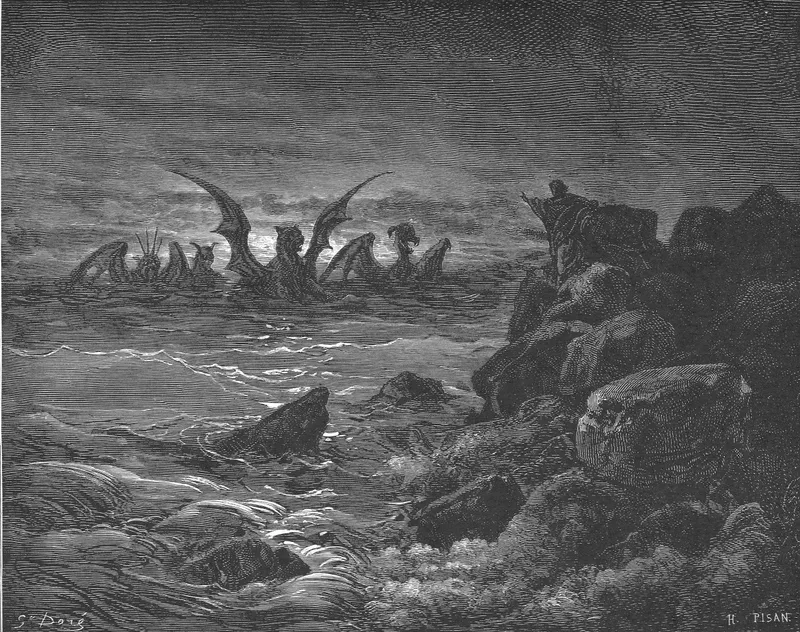
Daniel lies on his bed and the nightmare begins. The four winds of the heaven lash the great sea, and out of the chaos climb four monsters - a winged lion, a lopsided bear, a leopard, and a fourth too dreadful to name, with great iron teeth and ten horns. Among them rises a little horn with a mouth speaking great things (v. 8). This is how heaven sees the powers of the world. Not noble. Bestial.1
Tap any highlighted phrase to jump to the commentary that unpacks it.
Daniel 7:1-3Winds Upon the Great Sea
1In the first year of Belshazzar king of Babylon Daniel had a dream and visions of his head upon his bed: then he wrote the dream, and told the sum of the matters. 2Daniel spake and said, I saw in my vision by night, and, behold, the four winds of the heaven strove upon the great sea. 3And four great beasts came up from the sea, diverse one from another.
Notice where the monsters come from. The heaving sea, that churning water the four winds lash, the ancient image of chaos and the deep that resists order. Everything about the picture is unsettled and violent. And what comes up is not a parade of noble creatures but a procession of monsters - each one stranger and more frightening than the last. This is the first thing the chapter wants us to feel about the great powers of the world: seen from heaven, they are not as impressive as they look from below.
They rise out of turmoil and they trade in turmoil. For a man like Daniel, living under one empire and watching another loom on the horizon, the vision names a truth he knew in his bones - that the powers of this age are restless, hungry things, never finally at peace.1
Daniel 7:4-8Four Beasts from the Sea
4The first was like a lion, and had eagle’s wings: I beheld till the wings thereof were plucked, and it was lifted up from the earth, and made stand upon the feet as a man, and a man’s heart was given to it. 5And behold another beast, a second, like to a bear, and it raised up itself on one side, and it had three ribs in the mouth of it between the teeth of it: and they said thus unto it, Arise, devour much flesh. 6After this I beheld, and lo another, like a leopard, which had upon the back of it four wings of a fowl; the beast had also four heads; and dominion was given to it. 7After this I saw in the night visions, and behold a fourth beast, dreadful and terrible, and strong exceedingly; and it had great iron teeth: it devoured and brake in pieces, and stamped the residue with the feet of it: and it was diverse from all the beasts that were before it; and it had ten horns. 8I considered the horns, and, behold, there came up among them another little horn, before whom there were three of the first horns plucked up by the roots: and, behold, in this horn were eyes like the eyes of man, and a mouth speaking great things.
The beasts come in sequence, and the poem lingers over each. The first is like a lion, and had eagle's wings - royal and swift, until its wings are plucked and it is made to stand upon the feet as a man with a man's heart given to it (v. 4). The second is like to a bear, raised up lopsided, with three ribs in the mouth of it between the teeth of it, told to devour much flesh (v. 5).
The third is like a leopard with four wings and four heads, and dominion was given to it (v. 6). Then the fourth, and here the language breaks down, because there is no animal terrible enough to carry it: dreadful and terrible, and strong exceedingly… great iron teeth: it devoured and brake in pieces, and stamped the residue with the feet of it (v. 7). The first three at least resembled known creatures; the fourth is simply a beast, diverse from all the beasts that were before it - raw destructive power with nothing to compare it to.
The vision is showing the escalation of earthly might: each kingdom hungrier than the last, until violence itself stands undisguised on the stage.
Then attention narrows to one horn among the ten. It starts small - a little horn (v. 8) - but it grows by uprooting others, and what marks it out above all is the mouth. It has the eyes of man, a calculating intelligence, and it speaks great things - the boasting, swollen speech of a power that exalts itself against heaven. Later the angel will say plainly that it shall speak great words against the most High (v. 25).
This is the chapter's portrait of arrogance with a crown: not merely cruel but blasphemous, a mouth that thinks it can outshout God. The little horn fixes our attention because its loud mouth seems, for a time, to be running the world. The whole drama of the vision now hangs on a question: who silences that mouth? The answer will not come from among the beasts. It will come from the throne.1
Daniel 7:9-12The Ancient of Days Did Sit
9I beheld till the thrones were cast down, and the Ancient of days did sit, whose garment was white as snow, and the hair of his head like the pure wool: his throne was like the fiery flame, and his wheels as burning fire. 10A fiery stream issued and came forth from before him: thousand thousands ministered unto him, and ten thousand times ten thousand stood before him: the judgment was set, and the books were opened. 11I beheld then because of the voice of the great words which the horn spake: I beheld even till the beast was slain, and his body destroyed, and given to the burning flame. 12As concerning the rest of the beasts, they had their dominion taken away: yet their lives were prolonged for a season and time.
The camera lifts from the sea to the sky, and everything changes. After the noise and hunger of the beasts, there is suddenly stillness and order: thrones are set in place, and One takes His seat - the Ancient of days, unhurried, as if the monsters below had never disturbed Him. His garment was white as snow, and the hair of his head like the pure wool - the white of perfect purity and of great age, the dignity of One who was before all the empires and will outlast them.
His throne was like the fiery flame, and his wheels as burning fire, and a fiery stream issued and came forth from before him (vv. 9-10). Fire here is not destruction for its own sake; it is the blaze of holiness, the searching brightness in whose presence nothing false can stand. And He is not alone: thousand thousands ministered unto him, and ten thousand times ten thousand stood before him. Against the four lone beasts, an innumerable court.
The contrast is the whole point. The beasts roared as if no one were over them. They were wrong. Above the tumult of the sea sits a throne, ancient and unshaken, attended by a host beyond counting.
And the throne is convened for a purpose: the judgment was set, and the books were opened (v. 10). A court is in session. The boasting of the little horn, which seemed to fill the whole world a moment ago, is now a defendant's noise in a courtroom where the verdict is already being written. The books were opened - the record is kept, nothing is forgotten, and the account will be settled. Then the sentence is carried out: I beheld… because of the voice of the great words which the horn spake: I beheld even till the beast was slain, and his body destroyed, and given to the burning flame (v. 11).
It is the very loudness of the horn - the voice of the great words - that draws Daniel's eye to the moment of its undoing. The mouth that spoke great things is silenced. As for the other beasts, they had their dominion taken away: yet their lives were prolonged for a season and time (v. 12) - stripped of rule, allowed to linger only for a while. This is the chapter's great reversal: the powers that looked permanent are shown to be on trial, and their time is measured out by a court they never reckoned with.
Daniel 7:13-14One Like the Son of Man
13I saw in the night visions, and, behold, one like the Son of man came with the clouds of heaven, and came to the Ancient of days, and they brought him near before him. 14And there was given him dominion, and glory, and a kingdom, that all people, nations, and languages, should serve him: his dominion is an everlasting dominion, which shall not pass away, and his kingdom that which shall not be destroyed.
Here is the summit of the whole vision, and the language slows so we will not rush past it. Mark the contrast with everything before. The beasts came up from the sea - from below, from the chaos. This one comes with the clouds of heaven - from above, from the throne's own realm. In Scripture the clouds belong to God; He rides upon them, He appears in them. And this figure, unlike the monsters, is not bestial at all: He is like the Son of man, in human form, the one true human face in a vision full of fangs and horns.
He is brought… near before the Ancient of days - presented at the throne, welcomed into the very center of heaven's court. After the beasts that seized and devoured, here is One who is given. He is led into the presence of the Ancient of days and there receives what no beast could ever take.
And what He receives is everything the beasts grasped at and never truly held: And there was given him dominion, and glory, and a kingdom, that all people, nations, and languages, should serve him (v. 14). The beasts had dominion for a season; this is dominion given by the Ancient of days Himself. The little horn boasted of greatness; here is glory granted by the Ancient of days Himself. And the reach of it is total - all people, nations, and languages, the whole human family, brought to serve Him.
Then comes the line that sets this kingdom apart from every kingdom that ever rose from the sea: his dominion is an everlasting dominion, which shall not pass away, and his kingdom that which shall not be destroyed. Every empire in the vision is defined by its expiration - dominion taken away, lives prolonged only for a season and time. This one alone is defined by its permanence. It shall not pass away. It shall not be destroyed. The whole anxious sweep of rising and falling powers comes to rest at last in a kingdom with no end - and it is given to One in human likeness, the Son of man.
Daniel 7:15-18The Saints Shall Take the Kingdom
15I Daniel was grieved in my spirit in the midst of my body, and the visions of my head troubled me. 16I came near unto one of them that stood by, and asked him the truth of all this. So he told me, and made me know the interpretation of the things. 17These great beasts, which are four, are four kings, which shall arise out of the earth. 18But the saints of the most High shall take the kingdom, and possess the kingdom for ever, even for ever and ever.
It is worth pausing on Daniel's reaction. The man who just saw the everlasting kingdom handed to the Son of man is not exhilarated; he is grieved… in the midst of my body, the visions of his head troubling him (v. 15). He is shaken, and he wants to understand. So he does the wise thing - I came near unto one of them that stood by, and asked him the truth of all this (v. 16).
The interpretation comes in two strokes, and they are the chapter's whole message in miniature. First: These great beasts, which are four, are four kings, which shall arise out of the earth (v. 17). The terrifying monsters are demystified - they are kings, human powers that arise, which means they also pass. The text does not lock them to particular names or set a calendar; it simply says they rise from the earth and have their day.
Then the second stroke, and it is the heart of the answer: But the saints of the most High shall take the kingdom, and possess the kingdom for ever (v. 18). Notice the turn. The dominion that verse 14 gave to the Son of man is, in verse 18, shared with His people. The everlasting kingdom is His - and it is theirs in Him.
Daniel 7:19-22Until the Ancient of Days Came
19Then I would know the truth of the fourth beast, which was diverse from all the others, exceeding dreadful, whose teeth were of iron, and his nails of brass; which devoured, brake in pieces, and stamped the residue with his feet; 20And of the ten horns that were in his head, and of the other which came up, and before whom three fell; even of that horn that had eyes, and a mouth that spake very great things, whose look was more stout than his fellows. 21I beheld, and the same horn made war with the saints, and prevailed against them; 22Until the Ancient of days came, and judgment was given to the saints of the most High; and the time came that the saints possessed the kingdom.
Daniel presses for more about the fourth beast and especially its boastful horn - that horn that had eyes, and a mouth that spake very great things, whose look was more stout than his fellows (v. 20) - and now the vision tells him something sobering that the throne-room scene had not yet shown. I beheld, and the same horn made war with the saints, and prevailed against them (v. 21). This is the hard honesty of the chapter.
It does not pretend the people of God are spared the violence of the beasts. For a real and painful stretch, the arrogant power prevails. The saints lose ground; they suffer; from where they stand it looks for all the world as if the horn is winning. If you have ever stood in that place - faithful and still losing - the chapter does not flinch from it. But the verse does not end there, and the single most important word in the whole interpretation is the next one: Until. Until the Ancient of days came, and judgment was given to the saints of the most High; and the time came that the saints possessed the kingdom (v. 22).
The horn prevails - until. There is a fixed limit on its hour. The throne convenes, the verdict turns, and what looked like defeat for the saints becomes possession of the kingdom. Their suffering is real, but it is not the end of the sentence.
Daniel 7:23-26He Shall Wear Out the Saints
23Thus he said, The fourth beast shall be the fourth kingdom upon earth, which shall be diverse from all kingdoms, and shall devour the whole earth, and shall tread it down, and break it in pieces. 24And the ten horns out of this kingdom are ten kings that shall arise: and another shall rise after them; and he shall be diverse from the first, and he shall subdue three kings. 25And he shall speak great words against the most High, and shall wear out the saints of the most High, and think to change times and laws: and they shall be given into his hand until a time and times and the dividing of time. 26But the judgment shall sit, and they shall take away his dominion, to consume and to destroy it unto the end.
The angel describes the little horn's campaign in its fullest terms: he shall speak great words against the most High, and shall wear out the saints of the most High, and think to change times and laws (v. 25). Each phrase is heavy. The mouth that spake great things now speaks great words against the most High - arrogance that has become outright defiance of God. It does not merely strike the saints; it wears them out, a slow grinding-down meant to exhaust their endurance.
And it presumes to change times and laws, to remake the very order of life as if it answered to no higher throne. The saints are given into his hand until a time and times and the dividing of time - a limited, measured span, here today but counted and bounded. And then, again, the turn: But the judgment shall sit, and they shall take away his dominion, to consume and to destroy it unto the end (v. 26).
The court reconvenes; the dominion is stripped away for good. The vision will not say precisely when or in what shape these things unfold - the saint living through it is given a promise to hold, not a timetable to calculate. What is certain is the verdict, and what the verdict secures.
Daniel 7:27-28The Kingdom Given to the Saints
27And the kingdom and dominion, and the greatness of the kingdom under the whole heaven, shall be given to the people of the saints of the most High, whose kingdom is an everlasting kingdom, and all dominions shall serve and obey him. 28Hitherto is the end of the matter. As for me Daniel, my cogitations much troubled me, and my countenance changed in me: but I kept the matter in my heart.
The interpretation rises to its climax, and it lands exactly where verse 14 did, but now with the saints written into the promise: And the kingdom and dominion, and the greatness of the kingdom under the whole heaven, shall be given to the people of the saints of the most High, whose kingdom is an everlasting kingdom, and all dominions shall serve and obey him (v. 27). Everything the beasts seized - the kingdom and dominion, and the greatness of the kingdom under the whole heaven - is handed, in the end, to the people of the saints of the most High. The same gift given to the Son of man in verse 14 is shared with His people in verse 27; His everlasting kingdom becomes the inheritance of all who are His.
And then the chapter closes on a strikingly human note: Hitherto is the end of the matter. As for me Daniel, my cogitations much troubled me, and my countenance changed in me: but I kept the matter in my heart (v. 28). Daniel does not walk away triumphant. He is shaken, his face changed - and yet he keeps the matter in his heart. That is the posture the vision asks of every reader who cannot yet see how it all resolves: to be honest about the trouble, and still to treasure the promise, holding the certainty of the kingdom through the long stretch before it comes.
Research trail
Sources & further study
These references support the historical, linguistic, manuscript, and contextual notes in this chapter. Scripture remains the primary text; external sources are provided so readers can inspect the research directly.
- Daniel 7 - Translators' NotesThe NET Bible's detailed footnotes on Daniel 7 - the four beasts from the sea (vv. 2-7), the much-discussed little horn (vv. 8, 20-25), the throne-room scene with the Ancient of days (vv. 9-10), and the Aramaic of the Son-of-man vision (vv. 13-14).
- Daniel 7 · Aramaic + classical Jewish commentaryThe text of Daniel 7 - here in Aramaic, the language of Daniel 2-7 - with Rashi, Ibn Ezra, and other classical commentators side by side. Useful for the phrase kibar enash (v. 13, “one like the Son of man”) and the title attiq yomin (vv. 9, 13, 22, “the Ancient of days”).
- Daniel 7 ↔ Mark 14 · Matthew 26 · Revelation 1 & 11Traces the threads tying Daniel 7 to the rest of Scripture - the Son of man… with the clouds of heaven (vv. 13-14) read alongside Jesus' words at His trial (Mark 14:62) and the vision of the risen Christ whose hairs were white like wool (Rev. 1:14), and the everlasting kingdom (v. 14) read beside the kingdoms of this world are become the kingdoms of our Lord (Rev. 11:15).
Where this echoes in Scripture
Four Beasts from the Sea
- Daniel 2:31-35Thou sawest till that a stone was cut out without hands, which smote the image... and brake them to pieces... and the stone... became a great mountain, and filled the whole earth.The same sweep of rising-and-falling kingdoms as verses 2-7, ended by a kingdom not made by human hands.
- Isaiah 17:12-13the rushing of nations... like the rushing of mighty waters: but God shall rebuke them, and they shall flee far off.The image behind verses 2-3 - raging nations as a tumultuous sea that God alone can still.
- Revelation 13:1-2I... saw a beast rise up out of the sea... like unto a leopard... as the feet of a bear... as the mouth of a lion.John's vision gathers Daniel's four beasts (vv. 4-7) into one - the same monstrous power rising from the sea.
- Psalm 2:1-2Why do the heathen rage... The kings of the earth set themselves... against the LORD, and against his anointed.The boast of the little horn (v. 8) heard among the nations - earthly power set against heaven and its Anointed.
- Psalm 89:9Thou rulest the raging of the sea: when the waves thereof arise, thou stillest them.The sea of verse 2 under the hand of the One who rules it - the chaos the beasts rise from is not beyond His reach.
The Ancient of Days Did Sit
- Revelation 1:13-15one like unto the Son of man... His head and his hairs were white like wool, as white as snow; and his eyes were as a flame of fire.The Ancient of days' white hair and fire (vv. 9-10) drawn onto the risen Christ, who is the Son of man of this chapter.
- Revelation 20:11-12I saw a great white throne, and him that sat on it... and the books were opened... and the dead were judged.The court of verse 10 seen again - the throne set, the books opened, the judgment of all.
- Ezekiel 1:26-28the likeness of a throne... and upon the likeness of the throne was the likeness as the appearance of a man above upon it.A throne-room vision like verses 9-10 - fire, brightness, and a glory before which the prophet falls.
- Psalm 97:2-3clouds and darkness are round about him: righteousness and judgment are the habitation of his throne. A fire goeth before him.The fiery throne of verse 9 and the stream before it (v. 10) - fire and justice as the ground of God's rule.
- 2 Corinthians 5:10we must all appear before the judgment seat of Christ; that every one may receive the things done in his body.The opened books of verse 10 - the reckoning before the throne that no one finally escapes.
One Like the Son of Man
- Mark 14:61-62Art thou the Christ...? And Jesus said, I am: and ye shall see the Son of man sitting on the right hand of power, and coming in the clouds of heaven.Jesus quotes verse 13 of His own future at His trial - the claim for which He was condemned.
- Luke 1:33And he shall reign over the house of Jacob for ever; and of his kingdom there shall be no end.The everlasting kingdom of verse 14 promised at the birth of Jesus - a reign with no end.
- Revelation 11:15The kingdoms of this world are become the kingdoms of our Lord, and of his Christ; and he shall reign for ever and ever.The service of all nations (v. 14) reached at last - the world's kingdoms become His.
- Matthew 25:31When the Son of man shall come in his glory, and all the holy angels with him, then shall he sit upon the throne of his glory.The Son of man of verse 13 coming in glory to the throne, attended by the heavenly host of verse 10.
- Philippians 2:9-11God also hath highly exalted him... that... every tongue should confess that Jesus Christ is Lord.The dominion and universal service given in verse 14 - every nation and tongue brought to confess Him.
The Kingdom Given to the Saints
- 2 Timothy 2:12If we suffer, we shall also reign with him: if we deny him, he also will deny us.The saints who possess the kingdom (vv. 18, 27) - those who endure with Christ share His reign.
- Revelation 5:10And hast made us unto our God kings and priests: and we shall reign on the earth.The promise of verses 18 and 27 sung of the redeemed - a people given to reign.
- Revelation 20:4I saw thrones, and they sat upon them... and they lived and reigned with Christ.The saints possessing the kingdom (v. 22) - thrones given, and the faithful reigning with Christ.
- Daniel 2:44shall the God of heaven set up a kingdom, which shall never be destroyed... it shall stand for ever.The everlasting kingdom of verse 27 promised already in Daniel 2 - the kingdom that outlasts every other.
- Matthew 5:10Blessed are they which are persecuted for righteousness' sake: for theirs is the kingdom of heaven.The pattern of verses 21-22 in the Beatitudes - warred against now, but theirs is the kingdom.