Daniel 6
People in this chapter
Daniel is an old man now. The teenager carried into Babylon has outlived one empire and risen to the top of the next, and the king means to set him over the whole realm. That is what lights the fuse. His rivals comb his life for dirt and come up empty - they could find none occasion nor fault; forasmuch as he was faithful (v. 4). So they aim at the one place left, and outlaw prayer to anyone but the king, on pain of the lions.1
Tap any highlighted phrase to jump to the commentary that unpacks it.
Daniel 6:1-3An Excellent Spirit Was in Him
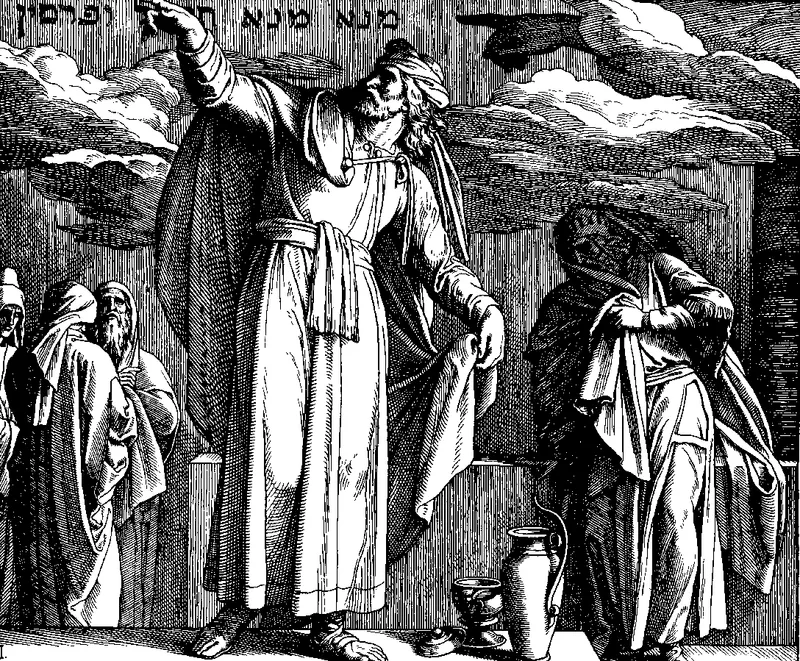
1It pleased Darius to set over the kingdom an hundred and twenty princes, which should be over the whole kingdom; 2And over these three presidents; of whom Daniel was first: that the princes might give accounts unto them, and the king should have no damage. 3Then this Daniel was preferred above the presidents and princes, because an excellent spirit was in him; and the king thought to set him over the whole realm.
The chapter opens on a man at the height of a long life. The youth carried captive in chapter 1 is now old, and he has outlived the entire Babylonian empire; the kingdom has changed hands, yet he is still standing - of whom Daniel was first (v. 2). Darius organizes his realm under a hundred and twenty princes with three presidents over them, and Daniel rises straight to the top, so that the king thought to set him over the whole realm (v. 3).
The reason given is striking in its simplicity: because an excellent spirit was in him. A quality of character so evident that even a foreign king could not miss it had lifted Daniel. The phrase quietly tells us what decades of faithfulness had made of him - a man whose competence and integrity were of a different order from those around him. This is the soil out of which everything else grows. The crisis of this chapter does not fall on a reckless zealot but on a man whose long, steady excellence had become impossible to ignore, and impossible, for some, to bear.1
Daniel 6:4-5None Occasion Nor Fault
4Then the presidents and princes sought to find occasion against Daniel concerning the kingdom; but they could find none occasion nor fault; forasmuch as he was faithful, neither was there any error or fault found in him. 5Then said these men, We shall not find any occasion against this Daniel, except we find it against him concerning the law of his God.
Excellence breeds envy, and envy goes hunting. The other officials sought to find occasion against Daniel concerning the kingdom (v. 4) - they pored over his public conduct, his administration, his handling of power, looking for any corruption or failure they could expose. And here the text does something remarkable: it records their failure as Daniel's vindication. They could find none occasion nor fault; forasmuch as he was faithful, neither was there any error or fault found in him. His enemies became, against their will, the witnesses to his integrity.
They had every motive to find a flaw and the full machinery of the state to look with, and they came up with nothing. So they reasoned their way to a chilling conclusion: We shall not find any occasion against this Daniel, except we find it against him concerning the law of his God (v. 5). If his public life was spotless, the only place left to strike was his devotion to God. They would have to make his faith itself a crime.
It is a backhanded tribute of the highest kind - a man so blameless that the only charge his enemies could bring was that he prayed.
Daniel 6:6-9Which Altereth Not
6Then these presidents and princes assembled together to the king, and said thus unto him, King Darius, live for ever. 7All the presidents of the kingdom, the governors, and the princes, the counsellors, and the captains, have consulted together to establish a royal statute, and to make a firm decree, that whosoever shall ask a petition of any God or man for thirty days, save of thee, O king, he shall be cast into the den of lions. 8Now, O king, establish the decree, and sign the writing, that it be not changed, according to the law of the Medes and Persians, which altereth not. 9Wherefore king Darius signed the writing and the decree.
The plot is built with cold cleverness. The conspirators come before the king as a united front - presidents, governors, princes, counsellors, captains - and claim they have all consulted together (v. 7), a lie that conveniently leaves out the most senior official of all, Daniel himself. They propose a decree perfectly shaped to flatter Darius and trap his best servant: that whosoever shall ask a petition of any God or man for thirty days, save of thee, O king, he shall be cast into the den of lions. The genius of it is that it never names Daniel; it simply outlaws prayer to anyone but the king, knowing exactly what one man will do.
And they lock the door behind it: sign the writing, that it be not changed, according to the law of the Medes and Persians, which altereth not (v. 8). Persian royal decrees were famously irreversible - a point the book returns to twice in this chapter. Flattered into thinking himself worthy of a month's undivided devotion, Darius signs without seeing the snare. The trap is now set, sealed by a law not even the king can undo.
Everything waits on what Daniel will do when he hears.
Daniel 6:10-18As He Did Aforetime
10Now when Daniel knew that the writing was signed, he went into his house; and his windows being open in his chamber toward Jerusalem, he kneeled upon his knees three times a day, and prayed, and gave thanks before his God, as he did aforetime. 11Then these men assembled, and found Daniel praying and making supplication before his God. 12Then they came near, and spake before the king concerning the king’s decree; Hast thou not signed a decree, that every man that shall ask a petition of any God or man within thirty days, save of thee, O king, shall be cast into the den of lions? The king answered and said, The thing is true, according to the law of the Medes and Persians, which altereth not. 13Then answered they and said before the king, That Daniel, which is of the children of the captivity of Judah, regardeth not thee, O king, nor the decree that thou hast signed, but maketh his petition three times a day.
Here is the still center of the chapter, and everything turns on three words at the end of the verse: as he did aforetime. Daniel knew that the writing was signed (v. 10); he understood the decree and the penalty fully. And then he did nothing new. The windows were already open toward Jerusalem; the three set times were already his rhythm; the kneeling and the thanksgiving were already his habit. He simply went on, windows open, kneeling at the same set hours, keeping the same prayer.
The decree changed the cost of that prayer, nothing else. That is the quiet, almost shocking lesson here: his courage in the crisis was not summoned in the moment - it was the overflow of a thousand ordinary mornings when no one was watching and nothing was at stake. He had settled the question long before it was ever asked of him. When the trial came he did not have to find new resolve; he only had to keep being who he already was.
Sit with that for a moment, because it is good news for you: the faithfulness that holds on the hardest day is not a heroism you have to manufacture then - it is the plain habit you are quietly keeping now. The direction of the windows matters too. Turned toward the city of the temple, toward the place of promise, his prayer reached past the empire that ruled him to the God who had pledged to hear His people when they prayed toward that place.1
The conspirators have been watching the windows. Then these men assembled, and found Daniel praying and making supplication before his God (v. 11). The word found lands with a quiet irony: this is the very thing they could not find in verse 4. Having failed to discover any fault, they have manufactured one and caught him in it. Now they spring the trap with practiced care. They first get the king to reaffirm his own decree - Hast thou not signed a decree…? The thing is true, according to the law of the Medes and Persians, which altereth not (v. 12) - pinning him to the law before they reveal their target.
Only then do they name Daniel, and they name him with calculated contempt: That Daniel, which is of the children of the captivity of Judah (v. 13). They reduce the man the king meant to set over the whole realm to a mere foreign captive, and they twist his faithful habit into an insult to the throne: he regardeth not thee, O king, nor the decree that thou hast signed. What was reverence toward God they recast as disrespect toward the king.
It is the oldest move of the accuser - to take a person's devotion and make it look like defiance.
14Then the king, when he heard these words, was sore displeased with himself, and set his heart on Daniel to deliver him: and he laboured till the going down of the sun to deliver him. 15Then these men assembled unto the king, and said unto the king, Know, O king, that the law of the Medes and Persians is, That no decree nor statute which the king establisheth may be changed. 16Then the king commanded, and they brought Daniel, and cast him into the den of lions. Now the king spake and said unto Daniel, Thy God whom thou servest continually, he will deliver thee. 17And a stone was brought, and laid upon the mouth of the den; and the king sealed it with his own signet, and with the signet of his lords; that the purpose might not be changed concerning Daniel. 18Then the king went to his palace, and passed the night fasting: neither were instruments of musick brought before him: and his sleep went from him.
Now the trap closes on the trapper. The king, hearing Daniel named, was sore displeased with himself (v. 14) - he sees at once that he has been used, that the flattering decree was a weapon aimed at his most trusted servant, and that his own vanity loaded it. The text shows him in real anguish: he set his heart on Daniel to deliver him, and he laboured till the going down of the sun to find some way out.
But the conspirators return and press the very law they engineered: no decree nor statute which the king establisheth may be changed (v. 15). The most powerful man in the empire is helpless before his own signature. He must give the order. Yet even as Daniel is cast into the den, the king speaks words that are almost a prayer: Thy God whom thou servest continually, he will deliver thee (v. 16). It is a remarkable thing to hear from a pagan monarch.
Whether it is hope, or faith, or only the desperate wish of a man who has run out of options, Darius testifies to the very thing Daniel's whole life had been preaching - that this is a God who is served continually, and a God who can deliver. The witness of a faithful life has reached even the one who signed his death warrant.
The chapter slows down to seal the pit, and every detail will matter. A stone was brought, and laid upon the mouth of the den; and the king sealed it with his own signet, and with the signet of his lords; that the purpose might not be changed concerning Daniel (v. 17). A stone over the mouth of a pit; an official seal pressed upon it; the matter declared finished and secure. Humanly speaking, this is the end of Daniel - shut into a death chamber, the way out blocked and stamped beyond appeal.
Then the camera follows the king home: he went to his palace, and passed the night fasting: neither were instruments of musick brought before him: and his sleep went from him (v. 18). It is a portrait of misery. The king who could not save Daniel cannot rest, cannot eat, cannot bear the comfort of music. He spends the night in a kind of vigil of dread, while the man in the den, by every indication, spends it at peace.
The contrast is the point: the one with all the power lies awake in torment; the one with none, sealed among the lions, is kept. The sealed stone meant to settle Daniel's fate has settled nothing - for the One who decides such things was never consulted, and was already in the pit.
Daniel 6:19-23My God Hath Sent His Angel
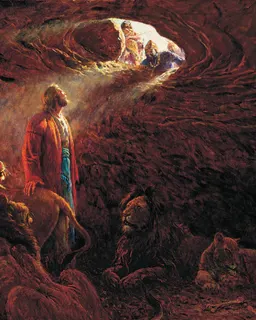
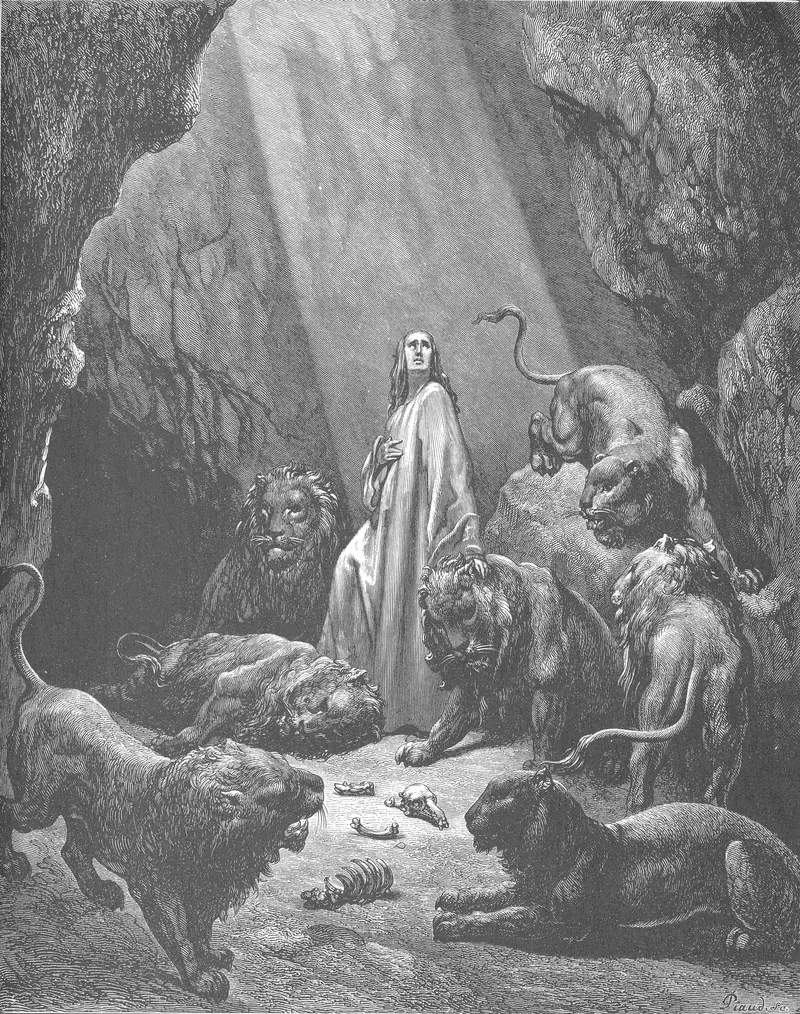
19Then the king arose very early in the morning, and went in haste unto the den of lions. 20And when he came to the den, he cried with a lamentable voice unto Daniel: and the king spake and said to Daniel, O Daniel, servant of the living God, is thy God, whom thou servest continually, able to deliver thee from the lions? 21Then said Daniel unto the king, O king, live for ever. 22My God hath sent his angel, and hath shut the lions’ mouths, that they have not hurt me: forasmuch as before him innocency was found in me; and also before thee, O king, have I done no hurt. 23Then was the king exceeding glad for him, and commanded that they should take Daniel up out of the den. So Daniel was taken up out of the den, and no manner of hurt was found upon him, because he believed in his God.
The long night breaks and the king cannot wait. Then the king arose very early in the morning, and went in haste unto the den of lions (v. 19). This is not the measured walk of a monarch; it is a man running at first light toward the place of his dread, half in hope and half in grief. He cried with a lamentable voice (v. 20) - the cry of someone who fully expects to be answered only by silence.
And listen to how he addresses the pit: O Daniel, servant of the living God, is thy God, whom thou servest continually, able to deliver thee from the lions? The king himself supplies the language the chapter has been building toward - the living God, the God served continually. His question trembles between faith and despair: he names God as living and as the object of Daniel's constant service, yet he asks whether such a God was able. If you have ever stood over a sealed and silent place in your own life and asked God the same trembling question - is He really able, here, now - you are in good company; a king asked it first.
And against all the odds of the night, an answer comes back out of the den. The pit that should have held only torn silence holds a living voice. Before Daniel says a word about lions or angels, the simple fact that he answers is the whole gospel of the morning: the sealed place of death is not silent after all.
Daniel's reply is a model of faith's composure. He does not begin with his ordeal; he begins with courtesy and calm - O king, live for ever (v. 21) - as though he had spent the night in worship rather than among lions. Then comes the testimony at the heart of the book: My God hath sent his angel, and hath shut the lions' mouths, that they have not hurt me (v. 22). He gives no credit to his own nerve and claims no power of his own; the deliverance is entirely God's doing, worked through a messenger God sent. And he names the ground of it twice over - forasmuch as before him innocency was found in me; and also before thee, O king, have I done no hurt. Innocent before God, and guiltless before the king: the very blamelessness his enemies could not overturn in verse 4 is now vindicated from inside the den.
The king's response is pure relief: Then was the king exceeding glad for him (v. 23), and he has Daniel lifted out. The narrator then states the reason the deliverance held, and it is not Daniel's courage or his innocence alone but his trust: no manner of hurt was found upon him, because he believed in his God. The faith that kept the windows open through the night is the faith that brought him up whole in the morning.
Daniel 6:24-28The Living God, Stedfast For Ever
24And the king commanded, and they brought those men which had accused Daniel, and they cast them into the den of lions, them, their children, and their wives; and the lions had the mastery of them, and brake all their bones in pieces or ever they came at the bottom of the den. 25Then king Darius wrote unto all people, nations, and languages, that dwell in all the earth; Peace be multiplied unto you. 26I make a decree, That in every dominion of my kingdom men tremble and fear before the God of Daniel: for he is the living God, and stedfast for ever, and his kingdom that which shall not be destroyed, and his dominion shall be even unto the end. 27He delivereth and rescueth, and he worketh signs and wonders in heaven and in earth, who hath delivered Daniel from the power of the lions. 28So this Daniel prospered in the reign of Darius, and in the reign of Cyrus the Persian.
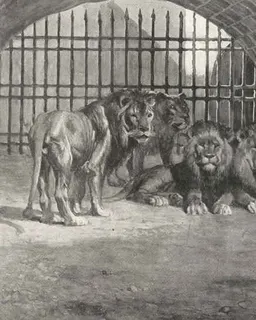
Justice in this chapter comes as a stark reversal. The king commanded, and they brought those men which had accused Daniel, and they cast them into the den of lions (v. 24). The pit they had built for an innocent man becomes their own; the trap recoils on the trappers. The narrator underscores how complete the reversal is by noting that the lions had the mastery of them, and brake all their bones in pieces or ever they came at the bottom of the den. The same lions that could not touch Daniel are now plainly, fiercely lethal - which puts the miracle beyond doubt.
There was nothing tame about these animals and nothing accidental about Daniel's survival; the only difference between his night and theirs was the angel God had sent. The detail that their children, and their wives share the sentence reflects the brutal collective justice of an ancient Persian court, where a conspirator's whole household could fall with him; the text reports the custom of that world rather than commending it. The moral center holds steady: those who dig a pit for the righteous have a way of falling into it themselves, and the schemes of the envious tend, in the end, to circle back upon their own heads.
The chapter ends where no one would have predicted: with a pagan emperor preaching to the whole world about the God of a Jewish exile. Then king Darius wrote unto all people, nations, and languages, that dwell in all the earth (v. 25), and his decree is no grudging acknowledgment but a ringing confession. That in every dominion of my kingdom men tremble and fear before the God of Daniel: for he is the living God, and stedfast for ever, and his kingdom that which shall not be destroyed (v. 26).
Set this beside the law that opened the chapter. The first decree exalted the king and outlawed prayer to any god; this last decree humbles the king and commands reverence before the one true God. The earlier law was locked shut by the law of the Medes and Persians, which altereth not - yet here the very king who signed it has, in effect, overturned its spirit entirely, bowing before a kingdom that truly cannot be changed: one that shall not be destroyed. And the king grounds it all in what he has just witnessed: He delivereth and rescueth, and he worketh signs and wonders in heaven and in earth, who hath delivered Daniel from the power of the lions (v. 27).
One man's faithfulness in a sealed pit has become a testimony carried to every nation under heaven. The closing line is quiet and complete: So this Daniel prospered in the reign of Darius, and in the reign of Cyrus the Persian (v. 28) - the faithful servant outlasting the crisis, and the kingdoms themselves giving way to the One whose dominion runs even unto the end.
Research trail
Sources & further study
These references support the historical, linguistic, manuscript, and contextual notes in this chapter. Scripture remains the primary text; external sources are provided so readers can inspect the research directly.
- Daniel 6 - Translators' NotesThe NET Bible's detailed footnotes on Daniel 6 - the administrative structure of verses 1-3, the legal language of the unalterable law of the Medes and Persians (vv. 8, 15), the wording of Daniel's open-windowed prayer in verse 10, and the testimony from the den in verse 22.
- Daniel 6 · Aramaic + classical Jewish commentaryThe text of Daniel 6 with Rashi, Ibn Ezra, and other classical commentators side by side. This stretch of Daniel is written in Aramaic, the diplomatic language of the empire - useful for the phrase rendered “as he did aforetime” in verse 10 (the habit of prayer kept unbroken) and for the closing royal confession of the living God… stedfast for ever in verse 26.
- Daniel 6 ↔ the Gospels · 1 Peter · 2 TimothyTraces the threads tying Daniel 6 to the rest of Scripture - the faithful man in whom none… fault was found (v. 4) read beside the One in whom Pilate found no fault at all (John 18:38), and the sealed pit of death opened at dawn (vv. 17-23) read beside the sealed tomb and the rising (Matt. 27:66; 28:1-6).
Where this echoes in Scripture
Which Altereth Not
- John 18:38Pilate saith unto him, What is truth?... I find in him no fault at all.The same empty-handed verdict as verse 4 - the judge searching for a charge and finding none.
- 1 Peter 2:22Who did no sin, neither was guile found in his mouth.The blamelessness of Daniel (v. 4) brought to its fullness - the One in whom no fault could be found.
- Genesis 39:2-4And his master saw that the LORD was with him... and he made him overseer over his house.The same pattern as verses 3-4 - a faithful exile so excellent that a foreign master sets him over everything.
- Psalm 37:32-33The wicked watcheth the righteous, and seeketh to slay him. The LORD will not leave him in his hand.The plotting of verses 4-7 - the wicked watching the righteous, and the LORD who will not abandon him.
- Titus 2:7-8shewing... gravity, sincerity... that he that is of the contrary part may be ashamed, having no evil thing to say of you.The aim verse 4 describes - a life so blameless that opponents are left with nothing to charge.
- Luke 23:4, 22I find no fault in this man... I have found no cause of death in him.The same empty-handed verdict as verse 4, repeated - the judge searching for a charge and finding none.
- Mark 14:61-64Art thou the Christ?... Then the high priest rent his clothes... they all condemned him to be guilty of death.Like Daniel in verse 5, condemned for who He confessed Himself to be before God, though no wrong could be found in Him.
As He Did Aforetime
- 1 Kings 8:48-49and pray unto thee toward their land... the city which thou hast chosen, and the house... then hear thou their prayer.Why Daniel's windows opened toward Jerusalem (v. 10) - Solomon's prayer that God would hear His people praying toward that place.
- Luke 18:1men ought always to pray, and not to faint.The settled habit of verse 10 - prayer kept faithfully whatever the cost.
- 1 Thessalonians 5:17Pray without ceasing.Daniel's unbroken rhythm (v. 10) - prayer as a continual habit, kept faithfully through every season.
- Matthew 27:60, 66he rolled a great stone to the door of the sepulchre... they... made the sepulchre sure, sealing the stone.The sealed stone over the pit (v. 17) - the same human attempt to make death final and secure.
- Acts 5:29Then Peter and the other apostles answered and said, We ought to obey God rather than men.The decision behind verse 10 - when a human law forbids obedience to God, where the higher allegiance lies.
My God Hath Sent His Angel
- 2 Timothy 4:17I was delivered out of the mouth of the lion.Verse 22 drawn on directly - the apostle's confidence that the Lord delivers out of the lion's mouth.
- Psalm 22:21Save me from the lion’s mouth: for thou hast heard me from the horns of the unicorns.The cry behind verse 22 - the suffering Righteous One praying to be saved from the lion's mouth.
- Hebrews 11:33who through faith... stopped the mouths of lions.Verse 22 named in the roll of faith - the mouths of lions stopped through trust in God.
- Matthew 28:5-6Fear not ye... he is not here: for he is risen, as he said.The dawn at the sealed pit (vv. 19-22) answered in full - the faithful One found alive on the morning after death.
- Daniel 3:27-28upon whose bodies the fire had no power... who hath sent his angel, and delivered his servants that trusted in him.The same deliverance and the same words as verses 22-23 - God sending His angel to keep those who trust Him through the danger.
The Living God, Stedfast For Ever
- Daniel 2:44the God of heaven set up a kingdom, which shall never be destroyed... it shall stand for ever.The kingdom the king confesses in verse 26 - the dominion no empire can overturn.
- Daniel 7:14his dominion is an everlasting dominion, which shall not pass away, and his kingdom that which shall not be destroyed.The same words as verse 26 - the everlasting dominion given to the Son of man.
- Luke 1:33he shall reign over the house of Jacob for ever; and of his kingdom there shall be no end.The kingdom of verse 26 announced at the birth of the Christ - a reign without end.
- Proverbs 26:27Whoso diggeth a pit shall fall therein: and he that rolleth a stone, it will return upon him.The reversal of verse 24 - the pit dug for the righteous claiming those who dug it.
- Psalm 145:13Thy kingdom is an everlasting kingdom, and thy dominion endureth throughout all generations.The truth the king proclaims in verse 26 - the everlasting kingdom of the living God.