Daniel 3
People in this chapter
A statue of gold rises on the plain of Dura, ninety feet of it, glittering over the empire. The music swells, and every people, nation, and language falls on its face. Bow at the sound, or burn. Among the kneeling multitude, three young Judeans stay on their feet. No speech, no riot. They just will not do the one easy thing the moment demands, and it is enough to get them dragged before the most powerful man alive.1
Tap any highlighted phrase to jump to the commentary that unpacks it.
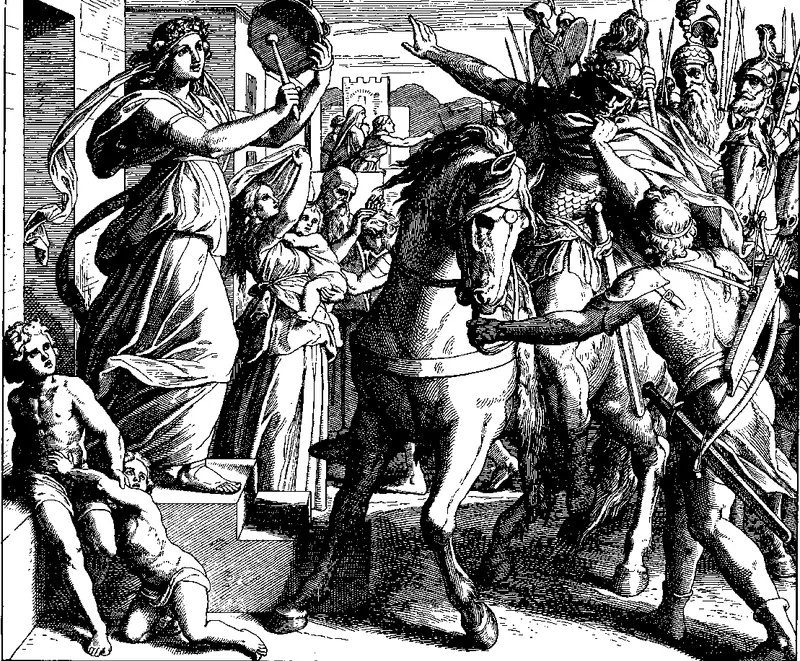
Daniel 3:1-3The Image on the Plain of Dura
1Nebuchadnezzar the king made an image of gold, whose height was threescore cubits, and the breadth thereof six cubits: he set it up in the plain of Dura, in the province of Babylon. 2Then Nebuchadnezzar the king sent to gather together the princes, the governors, and the captains, the judges, the treasurers, the counsellors, the sheriffs, and all the rulers of the provinces, to come to the dedication of the image which Nebuchadnezzar the king had set up. 3Then the princes, the governors, and captains, the judges, the treasurers, the counsellors, the sheriffs, and all the rulers of the provinces, were gathered together unto the dedication of the image that Nebuchadnezzar the king had set up; and they stood before the image that Nebuchadnezzar had set up.
Sixty cubits high and six across: roughly ninety feet tall, nine feet wide. The proportions are strange - ten times taller than it is broad, more a soaring pillar than a human figure - and that is the point. This is not art; it is scale meant to overwhelm, raised on the open plain of Dura where nothing competes with it and everyone for miles can see. There is an irony the first readers would not have missed.
In the previous chapter the king had been shown a dream-image with a head of gold that the prophet told him was his own kingdom - glorious, but destined to give way to lesser metals and at last to be shattered by a stone cut out without hands. Here he answers that warning by building an image of gold from head to foot, as if to overrule the prophecy outright: not gold over silver over clay, but gold all the way down, his reign declared permanent and total.
The whole scene is the posture of a power that will not be told it is mortal.
Daniel 3:4-7Fall Down and Worship
4Then an herald cried aloud, To you it is commanded, O people, nations, and languages, 5That at what time ye hear the sound of the cornet, flute, harp, sackbut, psaltery, dulcimer, and all kinds of musick, ye fall down and worship the golden image that Nebuchadnezzar the king hath set up: 6And whoso falleth not down and worshippeth shall the same hour be cast into the midst of a burning fiery furnace. 7Therefore at that time, when all the people heard the sound of the cornet, flute, harp, sackbut, psaltery, and all kinds of musick, all the people, the nations, and the languages, fell down and worshipped the golden image that Nebuchadnezzar the king had set up.
The long roll of officials in verse 2 - princes, governors, captains, judges, treasurers, counsellors, sheriffs - is doing real work. Every layer of authority is present, every official on the record, so that the act of worship becomes a public test of loyalty no one can quietly skip. Then comes the trigger, repeated through the chapter like a drumbeat: the cornet, flute, harp, sackbut, psaltery, dulcimer, and all kinds of musick (v. 5). The cue to bow is not a threat shouted in anger but a swell of beautiful sound.
That is how compromise usually arrives - festive, pleasant, everyone already doing it, swept along on music and pageantry. The command sounds almost reasonable: just fall down when the band plays. No one is asked to curse their God or sign a confession. They are asked only to bend with the crowd for a few seconds at a cue. The chapter quietly exposes how the gravest disloyalty to God can be dressed as nothing more than going along with a celebration.1
Behind the music stands the furnace: whoso falleth not down and worshippeth shall the same hour be cast into the midst of a burning fiery furnace (v. 6). The two halves of the decree belong together - the seduction of the music and the terror of the flame, the carrot and the fire. And the threat is immediate: the same hour. There is to be no trial, no appeal, no cooling-off; refusal means death on the spot.
So the trap is sprung from both sides at once. Bowing costs nothing visible and earns the safety of the crowd; standing costs everything. Verse 7 then records the result the king intended: all the people, the nations, and the languages, fell down and worshipped the golden image. The word all is heavy. The pressure works. An entire empire goes to its knees together, and for a moment it looks total - as if no one in all the provinces will be left standing.
That is the silence into which the next scene breaks. Against a whole world bowing on cue, three men remain on their feet, and their refusal is about to become the loudest thing on the plain.
Daniel 3:8-12They Serve Not Thy Gods
8Wherefore at that time certain Chaldeans came near, and accused the Jews. 9They spake and said to the king Nebuchadnezzar, O king, live for ever. 10Thou, O king, hast made a decree, that every man that shall hear the sound of the cornet, flute, harp, sackbut, psaltery, and dulcimer, and all kinds of musick, shall fall down and worship the golden image: 11And whoso falleth not down and worshippeth, that he should be cast into the midst of a burning fiery furnace. 12There are certain Jews whom thou hast set over the affairs of the province of Babylon, Shadrach, Meshach, and Abednego; these men, O king, have not regarded thee: they serve not thy gods, nor worship the golden image which thou hast set up.
The refusal does not stay private long. Certain Chaldeans came near, and accused the Jews (v. 8) - and the verb behind “accused” carries the flavor of a malicious denunciation, an eager informing. There is old resentment in it. These three are foreigners, exiles, men set over the affairs of the province while native Babylonians watched from below; their loyalty to their own God now hands their rivals the perfect weapon. The charge is laid with care: these men, O king, have not regarded thee: they serve not thy gods, nor worship the golden image which thou hast set up (v. 12).
Notice how it is framed - not “they broke a religious rule” but “they have not regarded thee.” Faithfulness to God is recast as a personal insult to the king, disloyalty to the state. That is an old and recurring move: those who keep their worship for God are charged with hating their neighbors, their nation, their ruler. The three are not accused of doing anything; their crime is what they would not do. And the indictment is true.
They had stood while the world bowed. They had made no scene, given no speech - but in a culture built on the bow, simply remaining upright was a confession everyone could read.
Daniel 3:13-15Who Is That God?
13Then Nebuchadnezzar in his rage and fury commanded to bring Shadrach, Meshach, and Abednego. Then they brought these men before the king. 14Nebuchadnezzar spake and said unto them, Is it true, O Shadrach, Meshach, and Abednego, do not ye serve my gods, nor worship the golden image which I have set up? 15Now if ye be ready that at what time ye hear the sound of the cornet, flute, harp, sackbut, psaltery, and dulcimer, and all kinds of musick, ye fall down and worship the image which I have made; well: but if ye worship not, ye shall be cast the same hour into the midst of a burning fiery furnace; and who is that God that shall deliver you out of my hands?
Nebuchadnezzar, in his rage and fury, has them brought, and then - tellingly - he offers a second chance (vv. 13-15). Even the furious king would rather have their compliance than their deaths; the image is about submission, and a forced bow would serve. So he repeats the terms, the music and the furnace, and ends with a challenge flung past the men and up at heaven itself: who is that God that shall deliver you out of my hands? (v. 15).
It is the proud center of the whole chapter. The man who has just watched an empire fall at his cue now reckons himself above any god a captive might name. The question is meant as a taunt, but it sets the stage exactly. Nebuchadnezzar has framed the contest as his hand against their God - out of my hands - and that is precisely the contest God will answer. The king thinks the furnace is the last word, that nothing can reach into his fire and undo his sentence.
By the end of the chapter his own mouth will give the reply to his own question: there is indeed a God who delivers after this sort, and no power of his could keep three men from being snatched out of his hands.
Daniel 3:16-18But If Not
16Shadrach, Meshach, and Abednego, answered and said to the king, O Nebuchadnezzar, we are not careful to answer thee in this matter. 17If it be so, our God whom we serve is able to deliver us from the burning fiery furnace, and he will deliver us out of thine hand, O king. 18But if not, be it known unto thee, O king, that we will not serve thy gods, nor worship the golden image which thou hast set up.
Their reply is the summit of the chapter, and its tone is as remarkable as its content. We are not careful to answer thee in this matter (v. 16) - not careless, but unanxious, untroubled; they feel no need to argue, plead, or scramble for a defense, because the question was settled long before the king asked it. Then comes the great two-part confession. First, full confidence in God's power: our God whom we serve is able to deliver us from the burning fiery furnace, and he will deliver us out of thine hand, O king (v. 17).
And then, with the same breath, the part that lifts this above ordinary bravado: But if not, be it known unto thee, O king, that we will not serve thy gods, nor worship the golden image (v. 18). Everything turns on those three words, but if not. They do not claim to know the outcome. They do not say, “We will obey because we are certain God will rescue us.” They say they will not bow whether He rescues them or not. Their obedience is not a wager placed on deliverance; it is loyalty to God that holds firm even if the fire is the end of them.
This is faith stripped down to its core: trust in God Himself, deserving of worship no matter what He permits. It is the most a creature can offer its Maker, and these three young men offer it standing in the shadow of the furnace.2
Daniel 3:19-23Bound Into the Furnace
19Then was Nebuchadnezzar full of fury, and the form of his visage was changed against Shadrach, Meshach, and Abednego: therefore he spake, and commanded that they should heat the furnace one seven times more than it was wont to be heated. 20And he commanded the most mighty men that were in his army to bind Shadrach, Meshach, and Abednego, and to cast them into the burning fiery furnace. 21Then these men were bound in their coats, their hosen, and their hats, and their other garments, and were cast into the midst of the burning fiery furnace. 22Therefore because the king’s commandment was urgent, and the furnace exceeding hot, the flame of the fire slew those men that took up Shadrach, Meshach, and Abednego. 23And these three men, Shadrach, Meshach, and Abednego, fell down bound into the midst of the burning fiery furnace.
The king's answer to their faith is pure rage: the form of his visage was changed (v. 19) - his face contorted out of its royal composure - and he orders the furnace stoked one seven times more than it was wont to be heated. Seven is the number of fullness; he wants it as hot as a furnace can be made, the maximum cruelty his power can devise. But the detail cuts against him even as he commands it.
A furnace seven times hotter cannot make the men any more dead than an ordinary one would; the extra heat is not strategy but fury, the powerless flailing of pride that has been told no. And it backfires before the three even reach the flames. The fire is so fierce that the flame of the fire slew those men that took up Shadrach, Meshach, and Abednego (v. 22) - the soldiers, the king's own mighty men, are killed by the heat at the furnace mouth.
There is grim irony here: the same fire that kills the executioners on the outside will not so much as singe the condemned on the inside. The king has poured all his strength into making the fire deadly, and it proves perfectly deadly - to his own servants. He has overreached, and the very excess meant to guarantee their destruction becomes the first sign that this fire is not under his control after all.
The narrator lingers, almost lovingly, on how thoroughly the men are doomed. They are bound - the word is repeated - and bound fully clothed: in their coats, their hosen, and their hats, and their other garments (v. 21), every layer named, all of it kindling. They fell down bound into the midst of the burning fiery furnace (v. 23): cast in, helpless, ropes on their hands and feet, dropped into the hottest part of the flame.
Three times in these verses the text drives home the totality of their bondage and the totality of the fire. This is deliberate. The story wants every avenue of natural escape sealed shut before the deliverance comes, so that what happens next can be credited to no one but God. There is no loosened knot, no cool corner of the furnace, no quick-thinking rescue. They go in bound, clothed, and condemned, into a fire that has just killed strong men from the outside.
Everything that follows will happen with the men at the absolute mercy of the flame - which is exactly where the chapter wants them, because the God it means to reveal is the God who works precisely there, in the place where nothing but Him could possibly help.
Daniel 3:24-25Like the Son of God
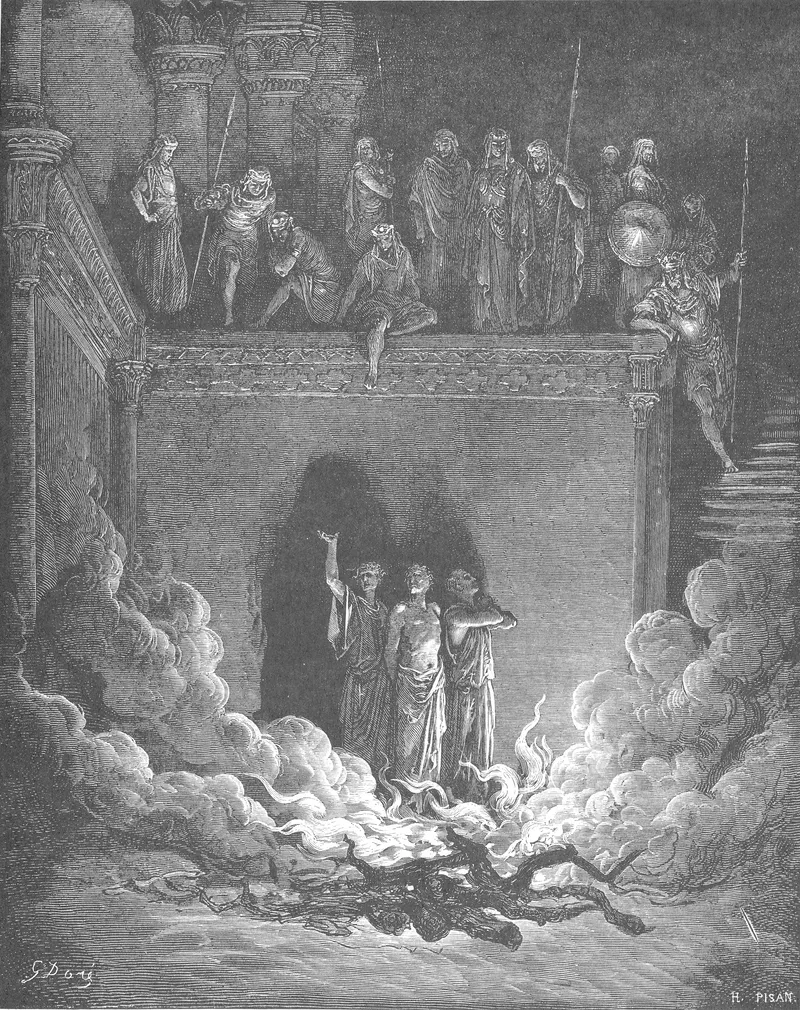
24Then Nebuchadnezzar the king was astonied, and rose up in haste, and spake, and said unto his counsellors, Did not we cast three men bound into the midst of the fire? They answered and said unto the king, True, O king. 25He answered and said, Lo, I see four men loose, walking in the midst of the fire, and they have no hurt; and the form of the fourth is like the Son of God.
Then the king's composure breaks entirely: he was astonied, and rose up in haste (v. 24). The man who had been seated in judgment is suddenly on his feet, rattled, asking his counsellors to confirm what he thought he knew - Did not we cast three men bound into the midst of the fire? He needs the obvious restated because what he is now seeing makes no sense of it. True, O king, they answer: three, bound.
And then his astonished report: Lo, I see four men loose, walking in the midst of the fire, and they have no hurt (v. 25). Count the reversals. Three have become four. The bound are now loose. Men thrown down to die are walking - not writhing, not consumed, but moving about freely as though the furnace were a courtyard. And they have no hurt. Here is the quiet miracle the chapter has been building toward: the fire that slew the soldiers at the door has, inside, burned nothing but the cords.
The one thing the flame consumes is the very thing that bound them. It is a parable in a single image - in the furnace into which their faithfulness brought them, the fire does not destroy the men; it only frees them from what held them captive. And it is the king, the persecutor himself, who is made to see it and to say it aloud before all his court.
Daniel 3:26-30Who Trusted in Him
26Then Nebuchadnezzar came near to the mouth of the burning fiery furnace, and spake, and said, Shadrach, Meshach, and Abednego, ye servants of the most high God, come forth, and come hither. Then Shadrach, Meshach, and Abednego, came forth of the midst of the fire. 27And the princes, governors, and captains, and the king’s counsellors, being gathered together, saw these men, upon whose bodies the fire had no power, nor was an hair of their head singed, neither were their coats changed, nor the smell of fire had passed on them. 28Then Nebuchadnezzar spake, and said, Blessed be the God of Shadrach, Meshach, and Abednego, who hath sent his angel, and delivered his servants that trusted in him, and have changed the king’s word, and yielded their bodies, that they might not serve nor worship any god, except their own God. 29Therefore I make a decree, That every people, nation, and language, which speak any thing amiss against the God of Shadrach, Meshach, and Abednego, shall be cut in pieces, and their houses shall be made a dunghill: because there is no other God that can deliver after this sort. 30Then the king promoted Shadrach, Meshach, and Abednego, in the province of Babylon.
The same king who shouted who is that God that shall deliver you? now walks to the furnace mouth and calls the men out by a new title: ye servants of the most high God, come forth (v. 26). The taunt has become a confession. And when they emerge, the whole assembly of officials crowds in to inspect them, and the wonder is total: upon whose bodies the fire had no power, nor was an hair of their head singed, neither were their coats changed, nor the smell of fire had passed on them (v. 27).
The detail is exquisite. Not a burn, not a singed hair, not a scorched garment - and, most tellingly of all, not even the smell of fire on them. Anyone who has stood near a bonfire knows that smoke clings to clothing and hair for days; it is the one trace that lingers even when nothing has burned. The text says even that is absent. They do not merely survive the furnace; they come out as though they had never been near it.
The protection was so complete that the fire left no mark of any kind. The clothes that should have been ash - their coats, their hats, all of it named so carefully in verse 21 - are exactly as they were. The God who met them in the fire brought them through it whole, leaving the flame nothing to show for all its fury.
The king's declaration is the theological heart of the ending, and it names precisely why the deliverance came: Blessed be the God of Shadrach, Meshach, and Abednego, who hath sent his angel, and delivered his servants that trusted in him (v. 28). The quality named is their trust: they trusted in him. And the king sees clearly what that trust had looked like in action: they yielded their bodies, that they might not serve nor worship any god, except their own God. Their trust was no passive feeling; it was a body laid down, a life surrendered rather than a knee bent to an idol.
They had been willing to burn, and that willingness was the very shape of their faith. Then comes the king's own astonished confession of the truth he had mocked an hour before: there is no other God that can deliver after this sort (v. 29). The phrase after this sort is striking - he has seen a kind of deliverance no idol could counterfeit, deliverance not from a distance but from within the heart of the fire, and it has forced even a pagan emperor to acknowledge the living God.
The very furnace meant to erase the worship of God has become the pulpit from which His power is proclaimed to every people, nation, and language in the empire.
Research trail
Sources & further study
These references support the historical, linguistic, manuscript, and contextual notes in this chapter. Scripture remains the primary text; external sources are provided so readers can inspect the research directly.
- Daniel 3 - Translators' NotesThe NET Bible's detailed footnotes on Daniel 3 - the dimensions and setting of the image (vv. 1-3), the list of musical instruments repeated through the chapter (vv. 5, 7, 10, 15), the much-discussed phrase in verse 25 describing the fourth figure in the fire, and the king's decree at the end (vv. 28-29).
- Daniel 3 · Aramaic text + classical Jewish commentaryThe text of Daniel 3 - this stretch of the book is written in Aramaic, not Hebrew - with Rashi, Ibn Ezra, and other classical commentators side by side. Useful for the verb shêzîb (“deliver,” vv. 17, 28, 29) and for the phrase bar elahin behind the KJV's “like the Son of God” in verse 25.
- Daniel 3 ↔ Isaiah 43 · Habakkuk 3 · 1 Peter 4Traces the threads tying Daniel 3 to the rest of Scripture - the deliverance in the fire (v. 25) read beside when thou walkest through the fire, thou shalt not be burned (Isa. 43:2), the “but if not” of verses 17-18 beside though he slay me, yet will I trust in him (Job 13:15), and the fiery trial of the faithful beside think it not strange concerning the fiery trial (1 Pet. 4:12).
Where this echoes in Scripture
Fall Down and Worship
- Exodus 20:3-5Thou shalt have no other gods before me. Thou shalt not make unto thee any graven image... thou shalt not bow down thyself to them.The command the three men keep by refusing to bow (vv. 5-7) - worship reserved for God alone.
- Matthew 4:9-10All these things will I give thee, if thou wilt fall down and worship me... Thou shalt worship the Lord thy God, and him only shalt thou serve.The same demand - fall down and worship - met with the same refusal the three men make here.
- Daniel 2:31-35This image's head was of fine gold... a stone was cut out without hands, which smote the image... and brake them to pieces.The dream-image of the previous chapter - the golden image of verse 1 looks like the king's defiant answer to it.
- Exodus 32:4-6he... made it a molten calf... and the people sat down to eat and to drink, and rose up to play.The same pattern as verses 5-7 - a golden image and a crowd swept into worship by festivity.
- 1 Corinthians 10:14Wherefore, my dearly beloved, flee from idolatry.The plain command beneath this scene - the worship the three men guard against the golden image.
But If Not
- Job 13:15Though he slay me, yet will I trust in him: but I will maintain mine own ways before him.The exact spirit of “but if not” (v. 18) - trust in God that holds even unto death.
- Habakkuk 3:17-18Although the fig tree shall not blossom... yet I will rejoice in the LORD, I will joy in the God of my salvation.Worship that is not contingent on the outcome - the same faith as verses 17-18.
- Matthew 26:39O my Father, if it be possible, let this cup pass from me: nevertheless not as I will, but as thou wilt.The deepest “but if not” - trust that did not turn aside when no rescue came.
- Acts 4:19-20Whether it be right in the sight of God to hearken unto you more than unto God, judge ye.The same calm refusal as verse 16 - faithfulness to God when a ruler commands otherwise.
- Romans 8:38-39I am persuaded, that neither death, nor life... shall be able to separate us from the love of God.The assurance beneath “but if not” (v. 18) - even the furnace cannot cut the faithful off from God.
Like the Son of God
- Isaiah 43:2-3When thou walkest through the fire, thou shalt not be burned; neither shall the flame kindle upon thee. For I am the LORD thy God.The promise made visible in verse 25 - kept unburned within the very fire they entered.
- Matthew 28:20Lo, I am with you alway, even unto the end of the world. Amen.The abiding presence the fourth figure pictures - God with His people in the furnace.
- Psalm 23:4Yea, though I walk through the valley of the shadow of death, I will fear no evil: for thou art with me.The same comfort as verse 25 - God's own presence within the danger, walking alongside His servant.
- Hebrews 13:5I will never leave thee, nor forsake thee.The assurance behind the fourth in the fire - God does not leave His servants to burn alone.
- Isaiah 7:14Behold, a virgin shall conceive, and bear a son, and shall call his name Immanuel.God with us - the name that gathers up what verse 25 shows: a divine presence joining His people.
- Matthew 1:23they shall call his name Emmanuel, which being interpreted is, God with us.The name fulfilled - the same “God with us” pictured by the fourth figure standing in the fire.
Who Trusted in Him
- 1 Peter 4:12-13think it not strange concerning the fiery trial which is to try you... but rejoice, inasmuch as ye are partakers of Christ's sufferings.The fiery trial of the faithful (vv. 19-27) read as the believer's own - not strange, but refining.
- 1 Peter 1:7the trial of your faith, being much more precious than of gold that perisheth, though it be tried with fire.The faith proved in the furnace (v. 28) - tried by fire and found genuine.
- Romans 12:1present your bodies a living sacrifice, holy, acceptable unto God, which is your reasonable service.The devotion the king names in verse 28 - bodies yielded rather than bowed to a false god.
- Romans 10:11For the scripture saith, Whosoever believeth on him shall not be ashamed.These three trusted and were not put to shame (v. 28) - the promise to everyone who believes.
- Acts 5:29We ought to obey God rather than men.The principle vindicated in verses 28-30 - obedience to God before any earthly decree.
- Psalm 34:7The angel of the LORD encampeth round about them that fear him, and delivereth them.The angel God sent (v. 28) - His deliverance surrounding those who trust and fear Him.