Daniel 2
People in this chapter
A dream wakes the most powerful man on earth and will not let him sleep. Nebuchadnezzar sets his wise men an impossible test: not just interpret the dream, but first tell me what I dreamed - and fail, and you die. They cannot. No human craft pulls a forgotten dream from a king's head; that belongs to the gods, whose dwelling is not with flesh (v. 11). Enraged, the king signs a death warrant for them all. It reaches a young exile named Daniel.1
Tap any highlighted phrase to jump to the commentary that unpacks it.
Daniel 2:1-5The Thing Is Gone From Me
1And in the second year of the reign of Nebuchadnezzar Nebuchadnezzar dreamed dreams, wherewith his spirit was troubled, and his sleep brake from him. 2Then the king commanded to call the magicians, and the astrologers, and the sorcerers, and the Chaldeans, for to shew the king his dreams. So they came and stood before the king. 3And the king said unto them, I have dreamed a dream, and my spirit was troubled to know the dream. 4Then spake the Chaldeans to the king in Syriack, O king, live for ever: tell thy servants the dream, and we will shew the interpretation. 5The king answered and said to the Chaldeans, The thing is gone from me: if ye will not make known unto me the dream, with the interpretation thereof, ye shall be cut in pieces, and your houses shall be made a dunghill.
The chapter opens with the most powerful man of his age unable to manage his own mind. Nebuchadnezzar dreams, and the dream troubled his spirit so that his sleep brake from him (v. 1). Here is the first quiet irony of the book: the king who rules the known world cannot rule his own sleep. He summons every kind of expert Babylon could field - magicians, astrologers, sorcerers, the learned Chaldeans - but his demand is extraordinary.
He will not tell them the dream and ask for its meaning; he requires them to recover the dream itself and then interpret it, The thing is gone from me (v. 5). And he weights the request with terror on one side and reward on the other: fail, and ye shall be cut in pieces, and your houses shall be made a dunghill; succeed, and there are gifts and rewards and great honour. Whatever drives the king - suspicion that they merely flatter, or a genuine dread he cannot name - he has set a test that no human technique can pass.
The whole machinery of pagan wisdom is about to be exposed as helpless before a thing only God can give.1
Daniel 2:6-10Ye Would Gain the Time
6But if ye shew the dream, and the interpretation thereof, ye shall receive of me gifts and rewards and great honour: therefore shew me the dream, and the interpretation thereof. 7They answered again and said, Let the king tell his servants the dream, and we will shew the interpretation of it. 8The king answered and said, I know of certainty that ye would gain the time, because ye see the thing is gone from me. 9But if ye will not make known unto me the dream, there is but one decree for you: for ye have prepared lying and corrupt words to speak before me, till the time be changed: therefore tell me the dream, and I shall know that ye can shew me the interpretation thereof. 10The Chaldeans answered before the king, and said, There is not a man upon the earth that can shew the king’s matter: therefore there is no king, lord, nor ruler, that asked such things at any magician, or astrologer, or Chaldean.
Daniel 2:11-13Except the Gods, Whose Dwelling Is Not With Flesh
11And it is a rare thing that the king requireth, and there is none other that can shew it before the king, except the gods, whose dwelling is not with flesh. 12For this cause the king was angry and very furious, and commanded to destroy all the wise men of Babylon. 13And the decree went forth that the wise men should be slain; and they sought Daniel and his fellows to be slain.
The wise men are right, and that is the heartbreak of it. No human art can pull a forgotten dream out of another man's head - they confess it plainly, and they are not wrong (vv. 10-11). Their only mistake is to think the limit of their craft is the limit of reality. They assume the divide between heaven and earth is sealed, that whatever the gods know stays with the gods, whose dwelling is not with flesh. The whole rest of the chapter is God's answer to that one assumption.
There is a God who reveals secrets, and His dwelling is not so far from flesh that He cannot make Himself known to a praying exile in the dark. The king, hearing only failure, flies into a rage and decrees death for every wise man in Babylon (v. 12) - and the sentence sweeps up Daniel and his friends, who were nowhere near the throne room but are counted among the wise (v. 13). An impossible demand has become a death warrant.
The stage is set for the true God to do what no astrologer could.
Daniel 2:14-18Desire Mercies of the God of Heaven
14Then Daniel answered with counsel and wisdom to Arioch the captain of the king’s guard, which was gone forth to slay the wise men of Babylon: 15He answered and said to Arioch the king’s captain, Why is the decree so hasty from the king? Then Arioch made the thing known to Daniel. 16Then Daniel went in, and desired of the king that he would give him time, and that he would shew the king the interpretation. 17Then Daniel went to his house, and made the thing known to Hananiah, Mishael, and Azariah, his companions: 18That they would desire mercies of the God of heaven concerning this secret; that Daniel and his fellows should not perish with the rest of the wise men of Babylon.
Watch how Daniel meets a death sentence. He does not bluster, flee, or despair. He answers Arioch with counsel and wisdom (v. 14), asks the king for time (v. 16), and then does the decisive thing: he goes home and gathers Hananiah, Mishael, and Azariah that they would desire mercies of the God of heaven concerning this secret (v. 18). Before there is any answer, there is prayer - and shared prayer at that, four friends pleading together with the only One who can help.
Notice the word Daniel reaches for: mercies. He does not come to God with a claim to special treatment; he comes asking for compassion. The secret was not pried loose by technique. It was given in answer to humble, urgent prayer. Then was the secret revealed unto Daniel in a night vision (v. 19) - through the very channel the dream itself had come, a vision in the night. The contrast with the opening scene could not be sharper.
The king commanded and threatened to no avail; Daniel asked for mercy, and heaven opened. The pattern holds for you too, and the whole book will repeat it: the kingdom of heaven answers the bent knee.
Daniel 2:19-22He Revealeth the Deep and Secret Things
19Then was the secret revealed unto Daniel in a night vision. Then Daniel blessed the God of heaven. 20Daniel answered and said, Blessed be the name of God for ever and ever: for wisdom and might are his: 21And he changeth the times and the seasons: he removeth kings, and setteth up kings: he giveth wisdom unto the wise, and knowledge to them that know understanding: 22He revealeth the deep and secret things: he knoweth what is in the darkness, and the light dwelleth with him.
Daniel's first response to the answered prayer is not to run to the king but to break into praise, and the doxology is one of the high points of the book: Blessed be the name of God for ever and ever: for wisdom and might are his: and he changeth the times and the seasons: he removeth kings, and setteth up kings (vv. 20-21). Before a single word of interpretation is spoken, Daniel names the theme the dream is about to unfold.
The God he blesses is the One who controls the times and the seasons - the turning of the ages, the rise and fall of eras - and, most pointedly, the One who removeth kings, and setteth up kings. In a moment Daniel will stand before the mightiest king on earth and explain a dream about thrones toppling one after another; here, in private, he confesses who is really doing the toppling. Kings imagine they take power and hold it by their own strength.
Daniel sees behind the curtain: every crown is given and every crown is taken by the God of heaven. And the same God who governs empires also giveth wisdom unto the wise - the very gift Daniel has just received. The One who moves the great wheels of history also bends to answer four praying exiles. Sovereignty over kingdoms and tenderness toward servants are, in this God, the same thing.
Daniel 2:23-26I Have Found a Man of the Captives of Judah
23I thank thee, and praise thee, O thou God of my fathers, who hast given me wisdom and might, and hast made known unto me now what we desired of thee: for thou hast now made known unto us the king’s matter. 24Therefore Daniel went in unto Arioch, whom the king had ordained to destroy the wise men of Babylon: he went and said thus unto him; Destroy not the wise men of Babylon: bring me in before the king, and I will shew unto the king the interpretation. 25Then Arioch brought in Daniel before the king in haste, and said thus unto him, I have found a man of the captives of Judah, that will make known unto the king the interpretation. 26The king answered and said to Daniel, whose name was Belteshazzar, Art thou able to make known unto me the dream which I have seen, and the interpretation thereof?
Daniel 2:27-30Not For Any Wisdom That I Have
27Daniel answered in the presence of the king, and said, The secret which the king hath demanded cannot the wise men, the astrologers, the magicians, the soothsayers, shew unto the king; 28But there is a God in heaven that revealeth secrets, and maketh known to the king Nebuchadnezzar what shall be in the latter days. Thy dream, and the visions of thy head upon thy bed, are these; 29As for thee, O king, thy thoughts came into thy mind upon thy bed, what should come to pass hereafter: and he that revealeth secrets maketh known to thee what shall come to pass. 30But as for me, this secret is not revealed to me for any wisdom that I have more than any living, but for their sakes that shall make known the interpretation to the king, and that thou mightest know the thoughts of thy heart.
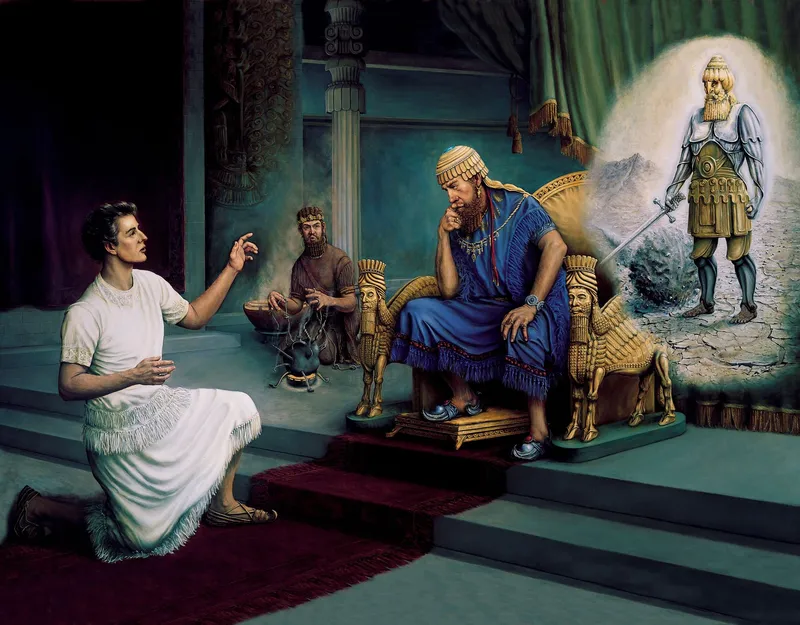
Brought at last before the king, Daniel does something a courtier angling for reward would never do: he gives away the credit before he says a word of the answer. The secret which the king hath demanded cannot the wise men, the astrologers, the magicians, the soothsayers, shew unto the king; but there is a God in heaven that revealeth secrets (vv. 27-28). He first confirms that the king's experts were right about their own helplessness - no human wisdom can do this - and then names the One who can.
And he is careful to keep himself out of the spotlight: this secret is not revealed to me for any wisdom that I have more than any living (v. 30). Daniel will not let the king mistake the messenger for the source. He is a window; the light passing through him comes from beyond him. Standing before a man who could kill him with a word, Daniel's humility is also a kind of courage - he would rather the true God be glorified than secure his own advancement.
He even discloses God's tender purpose in it all: the dream was given that thou mightest know the thoughts of thy heart (v. 30). The God of heaven is not merely flexing His knowledge; He is reaching for the heart of a pagan king who cannot sleep.
Daniel 2:31-35A Stone Cut Without Hands
31Thou, O king, sawest, and behold a great image. This great image, whose brightness was excellent, stood before thee; and the form thereof was terrible. 32This image’s head was of fine gold, his breast and his arms of silver, his belly and his thighs of brass, 33His legs of iron, his feet part of iron and part of clay. 34Thou sawest till that a stone was cut out without hands, which smote the image upon his feet that were of iron and clay, and brake them to pieces. 35Then was the iron, the clay, the brass, the silver, and the gold, broken to pieces together, and became like the chaff of the summer threshingfloors; and the wind carried them away, that no place was found for them: and the stone that smote the image became a great mountain, and filled the whole earth.
Look closely at how the statue is built, because the dream is an argument in metal. A single towering figure, gleaming and fearsome, plated from head to foot in descending metals - gold, then silver, then bronze, then iron, then iron crumbling into common clay (vv. 31-33). Two movements run through it at once, pulling against each other. From top to bottom the metals fall in value. Yet in hardness they mostly rise - iron is stronger than bronze, bronze than silver.
So the image is most precious where it gleams and most brittle where it stands: glorious up top, unstable at the base. And everything rests on those feet of iron mixed with clay, two materials that will not truly bond, a foundation with a fracture built in. This is the very nature of human empire. However golden its glory, however iron its strength, it is top-heavy and planted on a flaw. The whole colossus is waiting for the blow that will find its feet.
Then comes the turn the whole dream has been building toward: Thou sawest till that a stone was cut out without hands, which smote the image upon his feet… and brake them to pieces (v. 34). The stone is small against the towering statue, and it comes from nowhere the king expected - not forged in any workshop, not quarried by any army, but cut out without hands. It strikes not the golden head but the feet, the point of weakness, and the entire image collapses at once: the iron, the clay, the brass, the silver, and the gold, broken to pieces together (v. 35).
All of it - every metal, every kingdom, the precious with the base - goes down together and becomes like the chaff of the summer threshingfloors, blown away until no place was found for them. That is the end of human empire in God's sight: not even rubble, just chaff on the wind. But the stone does not vanish with the dust it scattered. The stone that smote the image became a great mountain, and filled the whole earth. The thing that looked smallest outlasts the thing that looked mightiest - and more than outlasts it, grows until it fills the world.
A kingdom not cut by human hands begins as a stone and ends as a mountain over all the earth. The dream sets the brief, brittle glory of every empire against the quiet, unstoppable expansion of the kingdom God Himself raises up.
Daniel 2:36-40Thou Art This Head of Gold
36This is the dream; and we will tell the interpretation thereof before the king. 37Thou, O king, art a king of kings: for the God of heaven hath given thee a kingdom, power, and strength, and glory. 38And wheresoever the children of men dwell, the beasts of the field and the fowls of the heaven hath he given into thine hand, and hath made thee ruler over them all. Thou art this head of gold. 39And after thee shall arise another kingdom inferior to thee, and another third kingdom of brass, which shall bear rule over all the earth. 40And the fourth kingdom shall be strong as iron: forasmuch as iron breaketh in pieces and subdueth all things: and as iron that breaketh all these, shall it break in pieces and bruise.
Daniel begins the interpretation with the one identification the dream spells out plainly: Thou art this head of gold (v. 38). Even here, in the highest compliment, he keeps the truth that the doxology already sounded. Nebuchadnezzar is indeed a king of kings, with dominion over peoples and lands and even the beasts of the field - but only because the God of heaven hath given thee a kingdom, power, and strength, and glory (v. 37).
The gold is real; the glory is genuine; and all of it is on loan. From there the interpretation moves down the statue: after thee shall arise another kingdom… and another third kingdom… and the fourth kingdom shall be strong as iron (vv. 39-40). Daniel does not name these later powers or fix their dates; he sketches a succession - kingdom giving way to kingdom across the long reach of history. What he stresses is the pattern: each empire, however strong, yields to the next.
The reader is not handed a chart to decode but a truth to feel in the bones - that the parade of human power, golden head to iron legs, is a parade of things that pass. The God who gave Nebuchadnezzar his golden hour is the God who will, in His time, hand the hour to another.
Daniel 2:41-44A Kingdom Which Shall Never Be Destroyed
41And whereas thou sawest the feet and toes, part of potters’ clay, and part of iron, the kingdom shall be divided; but there shall be in it of the strength of the iron, forasmuch as thou sawest the iron mixed with miry clay. 42And as the toes of the feet were part of iron, and part of clay, so the kingdom shall be partly strong, and partly broken. 43And whereas thou sawest iron mixed with miry clay, they shall mingle themselves with the seed of men: but they shall not cleave one to another, even as iron is not mixed with clay. 44And in the days of these kings shall the God of heaven set up a kingdom, which shall never be destroyed: and the kingdom shall not be left to other people, but it shall break in pieces and consume all these kingdoms, and it shall stand for ever.
The interpretation lingers longest on the feet, where the whole image is most vulnerable: part of potters' clay, and part of iron, the kingdom shall be divided… partly strong, and partly broken (vv. 41-42). Iron has real strength, but it is mixed with brittle clay, and the two will not bond: they shall not cleave one to another, even as iron is not mixed with clay (v. 43). It is a portrait of power that cannot finally hold together - alliances that fracture, unions forced but unfused, strength shot through with weakness.
This is where every tower of human empire tends, the dream says: toward division and instability, however it began. And it is precisely there, at the cracked and crumbling feet, that the stone strikes. The point is not to identify a particular coalition but to see the deep truth about all of it: that what humans build, even at its mightiest, carries the fracture of clay within the iron. Earthly kingdoms are divided things, and divided things fall.
The dream has been quietly preparing the reader for what comes next: a kingdom whole, unmixed, and unbreakable, rising where every divided thing has fallen.
Daniel 2:45-49A God of Gods, and a Lord of Kings
45Forasmuch as thou sawest that the stone was cut out of the mountain without hands, and that it brake in pieces the iron, the brass, the clay, the silver, and the gold; the great God hath made known to the king what shall come to pass hereafter: and the dream is certain, and the interpretation thereof sure. 46Then the king Nebuchadnezzar fell upon his face, and worshipped Daniel, and commanded that they should offer an oblation and sweet odours unto him. 47The king answered unto Daniel, and said, Of a truth it is, that your God is a God of gods, and a Lord of kings, and a revealer of secrets, seeing thou couldest reveal this secret. 48Then the king made Daniel a great man, and gave him many great gifts, and made him ruler over the whole province of Babylon, and chief of the governors over all the wise men of Babylon. 49Then Daniel requested of the king, and he set Shadrach, Meshach, and Abednego, over the affairs of the province of Babylon: but Daniel sat in the gate of the king.
Now the dream reaches its summit, and the language lifts: And in the days of these kings shall the God of heaven set up a kingdom, which shall never be destroyed: and the kingdom shall not be left to other people, but it shall break in pieces and consume all these kingdoms, and it shall stand for ever (v. 44). Every word answers the brittle image point for point. The empires were handed down from one people to the next; this kingdom shall not be left to other people - it never changes hands, never falls to a successor, because it has none.
The empires were broken to chaff; this kingdom shall never be destroyed. The empires lasted an age and passed; this kingdom shall stand for ever. And note who raises it: the God of heaven sets it up - it is not seized or built by human power but established by God, the kingdom answering to the stone cut out… without hands (v. 45). Daniel seals it with a guarantee: the dream is certain, and the interpretation thereof sure. What follows is the proof of where real power lies.
The king who threatened to cut his wise men to pieces now fell upon his face, and worshipped, and confessed, Of a truth… your God is a God of gods, and a Lord of kings, and a revealer of secrets (vv. 46-47). The most powerful man on earth bows, in the end, before the God of heaven - exactly as the dream foretold that every power finally must.
Research trail
Sources & further study
These references support the historical, linguistic, manuscript, and contextual notes in this chapter. Scripture remains the primary text; external sources are provided so readers can inspect the research directly.
- Daniel 2 - Translators' NotesThe NET Bible's detailed footnotes on Daniel 2 - the king's impossible demand and the wise men's reply (vv. 1-11), the shift into Aramaic at verse 4, the metals of the image and the much-discussed feet of iron and clay (vv. 31-43), and the stone and the everlasting kingdom (vv. 44-45).
- Daniel 2 · Aramaic + classical Jewish commentaryThe text of Daniel 2 with Rashi, Ibn Ezra, and other classical commentators side by side. From verse 4 onward the book shifts into Aramaic, the diplomatic language of the empire - useful for the recurring title elah shemayya (“the God of heaven,” vv. 18, 19, 28, 37, 44) and for malku (the “kingdom” that shall never be destroyed, v. 44).
- Daniel 2 ↔ Psalm 118 · Matthew 21 · Daniel 7 · Revelation 11Traces the threads tying Daniel 2 to the rest of Scripture - the stone cut out without hands (vv. 34-35) read alongside the rejected stone become the head of the corner (Ps. 118:22; Matt. 21:42-44), and the kingdom that shall never be destroyed (v. 44) read beside of his kingdom there shall be no end (Luke 1:33) and he shall reign for ever and ever (Rev. 11:15).
Where this echoes in Scripture
Except the Gods, Whose Dwelling Is Not With Flesh
- Genesis 41:8Pharaoh... called for all the magicians of Egypt, and all the wise men thereof... but there was none that could interpret them unto Pharaoh.The same scene as verses 2-11 - a pagan king's dream that his whole court of experts cannot read, and only God's servant can.
- Job 33:15-16In a dream, in a vision of the night... Then he openeth the ears of men, and sealeth their instruction.The God who troubles a king's sleep (v. 1) - speaking through dreams in the night.
- 1 Corinthians 1:20Where is the wise? where is the scribe? where is the disputer of this world? hath not God made foolish the wisdom of this world?The helplessness of Babylon's wise men (vv. 10-11) - the wisdom of this world brought to nothing before God.
- Isaiah 47:13Let now the astrologers, the stargazers, the monthly prognosticators, stand up, and save thee from these things that shall come upon thee.A word against the very Babylonian arts that fail in verses 10-11 - the stargazers who cannot save.
Not For Any Wisdom That I Have
- Proverbs 21:1The king's heart is in the hand of the LORD, as the rivers of water: he turneth it whithersoever he will.The truth Daniel blesses in verse 21 - that God removes and sets up kings, and turns even a pagan king's heart.
- James 1:5If any of you lack wisdom, let him ask of God, that giveth to all men liberally... and it shall be given him.The pattern of verses 18-19 - wisdom and the hidden answer given to those who ask God for it.
- 1 Corinthians 2:9-10Eye hath not seen... the things which God hath prepared... But God hath revealed them unto us by his Spirit... the deep things of God.The God who revealeth the deep and secret things (v. 22) - the same depths opened now in Christ.
- Matthew 18:19-20If two of you shall agree on earth as touching any thing that they shall ask, it shall be done for them of my Father.Daniel and his three companions praying together (vv. 17-18) - the power of friends asking God as one.
- Daniel 4:17the most High ruleth in the kingdom of men, and giveth it to whomsoever he will.The theme of verse 21 stated again later in the book - the Most High governs the kingdoms of men.
- Colossians 2:3In whom are hid all the treasures of wisdom and knowledge.The God who revealeth the deep and secret things (v. 22) - in Christ all wisdom is stored.
- Matthew 10:26there is nothing covered, that shall not be revealed; and hid, that shall not be known.The hidden thing brought to light (v. 22) - Jesus' own promise that what is concealed will be known.
- John 8:12I am the light of the world: he that followeth me shall not walk in darkness, but shall have the light of life.The God with whom the light dwelleth (v. 22) - the One who is Himself the light.
A Stone Cut Without Hands
- Psalm 118:22The stone which the builders refused is become the head stone of the corner.The stone-prophecy Jesus joins to this image (vv. 34-35) - the rejected stone become the cornerstone.
- Matthew 21:42-44whosoever shall fall on this stone shall be broken: but on whomsoever it shall fall, it will grind him to powder.Jesus' words deliberately echoing the crushing stone of verses 34-35 - the stone that grinds to powder.
- Isaiah 28:16Behold, I lay in Zion for a foundation a stone, a tried stone, a precious corner stone, a sure foundation.The stone laid by God, not by human hands (v. 34) - a sure foundation of His own setting.
- Matthew 13:31-32the kingdom of heaven is like to a grain of mustard seed... the least of all seeds: but when it is grown... the greatest among herbs.The stone that becomes a mountain filling the earth (v. 35) - the kingdom that begins small and fills the world.
- Hebrews 9:11a greater and more perfect tabernacle, not made with hands, that is to say, not of this building.The work “without hands” (v. 34) - the language of what God does, not human power.
- 1 Peter 2:7-8the stone which the builders disallowed, the same is made the head of the corner, and a stone of stumbling, and a rock of offence.The rejected stone of verses 34-35 gathered up - the cornerstone that is also a stone men stumble over.
- Mark 14:58I will destroy this temple that is made with hands, and within three days I will build another made without hands.The charge laid against Jesus - the “without hands” work of God (v. 34) set over against what human hands build.
A God of Gods, and a Lord of Kings
- Luke 1:32-33the Lord God shall give unto him the throne of his father David... and of his kingdom there shall be no end.The everlasting kingdom of verse 44 named in person - the King whose reign has no end.
- Daniel 7:13-14there was given him dominion, and glory, and a kingdom... his dominion is an everlasting dominion, which shall not pass away.The same eternal kingdom (v. 44) seen again later in the book - given to one like the Son of man.
- Revelation 11:15The kingdoms of this world are become the kingdoms of our Lord, and of his Christ; and he shall reign for ever and ever.The end of the parade of empires (vv. 44-45) - the kingdom of God standing for ever over them all.
- Hebrews 12:28we receiving a kingdom which cannot be moved, let us have grace, whereby we may serve God acceptably.The unshakable kingdom of verse 44 - the one inheritance that cannot be destroyed.
- Psalm 2:6-9Yet have I set my king upon my holy hill of Zion... Thou shalt break them with a rod of iron; thou shalt dash them in pieces.The King God sets up who breaks the nations (vv. 44-45) - the stone that shatters the kingdoms of men.
- Mark 1:15The time is fulfilled, and the kingdom of God is at hand: repent ye, and believe the gospel.The kingdom God sets up (v. 44) announced as having arrived - the reign drawn near in Christ.
- John 18:36My kingdom is not of this world: if my kingdom were of this world, then would my servants fight.The kingdom not raised by human hands (vv. 44-45) - established by God, not by sword or treaty.