Painter of the Bible
Pietro Testa
Pietro Testa, called Il Lucchesino from his birthplace, was a Lucchese-born painter, draftsman, and etcher who worked in Rome through the 1630s and 1640s as a member of the circle of Pietro da Cortona and Nicolas Poussin.

Their faith
Why Pietro Testa painted Christ
Pietro Testa, known as Il Lucchesino, was a dedicated artist whose life and work were deeply intertwined with his Christian faith. Born in Lucca in 1612, he moved to Rome where he trained under notable figures like Domenichino and Pietro da Cortona, both of whom were influenced by the Caravaggesque tradition. His artistic journey was marked by a commitment to sacred subjects, and he produced numerous altarpieces and biblical scenes that reflect his reverence for scripture. Although his life was marked by struggles, including chronic poverty and melancholia, his devotion to God and the Christian narrative remained steadfast, as evidenced by his choice of subjects and the emotional depth he infused into his work.
Testa's faith profoundly shaped his artistic vision, leading him to create powerful religious etchings and paintings. Works like "The Massacre of the Innocents" and "Joseph Sold by His Brothers" showcase not only his technical prowess but also his ability to convey deep spiritual truths. His etchings, particularly, circulated widely and were appreciated for their intricate detail and emotive power, allowing viewers to engage with the biblical stories on a profound level. Through his art, Testa invites us to reflect on the complexities of faith, sacrifice, and redemption. Even today, his devotion resonates through his works, inspiring viewers to contemplate their own spiritual journeys and the beauty of God's narrative in their lives.
Life & work
Pietro Testa, called Il Lucchesino from his birthplace, was a Lucchese-born painter, draftsman, and etcher who worked in Rome through the 1630s and 1640s as a member of the circle of Pietro da Cortona and Nicolas Poussin. Born in Lucca in 1612, sent to Rome as a young man and trained first in the orbit of the Caravaggesque painter Domenichino and then with Pietro da Cortona, he made his living from a combination of small painted commissions and his prolific output as an etcher. He died young in Rome in 1650, drowned in the Tiber under unclear circumstances.
His painted output is small and is concentrated in altarpieces and easel paintings of biblical and mythological subjects. The Massacre of the Innocents (Galleria Spada, Rome) and the Joseph Sold by His Brothers (Pinacoteca Capitolina) are characteristic. His drawings, in pen and ink with brown wash, are widely admired for their elegance and rapid invention.
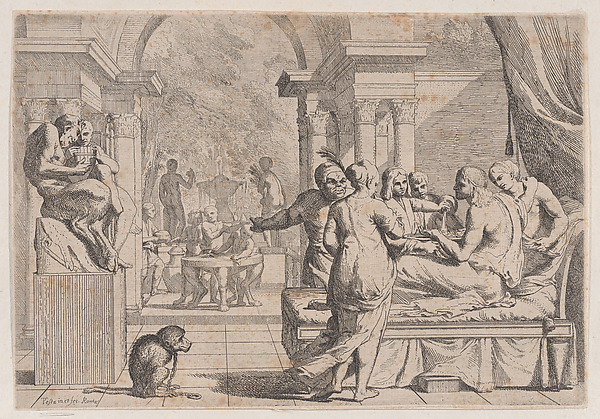
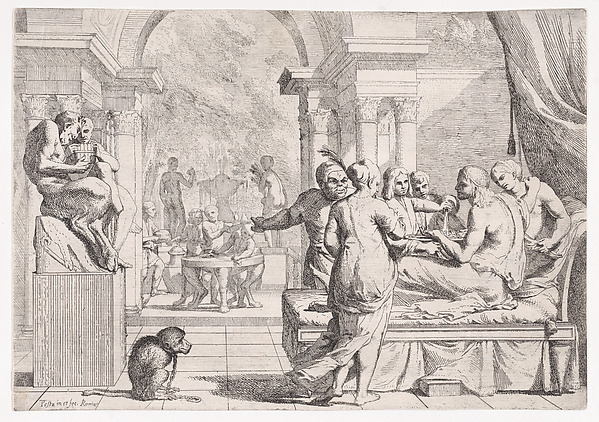
His etched output is the basis of his lasting reputation. The Massacre of the Innocents (1632), the Liberation of Saint Peter, the Adoration of the Shepherds, the Allegory of Spring, the Triumph of Painting, the Symposium, the Garden of Venus, and the late multi-plate Allegory of the Liberal Arts — all show his characteristic combination of dense, tightly cross-hatched figural groups with airy, classicizing landscape settings. His religious etchings circulated through the Roman publishing houses and were collected by connoisseurs across Catholic Europe.
His intellectual ambitions were considerable: he wrote treatises on painting (now lost, but reflected in his etched allegories of the arts) and was a member of the circle around Cassiano dal Pozzo, the great Roman antiquarian and patron whose Museo Cartaceo (Paper Museum) collected drawings and engravings of Roman antiquities for systematic study. Testa contributed drawings to the project.
The seventeenth-century biographers describe him as melancholic, contentious, and chronically poor; the eighteenth and nineteenth centuries half-forgot him. The twentieth century, particularly through the work of the Italian critic Anna Forlani Tempesti and the great 1988 Philadelphia Museum exhibition of his etchings, restored him to his place as one of the most original draftsmen and etchers of the Roman Baroque generation.
Notable works in detail
met-399888
The Sacrifice of Isaac, etched by Pietro Testa in his Roman workshop years (probably the late 1630s, the dating of his prints is somewhat contested), illustrates the climactic moment of Genesis 22 in which the angel descends to stop Abraham from sacrificing his son Isaac on the altar at the top of Mount Moriah. Testa stages the scene with characteristic Roman Baroque density: the bound Isaac kneels at the small stone altar in the foreground, Abraham raises the knife with one hand while the angel's hand grips his wrist from above, the ram caught in the thicket appears in the lower-right corner, and a panoramic landscape with distant hills fades into atmospheric haze in the background. The print demonstrates the late Testa etching technique — long swelling lines, dense crosshatched shadow, atmospheric distance — that defined his contribution to the seventeenth-century Roman printmaking tradition.
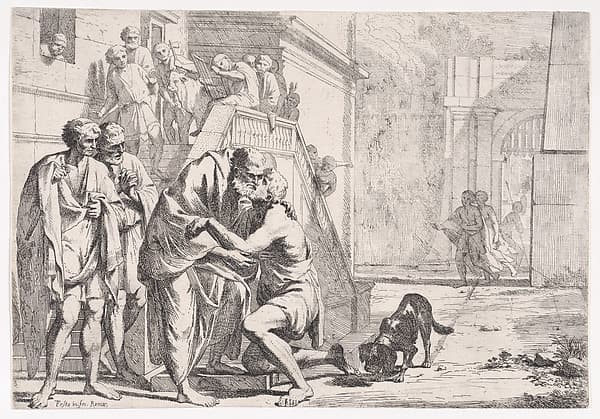
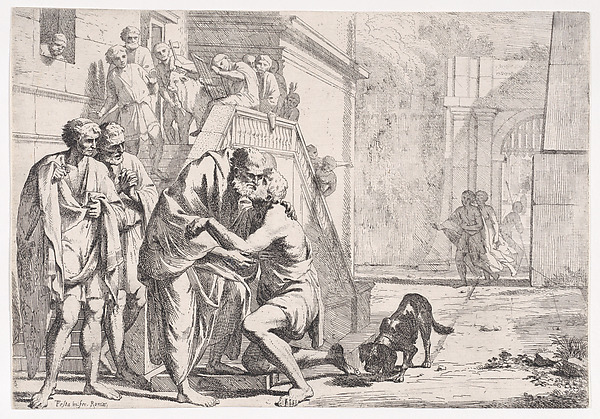
The Return of the Prodigal Son, Shown Embracing His Son
The Return of the Prodigal Son, etched by Pietro Testa in his Roman workshop years, illustrates the climactic moment of the Luke 15 parable: the father runs to embrace his returning son who, having squandered his inheritance, has returned home to throw himself at his father's feet. Testa stages the scene as a tender outdoor encounter at the gate of the family estate: the kneeling son embraced by the standing father, household servants in the background preparing the celebratory meal, the elder brother visible at the upper right tending the fields. The print is among the most reproduced Testa religious etchings and demonstrates his characteristic combination of dense narrative composition with the airy classicizing landscape that filled the backgrounds of his mature prints.
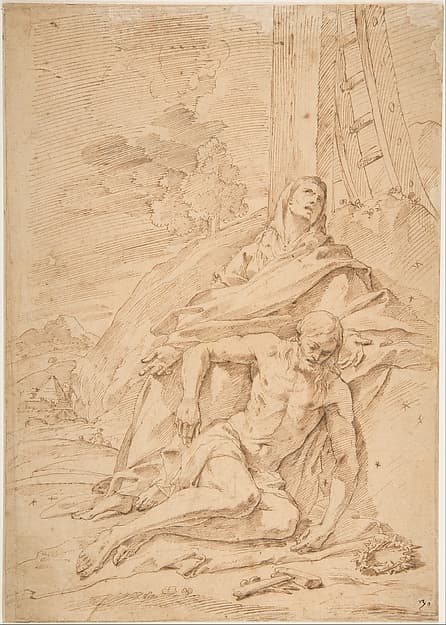
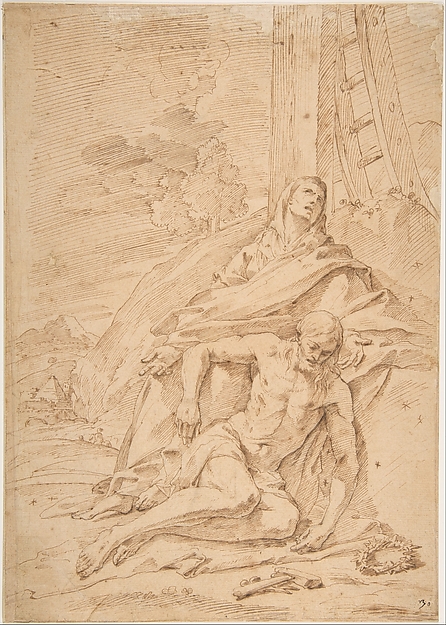
The Virgin Lamenting over the Dead Christ
The Virgin Lamenting over the Dead Christ, drawn by Pietro Testa around 1612 in his Roman workshop in pen and brown ink with brown wash on paper and now in the Metropolitan Museum of Art in New York, is a small preparatory drawing for one of his rare painted Pietà compositions. The drawing shows the seated Virgin holding the dead body of Christ across her lap in the conventional Pietà posture, with John the Evangelist standing behind to support the head and the Magdalene kneeling at the feet in attitude of grief. The drawing demonstrates Testa's elegant rapid pen-and-wash technique that the eighteenth-century connoisseurs Jean-Baptiste-Joseph Boucher and Pierre-Jean Mariette would treat as one of the supreme achievements of Italian Baroque draughtsmanship.
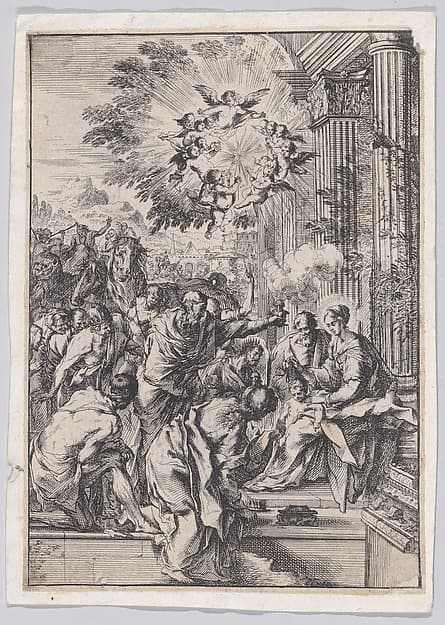
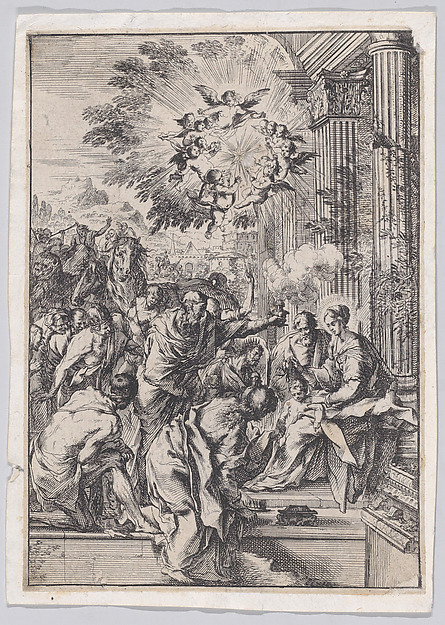
The Adoration of the Magi, set before and architectural colonnade
The Adoration of the Magi, etched by Pietro Testa around 1620 in his early Roman workshop years, depicts the visit of the three kings to the infant Christ as recorded in Matthew 2. Testa stages the scene as a dense vertical composition under a great Renaissance architectural canopy: the seated Virgin and the Christ Child at the right, the eldest king kneeling in profile in the foreground offering his gift, the second and third kings with their large attending retinue filling the background, and an Italianate landscape glimpsed beyond a colonnade behind. The print is one of the principal early Testa religious etchings and a defining example of his ability to combine dense narrative figural composition with the elegant classicizing architectural setting that the Roman seventeenth-century circle of Cassiano dal Pozzo cultivated as the right pictorial setting for biblical narrative.