Genesis 41
People in this chapter
Genesis 41 opens with Pharaoh alone with his dreams. Two centuries before Egypt's wise men will decode the mysteries of their own temples, they stand mute before these seven cows and seven ears of grain 1. Nothing in the wisdom of Egypt can read what God is saying. The magicians fail. And in the dungeon, still thirteen years from home, Joseph waits without knowing that a dream is about to change everything.
Tap any highlighted phrase to jump to the commentary that unpacks it.
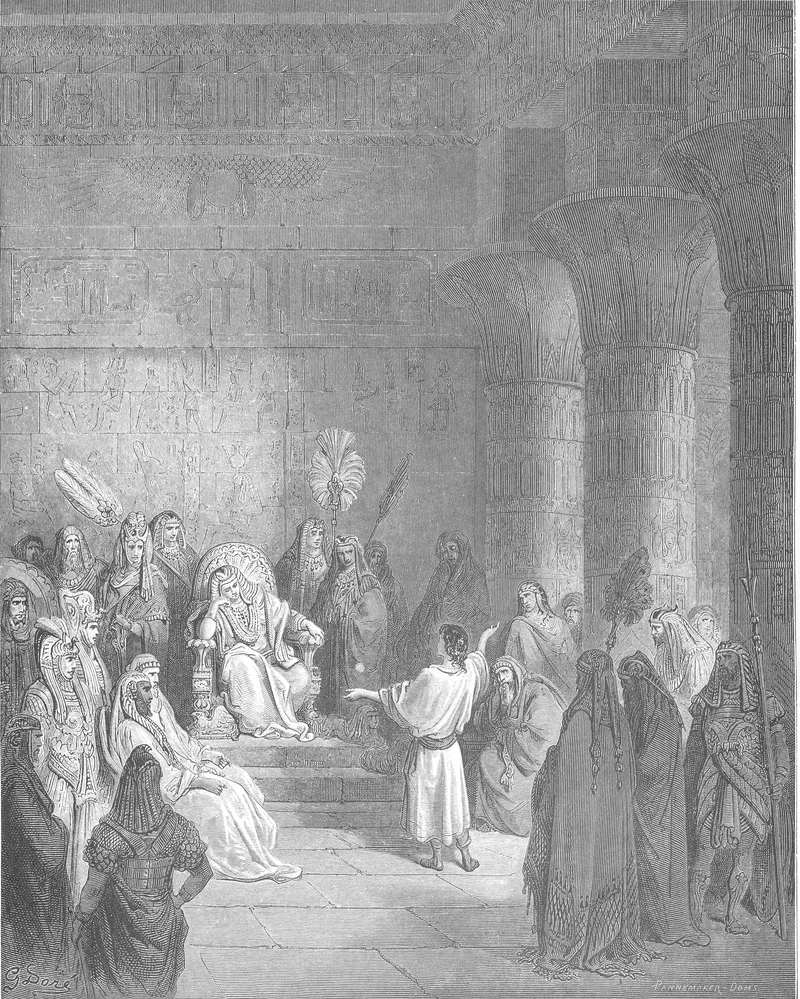
Genesis 41:1-8Pharaoh's Dreams
1And it came to pass at the end of two full years, that Pharaoh dreamed: and, behold, he stood by the river. 2And, behold, there came up out of the river seven well favoured kine and fatfleshed; and they fed in a meadow. 3And, behold, seven other kine came up after them out of the river, ill favoured and leanfleshed; and stood by the other kine upon the brink of the river. 4And the ill favoured and leanfleshed kine did eat up the seven well favoured and fat kine. So Pharaoh awoke.
Pharaoh wakes terrified--seven fat cows devoured by thin ones, seven healthy ears consumed by blighted grain. No interpreter can read the riddle.
5And he slept and dreamed the second time: and, behold, seven ears of corn came up upon one stalk, rank and good. 6And, behold, seven thin ears and blasted with the east wind sprung up after them. 7And the seven thin ears devoured the seven rank and full ears. And Pharaoh awoke, and, behold, it was a dream. 8And it came to pass in the morning that his spirit was troubled; and he sent and called for all the magicians of Egypt, and all the wise men thereof: and Pharaoh told them his dream; but there was none that could interpret them unto Pharaoh.
The dream comes in pairs: seven fat cows and seven lean cows; seven full ears and seven thin ears. The number seven is perfection, completeness. But here it is doubled, doubled to speak of fullness consuming fullness, absence devouring abundance. Pharaoh is not hearing a normal dream; he is hearing a nightmare of annihilation.
The lean cows come second, their scarcity contrasted with the abundance that came before. This is the movement of the dream: plenty first, and then the taking away.
The lean consume the fat - but they do not become fat themselves. They remain lean and wretched. This is the terror of the dream: the famine is so severe that eating all of Egypt's abundance cannot satisfy it. Destruction is speaking through this image.
The grain imagery repeats the cattle dream. Seven full ears on one stalk - what could be more abundant? One stalk bearing perfection. Yet the second dream speaks the same annihilation.
The thin ears devour the full ones. Again, the lean eats the fat. The famine speaks louder than abundance. The east wind blasts the thin ears - a detail that will echo later in how famine comes to Egypt.
Egypt was the intellectual center of the ancient world. Her priests read the stars, her scribes preserved knowledge, her wise men interpreted the mysteries of the gods. And all of them stand silent before Pharaoh's dreams. Whatever God is saying here, Egypt cannot hear it. The wisest men the world has to offer are helpless. This is the problem that will crack open the palace door for a prisoner.
Genesis 41:9-16The Butler Remembers
9Then spake the chief butler unto Pharaoh, saying, I do remember my faults this day: 10Pharaoh was wroth with his servants, and put me in ward in the captain of the guard’s house, both me and the chief baker: 11And we dreamed a dream in one night, I and he; we dreamed each man according to the interpretation of his dream. 12And there was there with us a young man, an Hebrew, servant to the captain of the guard; and we told him, and he interpreted to us our dreams; to each man according to his dream he did interpret.
Seven years of abundance will be followed by seven years of famine. Joseph proposes wise storage, and Pharaoh sees that the Spirit of God dwells in this Hebrew.
13And it came to pass, as he interpreted to us, so it was; me he restored unto mine office, and him he hanged. 14Then Pharaoh sent and called Joseph, and they brought him hastily out of the dungeon: and he shaved himself, and changed his raiment, and came in unto Pharaoh. 15And Pharaoh said unto Joseph, I have dreamed a dream, and there is none that can interpret it: and I have heard say of thee, that thou canst understand a dream to interpret it. 16And Joseph answered Pharaoh, saying, It is not in me: God shall give Pharaoh an answer of peace.
Two years have passed since Joseph interpreted the butler's dream. Two years of prison. Two years without word, without hope. And then, out of nowhere, the chief butler remembers. He does not remember out of gratitude or kindness at first - he remembers because Pharaoh is desperate. But God uses even selfish remembrance. Sometimes the only way out of the dungeon is someone else's need. Sometimes grace looks like being useful at the exact moment you are most forgotten.
Joseph shaves. He changes his clothes. In a single moment of grooming, he is transformed from a prisoner into a man who can stand before a king. But notice: he does not change who he is. He has not spent two years in chains rehearsing how to please Pharaoh or crafting a better pitch. He goes in ready to point away from himself. The shaving is only the exterior. The interior - the refusal to take credit - that is who Joseph has been in the dungeon, and it is who he will be on the throne.

Genesis 41:17-24The Dream Told Again
17And Pharaoh said unto Joseph, In my dream, behold, I stood upon the bank of the river: 18And, behold, there came up out of the river seven kine, fatfleshed and well favoured; and they fed in a meadow: 19And, behold, seven other kine came up after them, poor and very ill favoured and leanfleshed, such as I never saw in all the land of Egypt for badness: 20And the lean and the ill favoured kine did eat up the first seven fat kine:
Pharaoh places his signet on Joseph's finger and robes him in fine linen. Joseph, the prisoner, becomes Zaphenath-paneah, Pharaoh's hand-a man reborn.
21And when they had eaten them up, it could not be known that they had eaten them; but they were still ill favoured, as at the beginning. So I awoke. 22And I saw in my dream, and, behold, seven ears came up in one stalk, full and good: 23And, behold, seven ears, withered, thin, and blasted with the east wind, sprung up after them: 24And the thin ears devoured the seven good ears: and I told this unto the magicians; but there was none that could declare it to me.
Joseph promises "an answer of peace" - an answer that brings wholeness, not merely information. That is a remarkable promise to make to a desperate man. What Joseph means is that the answer will not destroy Pharaoh; it will come from God, and God is trustworthy. The word shalom here means more than peace; it means wholeness, soundness, the restoration of right relationship. Whatever God is saying through the dream, the answer will have God's character written into it.
Genesis 41:25-32The Interpretation
25And Joseph said unto Pharaoh, The dream of Pharaoh is one: God hath shewed Pharaoh what he is about to do. 26The seven good kine are seven years; and the seven good ears are seven years: the dream is one. 27And the seven thin and ill favoured kine that came up after them are seven years; and the seven empty ears blasted with the east wind shall be seven years of famine. 28This is the thing which I have spoken unto Pharaoh: What God is about to do he sheweth unto Pharaoh.
Joseph gathers grain like sand by the sea. Asenath bears him Manasseh and Ephraim--God has made him forget his suffering and double his inheritance.
29Behold, there come seven years of great plenty throughout all the land of Egypt: 30And there shall arise after them seven years of famine; and all the plenty shall be forgotten in the land of Egypt; and the famine shall consume the land; 31And the plenty shall not be known in the land by reason of that famine following; for it shall be very grievous. 32And for that the dream was doubled unto Pharaoh twice; it is because the thing is established by God, and God will shortly bring it to pass.
Joseph names reality. The dream is "one" - it is unified, it is speaking one truth in two images: seven years will come when Egypt drowns in abundance, and seven years will come when Egypt starves. The dream is telling Pharaoh to prepare. But more than that, the dream is telling Pharaoh that God is speaking. "What God is about to do he sheweth unto Pharaoh." Joseph's interpretation centers on God's intention.
The fact that the dream came twice is itself a message. In the ancient world, repetition was a sign of urgency and certainty. The thing that comes twice is the thing God is serious about. Joseph hears the double dream as a double affirmation: "God will shortly bring it to pass." The dream is a promise, certain and settled.
Genesis 41:33-40The Wisdom Proposal
33Now therefore let Pharaoh look out a man discreet and wise, and set him over the land of Egypt. 34Let Pharaoh do this, and let him appoint officers over the land, and take up the fifth part of the land of Egypt in the seven plenteous years. 35And let them gather all the food of those good years that come, and lay up corn under the hand of Pharaoh, and let them keep food in the cities. 36And that food shall be for store to the land against the seven years of famine, which shall be in the land of Egypt; that the land perish not through the famine.
The famine spreads wide; people cry out to Pharaoh. But Joseph has stored; Egypt alone has bread. In Canaan, Jacob hears the news--there is grain in Egypt.
37And the thing was good in the eyes of Pharaoh, and in the eyes of all his servants. 38And Pharaoh said unto his servants, Can we find such a one as this is, a man in whom the Spirit of God is? 39And Pharaoh said unto Joseph, Forasmuch as God hath shewed thee all this, there is none so discreet and wise as thou art: 40Thou shalt be over my house, and according unto thy word shall all my people be ruled: only in the throne will I be greater than thou.
Joseph does something remarkable: he does not wait for Pharaoh to offer him the job. He proposes the position himself - and then describes the man for the job in terms that fit him exactly. "A man discreet and wise." The interpretation came from God; the solution is practical; the man to carry it out is standing right here. Joseph is naming what needs to happen.
Joseph's plan is to take one-fifth of all the grain during the seven years of plenty and store it for the famine. It is a massive appropriation - the state taking a fifth of every harvest - but it is the only way Egypt will survive what is coming. The man who has nothing, who owns nothing, who has lost everything is now proposing to take one-fifth of everything Egypt owns and hold it in trust for a future he can see and Pharaoh cannot.
This is the character of Joseph: he sees what needs to be done and does it, whether it is dramatic or ordinary, popular or unpopular.
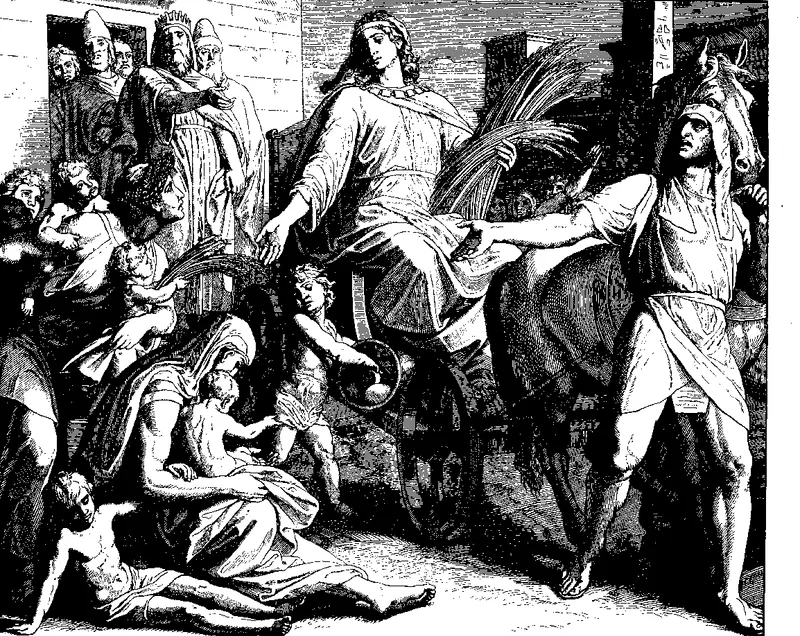
Genesis 41:41-45Joseph Exalted
41And Pharaoh said unto Joseph, See, I have set thee over all the land of Egypt. 42And Pharaoh took off his ring from his hand, and put it upon Joseph’s hand, and arrayed him in vestures of fine linen, and put a gold chain about his neck; 43And he made him to ride in the second chariot which he had; and they cried before him, Bow the knee: and he made him ruler over all the land of Egypt. 44And Pharaoh said unto Joseph, I am Pharaoh, and without thee shall no man lift up his hand or foot in all the land of Egypt. 45And Pharaoh called Joseph’s name Zaphnathpaaneah; and he gave him to wife Asenath the daughter of Potipherah priest of On. And Joseph went out over all the land of Egypt.
The ceremony is swift and absolute. Pharaoh gives Joseph his ring - a symbol of authority. He dresses him in linen - a symbol of rank. He puts a gold chain around his neck - a symbol of honor. All within minutes. The man who came out of the dungeon in prisoner's rags is now clothed in the garments of power. But notice the pattern: everything he will wield in Egypt comes to him as a gift.
As Joseph passes through the streets, the cry goes up: "Bow the knee." In the span of a single day, a man who had no honor, no name, no standing has been lifted to such a height that Egypt bows. This is the elevation from the pit to the throne, from powerlessness to authority. But the pattern matters: Joseph did not seize this. Joseph did not scheme to get it. Joseph spoke truth when asked, and Pharaoh lifted him up.
Genesis 41:46-52Manasseh and Ephraim
46And Joseph was thirty years old when he stood before Pharaoh king of Egypt. And Joseph went out from the presence of Pharaoh, and went throughout all the land of Egypt. 47And in the seven plenteous years the earth brought forth by handfuls. 48And he gathered up all the food of the seven years, which were in the land of Egypt, and laid up the food in the cities: the food of the field, which was round about every city, laid he up in the same.
Pharaoh grants permission, and the brothers depart. But Joseph stands at the border of Egypt, watching them vanish. He does not know if he will see Benjamin again.
49And Joseph gathered corn as the sand of the sea, very much, until he left numbering; for it was without number. 50And unto Joseph were born two sons before the years of famine came, which Asenath the daughter of Potipherah priest of On bare unto him. 51And Joseph called the name of the firstborn Manasseh: For God, said he, hath made me forget all my toil, and all my father’s house. 52And the name of the second called he Ephraim: For God hath caused me to be fruitful in the land of my affliction.
Joseph is thirty years old. Luke will note that Jesus was thirty when He began His ministry (Luke 3:23). Both men begin their public work at thirty. Both are lifted up for a work that no one else can do - Joseph by a king who has nowhere else to turn, the Son of God by a Father who sends Him to save the world. The age marks them both.
Manasseh means "God hath made me forget." It is a remarkable name for a son - a name celebrating what God has done for Joseph. The meaning is that God has given him grace to move beyond the pain. The bitterness is bearable now. The years in the pit and the prison have not been erased, but they are not bleeding into his present anymore. This is the healing of Manasseh: the past no longer gets to name the future.
Ephraim means "God hath caused me to be fruitful in the land of my affliction." This is resurrection language: fruitfulness in the land of the affliction itself. Joseph is in Egypt, a slave's son, far from home. And yet - fruit. Life multiplying. Possibility. Sons born to him when he had nothing. This is what God does with people He has broken: He makes them fruitful in it.
Genesis 41:53-57The Years of Plenty and Famine
53And the seven years of plenteousness, that was in the land of Egypt, were ended. 54And the seven years of dearth began to come, according as Joseph had said: and the dearth was in all lands; but in all the land of Egypt there was bread. 55And when all the land of Egypt was famished, the people cried to Pharaoh for bread: and Pharaoh said unto all the Egyptians, Go unto Joseph; what he saith to you, do. 56And the famine was over all the face of the earth: And Joseph opened all the storehouses, and sold unto the Egyptians; and the famine waxed sore in the land of Egypt. 57And all countries came into Egypt to Joseph for to buy corn; because that the famine was so sore in all lands.
Joseph does not hoard the grain for Egypt alone. He sells it. The economics are stark: people without money bring livestock. People without livestock bring land. People without land sell themselves into servitude. By the time the famine ends, Egypt is wealthy beyond measure, and the people are dependents of Pharaoh. But they are alive. They have been fed. The bread that Joseph stored has become the bread that keeps the known world alive.
Research trail
Sources & further study
These references support the historical, linguistic, manuscript, and contextual notes in this chapter. Scripture remains the primary text; external sources are provided so readers can inspect the research directly.