Daniel 5
People in this chapter
Belshazzar throws a feast for a thousand lords. Drunk on his own wine, he sends for the golden vessels his father Nebuchadnezzar had carried out of God's temple, and pours wine into them for a toast to the gods of gold, and of silver… of wood, and of stone (v. 4). Sacrilege on purpose, before a thousand witnesses. In that same hour a hand appears on the wall, and the swagger drains out of him: his knees smote one against another (v. 6). No wise man in Babylon can read it.1
Tap any highlighted phrase to jump to the commentary that unpacks it.
Daniel 5:1-4Wine From the Holy Vessels
1Belshazzar the king made a great feast to a thousand of his lords, and drank wine before the thousand. 2Belshazzar, whiles he tasted the wine, commanded to bring the golden and silver vessels which his father Nebuchadnezzar had taken out of the temple which was in Jerusalem; that the king, and his princes, his wives, and his concubines, might drink therein. 3Then they brought the golden vessels that were taken out of the temple of the house of God which was at Jerusalem; and the king, and his princes, his wives, and his concubines, drank in them. 4They drank wine, and praised the gods of gold, and of silver, of brass, of iron, of wood, and of stone.
A thousand lords, the king on display before all of them, Babylon at the summit of its power - and the worst thing in the room is about to be the king's own idea. Whiles he tasted the wine, with the drink already in him, he gives a calculated order: bring the golden vessels his father Nebuchadnezzar had taken out of the temple in Jerusalem, so the whole drunken company can drink from them (vv. 1-2).
This is not careless. These vessels were holy things, set apart for the worship of the living God and carried off as plunder a generation before. Even Nebuchadnezzar, for all his pride, had stored them away; he did not turn them into party cups. Belshazzar reaches deliberately for the one set of objects in his treasury most charged with the claims of the God of Israel - and profanes them for sport. The whole tragedy of the chapter is folded into this single act: the deliberate treating of what is holy as if it were common, the open boast against heaven made in front of a thousand witnesses.1
See what the profaning of the vessels is bent toward: They drank wine, and praised the gods of gold, and of silver, of brass, of iron, of wood, and of stone (v. 4). The holy cups of the true God are lifted in a toast to gods that are no gods at all - idols of metal and wood and rock, the work of human hands. Daniel will press the contrast in a moment: these are gods which see not, nor hear, nor know, while the God whose vessels they are is the one in whose hand thy breath is (v. 23).
The sin is not merely drunkenness or excess; it is worship aimed at the wrong object, gratitude given to dead things by people kept alive every second by the God they are insulting. The list of six materials - gold, silver, brass, iron, wood, stone - reads like an inventory of everything the empire prized and trusted: its wealth, its weapons, its craft. Belshazzar is praising the props of his own power as though they were divine.
It is the oldest exchange there is, the heart turning from the Maker to the made - and at this feast it is done with the stolen instruments of the Maker's own worship.
Daniel 5:5-9The Hand Upon the Wall
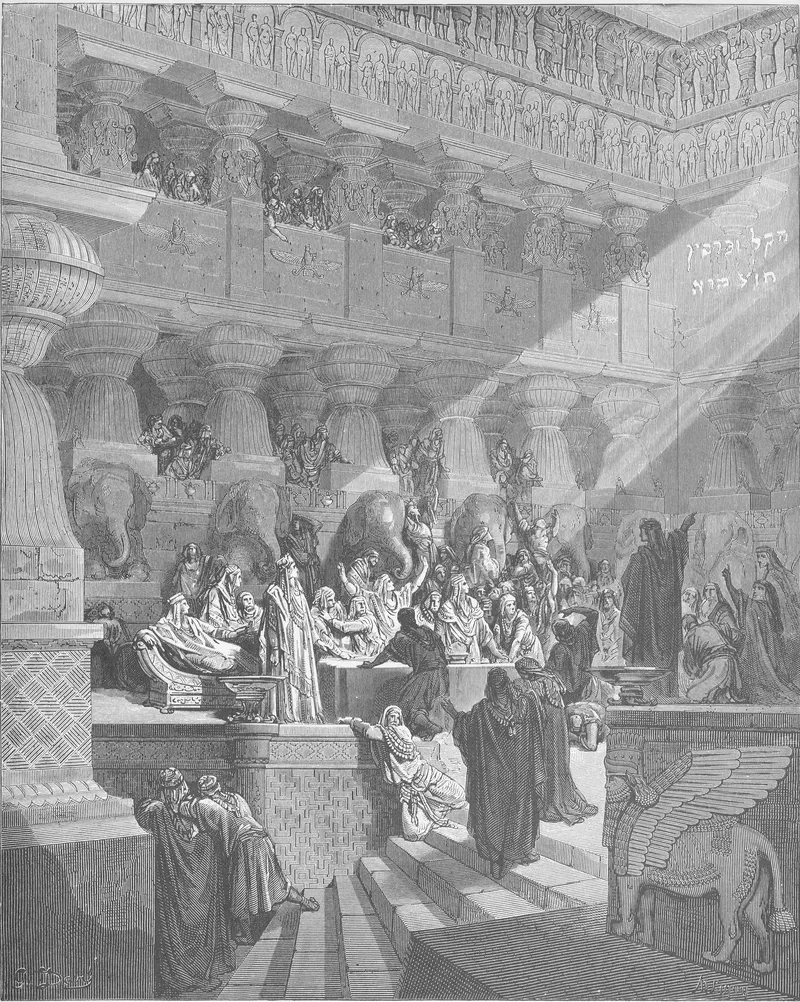
5In the same hour came forth fingers of a man’s hand, and wrote over against the candlestick upon the plaister of the wall of the king’s palace: and the king saw the part of the hand that wrote. 6Then the king’s countenance was changed, and his thoughts troubled him, so that the joints of his loins were loosed, and his knees smote one against another. 7The king cried aloud to bring in the astrologers, the Chaldeans, and the soothsayers. And the king spake, and said to the wise men of Babylon, Whosoever shall read this writing, and shew me the interpretation thereof, shall be clothed with scarlet, and have a chain of gold about his neck, and shall be the third ruler in the kingdom. 8Then came in all the king’s wise men: but they could not read the writing, nor make known to the king the interpretation thereof. 9Then was king Belshazzar greatly troubled, and his countenance was changed in him, and his lords were astonied.
Judgment does not wait. In the same hour - the boast still hanging in the air - came forth fingers of a man's hand, and wrote over against the candlestick upon the plaister of the wall of the king's palace (v. 5). Not a voice from the sky, not a prophet at the door, but something stranger and more dreadful: a disembodied hand, writing where the lamplight falls and every reveller can see it. And the king sees the part of the hand that wrote. The effect is immediate and physical.
Then the king's countenance was changed, and his thoughts troubled him, so that the joints of his loins were loosed, and his knees smote one against another (v. 6). The man who moments ago was mocking the God of heaven is now shaking so violently he can hardly stand; his knees knock together, his body gives way under him. There is something terrible and just in how fast it turns. He had felt invulnerable, master of the greatest kingdom on earth, daring heaven with stolen cups.
One hand, one line of writing he cannot even read, and the whole bravado collapses. The wise men he summons can do nothing - they could not read the writing (v. 8) - and the dread only deepens, until the king is greatly troubled and his lords are astonied. The feast has become a courtroom, and no one in Babylon can read the verdict.
Daniel 5:10-12Now Let Daniel Be Called
10Now the queen by reason of the words of the king and his lords came into the banquet house: and the queen spake and said, O king, live for ever: let not thy thoughts trouble thee, nor let thy countenance be changed: 11There is a man in thy kingdom, in whom is the spirit of the holy gods; and in the days of thy father light and understanding and wisdom, like the wisdom of the gods, was found in him; whom the king Nebuchadnezzar thy father, the king, I say, thy father, made master of the magicians, astrologers, Chaldeans, and soothsayers; 12Forasmuch as an excellent spirit, and knowledge, and understanding, interpreting of dreams, and shewing of hard sentences, and dissolving of doubts, were found in the same Daniel, whom the king named Belteshazzar: now let Daniel be called, and he will shew the interpretation.
Into the panic comes a steadier voice. Now the queen by reason of the words of the king and his lords came into the banquet house (v. 10) - very likely the queen mother, an older woman who remembers the reign of Nebuchadnezzar and is not at the drunken table herself. She alone keeps her head. O king, live for ever: let not thy thoughts trouble thee, nor let thy countenance be changed, she says, and then points the terrified court to the one resource it has overlooked: There is a man in thy kingdom, in whom is the spirit of the holy gods (v. 11).
She recalls a whole history Belshazzar has either forgotten or never valued - how in the days of his father there was found in this man light and understanding and wisdom, so that Nebuchadnezzar himself made master of the magicians, astrologers, Chaldeans, and soothsayers. Her testimony is striking for what it reveals: Daniel, decades on, has apparently been pushed to the margins of this reign. The man Nebuchadnezzar set over all his wise men is not even in the room.
A new king came who did not know - or did not care - what the God of this servant had done. The queen's memory is the hinge of the chapter; she remembers what the king has let slip, and her remembering brings the word of God back into the palace.
Daniel 5:13-16The Third Ruler in the Kingdom
13Then was Daniel brought in before the king. And the king spake and said unto Daniel, Art thou that Daniel, which art of the children of the captivity of Judah, whom the king my father brought out of Jewry? 14I have even heard of thee, that the spirit of the gods is in thee, and that light and understanding and excellent wisdom is found in thee. 15And now the wise men, the astrologers, have been brought in before me, that they should read this writing, and make known unto me the interpretation thereof: but they could not shew the interpretation of the thing: 16And I have heard of thee, that thou canst make interpretations, and dissolve doubts: now if thou canst read the writing, and make known to me the interpretation thereof, thou shalt be clothed with scarlet, and have a chain of gold about thy neck, and shalt be the third ruler in the kingdom.
Daniel is summoned, and the king's words to him are worth weighing. Art thou that Daniel, which art of the children of the captivity of Judah, whom the king my father brought out of Jewry? (v. 13). Belshazzar knows exactly who Daniel is - an exile, one of the captives, a man marked by the very conquest that filled this treasury with stolen vessels. He has heard the reports: the spirit of the gods is in thee… light and understanding and excellent wisdom (v. 14).
So the knowledge was available to him all along; he simply had not sought it until the writing drove him to it. He recounts how his own wise men have failed (v. 15), and then dangles the reward again: scarlet, a gold chain, and to be the third ruler in the kingdom (v. 16). The offer is grand and, as the night will prove, worthless - one cannot be made third in a kingdom that has hours to live.
There is a quiet irony in a frightened king trying to purchase the truth with promotions, as if the word of God were a service to be bought. But notice too the mercy hidden in the moment: even now, even at the eleventh hour, the truth is being brought before Belshazzar by a faithful witness. He is not left to guess. The word will be spoken to him plainly - which is precisely what will make his refusal so weighty.
Daniel 5:17-21Let Thy Gifts Be to Thyself
17Then Daniel answered and said before the king, Let thy gifts be to thyself, and give thy rewards to another; yet I will read the writing unto the king, and make known to him the interpretation. 18O thou king, the most high God gave Nebuchadnezzar thy father a kingdom, and majesty, and glory, and honour: 19And for the majesty that he gave him, all people, nations, and languages, trembled and feared before him: whom he would he slew; and whom he would he kept alive; and whom he would he set up; and whom he would he put down. 20But when his heart was lifted up, and his mind hardened in pride, he was deposed from his kingly throne, and they took his glory from him: 21And he was driven from the sons of men; and his heart was made like the beasts, and his dwelling was with the wild asses: they fed him with grass like oxen, and his body was wet with the dew of heaven; till he knew that the most high God ruled in the kingdom of men, and that he appointeth over it whomsoever he will.
Daniel's first words set the tone for everything that follows: Let thy gifts be to thyself, and give thy rewards to another; yet I will read the writing unto the king, and make known to him the interpretation (v. 17). He will not take the scarlet, the chain, or the third place. This is not rudeness; it is freedom. By refusing the reward before he says a word, Daniel makes plain that nothing he is about to speak has been bought.
He owes Belshazzar nothing and fears him not at all, and so he can tell him the truth whole. There is a deep integrity here that the whole book has been building: the man who once refused the king's rich food (ch. 1) now refuses the king's rich reward. A messenger who cannot be paid cannot be silenced. And so, with the gifts pushed aside, Daniel turns to deliver the hardest word a king ever heard at his own feast - freely, plainly, and without a trace of self-interest to blunt it.
Before he reads the writing, Daniel makes Belshazzar look at his own father's story, because that story is the key to his guilt. The most high God gave Nebuchadnezzar thy father a kingdom, and majesty, and glory, and honour (v. 18) - everything the great king had was a gift, not an achievement. And when that gift swelled into arrogance - when his heart was lifted up, and his mind hardened in pride - God brought him down: he was deposed from his kingly throne, and they took his glory from him (v. 20).
Daniel recounts the humbling without flinching: the proudest man alive was driven from the sons of men, made to live like a beast, eating grass and wet with dew, till he knew that the most high God ruled in the kingdom of men, and that he appointeth over it whomsoever he will (v. 21). That last line is the lesson of the whole episode - the very thing Nebuchadnezzar finally learned the hard way, and the thing Belshazzar still has not learned.
The point is not merely that pride is dangerous; it is that the kingdom was never Belshazzar's to boast in. It was on loan from the God who hands out thrones and takes them back. The father was broken until he confessed it. The son has had the whole account in front of him - and has done nothing with it.
Daniel 5:22-23Thou Knewest All This
22And thou his son, O Belshazzar, hast not humbled thine heart, though thou knewest all this; 23But hast lifted up thyself against the Lord of heaven; and they have brought the vessels of his house before thee, and thou, and thy lords, thy wives, and thy concubines, have drunk wine in them; and thou hast praised the gods of silver, and gold, of brass, iron, wood, and stone, which see not, nor hear, nor know: and the God in whose hand thy breath is, and whose are all thy ways, hast thou not glorified:
Now the charge falls, and the whole weight of it lands on four words: though thou knewest all this (v. 22). Daniel does not accuse the king of ignorance. He had the testimony; he knew how God had humbled the greatest king who ever sat on that throne and why. With full knowledge, he refused to bow. And he did worse than fail to humble himself: thou hast lifted up thyself against the Lord of heaven (v. 23).
Daniel lays out the indictment item by item - the vessels of God's house brought before him, the drinking, the praise offered to gods which see not, nor hear, nor know - and sets against it the one sentence that exposes the madness of it all: the God in whose hand thy breath is, and whose are all thy ways, hast thou not glorified. There it is. The God Belshazzar mocked is the God holding his very breath in His hand at that moment, the God who owns every step the king has ever taken.
To insult such a God with His own stolen cups, while wholly dependent on Him for the next heartbeat, is not strength but folly - and the knowledge that made it possible is exactly what makes it unforgivable here.
Daniel 5:24-27Weighed in the Balances
24Then was the part of the hand sent from him; and this writing was written. 25And this is the writing that was written, MENE, MENE, TEKEL, UPHARSIN. 26This is the interpretation of the thing: MENE; God hath numbered thy kingdom, and finished it. 27TEKEL; Thou art weighed in the balances, and art found wanting.
The first word is doubled, and it rings like a tolling bell - Mene, Mene, numbered, numbered. God has counted the kingdom and finished it (v. 26). The thought is of a count brought to completion, a tally closed. Belshazzar imagined his reign as open-ended, the feast as one of many; God declares that the days have been counted out and the sum is reached. There is a sobering truth folded into the word: the kingdom had a number all along, known to God if to no one else, and that night the last unit fell.
Empires that feel permanent to those inside them are, to the God who appointeth over it whomsoever he will (v. 21), measured things with an appointed end. Mene says the end has come. What the king took to be the middle of his story was, in heaven's reckoning, already the last line. The counting is finished; nothing remains to be added.1
The middle word is the one that searches the soul. Tekel; Thou art weighed in the balances, and art found wanting (v. 27). The image is of a scale: the king set in one pan, the weight of what God requires in the other - and the king rises, too light. The verdict is not that Belshazzar is weak, or unlucky, or outmatched by a stronger army. It is that he has been measured against the truth and found wanting - short, deficient, lacking the substance a life is meant to have.
For all his thousand lords and his treasury of gold, weighed in heaven's balance he is hollow. This is the most personal line on the wall. Mene spoke of the kingdom; Tekel speaks of the man. It is one thing to lose a throne; it is another to be told that you yourself, set on the scale before God, do not weigh enough. And the dreadful justice of it is that he had the means to have weight - the testimony of his father, the witness of God's servant, the breath in his lungs given by God - and spent it all on idols and boasts.
The balance does not lie. Stripped of the borrowed glory, there was nothing there.
Daniel 5:28-31The Kingdom Divided
28PERES; Thy kingdom is divided, and given to the Medes and Persians. 29Then commanded Belshazzar, and they clothed Daniel with scarlet, and put a chain of gold about his neck, and made a proclamation concerning him, that he should be the third ruler in the kingdom. 30In that night was Belshazzar the king of the Chaldeans slain. 31And Darius the Median took the kingdom, being about threescore and two years old.
The last word completes the sentence and names the executor. Peres; Thy kingdom is divided, and given to the Medes and Persians (v. 28). What Belshazzar held as his own is to be broken up and handed to another people - and in the very word Peres lies a grim pun, for it sounds like Paras, the Persians who will take it. The kingdom he was profaning the holy vessels to celebrate is, even as he reads this, slipping out of his hands into the hands of his enemies.
Then comes a strange, almost pitiable detail: Then commanded Belshazzar, and they clothed Daniel with scarlet, and put a chain of gold about his neck, and made a proclamation concerning him, that he should be the third ruler in the kingdom (v. 29). The king keeps his word and grants the reward - but it is the emptiest honor ever given. To be made third ruler in a kingdom that has hours to live is to be handed a crown of smoke.
The scarlet and the gold are draped on Daniel in a court already condemned, by a king already weighed and found wanting. Whatever Belshazzar thought he was bestowing, he was decorating a prophet in a palace marked for the sword.
The chapter ends with no delay, no reprieve, no time for second thoughts. In that night was Belshazzar the king of the Chaldeans slain. And Darius the Median took the kingdom, being about threescore and two years old (vv. 30-31). The hand on the wall did not write a warning to be heeded over coming years; it wrote a verdict to be executed before dawn. In that night - the same night of the feast, the same night of the boast and the trembling and the reading - the king is dead and the kingdom has changed hands.
The swiftness is the point. There was no long decline, no slow erosion, no chance to rally the army or repent at leisure. The proverb is fulfilled to the letter: he, that being often reproved hardeneth his neck, shall suddenly be destroyed. What had felt to Belshazzar like solid ground - a mighty empire, an unending party, a future stretching out before him - was gone between sunset and sunrise. Babylon, the golden head of the great image Daniel had once interpreted, passes to Medo-Persia exactly as God had shown long before.
The God who numbers kingdoms had finished this one, and He did not wait.
Research trail
Sources & further study
These references support the historical, linguistic, manuscript, and contextual notes in this chapter. Scripture remains the primary text; external sources are provided so readers can inspect the research directly.
- Daniel 5 - Translators' NotesThe NET Bible's detailed footnotes on Daniel 5 - the relation of Belshazzar to Nebuchadnezzar (the “father” of vv. 2, 11, 18), the historical setting of Babylon's last night, the meaning of the weights named in the writing (vv. 25-28), and the identity of Darius the Median in verse 31.
- Daniel 5 · Aramaic text + classical Jewish commentaryThe text of Daniel 5 - written in Aramaic, like most of chapters 2-7 - with Rashi, Ibn Ezra, and other classical commentators side by side. Useful for the play of words behind the writing on the wall: mene (numbered), teqel (weighed), peres / pharsin (divided), and the pun on Paras, Persia, in verse 28.
- Daniel 5 ↔ Romans 1 & 3 · Colossians 2 · Luke 12Traces the threads tying Daniel 5 to the rest of Scripture - the king who knew yet would not humble himself (vv. 22-23) read beside when they knew God, they glorified him not (Rom. 1:21) and the servant who knew his lord's will (Luke 12:47), and the verdict found wanting (v. 27) read beside all have sinned, and come short (Rom. 3:23) and the handwriting nailing it to his cross (Col. 2:14).
Where this echoes in Scripture
The Hand Upon the Wall
- Daniel 1:1-2the vessels of the house of God: which he carried into the land of Shinar to the house of his god; and he brought the vessels into the treasure house of his god.The very vessels Belshazzar now profanes (vv. 2-3) - carried off to Babylon a generation before.
- Proverbs 16:18Pride goeth before destruction, and an haughty spirit before a fall.The pattern of the whole chapter - the boast at the feast (vv. 1-4) and the fall before morning.
- Isaiah 47:7-9thou saidst, I shall be a lady for ever... these two things shall come to thee in a moment in one day.Babylon's confidence and her sudden undoing - the same overthrow the hand announces in verse 5.
- Matthew 21:12-13My house shall be called the house of prayer; but ye have made it a den of thieves.The Lord's zeal for the holiness of God's house - the opposite of the profaning in verses 2-4.
- Matthew 7:6Give not that which is holy unto the dogs, neither cast ye your pearls before swine.The holy is not to be handled carelessly - what Belshazzar did with the vessels (vv. 2-4).
- Galatians 6:7Be not deceived; God is not mocked: for whatsoever a man soweth, that shall he also reap.The truth the feast forgot - that the God toasted with stolen cups (v. 4) will not be mocked.
The Third Ruler in the Kingdom
- Daniel 2:48the king made Daniel a great man... and chief of the governors over all the wise men of Babylon.The standing the queen recalls in verse 11 - the place Nebuchadnezzar gave Daniel, now half-forgotten.
- Daniel 4:8-9Daniel... in whom is the spirit of the holy gods... no secret troubleth thee.Nebuchadnezzar's own testimony, echoed by the queen in verses 11-12.
- Luke 21:15I will give you a mouth and wisdom, which all your adversaries shall not be able to gainsay nor resist.The wisdom from God that the wise men could not match (v. 15) - promised to all His servants.
- 1 Corinthians 1:27God hath chosen the foolish things of the world to confound the wise.A captive from Judah reads what Babylon's sages cannot (vv. 8, 16) - the wisdom of God confounding the world's.
- Colossians 2:3In whom are hid all the treasures of wisdom and knowledge.The source of the light found in Daniel (vv. 11-14) - the wisdom that sees what is hidden.
- 1 Corinthians 4:5who will... bring to light the hidden things of darkness, and will make manifest the counsels of the hearts.God's light reads what is hidden - as Daniel read the wall no one else could (v. 8).
Thou Knewest All This
- Daniel 4:37those that walk in pride he is able to abase.Nebuchadnezzar's own conclusion after his humbling (vv. 20-21) - the lesson his son refused to learn.
- Luke 12:47-48that servant, which knew his lord's will... shall be beaten with many stripes... unto whomsoever much is given, of him shall be much required.The greater guilt of the one who knows (v. 22) - the principle behind Daniel's charge.
- Romans 1:21when they knew God, they glorified him not as God, neither were thankful.The exact failure of verse 23 - the God who holds the breath not glorified by those who knew Him.
- Job 12:10In whose hand is the soul of every living thing, and the breath of all mankind.The truth Belshazzar defied (v. 23) - his very breath was in the hand of the God he mocked.
- James 4:6God resisteth the proud, but giveth grace unto the humble.The two paths of the chapter - the humbled father restored (v. 21), the proud son resisted (v. 22).
The Kingdom Divided
- Proverbs 29:1He, that being often reproved hardeneth his neck, shall suddenly be destroyed, and that without remedy.The sudden, remediless end of verse 30 - the hardened neck broken in a single night.
- Romans 3:23For all have sinned, and come short of the glory of God.The universal verdict behind verse 27 - every person, on their own, weighed and found wanting.
- Colossians 2:14Blotting out the handwriting of ordinances that was against us... nailing it to his cross.The Gospel's answer to the handwriting on the wall - the sentence against us paid and removed.
- Ephesians 1:6To the praise of the glory of his grace, wherein he hath made us accepted in the beloved.The reverse of the verdict in verse 27 - in Christ, no longer found wanting but accepted.
- Romans 5:8-9while we were yet sinners, Christ died for us... being now justified by his blood, we shall be saved from wrath through him.The love that meets the verdict of verse 27 - the one found wanting received, not rejected.
- Daniel 2:39And after thee shall arise another kingdom inferior to thee.The fall foretold long before - Babylon giving way to the Medes and Persians (v. 28).