Revelation 20
People in this chapter
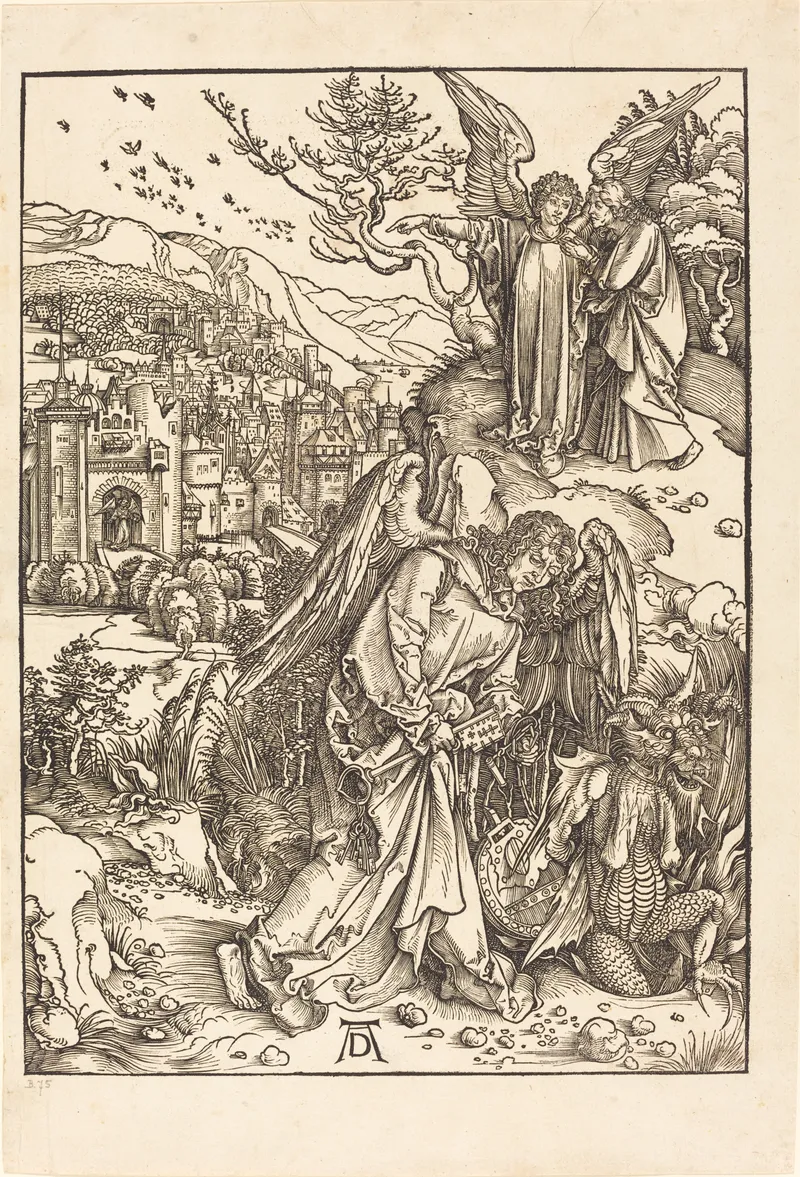
The chapter opens with a descent and a seizure. I saw an angel come down from heaven, having the key of the bottomless pit and a great chain in his hand (v. 1) - the key to open and the chain to bind, both held in a single hand. And the angel laid hold on the dragon, that old serpent, which is the Devil, and Satan (v. 2), the enemy named four ways at once, the deceiver who has been at his work since the garden.
He is bound a thousand years, cast into the bottomless pit, shut up, and sealed, that he should deceive the nations no more, till the thousand years should be fulfilled: and after that he must be loosed a little season (v. 3). The binding is real, and it has a stated limit - a duration set, and an after.1
Tap any highlighted phrase to jump to the commentary that unpacks it.
Revelation 20:1-6That Old Serpent Bound; the First Resurrection
1And I saw an angel come down from heaven, having the key of the bottomless pit and a great chain in his hand. 2And he laid hold on the dragon, that old serpent, which is the Devil, and Satan, and bound him a thousand years, 3And cast him into the bottomless pit, and shut him up, and set a seal upon him, that he should deceive the nations no more, till the thousand years should be fulfilled: and after that he must be loosed a little season. 4And I saw thrones, and they sat upon them, and judgment was given unto them: and I saw the souls of them that were beheaded for the witness of Jesus, and for the word of God, and which had not worshipped the beast, neither his image, neither had received his mark upon their foreheads, or in their hands; and they lived and reigned with Christ a thousand years. 5But the rest of the dead lived not again until the thousand years were finished. This is the first resurrection. 6Blessed and holy is he that hath part in the first resurrection: on such the second death hath no power, but they shall be priests of God and of Christ, and shall reign with him a thousand years.
The chapter opens with a single image of total control: I saw an angel come down from heaven, having the key of the bottomless pit and a great chain in his hand (v. 1). One hand holds both the key that opens the abyss and the chain that binds - the authority to confine and the means to do it, brought down from heaven, not seized from below. There is no struggle in the scene. The angel laid hold on the dragon (v. 2) the way one lays hold of something already mastered.
And the enemy is named with deliberate fullness, every title stacked together so no reader can mistake who this is: the dragon, that old serpent, which is the Devil, and Satan. The dragon is the monstrous power of the earlier visions; that old serpent reaches all the way back to the garden, to the one who first deceived; the Devil is the slanderer; Satan is the accuser, the adversary. Four names for one foe - the same enemy through the whole story of Scripture, and now bound.
The very first thing this chapter shows is not the saints, not the throne, but the seizing and chaining of the one who has done all the deceiving since the beginning.
What the angel does with the dragon is told in a chain of decisive verbs: bound, cast him into the bottomless pit, and shut him up, and set a seal upon him (v. 3). Each act tightens the last - bound, then thrown down, then shut in, then sealed over. And the purpose is stated plainly: that he should deceive the nations no more, till the thousand years should be fulfilled. The text frames the binding around one specific effect - the stopping of his deception of the nations - rather than spelling out everything it does or does not mean; the point pressed is that his power to deceive is, for the stated span, shut off and sealed.
Then comes a line the chapter does not soften: and after that he must be loosed a little season. Two things are held together here, and the text holds them without flinching. The binding is real - a sealed prison, a deceiver silenced. And it is bounded - a little season of loosing still lies ahead. The reader is told both, and asked to carry both, without being handed a chart that resolves the tension. What is certain is the restraint itself: the deceiver does not run free; he is held, by a hand that came down from heaven.1
The scene lifts from the pit to the thrones: I saw thrones, and they sat upon them, and judgment was given unto them (v. 4). This is the language of Daniel's vision, where thrones were cast down and the court sat in judgment - authority handed over, the seat of rule given to others.2 And then John's eye falls on a particular company: the souls of them that were beheaded for the witness of Jesus, and for the word of God. These are the ones who paid the last price for their testimony - the very martyrs who earlier cried out from beneath the altar, How long, O Lord… Here is their answer.
They are the ones who had not worshipped the beast, neither his image, neither had received his mark; they refused the world's pressure even unto death. And now the reversal: they lived and reigned with Christ a thousand years. The ones the world cut off are the ones who live; the ones stripped of every earthly standing are the ones given thrones. To the churches reading this under threat of execution, the message is unmistakable.
The beast can behead you. It cannot keep you from reigning with Christ.
Two sentences set the faithful apart from the rest: But the rest of the dead lived not again until the thousand years were finished. This is the first resurrection (v. 5). John names what he has just described - the living and reigning of those who were Christ's - as the first resurrection, and by calling it first he implies what the chapter goes on to show: there is a further raising of the dead to come, when all small and great will stand before the throne (v. 12).
The text marks the order - first, and then the rest - without laying out a timetable for the reader to map. What it does press, and presses with great force, is the blessing that belongs to the people of the first resurrection. They are not merely spared something; they are blessed and holy, given thrones, made to reign. The weight of the passage falls not on calculating the sequence but on which company a person belongs to - and on the staggering mercy that the ones the world counted as losers, the beheaded and the faithful, are the ones who live.
The section ends on a beatitude - one of the seven blessings scattered through this book: Blessed and holy is he that hath part in the first resurrection: on such the second death hath no power, but they shall be priests of God and of Christ, and shall reign with him a thousand years (v. 6). Three gifts are named for the one who shares this resurrection. He is blessed and holy - set apart, marked with God's favor and belonging to Him.
The second death - the dread end the chapter will define in verse 14 - hath no power over him; the worst that can befall a soul simply cannot touch this person. And he is made a priest of God and of Christ, lifted into the very nearness and service the book elsewhere promises the redeemed - those whom Christ hath made us kings and priests unto God (Rev. 1:6). This is the deep comfort of the whole passage.
To the believer who fears death, who has watched it take those they love, who wonders what waits on the far side - the word here is that for those who are Christ's, the second death hath no power. The first death they may yet face; the second cannot have them.
Revelation 20:7-10Loosed a Little Season; the Devil into the Lake of Fire
7And when the thousand years are expired, Satan shall be loosed out of his prison, 8And shall go out to deceive the nations which are in the four quarters of the earth, Gog and Magog, to gather them together to battle: the number of whom is as the sand of the sea. 9And they went up on the breadth of the earth, and compassed the camp of the saints about, and the beloved city: and fire came down from God out of heaven, and devoured them. 10And the devil that deceived them was cast into the lake of fire and brimstone, where the beast and the false prophet are, and shall be tormented day and night for ever and ever.
The chapter now returns to the thread it left hanging in verse 3: when the thousand years are expired, Satan shall be loosed out of his prison (v. 7). The binding had a stated term, and here the term runs out. The text states the loosing as flatly as it stated the binding - the same enemy, the same prison, now opened - without pausing to explain why the appointed span includes a release at its end.
What follows makes the deceiver's nature unmistakable: the moment he is free, he does the one thing he has always done. And shall go out to deceive the nations (v. 8). He has not changed; he has not repented; release does not reform him. The old serpent loosed is the old serpent still. There is a sober realism in this. Evil, even after long restraint, is not domesticated by the passage of time. But the reader who has read to the end of the chapter already knows how short this last chapter of his is.
He is loosed for a little season (v. 3), and only to be gathered up into his final ruin. The leash is long, but it is still a leash, and the hand that loosed it will draw it in.
The loosed deceiver gathers a host: he goes out to deceive the nations which are in the four quarters of the earth, Gog and Magog, to gather them together to battle: the number of whom is as the sand of the sea (v. 8). The names Gog and Magog are drawn from the prophet Ezekiel, where they stand for a great hostile power massed against the people of God in the latter days.2 Here they are not a riddle to be decoded into a particular nation on a map; they are named as what they represent - the whole gathered force of the world's last rebellion, drawn from the four quarters of the earth, that is, from everywhere.
The measure given is the language of an uncountable multitude: as the sand of the sea, beyond numbering. It is meant to look overwhelming. They went up on the breadth of the earth, and compassed the camp of the saints about, and the beloved city (v. 9). The people of God are pictured as a camp surrounded, a beloved city under siege, ringed by an enemy without number. For a moment the scene is set as the worst kind of odds - the faithful few encircled by all the massed hostility there is.
And then, in the next breath, the whole threat is answered.
The siege ends in a single clause: and fire came down from God out of heaven, and devoured them (v. 9). There is no long battle, no uncertain struggle, no turning of the tide. The countless host, the sand of the sea, the whole gathered rebellion of the nations - all of it is undone in one act, and the act is entirely God's. Fire came down from God out of heaven. This is the way the LORD answered His enemies of old, fire from heaven that falls and consumes; here it falls one final time.
Notice what the saints are not said to do. They do not fight; they do not win the battle by their own strength; they are simply the encircled camp, and their deliverance comes down from above. The contrast could not be sharper - the enemy is numberless and the saints are surrounded, and yet the outcome is never in doubt for an instant, because the deciding power is not in the size of the armies but in the hand of God.
Whatever a believer faces that looks like overwhelming odds, this verse stands as a picture of the end: the threat may be vast, but God needs only to speak, and fire comes down.
With the host consumed, the chapter turns to the deceiver himself for the last time: the devil that deceived them was cast into the lake of fire and brimstone, where the beast and the false prophet are, and shall be tormented day and night for ever and ever (v. 10). This is the end of the enemy named in verse 2. He is cast - the same helpless passive as before, acted upon, not acting - into the lake of fire, the final place, joining the beast and the false prophet who were thrown there before him.
The three who deceived the world are gathered into one ruin. The words for ever and ever are not softened, and the text does not present this as a fate the devil stumbled into by accident; it is the settled, righteous end of the one who chose deception to the last and never turned from it. The picture is sobering, and it is meant to be. But for the besieged saints of verse 9, it is also the deepest relief: the one who has deceived the nations, accused the brethren, and warred against the people of God from the beginning is finished - not merely defeated for a season but cast away for ever.
The long war is over, and the deceiver does not rise again.
Revelation 20:11-15The Books Were Opened... and the Book of Life
11And I saw a great white throne, and him that sat on it, from whose face the earth and the heaven fled away; and there was found no place for them. 12And I saw the dead, small and great, stand before God; and the books were opened: and another book was opened, which is the book of life: and the dead were judged out of those things which were written in the books, according to their works. 13And the sea gave up the dead which were in it; and death and hell delivered up the dead which were in them: and they were judged every man according to their works. 14And death and hell were cast into the lake of fire. This is the second death. 15And whosoever was not found written in the book of life was cast into the lake of fire.
Everything in the chapter has been moving toward this: I saw a great white throne, and him that sat on it, from whose face the earth and the heaven fled away; and there was found no place for them (v. 11). The throne is great - the highest seat, above which there is no appeal - and white, the color of unstained holiness and unanswerable purity. And the One seated on it is of such overwhelming holiness that the whole created order cannot bear His presence: the earth and the heaven fled away. This is the most arresting detail in the verse.
It is not the dead who flee; it is the universe itself, recoiling from the face of the Judge, and there was found no place for them. Every refuge is gone. There is nowhere left to hide, no rock to fall on, no shadow to slip into - heaven and earth themselves have fled, and the soul stands utterly exposed before the throne. The scene is meant to still the reader. Whatever a person has spent a life hiding behind, it is not there anymore.
There is only the throne, and the One upon it, and the dead standing before Him.
The court convenes, and no one is missing: I saw the dead, small and great, stand before God (v. 12). Small and great - the obscure and the famous, the powerless and the powerful, the forgotten and the celebrated - all stand together on level ground before the throne. Death has erased every earthly distinction; here there is only one division that will matter. And the books were opened - the record of deeds, every word and work and hidden thing written down, for the dead were judged out of those things which were written in the books, according to their works. Nothing is lost; nothing is overlooked; God's justice is exact, weighed against a true and complete record.
But then the verse turns on a single phrase that changes everything: and another book was opened, which is the book of life. Two kinds of books lie open at this judgment - the books that record what each one did, and the one book that records whose names belong to life. The deeds are real and they are weighed. Yet the chapter is about to make plain which book finally decides a person's standing, and it is not the one that holds the record of works.
The reach of this judgment is total: the sea gave up the dead which were in it; and death and hell delivered up the dead which were in them: and they were judged every man according to their works (v. 13). Every place that has ever held the dead is emptied out. The sea - the drowned, those with no grave, those swallowed where no one could mark the spot - gives them up. Death and hell - the grave and the realm of the dead - deliver up all they have held.
No one is beyond summons; no death was ever so obscure or so final that it placed a soul outside this reckoning. All come, and every man is judged according to their works. Then the next stroke: death and hell were cast into the lake of fire (v. 14). The very powers that have held humanity captive - death itself and the grave that swallowed every generation - are themselves thrown into the lake of fire and ended.
Death does not merely lose its prisoners; death is itself destroyed. The long tyranny of the grave, the thing that has taken every person who ever lived, is brought to nothing - and the chapter pauses to name what this means.
The chapter ends on the line everything has been building toward: And whosoever was not found written in the book of life was cast into the lake of fire (v. 15). Read it carefully, because it tells us which of the opened books finally decides. The deeds were written and weighed - that was real - but the verse that closes the judgment does not turn on the deed-books. It turns on the other book: whosoever was not found written in the book of life. The deciding question at the end of all things is not whether a person's record was clean enough to stand - for measured against a holy throne, no record is - but whether their name is written in the book of life.
This is the chapter's great mercy hidden inside its great sobriety. The works matter, and they are the true shape of a life; but the soul is not finally saved by the weight of its own record. It is saved by being found written in a book it could never have entered on its own merit. And so the whole towering vision of thrones and resurrections and the lake of fire comes down, at the last, to one searching and answerable question: is your name in that book?
Research trail
Sources & further study
These references support the historical, linguistic, manuscript, and contextual notes in this chapter. Scripture remains the primary text; external sources are provided so readers can inspect the research directly.
- Revelation 20 - Translators' NotesThe NET Bible's detailed footnotes on Revelation 20 - the fourfold naming of the enemy in verse 2, the much-discussed phrasing of the first resurrection in verses 5-6, the imagery of the books opened in verse 12, and the “second death” defined in verse 14.
- Revelation 20 ↔ Genesis 3 · Daniel 7 & 12 · Ezekiel 38-39Traces the older Scriptures gathered into the chapter - that old serpent (v. 2) from Genesis 3; the thrones and the books of judgment (vv. 4, 12) from Daniel 7:9-10 and 12:1-2; the names Gog and Magog (v. 8) drawn from Ezekiel 38-39; and fire from heaven devouring the enemy (v. 9) in the manner of the LORD's ancient deliverances.
- Revelation 20 · Greek interlinearThe Greek text of Revelation 20 word by word, with parsing and Strong's links - useful for chilia ete (the “thousand years” that sounds through verses 2-7), for he biblos tes zoes (v. 12, “the book of life”), and for ho deuteros thanatos (vv. 6, 14, “the second death”).
Where this echoes in Scripture
That Old Serpent Bound; the First Resurrection
- Genesis 3:15I will put enmity between thee and the woman, and between thy seed and her seed; it shall bruise thy head, and thou shalt bruise his heel.The first promise behind verse 2 - the old serpent whose head was marked for bruising, now bound.
- Daniel 7:9-10I beheld till the thrones were cast down... the judgment was set, and the books were opened.The thrones and judgment of verse 4 (and the books of v. 12) - Daniel's court of the last things.
- Luke 10:18I beheld Satan as lightning fall from heaven.The fall behind verses 2-3 - the defeat of the enemy Christ saw and secured.
- 1 John 3:8For this purpose the Son of God was manifested, that he might destroy the works of the devil.Why the dragon is bound (vv. 2-3) - the very purpose of the Son's coming.
- Revelation 6:9-11I saw under the altar the souls of them that were slain for the word of God, and for the testimony which they held.The martyrs of verse 4 - the souls who cried “How long,” now living and reigning.
Loosed a Little Season; the Devil into the Lake of Fire
- Ezekiel 38:2Son of man, set thy face against Gog, the land of Magog... and prophesy against him.The names of verse 8 - Ezekiel's hostile power massed against the people of God in the last days.
- Ezekiel 39:6And I will send a fire on Magog... and they shall know that I am the LORD.The fire of verse 9 - the LORD answering the gathered enemy with consuming fire.
- Hebrews 2:14-15that through death he might destroy him that had the power of death, that is, the devil.How the enemy of verse 10 was undone - by the death of the Son who broke the devil's power.
- Colossians 2:15And having spoiled principalities and powers, he made a shew of them openly, triumphing over them in it.The triumph carried out in verse 10 - the open defeat of the powers secured at the cross.
- Romans 16:20And the God of peace shall bruise Satan under your feet shortly.The promise fulfilled in verse 10 - the bruising of the serpent of Genesis 3:15 brought to its end.
The Books Were Opened... and the Book of Life
- Daniel 12:1-2thy people shall be delivered, every one that shall be found written in the book... many of them that sleep in the dust of the earth shall awake.Behind verses 12-15 - the dead awaking, and deliverance for those found written in the book.
- John 5:22For the Father judgeth no man, but hath committed all judgment unto the Son.Who sits on the throne of verse 11 - the Son, to whom all judgment is committed.
- 1 Corinthians 15:26The last enemy that shall be destroyed is death.Fulfilled in verse 14 - death itself cast into the lake of fire and ended.
- Luke 10:20rejoice, because your names are written in heaven.The book of life of verses 12 and 15 - the names written in heaven that Christ bids us rejoice in.
- Revelation 21:27they which are written in the Lamb's book of life.Whose book decides in verse 15 - the book of life that belongs to the Lamb.