Luke 19
People in this chapter
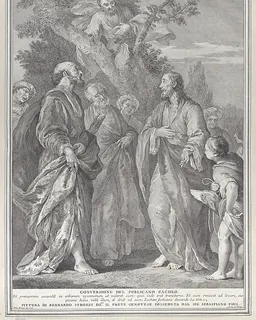
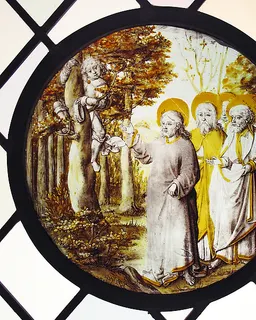
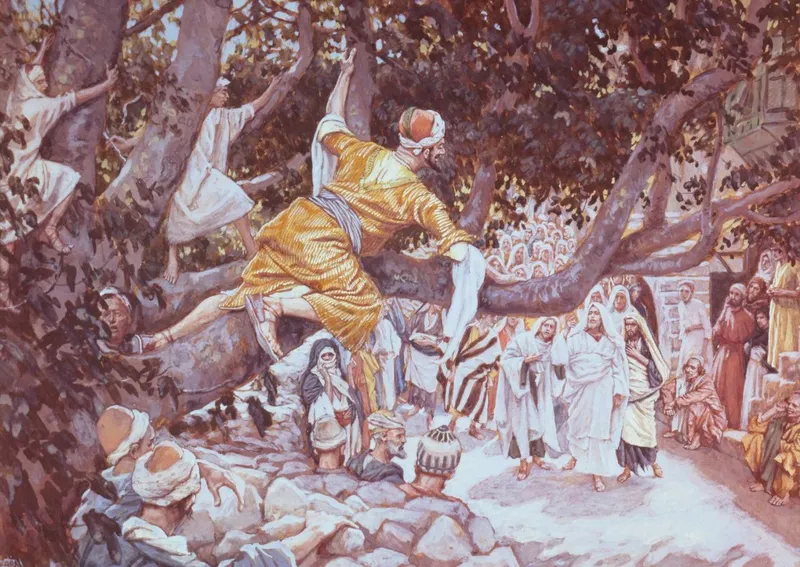
Jesus enters and passes through Jericho, and the camera narrows to one man. There was a man named Zacchaeus, which was the chief among the publicans, and he was rich (v. 2). A publican was a tax-farmer who collected Rome's revenue from his own people and kept the overflow - despised as a traitor and a thief, and a chief publican most of all. This rich, powerful, hated man wants only to see who Jesus is, but he is little of stature and cannot see over the press; so he runs ahead and climbs a sycomore tree (vv. 3-4).
And Jesus, coming to the place, looks up and speaks first: Zacchaeus, make haste, and come down; for to day I must abide at thy house (v. 5). The crowd murmurs that he was gone to be guest with a man that is a sinner (v. 7) - and out of that scandalous welcome comes a changed life and the verse that names the whole errand of Jesus: the Son of man is come to seek and to save that which was lost (v. 10).1
Tap any highlighted phrase to jump to the commentary that unpacks it.
Luke 19:1-10To Seek and to Save That Which Was Lost
1And Jesus entered and passed through Jericho. 2And, behold, there was a man named Zacchaeus, which was the chief among the publicans, and he was rich. 3And he sought to see Jesus who he was; and could not for the press, because he was little of stature. 4And he ran before, and climbed up into a sycomore tree to see him: for he was to pass that way. 5And when Jesus came to the place, he looked up, and saw him, and said unto him, Zacchaeus, make haste, and come down; for to day I must abide at thy house. 6And he made haste, and came down, and received him joyfully. 7And when they saw it, they all murmured, saying, That he was gone to be guest with a man that is a sinner. 8And Zacchaeus stood, and said unto the Lord; Behold, Lord, the half of my goods I give to the poor; and if I have taken any thing from any man by false accusation, I restore him fourfold. 9And Jesus said unto him, This day is salvation come to this house, forsomuch as he also is a son of Abraham. 10For the Son of man is come to seek and to save that which was lost.
Everything in these opening verses is bent toward one improbable meeting. Jericho was a wealthy customs town on the trade road, and Zacchaeus sat at the top of its tax establishment - the chief among the publicans, and he was rich (v. 2). A publican collected Rome's revenue from his own countrymen and made his living on the margin he could squeeze above the quota; a chief publican ran others who did the same. To his neighbors he was a traitor with a Roman badge and a thief with a ledger, and his wealth only deepened the contempt.
Yet this powerful, isolated man sought to see Jesus who he was (v. 3) - not to be healed, not to argue, simply to see - and his wealth could not buy him a clear line of sight, because he was little of stature. So he does something a man of his standing would never ordinarily do: he ran before, and climbed up into a sycomore tree (v. 4). The detail is almost comic and entirely human - the despised official, undignified, perched in the branches like a child, willing to look foolish for the sake of one glimpse.
Already the chapter is showing us how grace tends to find people: the one whose hunger is large enough to overcome his shame.1
Then the encounter turns inside out. Zacchaeus came hoping for a glimpse of a passing teacher; instead Jesus came to the place, he looked up, and saw him, and called him by name - Zacchaeus, make haste, and come down; for to day I must abide at thy house (v. 5). The seeker is sought. The man who wanted only to see is the one who is seen, known, named, and invited. And note who issues the invitation.
In that culture, to enter a man's house and share his table was to declare friendship and acceptance; ordinarily the host invites the guest. Here Jesus invites Himself, and not to the home of a Pharisee or a notable but to the house of the one man the whole town despised. Zacchaeus made haste, and came down, and received him joyfully (v. 6) - the joy of a man who never expected to be wanted.
But the crowd reads the scene exactly as crowds do: when they saw it, they all murmured, saying, That he was gone to be guest with a man that is a sinner (v. 7). It is the recurring complaint of the Gospel - that Jesus keeps the wrong company. The murmur is meant to shame Him; instead it frames the very thing He came to do.
What grace touches, it changes - and the change shows up first in Zacchaeus's relationship to his money, which is exactly where his sin had lived. Zacchaeus stood, and said unto the Lord; Behold, Lord, the half of my goods I give to the poor; and if I have taken any thing from any man by false accusation, I restore him fourfold (v. 8). The order of the story is clear: Jesus has already invited Himself in, already received him; the welcome came first, freely.
The giving and the restoring are the response of a man who has been received. And the response is costly and concrete. The half of my goods goes to the poor at a stroke. Then he goes further than any law required: the Mosaic restitution for ordinary fraud was the principal plus a fifth, and even fourfold restoration was reserved for outright theft of an animal - Zacchaeus volunteers the harshest measure on himself, fourfold, for anything he has wrongly taken.
Repentance here is not a feeling but a reversal: the hands that grasped now give, the ledger that defrauded now repays beyond the debt. The fruit proves the root. Salvation has come, and you can see it in his accounts.1
Jesus reads the changed man and announces the verdict: This day is salvation come to this house, forsomuch as he also is a son of Abraham (v. 9). Two things stand out. First, salvation has a date - this day - and an address - to this house. It is not a distant hope but a present arrival that reaches a whole household through one found man. Second, Jesus calls this despised tax-collector a son of Abraham. The crowd had written him off as a traitor outside the covenant; Jesus restores him to his place among the people of promise.
He had not stopped being a son of Abraham by descent, but he had been treated as lost - and now he is openly named and reclaimed. The word also is gentle and pointed at once: he also - this man too, the one you murmured about - belongs. Salvation, in Luke's telling, is not only forgiveness of sins; it is restoration to belonging, a lost man brought home to the family of faith. And it answers the murmur of verse 7 directly: the very fact that Jesus is guest with a man that is a sinner is the fact that salvation has come to that man's house.
Luke 19:11-27Occupy Till I Come
11And as they heard these things, he added and spake a parable, because he was nigh to Jerusalem, and because they thought that the kingdom of God should immediately appear. 12He said therefore, A certain nobleman went into a far country to receive for himself a kingdom, and to return. 13And he called his ten servants, and delivered them ten pounds, and said unto them, Occupy till I come. 14But his citizens hated him, and sent a message after him, saying, We will not have this man to reign over us. 15And it came to pass, that when he was returned, having received the kingdom, then he commanded these servants to be called unto him, to whom he had given the money, that he might know how much every man had gained by trading. 16Then came the first, saying, Lord, thy pound hath gained ten pounds. 17And he said unto him, Well, thou good servant: because thou hast been faithful in a very little, have thou authority over ten cities. 18And the second came, saying, Lord, thy pound hath gained five pounds. 19And he said likewise to him, Be thou also over five cities. 20And another came, saying, Lord, behold, here is thy pound, which I have kept laid up in a napkin: 21For I feared thee, because thou art an austere man: thou takest up that thou layedst not down, and reapest that thou didst not sow. 22And he saith unto him, Out of thine own mouth will I judge thee, thou wicked servant. Thou knewest that I was an austere man, taking up that I laid not down, and reaping that I did not sow: 23Wherefore then gavest not thou my money into the bank, that at my coming I might have required mine own with usury? 24And he said unto them that stood by, Take from him the pound, and give it to him that hath ten pounds. 25(And they said unto him, Lord, he hath ten pounds.) 26For I say unto you, That unto every one which hath shall be given; and from him that hath not, even that he hath shall be taken away from him. 27But those mine enemies, which would not that I should reign over them, bring hither, and slay them before me.
Luke tells us exactly why Jesus speaks this parable: he was nigh to Jerusalem, and the crowds thought that the kingdom of God should immediately appear (v. 11). They expected the Messiah to enter the capital and seize the throne on the spot. The parable gently corrects that timetable without denying the kingdom. A certain nobleman went into a far country to receive for himself a kingdom, and to return (v. 12). The picture would have been familiar: a claimant traveling to a distant imperial court to be confirmed as king, then coming back to reign.
So there will be a kingdom - but first a departure, then an interval, then a return in power. Into that interval the nobleman places a charge. He delivered them ten pounds, and said unto them, Occupy till I come (v. 13). The old word occupy means to do business, to trade, to put to work - not to guard the money idly but to make it active. The servants are given something of his and told to employ it until he returns.
The shape of the whole Christian life is in that one command. The King has gone to receive His kingdom; He will certainly return; and the time in between is not empty waiting but entrusted work.2
When the nobleman returns having received the kingdom, he calls the servants to account that he might know how much every man had gained by trading (v. 15). The first two have put his pound to work. Lord, thy pound hath gained ten pounds, says the first - and note his care to say thy pound, crediting the increase to what the master gave, not to his own cleverness (v. 16). The reward is striking in its proportion: because thou hast been faithful in a very little, have thou authority over ten cities (v. 17).
A single pound faithfully traded is called a very little; the return on it is rule over cities. The second servant, who gained five, is set over five (vv. 18-19). Two things in the master's reply repay attention. First, the word he commends is not successful but faithful - the issue is trustworthy stewardship of what was given. Second, the reward is enlargement: faithfulness with a little earns responsibility over much. The kingdom widens its good servants' trust.
What we do with the small thing entrusted now is the training ground for what we will be given to do then.
The third servant breaks the pattern, and the parable slows down to let him speak. Lord, behold, here is thy pound, which I have kept laid up in a napkin (v. 20). He has not stolen it or squandered it; he has kept it - wrapped it safely away and done precisely nothing with it. And he names his reason: For I feared thee, because thou art an austere man… thou takest up that thou layedst not down, and reapest that thou didst not sow (v. 21).
His whole inaction grows from a picture of the master as harsh and grasping, a man impossible to please. Fear, not malice, paralyzed him - but a fear rooted in a false image of the one he served. This is the quiet warning at the center of the parable. The servant who buries his pound is not the open enemy; he is the one who professes to belong, holds the master's gift in his hands, and renders it useless because he has so misjudged the giver that he is afraid to risk anything for him.
A wrong idea of God can be as barren as outright rebellion. The pound that was meant to be traded sits idle in a cloth, returned exactly as it came, and a life that was given something to do gives back nothing but the gift itself, untouched.
The master's reply turns the servant's own words against him: Out of thine own mouth will I judge thee, thou wicked servant (v. 22). He takes up the servant's own caricature and presses it: if you truly believed I was a hard man who reaps where I did not sow, then your fear should at least have driven you to the simplest, safest action - wherefore then gavest not thou my money into the bank, that at my coming I might have required mine own with usury? (v. 23).
Even a fearful servant could have lodged the pound where it would earn interest. The point is devastating: the man's excuse condemns him, because by his own account he had every reason to do something, and he did nothing. So the pound is taken from him and given to the servant with ten (v. 24), and the principle is stated plainly: unto every one which hath shall be given; and from him that hath not, even that he hath shall be taken away (v. 26).
It is the law of entrusted things - what is used grows, what is hoarded withers. And the parable closes by returning to the citizens of verse 14 who said We will not have this man to reign over us: those who refuse the King's reign altogether (v. 27) are a different and graver case than even the faithless servant. The kingdom is coming; the only question the parable leaves is what each hearer will have done with it - and whether they will have it at all.1
Luke 19:28-40Blessed Be the King That Cometh
28And when he had thus spoken, he went before, ascending up to Jerusalem. 29And it came to pass, when he was come nigh to Bethphage and Bethany, at the mount called the mount of Olives, he sent two of his disciples, 30Saying, Go ye into the village over against you; in the which at your entering ye shall find a colt tied, whereon yet never man sat: loose him, and bring him hither. 31And if any man ask you, Why do ye loose him? thus shall ye say unto him, Because the Lord hath need of him. 32And they that were sent went their way, and found even as he had said unto them. 33And as they were loosing the colt, the owners thereof said unto them, Why loose ye the colt? 34And they said, The Lord hath need of him. 35And they brought him to Jesus: and they cast their garments upon the colt, and they set Jesus thereon. 36And as he went, they spread their clothes in the way. 37And when he was come nigh, even now at the descent of the mount of Olives, the whole multitude of the disciples began to rejoice and praise God with a loud voice for all the mighty works that they had seen; 38Saying, Blessed be the King that cometh in the name of the Lord: peace in heaven, and glory in the highest. 39And some of the Pharisees from among the multitude said unto him, Master, rebuke thy disciples. 40And he answered and said unto them, I tell you that, if these should hold their peace, the stones would immediately cry out.
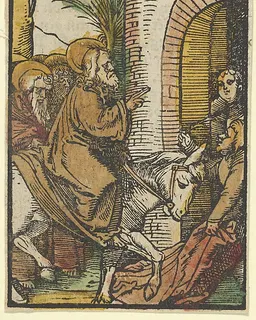
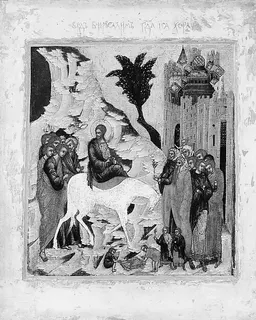
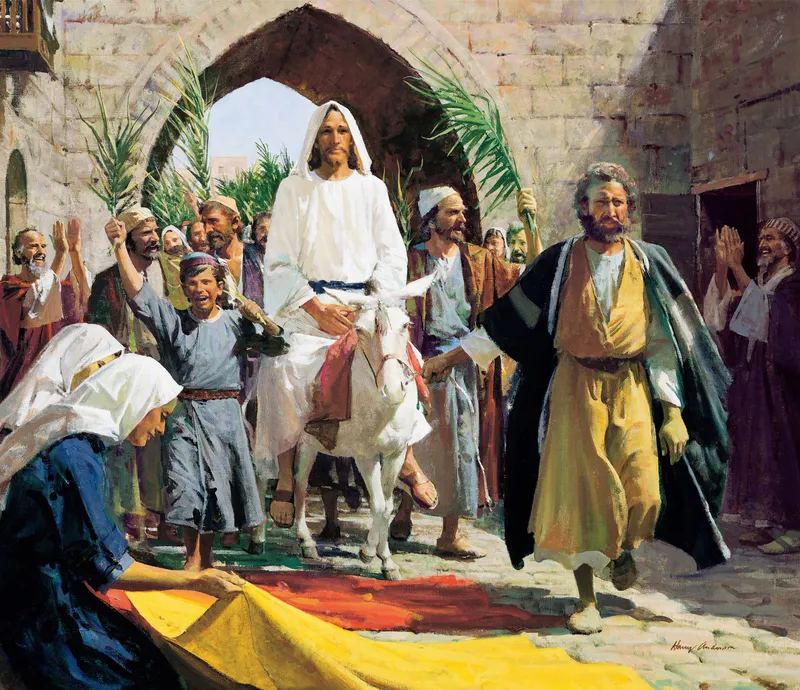
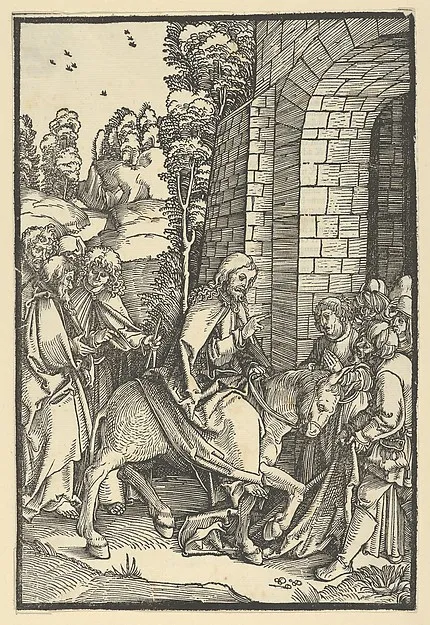
The long ascent ends as Jesus comes nigh to Bethphage and Bethany, at the mount called the mount of Olives (v. 29) - and for the first time in the Gospel He deliberately stages a public entrance. He sends two disciples ahead to a village for a colt tied, whereon yet never man sat (v. 30). Every detail carries weight. The animal is a colt, the foal of a working beast, the mount of peace; a king who rode a donkey came offering reconciliation.
That it is one whereon yet never man sat marks it as set apart, fit for a sacred use, like the unbroken animals reserved for holy purposes in the Law. And the whole arrangement is openly prophetic. Zechariah had foretold the day: Rejoice greatly, O daughter of Zion… behold, thy King cometh unto thee: he is just, and having salvation; lowly, and riding upon an ass, and upon a colt the foal of an ass (Zech. 9:9).
For months Jesus had quieted those who would proclaim Him; now, days from the cross, He arranges the very scene the prophet described, allowing - even orchestrating - the public confession that He is the King come to Zion. The hour for hiddenness is past.2
Twice the narrative lingers on a single phrase. Jesus tells the disciples that if anyone questions them, thus shall ye say unto him, Because the Lord hath need of him (v. 31); and when the owners do ask, the disciples answer exactly so - The Lord hath need of him (v. 34) - and the owners let the colt go. The repetition is the point. On the one hand, the words breathe quiet sovereignty: the colt is requisitioned for the King's use, and the simple claim of His need is enough to open the owner's hand.
On the other hand, there is something arresting in the phrase itself - the Lord hath need. The One through whom all things were made stoops to need a borrowed colt; the King of glory enters His city on something lent to Him for a day. The whole entry is woven from gifts freely given at His word: a borrowed colt, garments thrown down, branches and clothes spread in the road. He comes as a King, but a King who owns nothing of the pageant and receives it all as offering.
And the owners' instant release models the only fitting response to His claim: when the Lord has need of what is yours, it is enough that He has asked.
As Jesus rides down from the mount of Olives the crowd erupts. They cast their garments upon the colt and spread their clothes in the way (vv. 35-36) - the homage once paid to a newly proclaimed king - and the whole multitude of the disciples began to rejoice and praise God with a loud voice for all the mighty works that they had seen (v. 37). Their cry draws on Psalm 118, the great festival hymn: Blessed be the King that cometh in the name of the Lord: peace in heaven, and glory in the highest (v. 38).
It is unmistakably a coronation shout, and the Pharisees hear it as dangerous blasphemy. Master, rebuke thy disciples (v. 39), they demand - silence them before Rome does. But Jesus refuses, with one of His most vivid sayings: I tell you that, if these should hold their peace, the stones would immediately cry out (v. 40). The praise is the truth, and the truth will not be hushed. If human voices fall silent, creation itself will take up the cry - the very stones of the road, of the city, of the temple about to be cleansed.
This King will be confessed. The only question is by whom: by glad voices that own Him now, or by a creation that cannot keep silent if they will not.3
Luke 19:41-48The Time of Thy Visitation
41And when he was come near, he beheld the city, and wept over it, 42Saying, If thou hadst known, even thou, at least in this thy day, the things which belong unto thy peace! but now they are hid from thine eyes. 43For the days shall come upon thee, that thine enemies shall cast a trench about thee, and compass thee round, and keep thee in on every side, 44And shall lay thee even with the ground, and thy children within thee; and they shall not leave in thee one stone upon another; because thou knewest not the time of thy visitation. 45And he went into the temple, and began to cast out them that sold therein, and them that bought; 46Saying unto them, It is written, My house is the house of prayer: but ye have made it a den of thieves. 47And he taught daily in the temple. But the chief priests and the scribes and the chief of the people sought to destroy him, 48And could not find what they might do: for all the people were very attentive to hear him.
At the very height of the celebration the mood breaks. The crowd is rejoicing, the road is strewn with garments, the city is in view - and the King welcomed as a hero begins to weep. When he was come near, he beheld the city, and wept over it (v. 41). It is one of the most moving turns in the Gospel: tears, before anything else. And His lament names what the celebration cannot see: If thou hadst known, even thou, at least in this thy day, the things which belong unto thy peace! but now they are hid from thine eyes (v. 42).
The broken-off sentence - if thou hadst known… - trails into grief too deep to finish. There were things that belong unto thy peace; the city's true peace, its shalom, its wholeness and welfare, was standing in its streets in the person of its King. But the day of recognition was passing, and what could have been seen was now hid from thine eyes. There is a window in which grace may be known, and windows close.
The same Jerusalem that shouts on the road will cry Crucify him within the week; Jesus, seeing it all, does not rage - He weeps over a people about to miss the very thing that came to save them.
The lament turns to a sober foretelling of what the missed day will cost. The days shall come upon thee, that thine enemies shall cast a trench about thee, and compass thee round, and keep thee in on every side, and shall lay thee even with the ground, and thy children within thee; and they shall not leave in thee one stone upon another (vv. 43-44). The language describes a siege in unsparing detail - the earthwork thrown up around the walls, the encirclement, the leveling, the city and its people brought down stone by stone.
Within a generation it would happen exactly so. But Jesus does not present this as blind fate or mere politics. He names its deepest cause in the last line: because thou knewest not the time of thy visitation (v. 44). The catastrophe is, at root, a failure to recognize a moment of grace - the time when God Himself drew near, and was not received. This is the chapter's most solemn note, and it must be heard without hardness, for it is spoken through tears.
The God who came to seek and to save that which was lost (v. 10) also comes in a particular hour and may be missed; the visitation that was meant for peace, refused, leaves only the long consequences of the refusal. Grace is tender, and grace is urgent, and the two are not opposites.3
From the tears, Jesus walks straight into the temple and acts. He went into the temple, and began to cast out them that sold therein, and them that bought (v. 45). The outer courts had been turned into a market for sacrificial animals and currency exchange - commerce that fed off the worshippers and crowded out the very prayer the place existed for. His charge weaves two prophets into one sentence: It is written, My house is the house of prayer - the word of Isaiah, that the LORD's house should be a house of prayer for all people - but ye have made it a den of thieves (v. 46), the indictment of Jeremiah against those who hid their robbery behind religion.
Notice what fuels the act. The same Jesus who wept over the city now drives out the traders, and both spring from one source: a consuming zeal for what God's house and God's people were meant to be. His grief and His severity are not in tension; they are the love of the King for His Father's house, expressed first in tears and then in a cleansing. And the chapter ends with the lines drawn for the conflict to come: he taught daily in the temple. But the chief priests and the scribes and the chief of the people sought to destroy him, and could not find what they might do: for all the people were very attentive to hear him (vv. 47-48).
The King has entered His city and His Father's house; the rulers move to destroy Him; and the people hang on His every word. The final week has begun.1
Research trail
Sources & further study
These references support the historical, linguistic, manuscript, and contextual notes in this chapter. Scripture remains the primary text; external sources are provided so readers can inspect the research directly.
- Luke 19 - Translators' NotesThe NET Bible's detailed footnotes on Luke 19 - the office of the chief publican (v. 2), the worth of Zacchaeus's fourfold restitution against the law's requirements (v. 8), the parable of the pounds (vv. 11-27), and the lament over Jerusalem's coming siege (vv. 43-44).
- Luke 19 ↔ Zechariah 9 · Psalm 118 · Malachi 3Traces the threads tying Luke 19 to the rest of Scripture - the King riding upon… a colt (v. 35) read alongside Zechariah 9:9, the cry Blessed be the King that cometh in the name of the Lord (v. 38) beside Psalm 118:26, and the temple cleansing (v. 46) beside Isaiah 56:7 and Jeremiah 7:11.
- Luke 19 · Greek interlinear + lexiconThe Greek text of Luke 19 word by word, each term linked to its lexicon entry - useful for the paired verbs of the mission statement in verse 10, zeteo (“to seek”) and sozo (“to save”), and for episkope (“visitation”) in verse 44.
Where this echoes in Scripture
To Seek and to Save That Which Was Lost
- Luke 15:4-6doth not leave the ninety and nine... and go after that which is lost, until he find it? And when he hath found it, he layeth it on his shoulders, rejoicing.The seeking love of verse 10 told as a parable - the Shepherd who goes after the lost until He finds it.
- Luke 5:31-32They that are whole need not a physician; but they that are sick... I came... to call... sinners to repentance.Jesus' own answer to the murmur of verse 7 - the Physician comes for the sick who know their need.
- Ezekiel 34:16I will seek that which was lost, and bring again that which was driven away... and will bind up that which was broken.The LORD as the Shepherd who seeks the lost - the promise verse 10 takes up in the Son of man.
- Romans 5:8God commendeth his love toward us, in that, while we were yet sinners, Christ died for us.The order of the Zacchaeus story stated as doctrine - the welcome and the rescue come first, before we are worthy.
- Revelation 3:20Behold, I stand at the door, and knock: if any man hear my voice, and open the door, I will come in to him.The same Guest who invited Himself in at verse 5 - still seeking entry, still ready to sup with whoever opens.
Occupy Till I Come
- Matthew 25:21Well done, thou good and faithful servant... thou hast been faithful over a few things, I will make thee ruler over many things.The same reckoning as verse 17 - faithfulness in little rewarded with authority over much.
- Acts 1:11this same Jesus, which is taken up from you into heaven, shall so come in like manner as ye have seen him go into heaven.The nobleman's departure and return (v. 12) read as the ascension and the promised coming of Christ.
- Luke 12:35-36Let your loins be girded about... and ye yourselves like unto men that wait for their lord, when he will return.The posture the charge “Occupy till I come” calls for (v. 13) - servants working and watching for the master's return.
- 1 Corinthians 4:2Moreover it is required in stewards, that a man be found faithful.The single thing the master looks for in verses 16-17 - faithful stewardship of what was entrusted.
- Acts 10:42it is he which was ordained of God to be the Judge of quick and dead.The returning king who judges the servants (v. 22) named - the same Jesus appointed to judge the living and the dead.
Blessed Be the King That Cometh
- Zechariah 9:9behold, thy King cometh unto thee... lowly, and riding upon an ass, and upon a colt the foal of an ass.The prophecy Jesus deliberately fulfills in verses 30-35 - the King coming to Zion lowly, on a colt.
- Psalm 118:26Blessed be he that cometh in the name of the LORD: we have blessed you out of the house of the LORD.The festival hymn the multitude sings over Jesus in verse 38 - the welcome of the One who comes in the LORD's name.
- 2 Kings 9:13they hasted, and took every man his garment, and put it under him on the top of the stairs... saying, Jehu is king.The homage of garments spread for a new king (vv. 35-36) - the same gesture made for Jesus on the road.
- Habakkuk 2:11For the stone shall cry out of the wall, and the beam out of the timber shall answer it.Creation itself bearing witness - the image behind Jesus' word in verse 40 that the very stones would cry out.
- Philippians 2:10-11every knee should bow... and that every tongue should confess that Jesus Christ is Lord.The certainty of verse 40 carried to its end - the King who will be confessed by all, whether now in joy or at the last.
The Time of Thy Visitation
- Luke 13:34O Jerusalem, Jerusalem... how often would I have gathered thy children together... and ye would not!The same grief over the same city as verse 41 - the longing of the King to gather a people who refuse Him.
- Isaiah 56:7mine house shall be called an house of prayer for all people.The first half of Jesus' charge in verse 46 - what the temple was always meant to be.
- Jeremiah 7:11Is this house, which is called by my name, become a den of robbers in your eyes?The second half of verse 46 - the prophet's indictment Jesus lays on the temple traffic.
- Luke 1:68Blessed be the Lord God of Israel; for he hath visited and redeemed his people.The visitation of verse 44 announced at the Gospel's opening - the LORD coming near to redeem.
- John 2:17And his disciples remembered that it was written, The zeal of thine house hath eaten me up.The zeal behind the cleansing of verses 45-46 - the King's consuming love for His Father's house.