Zechariah 9
Zechariah 9 opens with a burden - a weighty oracle of the word of the LORD - that sweeps down the great trade roads from the north and along the Philistine coast: Hadrach and Damascus, Hamath, the wealthy merchant cities of Tyre and Zidon, and the cities of the Philistines. One by one the proud strongholds of the nations are named for judgment. Tyre had heaped up silver as the dust, and fine gold as the mire of the streets (v. 3), and trusted in it; the word of the LORD speaks against that trust.
Yet the movement of the chapter is not finally toward destruction but toward protection: over His own dwelling the LORD declares, I will encamp about mine house because of the army… and no oppressor shall pass through them any more (v. 8).1
Tap any highlighted phrase to jump to the commentary that unpacks it.
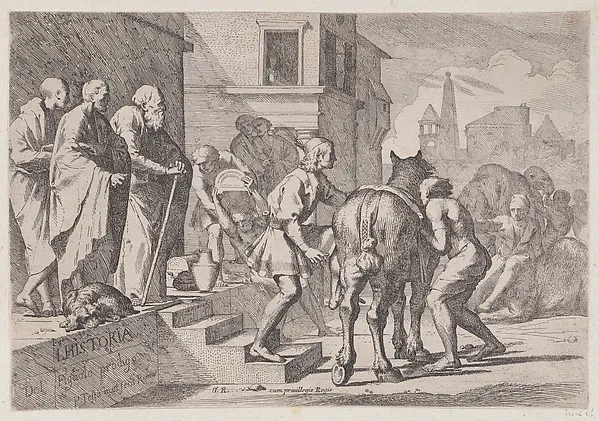
Zechariah 9:1-8I Will Encamp About Mine House
1The burden of the word of the LORD in the land of Hadrach, and Damascus shall be the rest thereof: when the eyes of man, as of all the tribes of Israel, shall be toward the LORD. 2And Hamath also shall border thereby; Tyrus, and Zidon, though it be very wise. 3And Tyrus did build herself a strong hold, and heaped up silver as the dust, and fine gold as the mire of the streets. 4Behold, the LORD will cast her out, and he will smite her power in the sea; and she shall be devoured with fire. 5Ashkelon shall see it, and fear; Gaza also shall see it, and be very sorrowful, and Ekron; for her expectation shall be ashamed; and the king shall perish from Gaza, and Ashkelon shall not be inhabited. 6And a bastard shall dwell in Ashdod, and I will cut off the pride of the Philistines. 7And I will take away his blood out of his mouth, and his abominations from between his teeth: but he that remaineth, even he, shall be for our God, and he shall be as a governor in Judah, and Ekron as a Jebusite. 8And I will encamp about mine house because of the army, because of him that passeth by, and because of him that returneth: and no oppressor shall pass through them any more: for now have I seen with mine eyes.
The chapter opens with a single heavy word: The burden of the word of the LORD (v. 1). A burden here is a weighty oracle, a pronouncement laid like a load upon the nations it names. And the load travels. It begins in the far north at Hadrach and Damascus, moves to Hamath on the inland route, then turns down the coast to Tyrus and Zidon, the great Phoenician merchant cities, before reaching the Philistine towns of the southern shore.
Anyone tracing it on a map sees the famous trade road sweeping down toward Israel from above. These were the proud powers that ringed the people of God - rich, fortified, confident in their commerce and their walls. The word of the LORD names them one by one, and its very first note is sovereignty: even the eyes of man, and of all the tribes of Israel, are toward the LORD. Before a single judgment falls, the chapter establishes who governs the nations.
The God of Israel is not a local deity defending one patch of hill country; His word reaches to Damascus and the sea, and the proudest cities of the age fall under His gaze.1
Tyre receives the longest look, and her portrait is a study in misplaced trust: And Tyrus did build herself a strong hold, and heaped up silver as the dust, and fine gold as the mire of the streets (v. 3). The picture is almost comic in its excess - silver as common as dust underfoot, gold as plentiful as the mud of the streets. Tyre was the wealthiest trading city of her world, set on an island fortress that armies had failed to take, and she had made her wealth and her walls into her security.
The text grants her cleverness - though it be very wise (v. 2) - but then pronounces the verdict that all such trust must finally meet: Behold, the Lord will cast her out, and he will smite her power in the sea; and she shall be devoured with fire (v. 4). The heaped-up gold cannot buy off the word of the LORD; the island walls cannot keep it out. There is a sober lesson written into the ruin of Tyre, and it is older than Tyre: whatever a people heap up and hide behind - riches, defenses, cleverness - is no fortress against God.
The coastal cities watch it happen and tremble: Ashkelon shall see it, and fear; Gaza also shall see it, and be very sorrowful (v. 5).
Then the burden does something unexpected. In the middle of judgment on the Philistines, a thread of mercy appears: And I will take away his blood out of his mouth, and his abominations from between his teeth: but he that remaineth, even he, shall be for our God, and he shall be as a governor in Judah, and Ekron as a Jebusite (vv. 6-7). The grim picture of blood and abominations between the teeth points to the pagan sacrificial meals the LORD will strip away.
But what follows is startling grace: the one who remaineth - the surviving Philistine - shall be for our God. The old enemy is not merely defeated; a remnant of him is brought in, made part of the people, like a governor in Judah. The comparison to a Jebusite is pointed: the Jebusites once held Jerusalem itself and were absorbed into Israel when David took the city. So Ekron, a Philistine town, will be folded in the same way.
This is the first hint of what the chapter will say openly at its center - that the reach of the LORD's salvation runs past Israel's borders to the very nations under judgment. Even here, the door is not only closing on the heathen; for a remnant, it is opening.
The first movement comes to rest on a promise of protection that turns the whole oracle from threat to comfort: And I will encamp about mine house because of the army, because of him that passeth by, and because of him that returneth: and no oppressor shall pass through them any more: for now have I seen with mine eyes (v. 8). After the long catalogue of foreign cities, the LORD finally speaks of mine house - His own dwelling, His people - and He stations Himself around it like an army encamped.
The armies of the nations may march by and march back, but they will not break through, because the LORD has set His own camp as the wall. And the reason given is deeply personal: for now have I seen with mine eyes. God is not distant or distracted; He has seen the threat, seen the marching armies, seen His vulnerable people, and He acts. The verse answers a fear every besieged generation has known - does He see what we are up against? - with a quiet yes.
He sees, and He encamps. The promise that no oppressor shall pass through them any more sets the stage for the King who is about to come: the same God who guards His house is the One whose King will enter its gates bringing peace.
Zechariah 9:9-12Behold, Thy King Cometh · Lowly, and Riding Upon an Ass
9Rejoice greatly, O daughter of Zion; shout, O daughter of Jerusalem: behold, thy King cometh unto thee: he is just, and having salvation; lowly, and riding upon an ass, and upon a colt the foal of an ass. 10And I will cut off the chariot from Ephraim, and the horse from Jerusalem, and the battle bow shall be cut off: and he shall speak peace unto the heathen: and his dominion shall be from sea even to sea, and from the river even to the ends of the earth. 11As for thee also, by the blood of thy covenant I have sent forth thy prisoners out of the pit wherein is no water. 12Turn you to the strong hold, ye prisoners of hope: even to day do I declare that I will render double unto thee;
The whole chapter has been climbing toward this, and now it breaks into song: Rejoice greatly, O daughter of Zion; shout, O daughter of Jerusalem: behold, thy King cometh unto thee (v. 9). The command is to overflowing joy - not quiet relief but loud, public gladness, the city told to shout. And the reason is a coming. The King is on His way unto thee; Zion is not summoned to go and find Him but to look up and see Him arrive.
Then the prophet describes Him, and every word matters. He is just - righteous, the kind of king under whom wrong is set right. He is having salvation - the Hebrew has the sense of one who is saved or who is endowed with deliverance, a King who comes carrying rescue rather than demanding tribute. And then the detail that overturns every expectation of how a king arrives: lowly, and riding upon an ass, and upon a colt the foal of an ass. Not a warhorse.
Not a chariot. A donkey - the patient beast of burden and of peace, the mount of one who comes in humility rather than at the head of an army. The city is told to rejoice greatly, and the King it is cheering comes in the lowest, most peaceable way a king could possibly come.
The King who comes lowly does not come weak; He comes to disarm the world: And I will cut off the chariot from Ephraim, and the horse from Jerusalem, and the battle bow shall be cut off: and he shall speak peace unto the heathen: and his dominion shall be from sea even to sea, and from the river even to the ends of the earth (v. 10). Notice what He cuts off. Not the enemy's weapons first, but His own people's - the chariot from Ephraim, the horse from Jerusalem, the battle bow.
The instruments of war are removed from the very city the King enters, because the peace He brings does not need them. Then His reign reaches outward: he shall speak peace unto the heathen. The nations that filled the burden of the chapter's opening - the ones under judgment - are now spoken peace. And His dominion has no border a map could draw: from sea even to sea, and from the river even to the ends of the earth. This is the same boundless reach the psalms sing of the LORD's anointed.
The lowly King on the donkey is no minor local figure; the One who enters Jerusalem in humility is the One whose peaceable rule will stretch to the ends of the earth. Humility and universal dominion are held together in a single breath - and that union is the heart of the prophecy.
The word now turns to those who cannot rejoice because they are still bound: As for thee also, by the blood of thy covenant I have sent forth thy prisoners out of the pit wherein is no water (v. 11). The image is vivid and harsh - a pit wherein is no water, an empty cistern, the kind of dry well into which Joseph was once thrown and prisoners were left to languish. And the deliverance comes not by force of arms but by the blood of thy covenant. A covenant sealed in blood reaches down into the dry pit and draws the prisoner up.
Then comes the summons that names these captives so memorably: Turn you to the strong hold, ye prisoners of hope: even to day do I declare that I will render double unto thee (v. 12). They are prisoners still - the chains are real - but they are prisoners of hope, bound to a promise that will not fail. They are told to turn - to come back, to take refuge - to the strong hold, the stronghold that is the LORD Himself.
And to the ones who have lost everything, the promise is overflowing: I will render double unto thee. Where they had loss, He will give twice the restoration. The captive in the waterless pit is the very one to whom the richest promise is made.
Zechariah 9:13-17The LORD Their God Shall Save Them as the Flock of His People
13When I have bent Judah for me, filled the bow with Ephraim, and raised up thy sons, O Zion, against thy sons, O Greece, and made thee as the sword of a mighty man. 14And the LORD shall be seen over them, and his arrow shall go forth as the lightning: and the LORD God shall blow the trumpet, and shall go with whirlwinds of the south. 15The LORD of hosts shall defend them; and they shall devour, and subdue with sling stones; and they shall drink, and make a noise as through wine; and they shall be filled like bowls, and as the corners of the altar. 16And the LORD their God shall save them in that day as the flock of his people: for they shall be as the stones of a crown, lifted up as an ensign upon his land. 17For how great is his goodness, and how great is his beauty! corn shall make the young men cheerful, and new wine the maids.
After the lowly King and the freed prisoners, the chapter turns to the LORD as a warrior fighting for His people: When I have bent Judah for me, filled the bow with Ephraim, and raised up thy sons, O Zion, against thy sons, O Greece, and made thee as the sword of a mighty man (v. 13). The imagery is striking - the LORD takes up Judah as His bow and Ephraim as the arrow set against the string, and makes Zion as the sword of a mighty man. His people become the weapon in His hand.
The naming of Greece is remarkable in a prophet of this era, looking ahead to a conflict centuries away. Then the LORD Himself appears over the battle: And the LORD shall be seen over them, and his arrow shall go forth as the lightning: and the Lord GOD shall blow the trumpet, and shall go with whirlwinds of the south (v. 14). This is the language of the great theophanies - lightning, trumpet, the storm-winds of the southern desert - the LORD coming down in power as He came at Sinai.
The point is not that the people win by their own strength; it is that the LORD shall be seen over them. The visible presence of God above His army is the whole battle. The same God who encamped about His house in verse 8 now goes forth at its head, His arrow like lightning, to fight for those He guards.
The LORD's defense of His people is total, and the language piles up to show it: The LORD of hosts shall defend them; and they shall devour, and subdue with sling stones; and they shall drink, and make a noise as through wine; and they shall be filled like bowls, and as the corners of the altar (v. 15). He is the LORD of hosts - the Lord of armies, of all the powers of heaven - and He shall defend them. The protected people prevail; they subdue with sling stones, the humblest of weapons, a reminder that victory is the LORD's and not their armory's.
The closing images are deliberately drawn from worship rather than war. They are filled like bowls, and as the corners of the altar - the bowls and the altar-corners of the temple, the vessels brimming with sacrificial blood. It is a startling turn: the victory ends not in plunder but in something like a festival, the people full as the sacred vessels are full, their celebration as abundant as wine. The battle the LORD fights for His people spills over into joy and fullness.
Where the chapter began with the dry pit and the besieging army, it moves toward a people filled - defended by the LORD of hosts and brimming over like the vessels of His house.
The chapter ends not in the noise of battle but in tenderness and beauty: And the LORD their God shall save them in that day as the flock of his people: for they shall be as the stones of a crown, lifted up as an ensign upon his land. For how great is his goodness, and how great is his beauty! corn shall make the young men cheerful, and new wine the maids (vv. 16-17).
After all the warrior imagery, the saved people are pictured as a flock - the LORD their God saves them the way a shepherd rescues his sheep, with care rather than violence. And they are precious to Him: as the stones of a crown, jewels set in a royal diadem, lifted up as an ensign for all to see. The God who fought for them now displays them like the gems of His own crown. Then the prophet can hold it in no longer and breaks into exclamation: how great is his goodness, and how great is his beauty! The whole chapter - the judgment on the proud nations, the lowly King, the freed prisoners, the warrior LORD - resolves into wonder at the sheer goodness of God.
And the last picture is ordinary peacetime gladness: corn and new wine, the young men and the maids cheerful with the simple abundance of harvest. The deliverance does not end in a monument; it ends in a people fed, glad, and safe under the goodness of their God.
Research trail
Sources & further study
These references support the historical, linguistic, manuscript, and contextual notes in this chapter. Scripture remains the primary text; external sources are provided so readers can inspect the research directly.
- Zechariah 9 - Translators' NotesThe NET Bible's detailed footnotes on Zechariah 9 - the geography of the burden against Hadrach, Damascus, Tyre, and the Philistine cities in verses 1-7, the LORD encamping about His house in verse 8, the grammar of the King's coming in verse 9, and the “pit wherein is no water” of verse 11.
- Zechariah 9 · Hebrew + classical Jewish commentaryThe Hebrew text of Zechariah 9 with Rashi, Radak, and other classical commentators side by side - useful for ani (v. 9, the “lowly” King, the same word for humble and afflicted), for asirei ha-tiqvah (v. 12, the “prisoners of hope”), and for the much-discussed phrase riding upon an ass, and upon a colt the foal of an ass.
- Zechariah 9 ↔ Matthew 21 · John 12 · Ephesians 2 · Psalm 72Traces the threads tying Zechariah 9 to the rest of Scripture - the lowly King on the colt (v. 9) quoted at the triumphal entry (Matt. 21:4-5; John 12:14-15), the peace spoken to the nations (v. 10) read beside he came and preached peace (Eph. 2:17) and the dominion from sea to sea (Ps. 72:8), and the prisoners freed by the blood of the covenant (v. 11) read alongside the blood of the everlasting covenant (Heb. 13:20).
Where this echoes in Scripture
I Will Encamp About Mine House
- Ezekiel 28:4-5With thy wisdom and with thine understanding thou hast gotten thee riches... and thine heart is lifted up because of thy riches.The pride of Tyre in verses 2-4 - her wealth and wisdom turned to arrogance, and the judgment that follows.
- Psalm 34:7The angel of the LORD encampeth round about them that fear him, and delivereth them.The same picture as verse 8 - the LORD encamping as a guard around His own.
- John 10:28I give unto them eternal life; and they shall never perish, neither shall any man pluck them out of my hand.The promise that no oppressor shall pass through (v. 8) fulfilled in the Shepherd who keeps His flock.
- Zechariah 2:5For I, saith the LORD, will be unto her a wall of fire round about, and will be the glory in the midst of her.The LORD Himself as the wall of His city - the guarding presence of verse 8 earlier in the book.
- Isaiah 23:1The burden of Tyre. Howl, ye ships of Tarshish; for it is laid waste.The same oracle against Tyre that verses 3-4 take up - the merchant city brought low.
Behold, Thy King Cometh · Lowly, and Riding Upon an Ass
- Matthew 21:4-5All this was done, that it might be fulfilled... Behold, thy King cometh unto thee, meek, and sitting upon an ass.The Gospel quotes verse 9 directly - the lowly King entering Jerusalem on Palm Sunday.
- John 12:14-15Fear not, daughter of Sion: behold, thy King cometh, sitting on an ass’s colt.John names this prophecy fulfilled at the triumphal entry - verse 9 come true at the city gate.
- Ephesians 2:17And came and preached peace to you which were afar off, and to them that were nigh.The peace spoken to the heathen in verse 10 - preached to the far-off in Christ.
- Psalm 72:8He shall have dominion also from sea to sea, and from the river unto the ends of the earth.The boundless dominion of verse 10, word for word - the reign of the King over all the earth.
- Hebrews 13:20that great shepherd of the sheep, through the blood of the everlasting covenant.The blood of the covenant that frees the prisoners (v. 11) - the everlasting covenant in Christ.
The LORD Their God Shall Save Them as the Flock of His People
- John 10:11I am the good shepherd: the good shepherd giveth his life for the sheep.The flock saved by their God (v. 16) - the Shepherd who lays down His life for the sheep.
- Isaiah 40:11He shall feed his flock like a shepherd: he shall gather the lambs with his arm, and carry them in his bosom.The LORD saving His people as a flock (v. 16) - the Shepherd-God who gathers and carries.
- Malachi 3:17they shall be mine, saith the LORD of hosts, in that day when I make up my jewels.The saved as the stones of a crown (v. 16) - the LORD’s own jewels in the day He gathers them.
- Psalm 18:13-14The LORD also thundered in the heavens... he sent out his arrows... and shot out lightnings.The LORD seen over His people, His arrow like lightning (v. 14) - the warrior God of the theophany.
- Psalm 31:19Oh how great is thy goodness, which thou hast laid up for them that fear thee.The chapter’s closing wonder (v. 17) - the marvel at the greatness of God’s goodness.