Luke 13
People in this chapter
The chapter opens with people bringing Jesus news of an atrocity: There were present at that season some that told him of the Galilaeans, whose blood Pilate had mingled with their sacrifices (v. 1). Behind their report lies an old and stubborn assumption - that catastrophe is a measure of guilt, that those who suffer most must have sinned most. Jesus meets it head-on and rejects it twice, adding a second disaster of His own, the eighteen crushed when the tower in Siloam fell (v. 4): Suppose ye that these… were sinners above all…? I tell you, Nay. He will not turn tragedy into a verdict on the dead.
Instead He turns it into a summons to the living: except ye repent, ye shall all likewise perish (vv. 3, 5). The news is not an answer to the question why did they die? - it is a question put to everyone still breathing.1
Tap any highlighted phrase to jump to the commentary that unpacks it.
Luke 13:1-9Except Ye Repent · The Barren Fig Tree
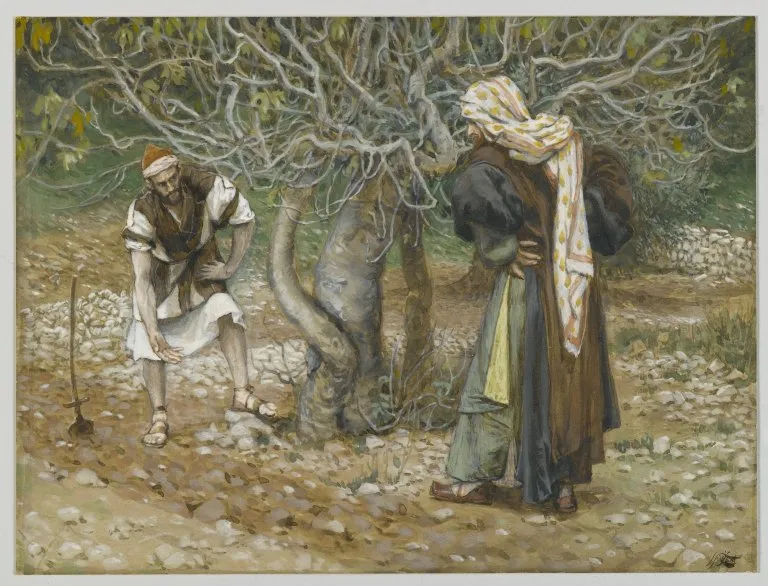
1There were present at that season some that told him of the Galilaeans, whose blood Pilate had mingled with their sacrifices. 2And Jesus answering said unto them, Suppose ye that these Galilaeans were sinners above all the Galilaeans, because they suffered such things? 3I tell you, Nay: but, except ye repent, ye shall all likewise perish. 4Or those eighteen, upon whom the tower in Siloam fell, and slew them, think ye that they were sinners above all men that dwelt in Jerusalem? 5I tell you, Nay: but, except ye repent, ye shall all likewise perish. 6He spake also this parable; A certain man had a fig tree planted in his vineyard; and he came and sought fruit thereon, and found none. 7Then said he unto the dresser of his vineyard, Behold, these three years I come seeking fruit on this fig tree, and find none: cut it down; why cumbereth it the ground? 8And he answering said unto him, Lord, let it alone this year also, till I shall dig about it, and dung it: 9And if it bear fruit, well: and if not, then after that thou shalt cut it down.
The chapter opens on a raw piece of news: some… told him of the Galilaeans, whose blood Pilate had mingled with their sacrifices (v. 1). It is a horror compounded - worshippers struck down in the very act of worship, their own blood mixed with the blood of their offerings. We are not told exactly why the people raise it, but Jesus' answer exposes the assumption hidden inside the report: that such a death must mean such a sin, that the slaughtered Galilaeans had it coming.
Suppose ye that these Galilaeans were sinners above all the Galilaeans, because they suffered such things? (v. 2). It is the oldest theology of suffering there is - the one Job's friends preached, the one the disciples will voice again over the man born blind - that calamity is a reliable measure of guilt, that the worse the disaster the worse the person. Jesus does not soften it or leave it to be inferred. He answers it flatly: I tell you, Nay. The dead were not worse sinners.
Their fate is not a verdict on their lives, and the survivors have no warrant to read it as one.1
Having denied the false reading, Jesus presses the true one - and to do it He reaches for a second tragedy, this one apparently an accident rather than a murder: those eighteen, upon whom the tower in Siloam fell, and slew them (v. 4). His verdict is the same: they were not sinners above all men that dwelt in Jerusalem. But notice what He does with both events. He refuses to use them to explain the dead, and instead turns them like a mirror toward the living: except ye repent, ye shall all likewise perish (vv. 3, 5).
The repetition is deliberate and weighty - the very same sentence sealing both stories. The point is not that everyone who fails to repent will die in a massacre or under a falling tower; the calamities are signs, not equations. The point is that every human being stands under the same need, and that sudden death - whoever it visits - is a summons to all who hear of it to turn before their own hour comes. Jesus takes the question why did they suffer?, which the text never finally answers, and replaces it with the question that matters and can be answered: have you turned?
Then He tells a parable that holds judgment and mercy together in a single, almost unbearable balance: A certain man had a fig tree planted in his vineyard; and he came and sought fruit thereon, and found none (v. 6). For three years the owner has looked for fruit and found none, and his patience has run out: cut it down; why cumbereth it the ground? (v. 7). The complaint is fair - a barren tree is not neutral; it occupies soil, draws nourishment, and gives nothing back.
But the dresser of the vineyard intercedes: Lord, let it alone this year also, till I shall dig about it, and dung it (v. 8). He asks for one more season, and he asks for it actively - he will dig around the roots and feed them, doing everything that can be done to provoke fruit. Here is the patience of God made visible: longing for fruit, granting time, working the soil of a life that has so far given nothing.
Yet the parable does not pretend the patience is endless. The reprieve has a term: and if not… thou shalt cut it down (v. 9). Mercy delays the axe; it does not abolish it. The same passage that shows how long God waits also shows that the waiting is for something - and that the tree is being given time precisely so that it will use it.
Luke 13:10-21Loosed on the Sabbath · The Mustard Seed and the Leaven
10And he was teaching in one of the synagogues on the sabbath. 11And, behold, there was a woman which had a spirit of infirmity eighteen years, and was bowed together, and could in no wise lift up herself. 12And when Jesus saw her, he called her to him, and said unto her, Woman, thou art loosed from thine infirmity. 13And he laid his hands on her: and immediately she was made straight, and glorified God. 14And the ruler of the synagogue answered with indignation, because that Jesus had healed on the sabbath day, and said unto the people, There are six days in which men ought to work: in them therefore come and be healed, and not on the sabbath day. 15The Lord then answered him, and said, Thou hypocrite, doth not each one of you on the sabbath loose his ox or his ass from the stall, and lead him away to watering? 16And ought not this woman, being a daughter of Abraham, whom Satan hath bound, lo, these eighteen years, be loosed from this bond on the sabbath day? 17And when he had said these things, all his adversaries were ashamed: and all the people rejoiced for all the glorious things that were done by him. 18Then said he, Unto what is the kingdom of God like? and whereunto shall I resemble it? 19It is like a grain of mustard seed, which a man took, and cast into his garden; and it grew, and waxed a great tree; and the fowls of the air lodged in the branches of it. 20And again he said, Whereunto shall I liken the kingdom of God? 21It is like leaven, which a woman took and hid in three measures of meal, till the whole was leavened.
The scene shifts to a synagogue on the sabbath, and into it comes one of the most quietly moving figures in the Gospels: a woman which had a spirit of infirmity eighteen years, and was bowed together, and could in no wise lift up herself (v. 11). For eighteen years she has been folded over on herself, unable to straighten, her whole world reduced to the ground in front of her feet. She does not cry out; she does not push through the crowd to demand anything.
It is Jesus who acts first: when Jesus saw her, he called her to him (v. 12). He notices the one bent so low that most eyes would pass over her, and He summons her by His own initiative. His word is decisive and immediate - Woman, thou art loosed from thine infirmity - and when He lays His hands on her, immediately she was made straight, and glorified God (v. 13). After eighteen years bowed toward the dust, the first thing she does upright is look up and praise.
The detail is its own small sermon: the body set free at once turns to worship.
The healing draws an immediate complaint, but notice how the ruler of the synagogue makes it: with indignation, and not even to Jesus directly but unto the people - There are six days in which men ought to work: in them therefore come and be healed, and not on the sabbath day (v. 14). He is scandalized that mercy has kept the wrong calendar. Jesus answers with a single, exposing word - Thou hypocrite - and then with an argument no one in the room could escape: doth not each one of you on the sabbath loose his ox or his ass from the stall, and lead him away to watering? (v. 15).
Every one of them, the ruler included, would untie an animal on the sabbath to keep it from thirst; the law was never thought to forbid that small mercy. Then comes the verse that turns the whole logic over: And ought not this woman, being a daughter of Abraham, whom Satan hath bound, lo, these eighteen years, be loosed from this bond on the sabbath day? (v. 16). The word loosed ties it all together - you loose an ox for water; how much more should this daughter of Abraham be loosed from a bondage of eighteen years?
The sabbath was made to bless and to free; to use it as a reason to leave a woman bound is to turn the day against its own purpose. The result is decisive: all his adversaries were ashamed: and all the people rejoiced (v. 17).1
From the loosing of one bent woman Jesus turns to the kingdom itself, and reaches for two of the smallest things anyone in His audience would know. First the seed: It is like a grain of mustard seed, which a man took, and cast into his garden; and it grew, and waxed a great tree; and the fowls of the air lodged in the branches of it (v. 19). The mustard seed was a byword for smallness - the least of seeds - and yet from that nearly invisible beginning comes a plant so great the birds nest in it.
Then the leaven: It is like leaven, which a woman took and hid in three measures of meal, till the whole was leavened (v. 21). A pinch of leaven disappears entirely into a great mass of dough - hid is the precise word - and works unseen until every part of it is changed. Set side by side, the two pictures say one thing from two angles. The kingdom of God does not arrive the way the crowds expected a kingdom to arrive, with armies and visible splendour overturning Rome in a day.
It begins small to the point of being overlooked, and it works in hidden ways - but it grows, and it spreads, and it does not stop until the whole is leavened. What looked like nothing more than an itinerant teacher loosing a bent woman in a village synagogue is, in fact, that seed already in the ground.
Luke 13:22-30Strive to Enter In at the Strait Gate
22And he went through the cities and villages, teaching, and journeying toward Jerusalem. 23Then said one unto him, Lord, are there few that be saved? And he said unto them, 24Strive to enter in at the strait gate: for many, I say unto you, will seek to enter in, and shall not be able. 25When once the master of the house is risen up, and hath shut to the door, and ye begin to stand without, and to knock at the door, saying, Lord, Lord, open unto us; and he shall answer and say unto you, I know you not whence ye are: 26Then shall ye begin to say, We have eaten and drunk in thy presence, and thou hast taught in our streets. 27But he shall say, I tell you, I know you not whence ye are; depart from me, all ye workers of iniquity. 28There shall be weeping and gnashing of teeth, when ye shall see Abraham, and Isaac, and Jacob, and all the prophets, in the kingdom of God, and you yourselves thrust out. 29And they shall come from the east, and from the west, and from the north, and from the south, and shall sit down in the kingdom of God. 30And, behold, there are last which shall be first, and there are first which shall be last.
As Jesus journeys toward Jerusalem (v. 22), someone puts the kind of question people have always loved to ask from a safe distance: Lord, are there few that be saved? (v. 23). It is a spectator's question, a request for a statistic, a way of discussing salvation in the abstract while keeping oneself out of it. Jesus does not answer the question He was asked; He answers the question the man should have asked.
He gives no number at all. Instead He turns it from the third person to the second, from them to you: Strive to enter in at the strait gate (v. 24). The gate is strait - narrow, tight, not the broad and easy way - and entering it is not a thing one drifts into; it calls for striving. And He adds a sobering warning: many… will seek to enter in, and shall not be able. Seeking is not the same as striving; a wistful, half-hearted, someday interest in the kingdom is not the same as actually pressing in through the narrow gate now.
The question how many? is left unanswered on purpose. The only urgent thing is the door in front of you, and whether you are going through it.
Jesus presses the warning with a scene that has the force of a closing door: When once the master of the house is risen up, and hath shut to the door (v. 25). There is a moment after which it is too late - not because the master is cruel, but because the time for entering had its season and the season ended. Those left outside knock and plead, Lord, Lord, open unto us, and protest their nearness: We have eaten and drunk in thy presence, and thou hast taught in our streets (v. 26).
They had proximity to Jesus - they shared meals, they heard Him teach in their own streets - and yet the dreadful answer is I know you not whence ye are (vv. 25, 27). Nearness is not the same as belonging; hearing is not the same as entering. To have been in the crowd, to have brushed up against the things of God, to be religiously familiar - none of it is the strait gate itself. This passage must be read with gravity and with care for one's own soul rather than as a weapon against anyone else.
It is not a sorting of peoples or a verdict on a nation; it is a warning, spoken to the very hearers in front of Him, that familiarity with Jesus is not the same as having truly come to Him - and that the time to make sure of it is now, while the door still stands open.
Against the picture of those who delay, Jesus sets a vision of astonishing breadth. There will indeed be grief for those who presumed and found themselves thrust out (v. 28), watching Abraham, and Isaac, and Jacob, and all the prophets within. But then the horizon opens to every point of the compass: they shall come from the east, and from the west, and from the north, and from the south, and shall sit down in the kingdom of God (v. 29).
The kingdom is not a small, closed circle but a feast with places filled from the ends of the earth. This is the great in-gathering the prophets had foreseen - people streaming from every direction to sit at the table of God. And it overturns every assumption about who is in and who is out: there are last which shall be first, and there are first which shall be last (v. 30). Those who counted on their place may find themselves surprised; those who seemed far off may be found at the feast.
The same urgency that drives the strait gate drives this promise: the door is narrow, but the gathering is vast - so come, from wherever you are, while there is room and time.
Luke 13:31-35O Jerusalem, Jerusalem
31The same day there came certain of the Pharisees, saying unto him, Get thee out, and depart hence: for Herod will kill thee. 32And he said unto them, Go ye, and tell that fox, Behold, I cast out devils, and I do cures to day and to morrow, and the third day I shall be perfected. 33Nevertheless I must walk to day, and to morrow, and the day following: for it cannot be that a prophet perish out of Jerusalem. 34O Jerusalem, Jerusalem, which killest the prophets, and stonest them that are sent unto thee; how often would I have gathered thy children together, as a hen doth gather her brood under her wings, and ye would not! 35Behold, your house is left unto you desolate: and verily I say unto you, Ye shall not see me, until the time come when ye shall say, Blessed is he that cometh in the name of the Lord.
A warning arrives: certain of the Pharisees tell Jesus, Get thee out, and depart hence: for Herod will kill thee (v. 31). Whether they mean it kindly or are simply trying to move Him along, the threat is real enough - this is the Herod who had already beheaded John. But Jesus is unmoved, and His reply is steel wrapped in calm: Go ye, and tell that fox, Behold, I cast out devils, and I do cures to day and to morrow, and the third day I shall be perfected (v. 32).
He calls Herod a fox - cunning, predatory, but small - and refuses to let a king's threat dictate His timetable. His work has its own appointed course: today, tomorrow, and a third day on which He will be perfected, brought to His goal. Nevertheless I must walk to day, and to morrow, and the day following: for it cannot be that a prophet perish out of Jerusalem (v. 33). The words carry a quiet, deliberate irony: Herod cannot kill Him in Galilee, because His death belongs to another place and another purpose.
He is not fleeing toward safety; He is walking, on purpose, toward the city that kills its prophets - and toward the cross.1
And then the steadiness breaks open into grief. The mention of Jerusalem - the city He is walking toward, the city that kills its prophets - draws from Him the most heartbroken words in the Gospels: O Jerusalem, Jerusalem, which killest the prophets, and stonest them that are sent unto thee; how often would I have gathered thy children together, as a hen doth gather her brood under her wings, and ye would not! (v. 34). The doubled name is the cry of love, not of accusation - the way one says a beloved name twice in sorrow.
And the image He chooses is startlingly tender: not a lion or an eagle but a hen, gathering her chicks under her wings, the homeliest picture of shelter and warmth there is - a mother bird who will spread her own body over her young against the storm or the fox. How often would I - the longing is real, repeated, reaching back through all the prophets sent to gather this people. And then the wall against which that longing breaks: and ye would not. Two wills stand here in the open, and the text holds them side by side without dissolving either.
There is Christ's genuine, aching desire to gather - I would - and there is the people's genuine refusal - ye would not. He does not erase their freedom by His longing, nor lessen His longing because of their refusal. The verse leaves the two facing each other, and asks the reader simply to feel the weight of both: a love that truly willed, and a no that was truly spoken.
The lament ends not in a curse but in a strange, suspended hope. First the loss is named plainly: Behold, your house is left unto you desolate (v. 35). The house - the city, the temple, all that had been trusted in - is left empty, abandoned to the consequences of the great refusal. There is no softening of that word; the desolation is real. But the sentence does not stop there. Ye shall not see me, until the time come when ye shall say, Blessed is he that cometh in the name of the Lord. The door is shut, but not nailed shut.
A day is held out - until - when the very ones who would not gather will greet Him with the words of welcome from the psalm, the cry of those who receive the One sent from God. Whatever the full unfolding of that promise, its shape is unmistakable: even here, at the end of the saddest words He speaks, Jesus will not close the door on hope entirely. The lament over the city that would not is sealed with a coming day when it shall say Blessed. The hen's wings are still spread; the welcome is still possible; the longing that would have gathered has not given up.
Research trail
Sources & further study
These references support the historical, linguistic, manuscript, and contextual notes in this chapter. Scripture remains the primary text; external sources are provided so readers can inspect the research directly.
- Luke 13 - Translators' NotesThe NET Bible's detailed footnotes on Luke 13 - the historical setting of Pilate and the Galilaeans (vv. 1-4), the agricultural force of the dresser's plea over the fig tree (vv. 6-9), the sense of being “loosed” on the sabbath (vv. 15-16), and the much-discussed saying on Herod and the perfecting of Christ's work (vv. 32-33).
- Luke 13 · Greek interlinear + lexiconThe Greek text of Luke 13 word by word, with parsing and lexical entries side by side - useful for metanoeo (vv. 3, 5, the “repent” on which the whole opening turns), for agonizomai (v. 24, the “strive” of the strait gate), and for thelo (v. 34, the “would… ye would not” that sets Christ's willing against the city's refusing).
- Luke 13 ↔ Psalms · Isaiah · the ProphetsTraces the threads tying Luke 13 to the rest of Scripture - the barren fig tree and Israel's vineyard (vv. 6-9; Isa. 5), the sheltering wings under which the LORD gathers His people (v. 34; Ps. 91:4; Deut. 32:11), and the in-gathering from every quarter foretold by the prophets (v. 29; Isa. 49:12; Mal. 1:11).
Where this echoes in Scripture
Except Ye Repent · The Barren Fig Tree
- John 9:1-3Master, who did sin, this man, or his parents, that he was born blind? Jesus answered, Neither hath this man sinned, nor his parents.The same false equation Jesus rejects in verses 2-5 - that suffering is a measure of sin.
- Acts 17:30and the times of this ignorance God winked at; but now commandeth all men every where to repent.The universal summons of verses 3 and 5 carried to the nations - all men, everywhere, called to turn.
- 2 Peter 3:9The Lord is... longsuffering to us-ward, not willing that any should perish, but that all should come to repentance.The patience of the dresser over the fig tree (vv. 8-9) - God's waiting that seeks repentance.
- Isaiah 5:1-7he looked that it should bring forth grapes, and it brought forth wild grapes... I will lay it waste.The vineyard sought for fruit and found wanting - the older image behind the barren fig tree of verses 6-9.
- Matthew 3:8-10Bring forth therefore fruits meet for repentance... every tree which bringeth not forth good fruit is hewn down.Repentance proved by fruit, and the unfruitful tree cut down - the very terms of verses 6-9.
Loosed on the Sabbath · The Mustard Seed and the Leaven
- Luke 4:18he hath sent me to heal the brokenhearted, to preach deliverance to the captives... to set at liberty them that are bruised.The commission Jesus claimed at the outset - the loosing He performs on the bent woman in verse 12.
- Acts 10:38who went about doing good, and healing all that were oppressed of the devil; for God was with him.The apostolic summary of His whole ministry - the freeing of one bound by Satan in verse 16.
- Mark 2:27The sabbath was made for man, and not man for the sabbath.The principle behind verses 14-16 - the day given for blessing, fulfilled in setting a sufferer free.
- Matthew 13:33The kingdom of heaven is like unto leaven, which a woman took, and hid in three measures of meal, till the whole was leavened.The same parable of the leaven as verse 21 - the kingdom working hidden until all is changed.
- Zechariah 4:10For who hath despised the day of small things?The warning behind the mustard seed of verse 19 - not to scorn the kingdom's small beginnings.
Strive to Enter In at the Strait Gate
- John 10:9I am the door: by me if any man enter in, he shall be saved, and shall go in and out, and find pasture.The strait gate of verse 24 named in person - the one door is Christ Himself.
- Matthew 7:13-14Enter ye in at the strait gate... strait is the gate, and narrow is the way, which leadeth unto life.The same call as verse 24 - the narrow gate and the few that find it.
- Isaiah 49:12Behold, these shall come from far: and, lo, these from the north and from the west.The in-gathering from every direction foreseen by the prophet - fulfilled in verse 29.
- Matthew 8:11many shall come from the east and west, and shall sit down with Abraham, and Isaac, and Jacob, in the kingdom of heaven.The feast filled from the ends of the earth - the same promise as verses 28-29.
- Revelation 7:9a great multitude... of all nations, and kindreds, and people, and tongues, stood before the throne.The vast gathering of verse 29 seen at last - every nation before the throne.
O Jerusalem, Jerusalem
- Psalm 91:4He shall cover thee with his feathers, and under his wings shalt thou trust.The sheltering wings of verse 34 - the LORD's protection that Christ longs to give the city.
- Deuteronomy 32:11As an eagle stirreth up her nest... spreadeth abroad her wings, taketh them, beareth them on her wings.The mother-bird image behind verse 34 - God gathering His people under His wings.
- Matthew 23:37-39O Jerusalem, Jerusalem... how often would I have gathered thy children together... and ye would not!The same lament repeated in Jerusalem itself - the longing of verse 34 spoken again near the end.
- Luke 19:41-42And when he was come near, he beheld the city, and wept over it.The grief of verse 34 made visible - Christ weeping over the city He would have gathered.
- Psalm 118:26Blessed be he that cometh in the name of the LORD.The very words held out as a coming welcome in verse 35 - the cry that greets the One sent from God.