John 9
People in this chapter
John 9 is one of the most carefully told stories in the Gospels - a single miracle that unfolds, scene by scene, into a courtroom drama and a parable about sight. It opens quietly: And as Jesus passed by, he saw a man which was blind from his birth (v. 1). The disciples see the same man and reach for an explanation that was common in their world - that such suffering must be the wages of sin: Master, who did sin, this man, or his parents, that he was born blind? (v. 2).
Jesus answers in a way that lifts the whole scene out of the logic of blame: Neither hath this man sinned, nor his parents: but that the works of God should be made manifest in him (v. 3). Then He names what He is doing here, and what He is: As long as I am in the world, I am the light of the world (v. 5).1
Tap any highlighted phrase to jump to the commentary that unpacks it.
John 9:1-12That the Works of God Should Be Made Manifest
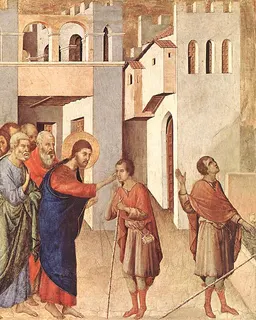
1And as Jesus passed by, he saw a man which was blind from his birth. 2And his disciples asked him, saying, Master, who did sin, this man, or his parents, that he was born blind? 3Jesus answered, Neither hath this man sinned, nor his parents: but that the works of God should be made manifest in him. 4I must work the works of him that sent me, while it is day: the night cometh, when no man can work. 5As long as I am in the world, I am the light of the world. 6When he had thus spoken, he spat on the ground, and made clay of the spittle, and he anointed the eyes of the blind man with the clay, 7And said unto him, Go, wash in the pool of Siloam, (which is by interpretation, Sent.) He went his way therefore, and washed, and came seeing. 8The neighbours therefore, and they which before had seen him that he was blind, said, Is not this he that sat and begged? 9Some said, This is he: others said, He is like him: but he said, I am he. 10Therefore said they unto him, How were thine eyes opened? 11He answered and said, A man that is called Jesus made clay, and anointed mine eyes, and said unto me, Go to the pool of Siloam, and wash: and I went and washed, and I received sight. 12Then said they unto him, Where is he? He said, I know not.
The disciples see a man blind from his birth and immediately reach for a cause: Master, who did sin, this man, or his parents, that he was born blind? (v. 2). The question takes for granted a whole way of reading the world - that suffering is a settled account, a punishment handed down for a particular wrong. Either the man sinned, or his parents did; somebody must have earned this. It is an ancient instinct and a stubborn one, the same one Job's friends pressed on him, and it is far from dead today: when something terrible happens, we want a ledger that balances, a sin we can name so the suffering makes sense.
But notice what the question really does. It turns a man into a case study and a problem to be solved, while he stands there listening. The disciples look at him and see a riddle about sin; they do not yet see a person about to be healed. Jesus is about to correct not just their theology but the whole direction of their gaze.1
Jesus refuses the premise outright: Neither hath this man sinned, nor his parents: but that the works of God should be made manifest in him (v. 3). He does not assign the blame to a different party; He sets the question of blame aside altogether. The man's blindness is not here being explained as the wages of anyone's sin. Instead Jesus lifts the man's whole situation onto a different plane: this is an occasion for the works of God to be made visible.
The point is not a tidy account of why the man was born blind - the text does not offer one, and we should not invent one - but a redirection from looking backward for someone to fault to looking forward at what God is about to do. And He presses the urgency of it: I must work the works of him that sent me, while it is day: the night cometh, when no man can work (v. 4).
There is a season for the works of God to be done, and Jesus means to act in it. The man who has been treated as a theological problem is about to become a place where the power and goodness of God are put on open display.
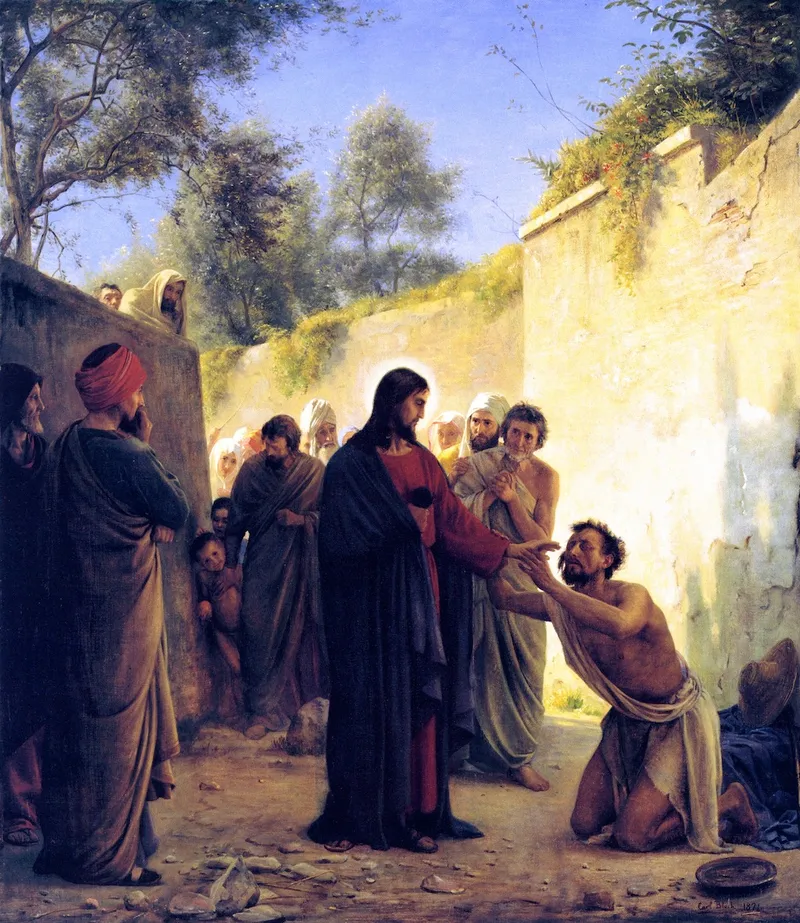
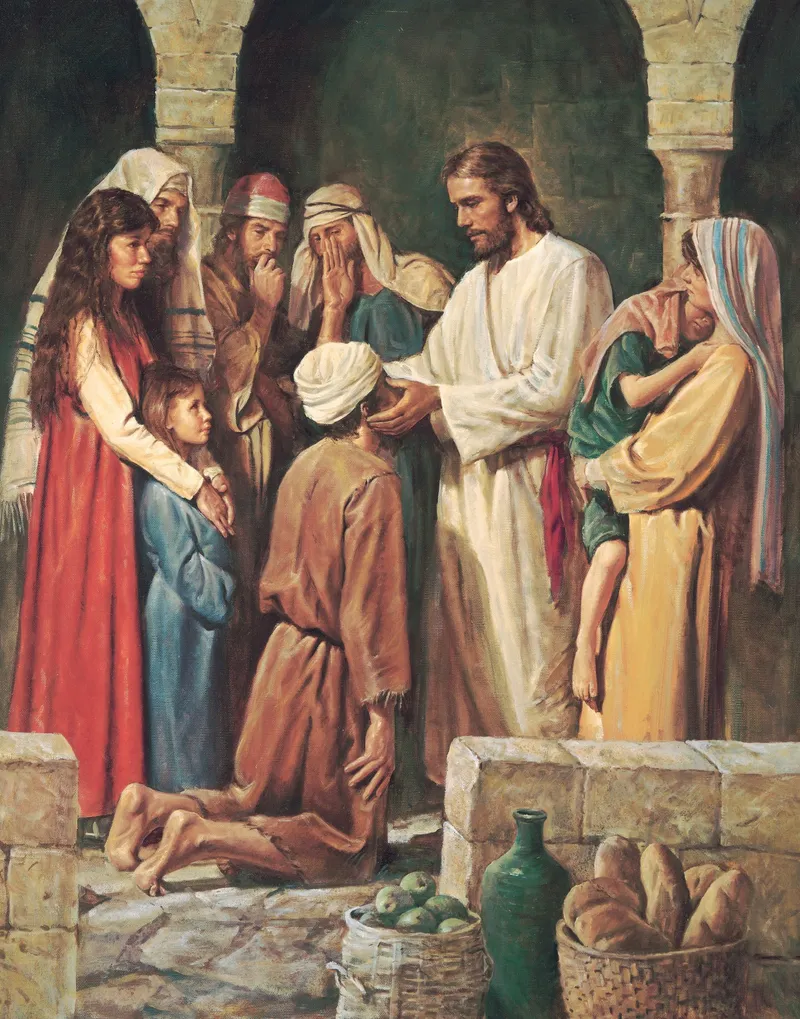
Then comes the strangest detail in the scene: he spat on the ground, and made clay of the spittle, and he anointed the eyes of the blind man with the clay (v. 6). Jesus could have healed with a word from across the road, as He healed others. Instead He kneels, He works with His hands, He makes something from the dust of the earth and presses it onto the man's sightless eyes. There is an unmistakable echo of the beginning here, of the God who formed man of the dust of the ground - the same hands at work on the same raw material, now mending what was broken.
And the healing is not finished in that touch. A command follows: Go, wash in the pool of Siloam (v. 7). The man, with mud on his eyes and no proof that anything will come of it, must do something: get up, find his way across the city, and wash. The healing asks for his trust and his feet. He gives both - He went his way therefore, and washed, and came seeing. Three short verbs carry the whole turning of his life: he went, he washed, he came seeing.
John pauses the action to make sure we catch the name of the pool: Siloam, (which is by interpretation, Sent.) (v. 7). He rarely translates a place name without reason, and here the reason runs deep. Just a verse before, Jesus spoke of him that sent me (v. 4), and all through this Gospel He is the One the Father sent into the world. So the blind man is sent to wash in the pool called Sent - and comes back seeing.
The water itself heals nothing; it is obedience to the word of the Sent One that opens the man's eyes. The neighbours, meanwhile, can hardly take it in: Is not this he that sat and begged? (v. 8). Some say it is the same man, some say it only looks like him - the change is so total they argue over his very identity, while he keeps insisting, I am he (v. 9). When they ask how, he tells it plainly: A man that is called Jesus made clay… and I went and washed, and I received sight (v. 11).
He does not yet know who Jesus is - asked where his healer has gone, he can only say, I know not (v. 12). His understanding is small and his sight is new, but the testimony has already begun.2
John 9:13-23He Is a Prophet
13They brought to the Pharisees him that aforetime was blind. 14And it was the sabbath day when Jesus made the clay, and opened his eyes. 15Then again the Pharisees also asked him how he had received his sight. He said unto them, He put clay upon mine eyes, and I washed, and do see. 16Therefore said some of the Pharisees, This man is not of God, because he keepeth not the sabbath day. Others said, How can a man that is a sinner do such miracles? And there was a division among them. 17They say unto the blind man again, What sayest thou of him, that he hath opened thine eyes? He said, He is a prophet. 18But the Jews did not believe concerning him, that he had been blind, and received his sight, until they called the parents of him that had received his sight. 19And they asked them, saying, Is this your son, who ye say was born blind? how then doth he now see? 20His parents answered them and said, We know that this is our son, and that he was born blind: 21But by what means he now seeth, we know not; or who hath opened his eyes, we know not: he is of age; ask him: he shall speak for himself. 22These words spake his parents, because they feared the Jews: for the Jews had agreed already, that if any man did confess that he was Christ, he should be put out of the synagogue. 23Therefore said his parents, He is of age; ask him.
The healed man is brought before the Pharisees, and at once a complication surfaces that will drive the rest of the chapter: it was the sabbath day when Jesus made the clay, and opened his eyes (v. 14). Asked to explain himself, the man gives the same plain account, only shorter and surer now: He put clay upon mine eyes, and I washed, and do see (v. 15). But the leaders are weighing a rule.
And they split. Some of the Pharisees reason from the sabbath: This man is not of God, because he keepeth not the sabbath day (v. 16). They have a fixed picture of how a man of God must behave, and Jesus does not fit it, so they conclude against the evidence in front of them. Others reason from the miracle: How can a man that is a sinner do such miracles? The healing itself testifies; a deed like this is not the work of a godless man.
Both groups are looking at the same restored eyes, and there was a division among them. It is a quietly devastating moment. The sign meant to open eyes is already dividing the seeing from the willfully blind - and the line runs between those who will follow the evidence and those who will not.
Unable to settle it among themselves, they turn back to the one person who actually knows what happened: They say unto the blind man again, What sayest thou of him, that he hath opened thine eyes? (v. 17). It is a telling move - the experts cannot agree, so they ask the man whose eyes were opened. And his answer marks a real step upward. At the pool he had said only that a man that is called Jesus healed him (v. 11).
Now, pressed to render a verdict, he says, He is a prophet. He is reasoning from what he has experienced: a man who can do what was done to me is no ordinary man; he must be sent from God, a prophet. It is honest and it is rising. He is following his own healing toward its source. Notice the pattern that is forming: the more the man is questioned, the clearer he sees who Jesus must be - while the more the leaders question, the more determined they grow not to see it at all.
The interrogation meant to break him is steadily teaching him.
When the man's testimony will not bend, the leaders try another route: they refuse to believe he was ever blind at all, and summon his parents (v. 18). The parents confirm the two facts they cannot deny - We know that this is our son, and that he was born blind (v. 20) - but on the one question that matters, they go silent and hand it back: by what means he now seeth, we know not… he is of age; ask him: he shall speak for himself (v. 21).
John tells us plainly why: because they feared the Jews: for the Jews had agreed already, that if any man did confess that he was Christ, he should be put out of the synagogue (v. 22). To be put out of the synagogue was no small thing - it meant being cut off from the worship, the community, the whole shared life of the people. The threat is already in the air, and the parents feel it.
So a quiet contrast opens up that the chapter will sharpen: the parents can see perfectly well, and out of fear they say less than they know; their son, newly able to see, will say everything he knows and pay for it. Fear can shut the mouth of a person with nothing wrong with their eyes. The cost of confessing Christ is being counted here - and the man born blind is the one who will prove willing to pay it.1
John 9:24-34One Thing I Know, That, Whereas I Was Blind, Now I See
24Then again called they the man that was blind, and said unto him, Give God the praise: we know that this man is a sinner. 25He answered and said, Whether he be a sinner or no, I know not: one thing I know, that, whereas I was blind, now I see. 26Then said they to him again, What did he to thee? how opened he thine eyes? 27He answered them, I have told you already, and ye did not hear: wherefore would ye hear it again? will ye also be his disciples? 28Then they reviled him, and said, Thou art his disciple; but we are Moses’ disciples. 29We know that God spake unto Moses: as for this fellow, we know not from whence he is. 30The man answered and said unto them, Why herein is a marvellous thing, that ye know not from whence he is, and yet he hath opened mine eyes. 31Now we know that God heareth not sinners: but if any man be a worshipper of God, and doeth his will, him he heareth. 32Since the world began was it not heard that any man opened the eyes of one that was born blind. 33If this man were not of God, he could do nothing. 34They answered and said unto him, Thou wast altogether born in sins, and dost thou teach us? And they cast him out.
The leaders summon the man a second time and open with a loaded demand: Give God the praise: we know that this man is a sinner (v. 24). It is pressure dressed as piety - an invitation to denounce Jesus while sounding devout, the verdict already announced before the man can speak. His reply is one of the great sentences of the Gospel, and its power lies in its restraint: Whether he be a sinner or no, I know not: one thing I know, that, whereas I was blind, now I see (v. 25).
He refuses to argue on their ground. He will not pronounce on the theological question they are trying to corner him with. He plants himself on the one thing he cannot be talked out of - the fact of his own healing. The contrast with the leaders is exact and biting. They keep saying we know, we know (vv. 24, 29) about things they have not seen; he says I know about the one thing he has lived.
Against their accumulated certainty he sets a single unshakeable experience, and it is enough. No amount of learning can argue a man out of the sight in his own eyes.
When they make him repeat the story yet again, the man's patience snaps into something close to humor: I have told you already, and ye did not hear: wherefore would ye hear it again? will ye also be his disciples? (v. 27). The once-blind beggar is now needling the religious authorities, and they reply with insult: Thou art his disciple; but we are Moses' disciples… as for this fellow, we know not from whence he is (vv. 28-29).
And here the man, untrained and unafraid, turns their own logic against them with devastating simplicity: Why herein is a marvellous thing, that ye know not from whence he is, and yet he hath opened mine eyes (v. 30). The argument is airtight. Everyone agrees God heareth not sinners but hears the one who worships Him and does His will (v. 31); everyone agrees that opening the eyes of a man born blind is unheard of - since the world began was it not heard of such a thing (v. 32).
Therefore the conclusion is forced: If this man were not of God, he could do nothing (v. 33). The man has reasoned straight from his own healing to its only possible source. The experts are confounded by the layman, the blind beggar has out-argued the teachers of Israel - and his very sight has become a sermon they cannot answer.
Having lost the argument, the leaders reach for the one weapon left to them - power: Thou wast altogether born in sins, and dost thou teach us? And they cast him out (v. 34). The cruelty of the line is layered. They throw back at him the very assumption Jesus had set aside at the chapter's start - that his blindness from birth proved he was steeped in sin - using his old affliction to shame him even now that it is gone.
And the indignity is sharp: dost thou teach us? That a man they regard as born in sin should presume to instruct them is intolerable, so rather than answer his reasoning they expel him. This is the threat of verse 22 made real - the man is put out, cut off from the synagogue and its community, the price he pays for refusing to deny what God did for him. And so the chapter's irony reaches its sharpest point.
The man who was physically blind now sees in every sense - sees who Jesus is, sees the truth, sees more clearly than his judges; and the men who pride themselves on their sight cast out the one person in the room who can actually see. He loses his place in the synagogue, yet keeps the thing that matters. In the very next verse, the One he confessed comes looking for him.
John 9:35-41Lord, I Believe
35Jesus heard that they had cast him out; and when he had found him, he said unto him, Dost thou believe on the Son of God? 36He answered and said, Who is he, Lord, that I might believe on him? 37And Jesus said unto him, Thou hast both seen him, and it is he that talketh with thee. 38And he said, Lord, I believe. And he worshipped him. 39And Jesus said, For judgment I am come into this world, that they which see not might see; and that they which see might be made blind. 40And some of the Pharisees which were with him heard these words, and said unto him, Are we blind also? 41Jesus said unto them, If ye were blind, ye should have no sin: but now ye say, We see; therefore your sin remaineth.
The first thing Jesus does after the man is thrown out is go and look for him: Jesus heard that they had cast him out; and when he had found him… (v. 35). The man lost his community for confessing what Christ had done; Christ will not leave him standing alone outside the door. All through this Gospel Jesus seeks out the ones others have shut out, and here He does it in the plainest way - the moment the man is cast out, the Lord comes to find him.
And the question He brings is the one the whole chapter has been climbing toward: Dost thou believe on the Son of God? The man has reasoned his way from a man called Jesus to a prophet to one who must be from God. Now he is offered something his reasoning could not reach on its own - the chance to believe on the Son of God. He answers with the openness of a heart ready to obey: Who is he, Lord, that I might believe on him? (v. 36).
He does not say he needs proof. He says, only tell me who, and I will believe. He has already learned to trust the voice that healed him; he asks only to know where to look.
Jesus answers with words that recall how the man's whole story began: Thou hast both seen him, and it is he that talketh with thee (v. 37). Thou hast both seen him - said to a man who, that very morning, had never seen anything at all. The eyes Jesus opened are now looking on the One who opened them, and the One who opened them is speaking face to face. The man's response is immediate and total: Lord, I believe. And he worshipped him (v. 38).
This is the summit the chapter has been ascending from its first verse. The journey that began with mud and a pool ends on the man's knees. His confession is now complete - the Son of God standing before him - and his response is worship. Sight of the body has become sight of the soul; the eyes opened at Siloam now see the deepest thing there is to see. And mark well what Jesus does in the moment: He receives the man's worship.
He does not wave it off or redirect it. The man worships Him, and He accepts it as rightly given to the Son of God. The beggar who could not see has been brought all the way home - to the feet of the One worth worshipping.2
With the man at His feet, Jesus speaks the sentence that gives the whole chapter its shape: For judgment I am come into this world, that they which see not might see; and that they which see might be made blind (v. 39). It sounds like a paradox until you set it beside the two men the chapter has shown. The one who knew he could not see - who made no claim, who simply received what was given - has been given sight of body and soul.
Those who are sure they already see - who keep insisting we know - have looked straight at the works of God and refused them. The coming of the Light does not change everyone the same way: to those who admit their darkness it brings sight; to those who insist they need none it leaves, and even deepens, the dark. The judgment is what people become as they meet the Light and either come to it or turn from it.
The humble blind man is the picture of the first; the confident, seeing Pharisees are about to become the picture of the second.1
The Pharisees catch the edge in His words and bristle: Are we blind also? (v. 40). The question is asked as if the answer were obviously no - surely we, the teachers, the learned, are not the blind ones. Jesus' reply turns on a fine and searching point: If ye were blind, ye should have no sin: but now ye say, We see; therefore your sin remaineth (v. 41). The man born blind proves that to know your darkness is the first step toward the Light.
The deadly thing is the claim to see while refusing the One who gives sight. We see is precisely what shuts the door, because the person who insists he already sees will never ask to have his eyes opened. Their guilt does not remain because their case is hopeless; it remains because, with the Light standing in front of them and the evidence of His work in plain view, they will not admit they are in the dark.
The chapter that opened with a man unable to see ends with men who could see and would not - and the warning hangs in the air for every reader: the most dangerous blindness is the kind that is certain it sees.
Research trail
Sources & further study
These references support the historical, linguistic, manuscript, and contextual notes in this chapter. Scripture remains the primary text; external sources are provided so readers can inspect the research directly.
- John 9 - Translators' NotesThe NET Bible's detailed footnotes on John 9 - the disciples' assumption about sin and suffering (vv. 2-3), the meaning of the pool name Siloam as “Sent” (v. 7), the gravity of being put out of the synagogue (vv. 22, 34), and the closing wordplay on seeing and blindness (vv. 39-41).
- John 9 · Greek interlinear + lexiconThe Greek text of John 9 word by word, with parsing and lexical entries - useful for to phos tou kosmou (v. 5, “the light of the world”), for the verb blepo behind the man's arti blepo (v. 25, “now I see”), and for aposunagogos (v. 22, “put out of the synagogue”).
- John 9 ↔ Isaiah 35 & 42 · John 8 · Psalm 146Traces the threads tying John 9 to the rest of Scripture - the opening of blind eyes promised of God's own coming (Isa. 35:5; 42:7) read beside Jesus' healing, and His claim I am the light of the world (v. 5) read beside John 8:12 and the prophets' light-and-darkness imagery.
Where this echoes in Scripture
That the Works of God Should Be Made Manifest
- John 8:12I am the light of the world: he that followeth me shall not walk in darkness, but shall have the light of life.The same claim Jesus makes in verse 5 - the Light of the world, now opening eyes born blind.
- Isaiah 35:5Then the eyes of the blind shall be opened, and the ears of the deaf shall be unstopped.The sign promised of God's own coming to save - fulfilled in the healing of verses 6-7.
- Isaiah 42:7To open the blind eyes, to bring out the prisoners from the prison... that sit in darkness.The work given to the LORD's servant - the very work Jesus does here as the light of the world.
- Psalm 146:8The LORD openeth the eyes of the blind: the LORD raiseth them that are bowed down.The opening of blind eyes named as the LORD's own doing - done here by Jesus (vv. 6-7).
- Genesis 2:7And the LORD God formed man of the dust of the ground, and breathed into his nostrils the breath of life.The hands that formed man from dust at work again in verse 6 - clay from the ground mending sight.
He Is a Prophet
- John 12:42-43they did not confess him, lest they should be put out of the synagogue... they loved the praise of men more than the praise of God.The same fear that silenced the parents in verses 21-22 - confession held back to keep one's place.
- John 7:43So there was a division among the people because of him.The division of verse 16 - Jesus' works and words splitting those who will see from those who will not.
- Deuteronomy 18:15The LORD thy God will raise up unto thee a Prophet from the midst of thee... unto him ye shall hearken.The promised Prophet - the man's confession in verse 17 reaching toward more than he yet knows.
- Luke 7:16a great prophet is risen up among us; and... God hath visited his people.The same conclusion drawn from a mighty work - that one who does such things is sent from God (v. 17).
- Proverbs 29:25The fear of man bringeth a snare: but whoso putteth his trust in the LORD shall be safe.The snare the parents fell into (v. 22) - and the trust the healed man will choose instead.
One Thing I Know, That, Whereas I Was Blind, Now I See
- Acts 4:20For we cannot but speak the things which we have seen and heard.The same unbreakable witness as verse 25 - the refusal to deny what God has plainly done.
- John 4:39And many of the Samaritans of that city believed on him for the saying of the woman, which testified, He told me all that ever I did.Lived testimony that opens others' eyes - the same power as the man's now I see (v. 25).
- 1 John 1:3That which we have seen and heard declare we unto you, that ye also may have fellowship with us.Witness grounded in what one has seen - the man's ground in verses 25 and 30-33.
- 1 Corinthians 1:27God hath chosen the foolish things of the world to confound the wise.The beggar confounding the teachers (vv. 30-33) - the unlearned out-reasoning the learned.
- John 16:2They shall put you out of the synagogues.The cost the man pays in verse 34 - the very expulsion Jesus foretold for those who confess Him.
Lord, I Believe
- John 8:12I am the light of the world: he that followeth me shall not walk in darkness, but shall have the light of life.The Light whose coming brings sight to some and blindness to others (v. 39) - named in person.
- Revelation 19:10And I fell at his feet to worship him. And he said unto me, See thou do it not... worship God.Worship refused by one who must not receive it - set against Jesus receiving worship in verse 38.
- Matthew 11:25thou hast hid these things from the wise and prudent, and hast revealed them unto babes.The reversal of verse 39 - sight given to the lowly, withheld from those sure of their own wisdom.
- Isaiah 6:9-10Hear ye indeed, but understand not; and see ye indeed, but perceive not... lest they see with their eyes.The seeing who do not perceive - the condition of those who say We see in verses 40-41.
- 2 Corinthians 4:6God, who commanded the light to shine out of darkness, hath shined in our hearts, to give the light of the knowledge of the glory of God in the face of Jesus Christ.The inward seeing the man received (v. 38) - the light of God shining in the face of Christ.