Matthew 11
People in this chapter
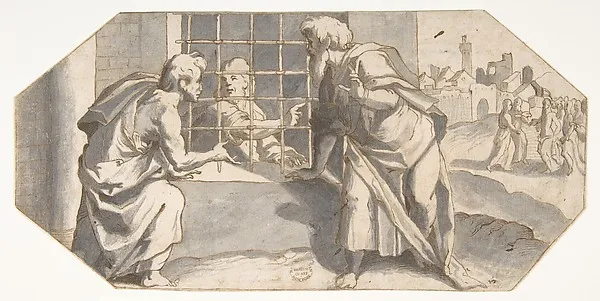
John the Baptist sits in Herod's prison. He had stood at the Jordan, baptized Jesus, and pointed the crowds to Him with the boldest words a prophet ever spoke. But now, shut away in the dark, he sends two of his disciples with a question: Art thou he that should come, or do we look for another? (v. 3). It is not flippant unbelief; it is the cry of a faithful man under strain, asking to be reassured of the very thing he had staked his life on.
And Jesus does not rebuke the question. He answers it the surest way there is - not by talking about Himself, but by pointing to what is happening in front of John's messengers: the blind receive their sight, and the lame walk… and the poor have the gospel preached to them (v. 5).1
Tap any highlighted phrase to jump to the commentary that unpacks it.
Matthew 11:1-15Art Thou He That Should Come?
1And it came to pass, when Jesus had made an end of commanding his twelve disciples, he departed thence to teach and to preach in their cities. 2Now when John had heard in the prison the works of Christ, he sent two of his disciples, 3And said unto him, Art thou he that should come, or do we look for another? 4Jesus answered and said unto them, Go and shew John again those things which ye do hear and see: 5The blind receive their sight, and the lame walk, the lepers are cleansed, and the deaf hear, the dead are raised up, and the poor have the gospel preached to them. 6And blessed is he, whosoever shall not be offended in me.
The chapter opens with Jesus going out to teach and to preach in their cities (v. 1), and then the scene shifts to a prison cell. Now when John had heard in the prison the works of Christ, he sent two of his disciples with a question that lands like a stone: Art thou he that should come, or do we look for another? (vv. 2-3). This is the same John who had stood at the Jordan and cried, Behold the Lamb of God - the forerunner who had seen the heavens open.
Yet now, shut away by Herod and likely awaiting death, he asks to be told again. It would be a mistake to read this only as failure of nerve. A faithful soul under crushing pressure may still need reassurance about the very thing it has staked everything on. John had announced a Messiah who would lay the axe… unto the root of the trees; what he was hearing of from prison was a quieter ministry of healing and good news, and it did not yet match the fire he had preached.
So he sends, honestly, to ask. The remarkable thing is what Jesus does with the question.2
Jesus does not answer with a claim about Himself. He says, Go and shew John again those things which ye do hear and see (v. 4), and then lists the works: The blind receive their sight, and the lame walk, the lepers are cleansed, and the deaf hear, the dead are raised up, and the poor have the gospel preached to them (v. 5). To a man steeped in the prophets, this list was an answer no argument could equal.
It is drawn straight from Isaiah's pictures of what it would look like when God Himself came to save: your God… will come and save you. Then the eyes of the blind shall be opened, and the ears of the deaf shall be unstopped. Then shall the lame man leap as an hart (Isa. 35:4-6), and the Anointed One sent to preach good tidings unto the meek (Isa. 61:1). Jesus is in effect saying: look at what is being fulfilled in front of you, and read it against what the prophets foretold.
The answer to Art thou he? is written in deeds of mercy. And He adds a gentle blessing with an edge of warning: blessed is he, whosoever shall not be offended in me (v. 6) - blessed is the one whose faith is not tripped up because the Messiah came in a way he did not expect.1
7And as they departed, Jesus began to say unto the multitudes concerning John, What went ye out into the wilderness to see? A reed shaken with the wind? 8But what went ye out for to see? A man clothed in soft raiment? behold, they that wear soft clothing are in kings’ houses. 9But what went ye out for to see? A prophet? yea, I say unto you, and more than a prophet. 10For this is he, of whom it is written, Behold, I send my messenger before thy face, which shall prepare thy way before thee. 11Verily I say unto you, Among them that are born of women there hath not risen a greater than John the Baptist: notwithstanding he that is least in the kingdom of heaven is greater than he. 12And from the days of John the Baptist until now the kingdom of heaven suffereth violence, and the violent take it by force. 13For all the prophets and the law prophesied until John. 14And if ye will receive it, this is Elias, which was for to come. 15He that hath ears to hear, let him hear.
The moment John's messengers leave, Jesus turns to defend John's honour to the crowd - and notice He does it the instant John is most vulnerable, asking questions from a cell. What went ye out into the wilderness to see? A reed shaken with the wind? (v. 7). No - John was no fickle reed bending to every breeze, no courtier in soft clothing currying favour in kings' houses (v. 8). He was a prophet, and more: this is he, of whom it is written, Behold, I send my messenger before thy face (v. 10), the herald promised by Malachi to go before the Lord.
Then comes the tribute at its full height: Among them that are born of women there hath not risen a greater than John the Baptist (v. 11). In the long line of prophets and patriarchs, none stood higher than the one whose whole calling was to point away from himself to the Coming One. And yet Jesus immediately adds the startling reversal: notwithstanding he that is least in the kingdom of heaven is greater than he. John stood at the threshold and announced the kingdom; but to live inside it - to know the King and belong to what He is bringing - is greater still than to be the greatest who only stood at its door.
Jesus places John at the hinge of the ages: For all the prophets and the law prophesied until John (v. 13). Everything before pointed forward; John is the last of that long succession and the first finger to point directly at the One who had come. And if ye will receive it, this is Elias, which was for to come (v. 14). Malachi had promised that God would send Elijah before the coming of the great and dreadful day of the LORD (Mal. 4:5), and Jesus says John fills that role - he came in the spirit and power of Elias to turn hearts and prepare a people.
The careful phrase if ye will receive it is telling: this is something to be taken hold of by those willing to hear, not forced on the unwilling. Verse 12 is harder - the kingdom of heaven suffereth violence, and the violent take it by force - and faithful readers have understood it in more than one way: the kingdom pressed upon by hostility, or the kingdom seized with holy eagerness by those who will not be kept out.
Either way, the entrance of the kingdom is no quiet, untroubled thing. So Jesus closes with the call He attaches to His weightiest sayings: He that hath ears to hear, let him hear (v. 15). The words are doing real work; the question is whether the listener will.2
Matthew 11:16-24Neither Dance Nor Mourn
16But whereunto shall I liken this generation? It is like unto children sitting in the markets, and calling unto their fellows, 17And saying, We have piped unto you, and ye have not danced; we have mourned unto you, and ye have not lamented. 18For John came neither eating nor drinking, and they say, He hath a devil. 19The Son of man came eating and drinking, and they say, Behold a man gluttonous, and a winebibber, a friend of publicans and sinners. But wisdom is justified of her children.
Jesus reaches for a picture from the village square to expose the heart of his hearers: It is like unto children sitting in the markets… We have piped unto you, and ye have not danced; we have mourned unto you, and ye have not lamented (vv. 16-17). Imagine children playing at the two great occasions of their world - a wedding and a funeral. One group pipes the wedding tune; the others will not dance.
They switch and wail the funeral dirge; the others will not mourn. Nothing pleases them, because the problem is not the music but the will to respond. Jesus reads his generation exactly so. John came neither eating nor drinking - austere, fasting, the stern prophet of the dirge - and they say, He hath a devil (v. 18). The Son of man came eating and drinking - sitting at tables with sinners, the joyful note of the wedding pipe - and they say, Behold a man gluttonous, and a winebibber, a friend of publicans and sinners (v. 19).
The two messengers came in opposite keys, and the same hardened generation found an excuse to reject them both. This is the danger of a heart that has already decided not to be moved: it will always find a reason. But Jesus ends with quiet confidence - wisdom is justified of her children. God's wisdom in sending both John and the Son will be proved right by its true children, by those whose lives are actually changed, whatever the crowd's verdict.
20Then began he to upbraid the cities wherein most of his mighty works were done, because they repented not: 21Woe unto thee, Chorazin! woe unto thee, Bethsaida! for if the mighty works, which were done in you, had been done in Tyre and Sidon, they would have repented long ago in sackcloth and ashes. 22But I say unto you, It shall be more tolerable for Tyre and Sidon at the day of judgment, than for you. 23And thou, Capernaum, which art exalted unto heaven, shalt be brought down to hell: for if the mighty works, which have been done in thee, had been done in Sodom, it would have remained until this day. 24But I say unto you, That it shall be more tolerable for the land of Sodom in the day of judgment, than for thee.
From the indifferent generation Jesus turns to the towns that had seen the most and turned the least: Then began he to upbraid the cities wherein most of his mighty works were done, because they repented not (v. 20). Woe unto thee, Chorazin! woe unto thee, Bethsaida! (v. 21) - small Galilean towns where so much of His healing and teaching had been poured out. The word woe here is not a curse hurled in anger so much as a lament, the grief of love met with hardness.
And the measure Jesus uses is searching: if the mighty works… had been done in Tyre and Sidon - pagan cities the prophets had condemned - they would have repented long ago in sackcloth and ashes (v. 21). Even Capernaum, the town that had become His own base, exalted unto heaven by the privilege of His constant presence, would be brought down; had Sodom itself seen what Capernaum saw, it would have remained until this day (v. 23).
The principle is sobering and runs all through Scripture: the more light a person is given, the greater the responsibility to walk in it. Privilege is not the same as repentance. To witness the works of God again and again and remain unmoved is a more serious thing than never to have seen them at all.2
It is worth weighing the small phrase that triggers the whole lament: because they repented not (v. 20). These towns were not condemned for lack of evidence - they had more evidence than Tyre, Sidon, or Sodom ever received. They were condemned because seeing did not lead to turning. This quietly answers a thing people often assume: that if only we saw enough miracles, faith would follow automatically. Chorazin and Bethsaida saw the mighty works of God up close, and it did not, by itself, change them.
Earlier in the chapter the unrepentant cannot be pleased by either John or the Son (vv. 16-19); here they cannot be moved even by signs and wonders. The common thread is the unyielding will. Repentance - a real turning of the heart and life toward God - is not manufactured by spectacle; it is a response a person must actually make. And the warning has an edge of hope inside it, for the very thing these towns withheld is the thing always held open to anyone who will offer it.
The door Chorazin would not walk through is the same door that stands open in the next breath: Come unto me.
Matthew 11:25-30Come Unto Me, and I Will Give You Rest
25At that time Jesus answered and said, I thank thee, O Father, Lord of heaven and earth, because thou hast hid these things from the wise and prudent, and hast revealed them unto babes. 26Even so, Father: for so it seemed good in thy sight. 27All things are delivered unto me of my Father: and no man knoweth the Son, but the Father; neither knoweth any man the Father, save the Son, and he to whomsoever the Son will reveal him.
After the grief of the woes, Jesus lifts His eyes and prays, and the tone changes entirely: I thank thee, O Father, Lord of heaven and earth, because thou hast hid these things from the wise and prudent, and hast revealed them unto babes (v. 25). It is a startling thanksgiving. The very ones who, by the world's reckoning, ought to grasp the kingdom first - the wise and prudent, the learned and the established - are the ones to whom it stays hidden, while it is opened to babes: the simple, the lowly, the ones with no credentials but a willing heart.
This is not a contempt for learning; it is a warning about a particular blindness. A person sure of their own wisdom may have no room left to receive what can only be received as a gift. Those who come empty, like children, have room. And Jesus does not merely accept this arrangement; He thanks the Father for it: Even so, Father: for so it seemed good in thy sight (v. 26). What looks upside-down to the world is exactly right in the Father's eyes - the kingdom is opened to the humble, and there is something fitting and good in that, not arbitrary.
The same downward direction we saw in verse 5, good news to the poor, runs straight through here: the kingdom comes to those low enough to receive it.1
Out of that prayer comes one of the most weighty sentences in the Gospels: All things are delivered unto me of my Father: and no man knoweth the Son, but the Father; neither knoweth any man the Father, save the Son, and he to whomsoever the Son will reveal him (v. 27). Let the words stand exactly as Jesus gives them. First, all things are delivered unto me of my Father - the Son holds everything from the Father's hand, in full trust.
Then a knowledge described as mutual and unique: the Father knows the Son as no one else does, and the Son knows the Father as no one else does. This is not the knowledge of one student among others; it is the knowing of a Father and a Son who belong wholly to each other. And then the door: and he to whomsoever the Son will reveal him. The Father, otherwise beyond our reach, is made known - but only through the Son, and only as the Son chooses to make Him known.
This is why the simple and lowly of verse 25 can know what the wise miss: not by climbing up to God by cleverness, but by receiving the Father from the Son who reveals Him. The whole movement of the chapter gathers here. The One who alone knows the Father, and alone unveils Him, is about to open His arms to all ye that labour. To come to the Son is to be brought, at last, to the Father.3
28Come unto me, all ye that labour and are heavy laden, and I will give you rest. 29Take my yoke upon you, and learn of me; for I am meek and lowly in heart: and ye shall find rest unto your souls. 30For my yoke is easy, and my burden is light.
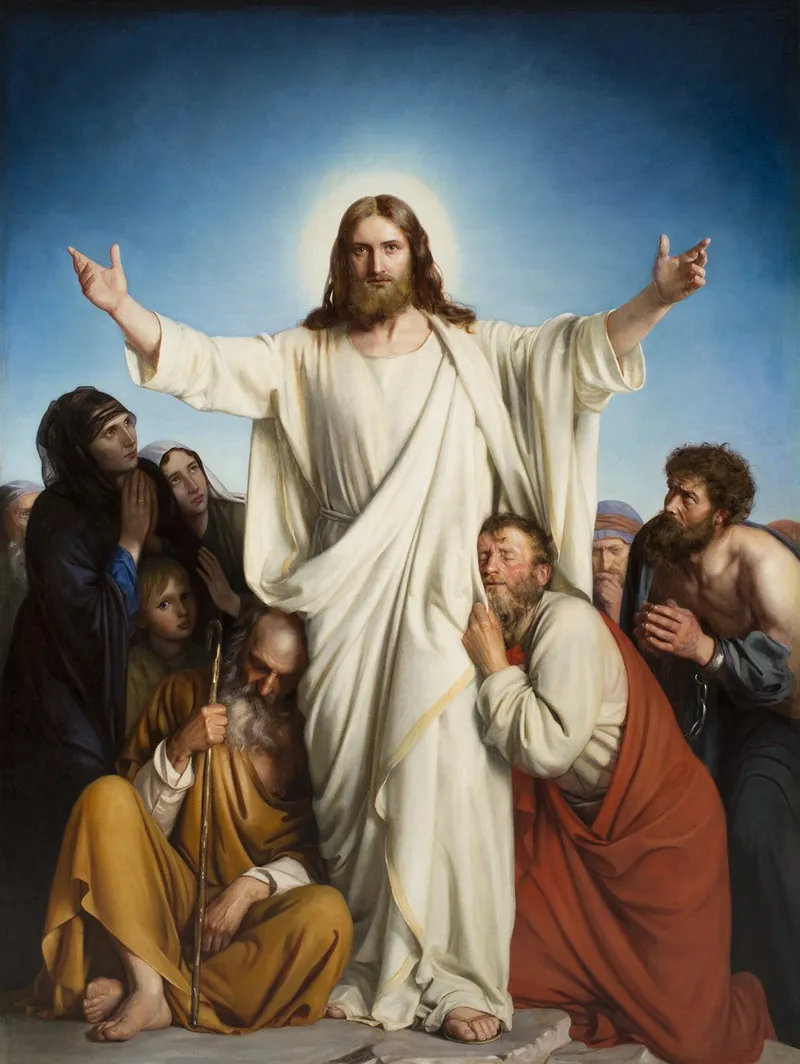
Now the chapter arrives where it has been heading all along, and the words are among the most loved Jesus ever spoke: Come unto me, all ye that labour and are heavy laden, and I will give you rest (v. 28). Weigh the breadth of the call. He does not say, Come, you who have it figured out, or Come, you who are strong and have earned it. He says come to those who are worn down - all ye that labour, all who toil to exhaustion, and are heavy laden, all who stagger under a weight too great to carry.
It is the widest door in the Gospels, and it is opened to people precisely at the point of their need, not their success. And notice who issues the call: the same One who, a verse earlier, said that no one knows the Father except through the Son. The invitation is not a vague comfort; it is the Lord of heaven and earth, into whose hand all things are delivered, stooping to the weary and saying, come. The promise attached is just as direct: I will give you rest. Not rest you must produce, or qualify for, or achieve - rest He gives. What burdened souls could never manufacture for themselves, He simply hands them.
The rest Jesus offers is not the rest of having nothing to do; it is the rest of being rightly joined to the right Master. Take my yoke upon you, and learn of me; for I am meek and lowly in heart: and ye shall find rest unto your souls (v. 29). A yoke is the wooden frame laid across the shoulders for work - so the invitation to rest is, surprisingly, an invitation to a yoke.
The point is not the end of all labour but a complete change of master. Many were toiling under yokes that crushed them: the unbearable weight of trying to earn God's favour by piling rule upon rule, the exhaustion of carrying it all alone. Jesus says: take my yoke instead, and learn of me. And the reason it will be different is the character of the One you are now joined to - for I am meek and lowly in heart. This is the only place in the Gospels where Jesus describes His own heart, and what He names is gentleness and humility.
The Master under whose yoke you come is not harsh or driving; He is tender, lowly, the very opposite of every taskmaster that ever wore a soul down. That is why He can say, my yoke is easy, and my burden is light (v. 30). Not because there is no work, but because the work is shared with a gentle Saviour, and done out of love rather than fear. To learn of Him is also to learn the Father, for He is the One who reveals Him (v. 27); under this yoke is the one place a weary soul truly comes to know God.
Research trail
Sources & further study
These references support the historical, linguistic, manuscript, and contextual notes in this chapter. Scripture remains the primary text; external sources are provided so readers can inspect the research directly.
- Matthew 11 ↔ Isaiah 35 & 61 · Jeremiah 6 · John 1 & 14Traces the threads tying Matthew 11 to the rest of Scripture - the works that answer John (v. 5) read against the eyes of the blind shall be opened (Isa. 35:5) and to preach good tidings unto the meek (Isa. 61:1), the call to rest (vv. 28-29) beside ye shall find rest for your souls (Jer. 6:16), and the Son who reveals the Father (v. 27) beside he that hath seen me hath seen the Father (John 14:9).
- Matthew 11 - Translators' NotesThe NET Bible's detailed footnotes on Matthew 11 - the messianic force of the works listed in verse 5, the proverb of the children in the marketplace (vv. 16-17), the geography and weight of the woes on Chorazin, Bethsaida, and Capernaum (vv. 20-24), and the much-discussed mutual knowledge of Father and Son in verse 27.
- Matthew 11 · Greek interlinear + lexiconThe Greek text of Matthew 11 word by word with parsing and lexicon links - useful for anapausis and anapauō (vv. 28-29, the “rest” Christ gives), for praus and tapeinos (v. 29, “meek and lowly”), and for the verbs of laboring and being burdened that the invitation answers.
Where this echoes in Scripture
Art Thou He That Should Come?
- Isaiah 35:5-6Then the eyes of the blind shall be opened, and the ears of the deaf shall be unstopped. Then shall the lame man leap as an hart.The prophecy Jesus fulfils in verse 5 - the works that tell John exactly who has come.
- Isaiah 61:1The Spirit of the Lord GOD is upon me; because the LORD hath anointed me to preach good tidings unto the meek.The good news to the poor that crowns the answer of verse 5.
- Malachi 3:1Behold, I will send my messenger, and he shall prepare the way before me.The promise Jesus applies to John in verse 10 - the herald sent before the Lord.
- Malachi 4:5Behold, I will send you Elijah the prophet before the coming of the great and dreadful day of the LORD.The Elias of verse 14 - the promised forerunner Jesus says John fulfils.
- Luke 1:17And he shall go before him in the spirit and power of Elias... to make ready a people prepared for the Lord.How John is “Elias” (v. 14) - not in person but in spirit and calling.
Neither Dance Nor Mourn
- Luke 7:31-35They are like unto children sitting in the marketplace... We have piped unto you, and ye have not danced.The same parable of the unpleasable children as verses 16-17, in Luke's telling.
- Matthew 23:37How often would I have gathered thy children together... and ye would not!The same grieving love behind the woes of verses 21-24 - the Lord who longs to gather.
- Ezekiel 3:6-7had I sent thee to them, they would have hearkened unto thee. But the house of Israel will not hearken.The principle of verses 21-23 - that those given more light may turn less than those given less.
- Luke 12:48unto whomsoever much is given, of him shall be much required.The measure Jesus uses on Chorazin and Capernaum (vv. 21-24) - responsibility rises with light.
- 2 Peter 3:9not willing that any should perish, but that all should come to repentance.The heart behind the lament of verses 20-24 - woe as grief, not mere condemnation.
Come Unto Me, and I Will Give You Rest
- John 1:18No man hath seen God at any time; the only begotten Son, which is in the bosom of the Father, he hath declared him.The unique knowledge of verse 27 - the Father made known only through the Son.
- John 14:6-9I am the way, the truth, and the life... he that hath seen me hath seen the Father.The Son who alone reveals the Father (v. 27) - the way by whom we come to Him.
- Jeremiah 6:16ask for the old paths, where is the good way, and walk therein, and ye shall find rest for your souls.The ancient call that verse 29 fulfils - rest for the soul, offered and at last given.
- Hebrews 4:9-10There remaineth therefore a rest to the people of God... he that is entered into his rest, he also hath ceased from his own works.The true Sabbath rest of verse 28 - ceasing from our own works to rest in Christ.
- Psalm 116:7Return unto thy rest, O my soul; for the LORD hath dealt bountifully with thee.The rest unto the soul of verse 29 - the quiet of a soul that has come home to God.