Revelation 7
People in this chapter
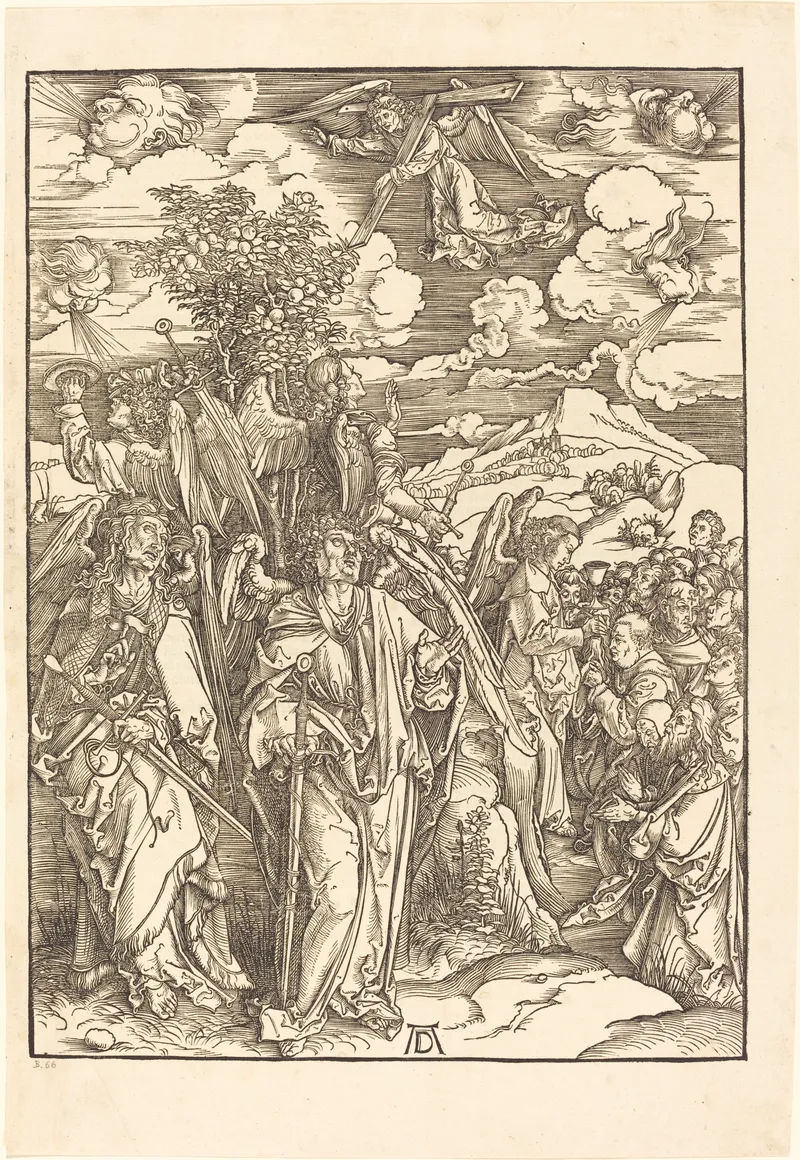
The sixth seal closed the previous chapter with the whole earth in terror, hiding from the wrath of the Lamb, and a question left ringing: who shall be able to stand? Chapter 7 steps into that question with a pause. And after these things I saw four angels standing on the four corners of the earth, holding the four winds of the earth, that the wind should not blow on the earth, nor on the sea, nor on any tree (v. 1).
The destroying winds are restrained - held back - while something is set in order first. Then another angel rises from the east, having the seal of the living God, and cries to the four with a loud voice not to hurt the earth or sea or trees till we have sealed the servants of our God in their foreheads (vv. 2-3). Before any further blow lands, the people of God are marked as His own.1
Tap any highlighted phrase to jump to the commentary that unpacks it.
Revelation 7:1-8Till We Have Sealed the Servants of Our God
1And after these things I saw four angels standing on the four corners of the earth, holding the four winds of the earth, that the wind should not blow on the earth, nor on the sea, nor on any tree. 2And I saw another angel ascending from the east, having the seal of the living God: and he cried with a loud voice to the four angels, to whom it was given to hurt the earth and the sea, 3Saying, Hurt not the earth, neither the sea, nor the trees, till we have sealed the servants of our God in their foreheads. 4And I heard the number of them which were sealed: and there were sealed an hundred and forty and four thousand of all the tribes of the children of Israel. 5Of the tribe of Juda were sealed twelve thousand. Of the tribe of Reuben were sealed twelve thousand. Of the tribe of Gad were sealed twelve thousand. 6Of the tribe of Aser were sealed twelve thousand. Of the tribe of Nephthalim were sealed twelve thousand. Of the tribe of Manasses were sealed twelve thousand. 7Of the tribe of Simeon were sealed twelve thousand. Of the tribe of Levi were sealed twelve thousand. Of the tribe of Issachar were sealed twelve thousand. 8Of the tribe of Zabulon were sealed twelve thousand. Of the tribe of Joseph were sealed twelve thousand. Of the tribe of Benjamin were sealed twelve thousand.
The sixth seal ended in dread, with the whole earth fleeing the face of the One on the throne and crying, who shall be able to stand? Chapter 7 opens by holding everything still before that question is answered. And after these things I saw four angels standing on the four corners of the earth, holding the four winds of the earth, that the wind should not blow on the earth, nor on the sea, nor on any tree (v. 1).
The four corners and four winds are the language of the whole world - north, south, east, west - every direction from which trouble could come. And the striking thing is that the winds are held. The forces that could sweep the earth bare are not loose; they are restrained, gripped by angels who will not let them go until they are told. The picture is one of total control. Whatever is coming does not come a moment before God permits it.
The world stands in a held breath, and into that pause the next scene steps.
Then comes the reason for the pause: And I saw another angel ascending from the east, having the seal of the living God: and he cried with a loud voice to the four angels… Saying, Hurt not the earth, neither the sea, nor the trees, till we have sealed the servants of our God in their foreheads (vv. 2-3). The angel rises from the east - the direction of the dawn, the quarter from which light and deliverance so often come in Scripture - and he carries the seal of the living God. Before any further harm is allowed, the servants of God must be marked.
The order matters: the seal comes first, then whatever follows. And the mark is set in their foreheads - not hidden away but in the open, on the most visible part of a person, where identity is plainly read. The image reaches back to Ezekiel, where a man with a writer's inkhorn was sent through a doomed city to set a mark upon the foreheads of the men that sigh and that cry for its sins, so that the coming judgment passed them by.2 To be sealed is to be claimed, named as belonging to the living God, kept as His own.
The chapter does not pause to spell out everything the seal protects them from or how; it simply shows the comfort plainly - God knows His own, and He marks them before the day grows dark.
John does not see the sealing; he hears the count: And I heard the number of them which were sealed: and there were sealed an hundred and forty and four thousand of all the tribes of the children of Israel (v. 4). Then the tribes are read out in a slow, deliberate roll - twelve thousand from Juda, twelve thousand from Reuben, and so on through twelve names. The repetition is the point. Twelve thousand… twelve thousand… falls like a drumbeat, tribe after tribe, with not one omitted.
The number itself is built out of the number of the tribes - twelve - multiplied and filled to overflowing, a figure of fullness and completeness rather than a ceiling. The weight rests on what the count declares: the people of God are gathered whole. No tribe is lost, no servant forgotten, none who belong to Him left off the roll. Just here the text asks for restraint, and the chapter itself supplies it: it does not stop to decode the number or to lay out a schedule of events.
It simply lets the sealed company be heard as a complete and counted people - every one of them known, every one of them kept - and then, in the next breath, lifts John's eyes to a sight that can be heard counted but never seen numbered.1
Revelation 7:9-12A Great Multitude, Which No Man Could Number
9After this I beheld, and, lo, a great multitude, which no man could number, of all nations, and kindreds, and people, and tongues, stood before the throne, and before the Lamb, clothed with white robes, and palms in their hands; 10And cried with a loud voice, saying, Salvation to our God which sitteth upon the throne, and unto the Lamb. 11And all the angels stood round about the throne, and about the elders and the four beasts, and fell before the throne on their faces, and worshipped God, 12Saying, Amen: Blessing, and glory, and wisdom, and thanksgiving, and honour, and power, and might, be unto our God for ever and ever. Amen.
The chapter turns on two words: After this. John has heard a number; now he beholds a sight, and the contrast could hardly be sharper. After this I beheld, and, lo, a great multitude, which no man could number, of all nations, and kindreds, and people, and tongues, stood before the throne, and before the Lamb, clothed with white robes, and palms in their hands (v. 9). The counted company gives way to one that cannot be counted - no man could number - and the tribes of one nation open out into all nations, and kindreds, and people, and tongues. Every barrier that divides the human family - nation, clan, ethnicity, language - is named, and then transcended; here they all stand together in one throng.
This is the promise spoken to Abraham at the very beginning, that in thee shall all families of the earth be blessed (Gen. 12:3), arrived at last at its harvest. They are clothed with white robes - the dress of purity and of victory - and they hold palms in their hands, the branches of festival and triumph, waved in celebration of a deliverance won. No people is missing from this crowd; no tongue goes unrepresented before the throne.
The full sweep of redeemed humanity stands gathered in the presence of God and of the Lamb.
Out of that vast throng rises a single cry: And cried with a loud voice, saying, Salvation to our God which sitteth upon the throne, and unto the Lamb (v. 10). It is worth weighing exactly what they shout. Not we saved ourselves, not even we are saved, but Salvation to our God… and unto the Lamb. The whole weight of their deliverance is laid back at the feet of the One who accomplished it.
The word ascribes the saving entirely to God and to the Lamb - it is His doing, His victory, His to be praised for. And notice that the cry is addressed to two and yet rises as one: to our God which sitteth upon the throne, and unto the Lamb. The God on the throne and the Lamb before it are praised together, in a single breath, for a single salvation. The redeemed do not parcel out their gratitude.
They ascribe their rescue to God and to the Lamb with one voice, and they do it with a loud voice - this is not a murmur but a shout, the full-throated joy of a people who know exactly to whom they owe everything.
The multitude's cry sets all heaven in motion. And all the angels stood round about the throne, and about the elders and the four beasts, and fell before the throne on their faces, and worshipped God (v. 11). The countless redeemed are ringed by the angelic hosts, and at the cry of Salvation the angels fall on their faces. Then they answer with a sevenfold ascription of praise: Saying, Amen: Blessing, and glory, and wisdom, and thanksgiving, and honour, and power, and might, be unto our God for ever and ever. Amen (v. 12).
The doxology opens and closes with Amen - so be it, it is true - wrapping the seven gifts of praise in agreement. Seven is the number of fullness, and so the list is meant to leave nothing out: every kind of worth that could be named is gathered up and laid before God. It is the only fitting response to what has just been seen. Once the full harvest of the redeemed stands safe before the throne, heaven cannot keep silent; the angels join the human throng, and the worship of the saved becomes the worship of all creation.
Earth's ransomed multitude and heaven's unfallen hosts are caught up together in one act of praise.
Revelation 7:13-17They Washed Their Robes in the Blood of the Lamb
13And one of the elders answered, saying unto me, What are these which are arrayed in white robes? and whence came they? 14And I said unto him, Sir, thou knowest. And he said to me, These are they which came out of great tribulation, and have washed their robes, and made them white in the blood of the Lamb. 15Therefore are they before the throne of God, and serve him day and night in his temple: and he that sitteth on the throne shall dwell among them. 16They shall hunger no more, neither thirst any more; neither shall the sun light on them, nor any heat. 17For the Lamb which is in the midst of the throne shall feed them, and shall lead them unto living fountains of waters: and God shall wipe away all tears from their eyes.
Now one of the heavenly elders turns the question back on John, and in doing so teaches him: And one of the elders answered, saying unto me, What are these which are arrayed in white robes? and whence came they? (v. 13). It is a teacher's question - not asked because the elder does not know, but to draw the answer out and fix John's attention on it. John responds with humble dependence: Sir, thou knowest (v. 14).
He will not guess; he waits to be told. And the elder gives the explanation the whole vision has been building toward: These are they which came out of great tribulation, and have washed their robes, and made them white in the blood of the Lamb. Two things are said of them, and the order is everything. First, where they came from: out of great tribulation. They are not a people who were spared all suffering; they are a people who came out of it, through it and beyond it.
Second, and decisively, how their robes came to be white: by being washed… in the blood of the Lamb. The text does not pin great tribulation to a particular dated season or lay out a schedule around it; it lets the phrase stand as the elder gives it - the pressure and affliction these came through - and moves the weight at once onto the blood that made them clean.
Hold the central image of the chapter up to the light, because it should stop us: washed their robes, and made them white in the blood of the Lamb (v. 14). On its face the picture is impossible. Blood does not whiten cloth; it stains it. A robe washed in blood should come out red and ruined. Yet here is the one exception in all the universe: the blood of the Lamb is the single thing that can make a robe white. The whiteness is not the wearers' own.
It is not the residue of their innocence, not the reward of their endurance, not anything they brought with them out of the tribulation. It was given them - washed into them - by the blood of Another. This is why the multitude's cry was Salvation to our God… and unto the Lamb, and not a word about themselves: they know exactly where the whiteness came from. The robe of the redeemed is clean because it was dipped in the blood that cleanseth us from all sin (1 John 1:7).
And this same blood is how the book elsewhere says the saints triumphed: they overcame him by the blood of the Lamb (Rev. 12:11). Their victory and their purity have one and the same source. Whatever they came through, they stand white before the throne for one reason only - the Lamb was slain, and they were washed.
Because they have been washed, a whole inheritance opens to them: Therefore are they before the throne of God, and serve him day and night in his temple: and he that sitteth on the throne shall dwell among them (v. 15). The little word therefore binds it all to the blood - because their robes are white in the blood of the Lamb, therefore they stand here. Their place before the throne is not earned by their suffering; it is given on the ground of the washing.
And the life described is not idle rest but glad service: they serve him day and night - ceaselessly, wholeheartedly - in his temple. Yet this service is not strain; it is the joy of the redeemed doing at last what they were made to do, in the immediate presence of God. And the crowning promise: he that sitteth on the throne shall dwell among them. God Himself spreads His tent over them; His presence is their dwelling.
This is the hope the whole Bible has been reaching for - God with His people - and the book will say it again in full at the end: Behold, the tabernacle of God is with men, and he will dwell with them, and they shall be his people (Rev. 21:3). The servants washed in the Lamb's blood are brought, at last, all the way home into the presence they were made for.
The chapter ends in a cascade of tenderness, every line answering some specific ache of the people who came out of great tribulation. They shall hunger no more, neither thirst any more; neither shall the sun light on them, nor any heat (v. 16). Every want they knew - the gnaw of hunger, the parch of thirst, the beating of the desert sun on weary pilgrims - is named and then forever ended. The words are lifted straight from Isaiah's promise to the LORD's redeemed: They shall not hunger nor thirst; neither shall the heat nor sun smite them: for he that hath mercy on them shall lead them, even by the springs of water shall he guide them (Isa. 49:10).2 Then the source of all this comfort is named: For the Lamb which is in the midst of the throne shall feed them, and shall lead them unto living fountains of waters: and God shall wipe away all tears from their eyes (v. 17).
The Lamb who was slain is now the Shepherd who tends His flock; He feeds them and leads them, the very language of the shepherd Psalm. And the last gesture in the chapter is the gentlest of all: God shall wipe away all tears from their eyes. Not merely dry them - wipe them away, with His own hand, as a parent wipes a child's face. The tears are not pretended away as though the suffering never happened; they are honored, and then tenderly removed by God Himself.
Research trail
Sources & further study
These references support the historical, linguistic, manuscript, and contextual notes in this chapter. Scripture remains the primary text; external sources are provided so readers can inspect the research directly.
- Revelation 7 - Translators' NotesThe NET Bible's detailed footnotes on Revelation 7 - the four winds and the sealing in verses 1-3, the list of the twelve tribes in verses 5-8, the great multitude and the palms in verse 9, and the elder's explanation of those who came out of great tribulation in verses 13-14.
- Revelation 7 ↔ Ezekiel 9 · Psalm 23 · Isaiah 25 & 49Traces the older Scriptures woven through the chapter - the mark set on the foreheads of the faithful (v. 3) from Ezekiel 9:4; the Lamb who feeds and leads to living water (v. 17) from Psalm 23 and Isaiah 49:10; the wiping away of tears and the end of hunger and thirst (vv. 16-17) from Isaiah 25:8 and 49:10; and the multitude from all nations before the throne (v. 9) gathered into the redeemed song of Revelation 5:9.
- Revelation 7 · Greek interlinearThe Greek text of Revelation 7 word by word, with parsing and Strong's links - useful for sphragis and the verb sphragizo (vv. 2-4, the “seal” set on the servants of God), for ochlos polys (v. 9, “a great multitude”), and for thlipsis megale (v. 14, “great tribulation”).
Where this echoes in Scripture
Till We Have Sealed the Servants of Our God
- Ezekiel 9:4Go through the midst of the city... and set a mark upon the foreheads of the men that sigh and that cry for all the abominations.The sealing of verses 3-4 - the faithful marked on the forehead before judgment, as in Ezekiel's vision.
- Ephesians 1:13-14ye were sealed with that holy Spirit of promise, Which is the earnest of our inheritance.The seal of the living God (v. 2) - the marking the New Testament names as the possession of all who believe.
- John 10:28-29they shall never perish, neither shall any man pluck them out of my hand.The keeping behind the sealing (vv. 3-4) - the people of God held safe, none lost.
- 2 Timothy 2:19The foundation of God standeth sure, having this seal, The Lord knoweth them that are his.What the seal declares (v. 4) - the Lord knows His own, and marks them as His.
- Revelation 14:1an hundred forty and four thousand, having his Father's name written in their foreheads.The same sealed company as verses 4-8 - bearing the Father's name on the forehead.
A Great Multitude, Which No Man Could Number
- Revelation 5:9thou... hast redeemed us to God by thy blood out of every kindred, and tongue, and people, and nation.The multitude of verse 9 - the very harvest the Lamb's blood was said to purchase, now standing before Him.
- Genesis 12:3in thee shall all families of the earth be blessed.The promise reaching its harvest in verse 9 - every family of earth gathered before the throne.
- John 10:16other sheep I have, which are not of this fold... and there shall be one fold, and one shepherd.The gathering of every nation (v. 9) - the one flock the Shepherd said He would bring.
- Acts 4:12there is none other name under heaven given among men, whereby we must be saved.The cry of verse 10 - salvation ascribed to God and the Lamb, found in no other name.
- Revelation 5:13Blessing, and honour, and glory, and power, be unto him that sitteth upon the throne, and unto the Lamb.The worship of verses 10-12 - God and the Lamb praised together by all creation.
They Washed Their Robes in the Blood of the Lamb
- Isaiah 49:10They shall not hunger nor thirst; neither shall the heat nor sun smite them... even by the springs of water shall he guide them.The promise behind verses 16-17 - no hunger, thirst, or scorching heat, the redeemed led to springs of water.
- Psalm 23:1-2The LORD is my shepherd; I shall not want... he leadeth me beside the still waters.The Lamb who feeds and leads (v. 17) - the shepherd's care, now the Lamb's own.
- John 10:11I am the good shepherd: the good shepherd giveth his life for the sheep.The Lamb who is the Shepherd (v. 17) - the One who laid down His life for the flock He leads.
- 1 John 1:7the blood of Jesus Christ his Son cleanseth us from all sin.The blood that whitens the robe (v. 14) - the cleansing the elder names as their only purity.
- Revelation 21:3-4the tabernacle of God is with men... and God shall wipe away all tears from their eyes.The promises of verses 15-17 brought to full flower - God dwelling with His people, every tear wiped away.