Revelation 8
People in this chapter
In Revelation 7, John saw the multitude of the redeemed standing before the throne, clothed in white robes, palms in their hands, singing the song of salvation. The vision was one of triumph and vindication. And then - the seventh seal. The Lamb opens it, and heaven itself goes silent. Not the silence of emptiness, but of terrible hush. Something momentous is about to unfold.
Tap any highlighted phrase to jump to the commentary that unpacks it.

Revelation 8:1The Seventh Seal Opened: Silence
1And when he had opened the seventh seal, there was silence in heaven about the space of half an hour.
For half an hour, all heaven is still. This is not emptiness; this is the hush before judgment. This is the moment when earth and heaven hold their breath12.
Revelation 8:2Seven Angels Given Trumpets
2And I saw the seven angels which stood before God; and to them were given seven trumpets.
John sees seven angels standing before God. These are not minor heavenly servants. These are the angels who "stand before God," the inner circle of the throne, those who are always in the presence of the King. Now they are given trumpets - instruments of proclamation and judgment. The trumpet in Scripture is the voice of God breaking into history.
The seven trumpets are given to the seven angels who stand before God. These are not random instruments of chaos, but a measured sequence of proclamations. Each trumpet announces a judgment. Together, they constitute a divine response to the prayers of the saints that rose up like incense.
Revelation 8:3-4The Prayers of the Saints Before God
3And another angel came and stood at the altar, having a golden censer; and there was given unto him much incense, that he should offer it with the prayers of all saints upon the golden altar which was before the throne. 4And the smoke of the incense, which came with the prayers of the saints, ascended up before God out of the angel’s hand.
An angel comes with a golden censer - a vessel filled with hot coals and incense. The censer itself is made of gold, marking it as worthy of the holy place. In the tabernacle and temple, the golden altar of incense stood directly before the Holy of Holies, separated from the Most Holy Place by only a veil. This is the most sacred space in Israel's worship.
The angel does not offer perfume or fragrance alone. The angel offers incense with the prayers of all saints. Every prayer that has been prayed, every cry for mercy, every intercession, every plea for justice - all of it is mixed with incense and presented before God. Your prayers have weight. Your prayers are worth presenting before the throne of heaven itself.
The golden altar standing before the throne is the place where God receives worship and petition. This is where your prayers meet the fire of God's presence. Not in a distant, abstract way, but in a real spatial reality within heaven itself - at the very edge of the throne room, where only the most sacred offerings are made.
Revelation 8:5The Censer Filled with Fire; Judgment Declared
5And the angel took the censer, and filled it with fire of the altar, and cast it into the earth: and there were voices, and thunderings, and lightnings, and an earthquake.
The same censer connects the prayers presented before God with the action that follows on earth. Its movement gives the sequence a direction: petitions rise before the throne, then fire descends from the altar. Prayer and judgment are joined within the vision.
Four signs accompany the casting down of the censer: voices, thunderings, lightnings, and an earthquake. These are not incidental noise. They are the signature of God's presence, the manifestation of His power. When God moved at Sinai, there were voices, thunder, lightning, and the mountain trembled.
Revelation 8:6The Seven Angels Prepare to Sound
6And the seven angels which had the seven trumpets prepared themselves to sound.
The angels receive their trumpets in verse 2, yet the sounding waits while the altar scene unfolds. This arrangement places the prayers of the saints before the judgments announced by the trumpets.
Revelation 8:7The First Angel Sounds: Hail and Fire
7The first angel sounded, and there followed hail and fire mingled with blood, and they were cast upon the earth: and the third part of trees was burnt up, and all green grass was burnt up.
The hail and fire recall the Egyptian plague in Exodus 9:24. That memory places the trumpet within an established scriptural pattern of judgment. The damage to vegetation also shows how a blow to the land reaches the conditions on which human life depends.
Revelation 8:8-9The Second Angel Sounds: A Burning Mountain
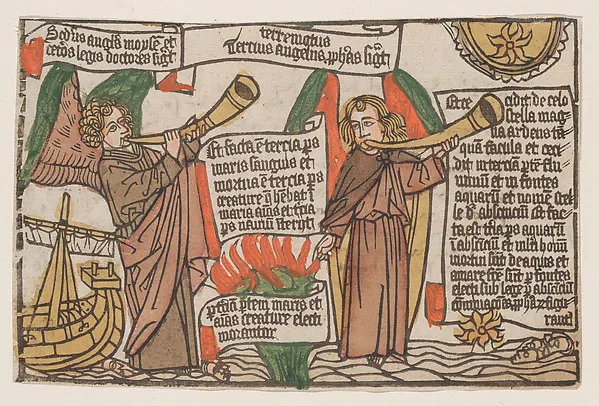
8And the second angel sounded, and as it were a great mountain burning with fire was cast into the sea: and the third part of the sea became blood; 9And the third part of the creatures which were in the sea, and had life, died; and the third part of the ships were destroyed.
The sea judgment reaches both marine life and the ships used for trade and travel. The vision joins damage to a natural realm with damage to the human activity dependent on it, widening the consequences beyond the shoreline.
Revelation 8:10-11The Third Angel Sounds: Wormwood
10And the third angel sounded, and there fell a great star from heaven, burning as it were a lamp, and it fell upon the third part of the rivers, and upon the fountains of waters; 11And the name of the star is called Wormwood: and the third part of the waters became wormwood; and many men died of the waters, because they were made bitter.
A great star falls from heaven. It falls upon a third of the rivers and fountains - the fresh waters that sustain life. And it is called Wormwood. In Scripture, wormwood is the symbol of bitterness, of curse, of poison. The waters that gave life are poisoned. Many die because the waters are made bitter.
Revelation 8:12The Fourth Angel Sounds: Darkness
12And the fourth angel sounded, and the third part of the sun was smitten, and the third part of the moon, and the third part of the stars; so as the third part of them was darkened, and the day shone not for a third part of it, and the night likewise.
The fourth trumpet reaches the lights that order day and night. The repeated third part links this scene to the earlier trumpets and marks the damage as extensive yet partial. The coming woes will intensify what has begun here.
Revelation 8:13"Woe, Woe, Woe" - The Three Remaining Trumpets Announced
13And I beheld, and heard an angel flying through the midst of heaven, saying with a loud voice, Woe, woe, woe, to the inhabiters of the earth by reason of the other voices of the trumpet of the three angels, which are yet to sound!
The threefold woe corresponds to the three trumpets still to sound. It marks a transition from the first four judgments to the final three and gives the reader an audible warning before those scenes unfold.

Research trail
Sources & further study
These references support the historical, linguistic, manuscript, and contextual notes in this chapter. Scripture remains the primary text; external sources are provided so readers can inspect the research directly.
- Exodus 7-12 - The Ten PlaguesOT parallel to the trumpet judgments - hail, darkness, locusts, and water turning to blood.
- Joel 2:1-11 - Locust Army and JudgmentApocalyptic imagery of locusts and trumpet sounds echoed in Revelation's trumpet plagues.
- Exodus 7:17-21 ↔ Revelation 8:8-9Water-to-blood plague: Exodus pattern repeated in John's apocalyptic sequence.