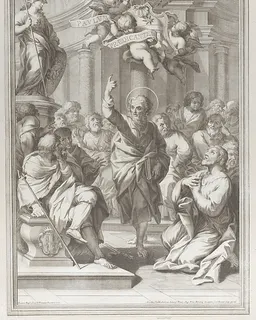
Acts 17
People in this chapter
Three cities, three crowds, one message. In Thessalonica the synagogue erupts and Paul is hauled before the rulers as a man who turns the world upside down. In Berea they do something rarer: they hear him out and search the scriptures daily to see whether the things he says are so. Then Athens, a city crowded with statues, where the philosophers trade Paul back and forth in the marketplace like the latest curiosity to amuse a bored town.1
Tap any highlighted phrase to jump to the commentary that unpacks it.
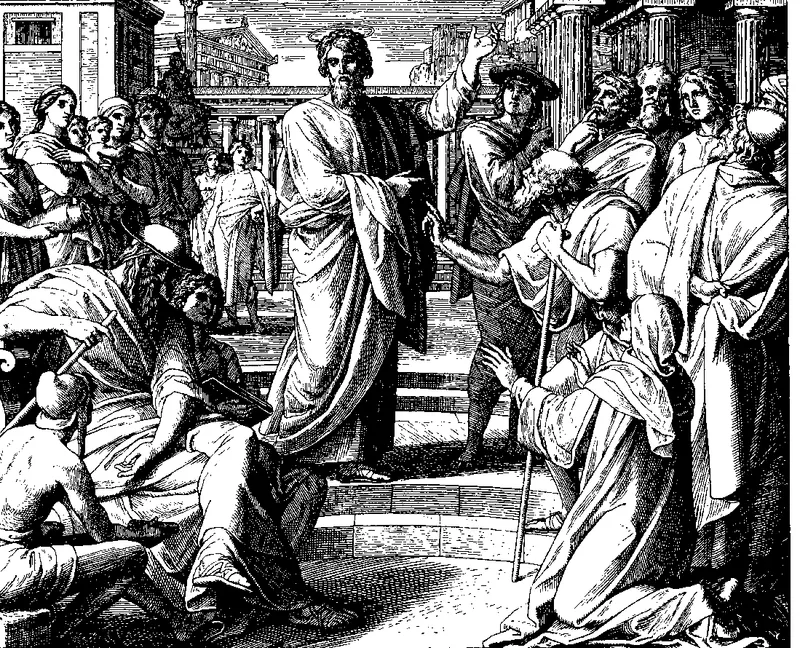
Acts 17:1-9Thessalonica: Uproar and Opposition
1Now when they had passed through Amphipolis and Apollonia, they came to Thessalonica, where was a synagogue of the Jews: 2And Paul, as his manner was, went in unto them, and three sabbath days reasoned with them out of the scriptures, 3Opening and alleging, that Christ must needs have suffered, and risen again from the dead; and that this Jesus, whom I preach unto you, is Christ. 4And some of them believed, and consorted with Paul and Silas; and of the devout Greeks a great multitude, and of the chief women not a few.
Count who believed: devout Greeks in great number, and not a few of the leading women. That is precisely the problem about to break. These were people whose money and standing the synagogue had counted on, and overnight their loyalty tilts toward a crucified Galilean. Three Sabbaths of reasoning, and the social map of the city starts to move. Watch what that costs.
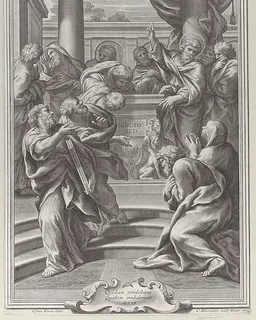
5But the Jews which believed not, moved with envy, took unto them certain lewd fellows of the baser sort, and gathered a company, and set all the city on an uproar, and assaulted the house of Jason, and sought to bring them out to the people. 6And when they found them not, they drew Jason and certain brethren unto the rulers of the city, crying, These that have turned the world upside down are come hither also; 7Whom Jason hath received: and these all do contrary to the decrees of Caesar, saying that there is another king, one Jesus. 8And they troubled the people and the rulers of the city, when they heard these things. 9And when they had taken security of Jason, and of the other, they let them go.
Paul follows a pattern: when he enters a city, he goes first to the synagogue. He argues from Scripture, using the texts his listeners already hold sacred. The gospel is the fulfillment of what Scripture has been preparing all along.
The phrase "turned the world upside down" is a stunning indictment and a compliment both at once. The accusers mean it as slander - these are troublemakers, seditionists. But the phrase is true. The gospel does turn things upside down: the last are first, the weak are strong, the death of God on a cross redeems the world. The kingdom of Jesus inverts every kingdom built on power and wealth.
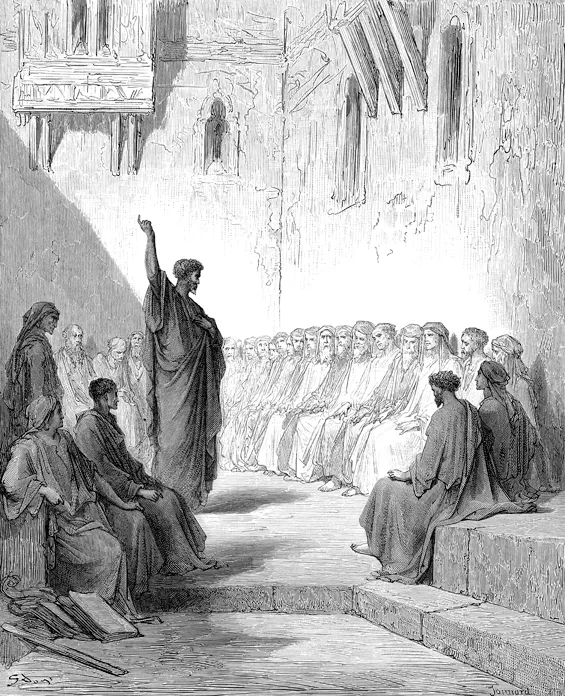
Acts 17:10-14Sent Away by Night
10And the brethren immediately sent away Paul and Silas by night unto Berea: who coming thither went into the synagogue of the Jews. 11These were more noble than those in Thessalonica, in that they received the word with all readiness of mind, and searched the scriptures daily, whether those things were so. 12Therefore many of them believed; also of honourable women which were Greeks, and of men, not a few. 13But when the Jews of Thessalonica had knowledge that the word of God was preached of Paul at Berea, they came thither also, and stirred up the people. 14And then immediately the brethren sent away Paul to go as it were to the sea: but Silas and Timotheus abode there still.
Paul's pattern persists: he goes to the synagogue first. Even when he is fleeing persecution, even when safety matters, he seeks out the place where Scripture is read and taught. This is not stubbornness. It is the conviction that the gospel is written into the texts the Jews themselves hold sacred.
Here faith and homework walk arm in arm. The Bereans throw the windows open - they want to believe - and then they go check, day after day, whether the man is telling them the truth. They were not gullible; an eager heart is not the same as an empty head. They were not cynics either, looking for a reason to dismiss him. They were willing to be persuaded by evidence, and the evidence held. So you can bring your real questions to Jesus. He has never once asked anyone to stop thinking in order to start believing.
Even in Berea, opposition catches up. The enemies from Thessalonica pursue Paul, intent on stopping him. But by this time the seed is planted. The Bereans have investigated, believed, and their faith will not be easily shaken. Opposition that comes after belief is simply confirmation that the gospel matters.
Acts 17:15-17Paul Alone in Athens
15And they that conducted Paul brought him unto Athens: and receiving a commandment unto Silas and Timotheus for to come to him with all speed, they departed. 16Now while Paul waited for them at Athens, his spirit was stirred in him, when he saw the city wholly given to idolatry. 17Therefore disputed he in the synagogue with the Jews, and with the devout persons, and in the market daily with them that met with him.
Athens in Paul's day was a city of temples and statues2. Nearly every street corner held a shrine, an altar, a god. For a man whose conviction was that "an idol is nothing in the world" (1 Corinthians 8:4) and that all such worship is misdirected devotion to demons, Athens must have been overwhelming - a sprawl of religious confusion, spiritual energy aimed at countless false gods.
Acts 17:18-21In the Marketplace: Philosophers and Babbler
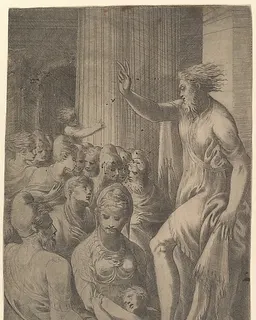
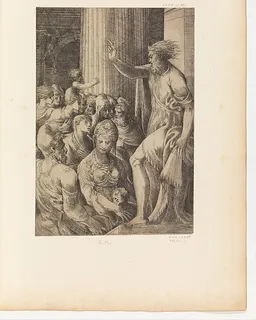
18Then certain philosophers of the Epicureans, and of the Stoicks, encountered him. And some said, What will this babbler say? other some, He seemeth to be a setter forth of strange gods: because he preached unto them Jesus, and the resurrection. 19And they took him, and brought him unto Areopagus, saying, May we know what this new doctrine, whereof thou speakest, is? 20For thou bringest certain strange things to our ears: we would know therefore what these things mean. 21(For all the Athenians and strangers which were there spent their time in nothing else, but either to tell, or to hear some new thing.)
Listen to the sneer in the word “babbler.” In Greek it is spermologos - a seed-picker, the little bird that hops the gutter snatching scraps. The sophisticates mean: this man has no real system, just bits and pieces he has scavenged. And in their hearing Jesus and the resurrection are simply two more “strange gods,” foreign imports against the city's law. What they file away as oddity is the one announcement that could set them free.
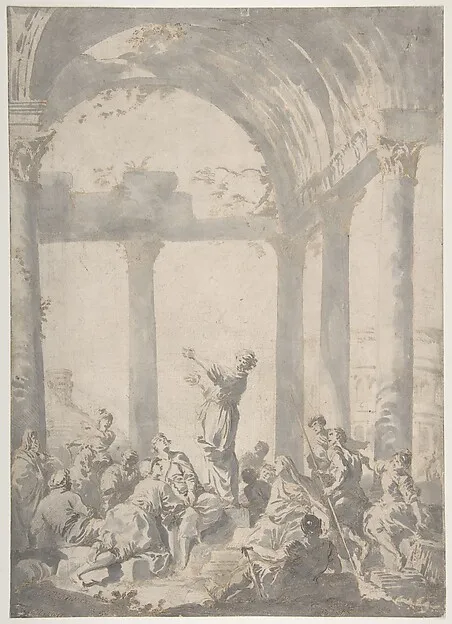
Acts 17:22-28Mars Hill: "The Unknown God"
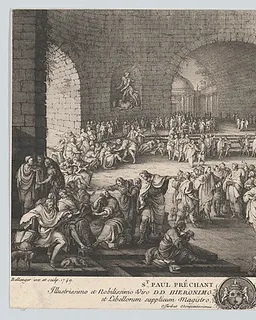
22Then Paul stood in the midst of Mars’ hill, and said, Ye men of Athens, I perceive that in all things ye are too superstitious. 23For as I passed by, and beheld your devotions, I found an altar with this inscription, TO THE UNKNOWN GOD. Whom therefore ye ignorantly worship, him declare I unto you. 24God that made the world and all things therein, seeing that he is Lord of heaven and earth, dwelleth not in temples made with hands;
Notice the hinge in Paul's logic. The God who made the world and all things therein cannot be housed in anything human hands could build. You do not shelter the Maker of heaven under a marble roof; you do not feed the One who hands out breath. So every shrine on the hill has the relationship backwards - reaching up to supply a God who has been supplying them all along. Paul turns the whole transaction inside out.
25Neither is worshipped with men’s hands, as though he needed any thing, seeing he giveth to all life, and breath, and all things; 26And hath made of one blood all nations of men for to dwell on all the face of the earth, and hath determined the times before appointed, and the bounds of their habitation; 27That they should seek the Lord, if haply they might feel after him, and find him, though he be not far from every one of us: 28For in him we live, and move, and have our being; as certain also of your own poets have said, For we are also his offspring.
The altar to "the unknown God" is likely a real artifact - a safeguard in case some divinity was overlooked. But for Paul it becomes a door. The Athenians worship without knowing; Paul comes to make the unknown known3. The line he quotes a few verses later - "we are also his offspring" - is taken straight from the opening of Aratus4, a Stoic poet whose work would have been on the lips of any educated Athenian.
Paul plants the gospel in soil their own poets had already turned. This is the entire gospel in one image: the God humanity seeks without seeing, now revealed in Christ.
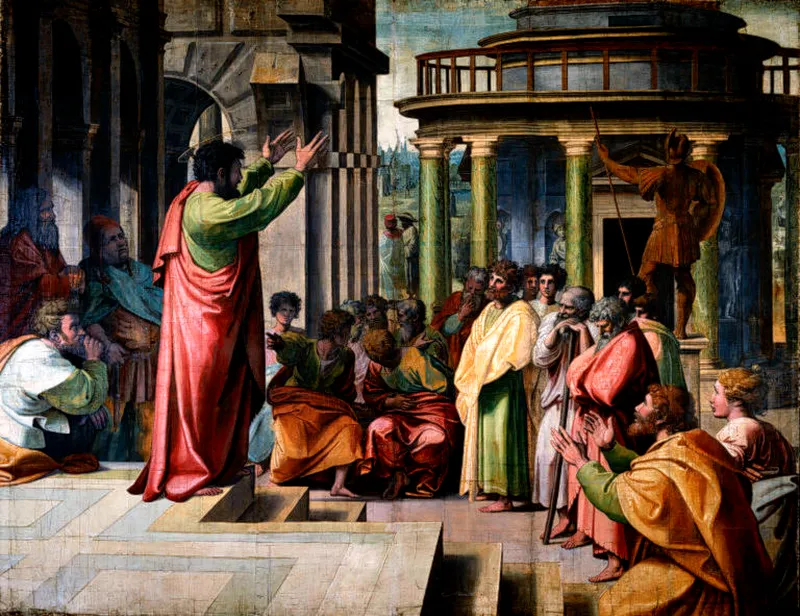
Acts 17:29-31The Resurrection: Mocked and Believed
29Forasmuch then as we are the offspring of God, we ought not to think that the Godhead is like unto gold, or silver, or stone, graven by art and man’s device. 30And the times of this ignorance God winked at; but now commandeth all men every where to repent: 31Because he hath appointed a day, in the which he will judge the world in righteousness by that man whom he hath ordained; whereof he hath given assurance unto all men, in that he hath raised him from the dead.
Paul calls for metanoia - a turning around, a complete reorientation of mind. It is not emotion or sentiment. It is a deliberate act of turning from false worship to the true God. The Athenians have been ignorant; now they are summoned to know.
Watch how Paul argues. He does not ask Athens to take the coming judgment on faith; he points to a date already kept. God has given the whole world a receipt - He raised the Judge from the dead. The empty tomb is not only good news about the past; it is a guarantee about the future. The Man who walked out of His own grave is the Man appointed to set every account right.
Acts 17:32-34Some Mocked; Some Believed
32And when they heard of the resurrection of the dead, some mocked: and others said, We will hear thee again of this matter. 33So Paul departed from among them. 34Howbeit certain men clave unto him, and believed: among the which was Dionysius the Areopagite, and a woman named Damaris, and others with them.
Dionysius the Areopagite is named - a member of the highest court of Athens. Damaris is named - a woman of standing. These are not marginal people. They are people of authority and respect who heard Paul, questioned him, and believed. The gospel reaches into every level of Athenian society. Some mock. Some hear him again. Some cling to him and believe.
Research trail
Sources & further study
These references support the historical, linguistic, manuscript, and contextual notes in this chapter. Scripture remains the primary text; external sources are provided so readers can inspect the research directly.
- AreopagusOpen-access SBL entry on the limestone outcrop where Paul addressed the philosophers, covering both the site and the council.
- Athenian Agora ExcavationsContinuous excavation of the marketplace below the Areopagus since 1931 - the temples, altars and shrines Acts describes.
- Aratus Phaenomena 5 ↔ Acts 17:28Side-by-side comparison of Aratus's Greek and Paul's Greek, showing how the citation works.
- Aratus, PhaenomenaFull Greek + English of the Stoic poem Paul quotes at Acts 17:28 - line 5 of the proem.
Where this echoes in Scripture
Thessalonica: Uproar and Opposition
- Luke 24:26Ought not Christ to have suffered these things, and to enter into his glory?The risen Jesus calls His own suffering a “must” - the same word Paul preaches here.
- 1 Corinthians 15:14And if Christ be not risen, then is our preaching vain, and your faith is also vain.Paul stakes everything on the resurrection he proclaims in the synagogue.
- Luke 24:32Did not our heart burn within us, while he talked with us by the way, and while he opened to us the scriptures?Opening the scriptures to show the suffering Christ - exactly Paul's “manner.”
- James 5:6Ye have condemned and killed the just; and he doth not resist you.The kingdom that turns the world upside down comes through a King who does not fight back.
Sent Away by Night
- John 5:39Search the scriptures; for in them ye think ye have eternal life: and they are they which testify of me.The very searching the Bereans practiced is what Jesus said the scriptures invite.
- 1 Thessalonians 2:13Ye received it not as the word of men, but as it is in truth, the word of God.Paul's own verdict on a church that received the word with readiness.
- 1 John 4:1Believe not every spirit, but try the spirits whether they are of God.Testing what you hear is not unbelief; it is faithfulness.
- Isaiah 8:20To the law and to the testimony: if they speak not according to this word, it is because there is no light in them.The measuring rod the Bereans reached for daily.
Paul Alone in Athens
- Psalm 115:4-8Their idols are silver and gold, the work of men's hands. They have mouths, but they speak not.The hollowness behind Athens' crowded altars.
- 1 Corinthians 8:4We know that an idol is nothing in the world, and that there is none other God but one.Paul's settled conviction as he walks the city of statues.
- Ezekiel 9:4Set a mark upon the foreheads of the men that sigh and that cry for all the abominations.A spirit stirred and grieved by idolatry is counted faithful, not weak.
In the Marketplace: Philosophers and Babbler
- 1 Corinthians 1:23We preach Christ crucified, unto the Jews a stumblingblock, and unto the Greeks foolishness.The Greek verdict on the gospel, named in advance.
- Acts 26:24Paul, thou art beside thyself; much learning doth make thee mad.The same scorn meets the same message before another court.
- Colossians 2:8Beware lest any man spoil you through philosophy and vain deceit, after the tradition of men.The systems that found Christ “strange” could not finally hold their builders.
Mars Hill: "The Unknown God"
- John 14:6I am the way, the truth, and the life: no man cometh unto the Father, but by me.The unknown God of the altar has made Himself known, and gives His own name.
- Jeremiah 23:23-24Am I a God at hand, saith the LORD, and not a God afar off?... Do not I fill heaven and earth?The God who is “not far from every one of us” spoke this long before Athens.
- Deuteronomy 4:7What nation is there so great, who hath God so nigh unto them, as the LORD our God is in all things?Nearness was always the wonder of the true God, not distance.
- 1 Kings 8:27Behold, the heaven and heaven of heavens cannot contain thee; how much less this house that I have builded?Even Israel's temple confessed what Paul tells Athens: God dwells in no building.
The Resurrection: Mocked and Believed
- Acts 10:42It is he which was ordained of God to be the Judge of quick and dead.The risen Jesus is named the appointed Judge here too.
- Romans 2:16In the day when God shall judge the secrets of men by Jesus Christ according to my gospel.The “day” Paul announces in Athens, with the Judge named.
- 2 Corinthians 7:10For godly sorrow worketh repentance to salvation not to be repented of.The turning Paul summons is a gift that leads to life, not mere remorse.
Some Mocked; Some Believed
- 1 Corinthians 1:26-28Not many wise men after the flesh, not many mighty, not many noble, are called... God hath chosen the weak.Yet here a judge and a noblewoman are among the called - grace reaches every rung.
- Mark 4:8And other fell on good ground, and did yield fruit that sprang up and increased.Mockery, delay, belief - the same sermon, the same soils.
- 2 Timothy 1:8Be not thou therefore ashamed of the testimony of our Lord.The charge to keep speaking when the cost of speaking is ridicule.