Painter of the Bible
Pieter Bruegel the Elder
Pieter Bruegel the Elder painted the Bible into the Low Countries.

Their faith
Why Pieter Bruegel the Elder painted Christ
Pieter Bruegel the Elder was deeply influenced by his Christian faith, which is evident in the way he infused biblical narratives into the everyday lives of the people in the Low Countries. His upbringing and training in Antwerp, combined with his travels across Italy, enriched his understanding of scripture and the human condition. Bruegel's works reveal a profound reverence for both the sacred and the mundane, as he sought to depict the spiritual significance of ordinary life. His commitment to portraying biblical themes in the context of Northern European culture underscores his belief that God's presence is found in the daily struggles and joys of humanity. This connection to faith is further emphasized by his admiration for the moralizing works of Hieronymus Bosch, which inspired Bruegel to convey deeper truths through his art.
Bruegel's paintings, such as the iconic "Tower of Babel" and "The Procession to Calvary," illustrate how his faith shaped his artistic vision. In the "Tower of Babel," he presents the biblical story of humanity's ambition and subsequent confusion, set against a backdrop of a Flemish landscape, highlighting the folly of pride and the consequences of disunity. Similarly, in "The Procession to Calvary," Christ is depicted as a small figure lost among the bustling Flemish crowd, emphasizing the weight of human suffering and the often-overlooked presence of the divine in our lives. Through these works, Bruegel invites viewers to reflect on their own spiritual journeys, reminding us that faith can be found in the most ordinary moments. His devotion continues to resonate, inspiring generations to seek the sacred in the everyday and to recognize the beauty of God's creation in all its forms.
Life & work
Pieter Bruegel the Elder painted the Bible into the Low Countries. Trained in Antwerp under Pieter Coecke van Aelst, traveled across Italy and the Alps in the early 1550s, and active mainly in Antwerp and then Brussels for the rest of his short life, he produced a body of work that married a fierce devotion to peasant life with a steady stream of large-scale biblical compositions. He is the only painter of his stature to set scriptural events in the snow and mud of Northern European villages.
His Tower of Babel paintings — the great panel in the Kunsthistorisches Museum in Vienna and the smaller version in the Boijmans Van Beuningen in Rotterdam — are the canonical visualizations of Genesis 11. Cylindrical, half-built, carved into a Flemish coastline, they read as both political allegory and structural drawing. The Procession to Calvary (1564, Vienna) places Christ on the road to Golgotha as a small, almost-lost figure inside a swarming Flemish crowd. The Massacre of the Innocents puts Herod's soldiers in sixteenth-century armor in a snowed-in village square; the Census at Bethlehem sets Joseph and Mary in a slow line outside a tax-collector's house. The Conversion of Paul (1567, Vienna) carries Saul and his retinue up an Alpine pass; the Suicide of Saul (1562, Vienna) ends in a panoramic battlefield.
He worked in oil, drew tirelessly, and produced print designs that the Antwerp publisher Hieronymus Cock turned out in editions across Europe. His style stands at the edge of the Northern Renaissance and what we now call genre painting; you can read in him both the late-medieval moralizing pictorialism of Hieronymus Bosch (whom he openly admired) and the beginnings of the secular landscape tradition that would flower in the Dutch Golden Age a century later.
He died in Brussels in 1569, leaving two young sons who became painters in their own right: Pieter Brueghel the Younger, who copied his father's compositions for a Catholic Antwerp clientele, and Jan Brueghel the Elder, the great floral and Edenic painter who sometimes collaborated with Rubens. The "h" in Brueghel — added by his sons — distinguishes their generations from his own. He himself signed simply "Bruegel."
Notable works in detail
met-383053
The Last Judgment, designed by Pieter Bruegel the Elder around 1558 and engraved by Pieter van der Heyden for publication by Hieronymus Cock at the Antwerp printing house Aux Quatre Vents, is among the most ambitious of Bruegel's printed compositions. The horizontal sheet shows Christ enthroned in judgment in a small upper-center mandorla, with the apostles ranged around him; the elect rise on the left, the damned tumble into a Bosch-influenced multi-tiered hell on the right, and the resurrected dead emerge from open graves across the foreground. Bruegel's drawn original for the print survives in the Albertina in Vienna and was the basis for the engraving Cock published throughout Catholic Europe. The print was the principal channel through which Bruegel's compositional inventions reached the wider European market in his lifetime, since his paintings remained almost entirely in private Habsburg and Antwerp collections.
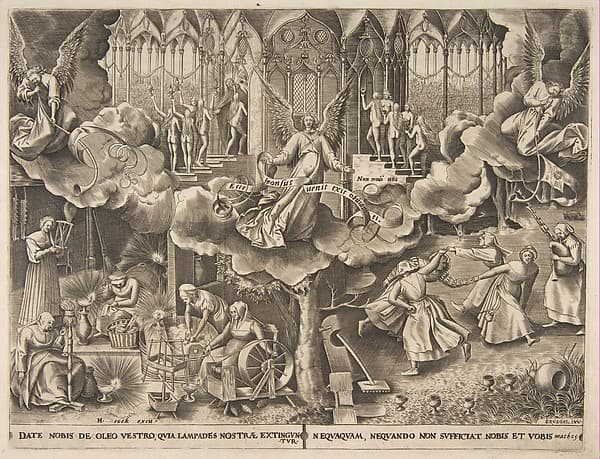
The Parable of the Wise and Foolish Virgins
The Parable of the Wise and Foolish Virgins, designed by Pieter Bruegel the Elder around 1555 and engraved by Pieter van der Heyden for publication by Hieronymus Cock at Aux Quatre Vents in Antwerp, illustrates the Matthew 25 parable: ten virgins waiting for the bridegroom, of whom five wisely brought oil for their lamps and five foolishly did not. Bruegel divides the composition vertically: on the right, the wise virgins enter through the open door into the wedding feast above; on the left, the foolish virgins arrive too late and find the door closed against them. The Bridegroom appears in the upper register inside an architectural setting; small angels carry banners with Latin text quoting the parable. The print circulated widely through Cock's distribution network and shaped the visual iconography of the parable across Catholic and Protestant Europe through the seventeenth century.
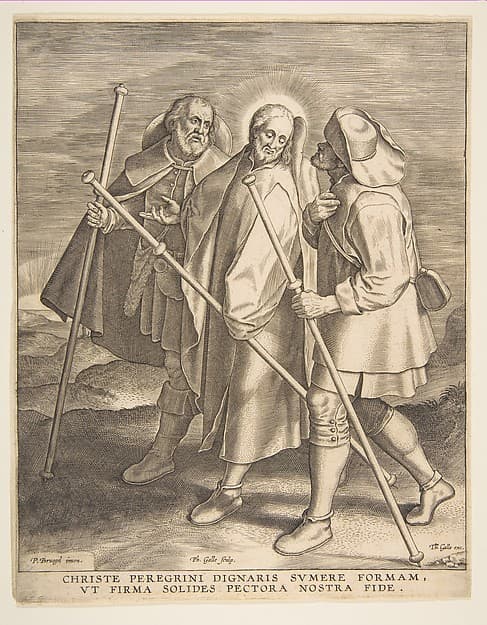
Christ and the Disciples on the Way to Emmaus
Christ and the Disciples on the Way to Emmaus, designed by Pieter Bruegel the Elder around 1571 and engraved for publication by the Antwerp printing house Aux Quatre Vents, illustrates the Luke 24 episode in which the risen Christ joins two disciples on the road to the village of Emmaus on the afternoon of the Resurrection. Bruegel stages the three figures walking in the foreground along a winding road across an extensive Northern European landscape — fields, distant villages, a low hilly horizon, a cloudy sky. The disciples, not yet recognizing their companion, gesture in animated mid-conversation; Christ walks slightly behind them, his face calm. The composition is among the most reproduced of Bruegel's printed religious compositions and brought his characteristic combination of Gospel narrative and panoramic Northern landscape to the wider European print market in the years immediately after his death in 1569.
met-383050
The Descent of Christ Into Limbo, designed by Pieter Bruegel the Elder around 1551 (one of his earliest engraved compositions) and engraved by Pieter van der Heyden for the Antwerp publisher Hieronymus Cock, illustrates the apocryphal episode known as the Harrowing of Hell — the tradition that Christ between his death on Friday and his Resurrection on Sunday descended into the underworld to free the souls of the just who had died before his Incarnation. Bruegel stages the scene in a Bosch-influenced landscape of hellish architecture, monsters, and tormented bodies; Christ stands upright in a luminous oval at the lower center, his banner raised, while Adam, Eve, the patriarchs and prophets emerge from a great open mouth on the left side of the composition. The visual debt to Hieronymus Bosch — whom Bruegel openly admired and whose work he absorbed during his Antwerp years — is direct, but the compositional discipline and the careful placement of the figures are entirely Bruegel's own.
Bible scenes Pieter Bruegel the Elder painted
Matthew
Luke