Genesis 19
People in this chapter
Content note: Genesis 19 includes threatened sexual assault, coercion within a family, intoxication and incest, and destruction. It should never be used to pressure a person to remain in danger or to reduce a later people to an origin story. The chapter calls Lot's rescue mercy while also recording commands and choices within the flight.
Tap any highlighted phrase to jump to the commentary that unpacks it.
Genesis 19:1-3Lot Welcomes the Visitors
1And there came two angels to Sodom at even; and Lot sat in the gate of Sodom: and Lot seeing them rose up to meet them; and he bowed himself with his face toward the ground; 2And he said, Behold now, my lords, turn in, I pray you, into your servant’s house, and tarry all night, and wash your feet, and ye shall rise up early, and go on your ways. And they said, Nay; but we will abide in the street all night. 3And he pressed upon them greatly; and they turned in unto him, and entered into his house; and he made them a feast, and did bake unleavened bread, and they did eat.
Genesis 19:4-11Violence at the House
4But before they lay down, the men of the city, even the men of Sodom, compassed the house round, both old and young, all the people from every quarter: 5And they called unto Lot, and said unto him, Where are the men which came in to thee this night? bring them out unto us, that we may know them. 6And Lot went out at the door unto them, and shut the door after him, 7And said, I pray you, brethren, do not so wickedly. 8Behold now, I have two daughters which have not known man; let me, I pray you, bring them out unto you, and do ye to them as is good in your eyes: only unto these men do nothing; for therefore came they under the shadow of my roof. 9And they said, Stand back. And they said again, This one fellow came in to sojourn, and he will needs be a judge: now will we deal worse with thee, than with them. And they pressed sore upon the man, even Lot, and came near to break the door. 10But the men put forth their hand, and pulled Lot into the house to them, and shut to the door. 11And they smote the men that were at the door of the house with blindness, both small and great: so that they wearied themselves to find the door.
A crowd surrounds the house and threatens collective sexual assault. Lot's offer of his daughters is appalling and not commendable. The angels bring Lot inside and strike the crowd so they cannot find the door, ending the immediate attack.
Genesis 19:12-22The Flight to Zoar
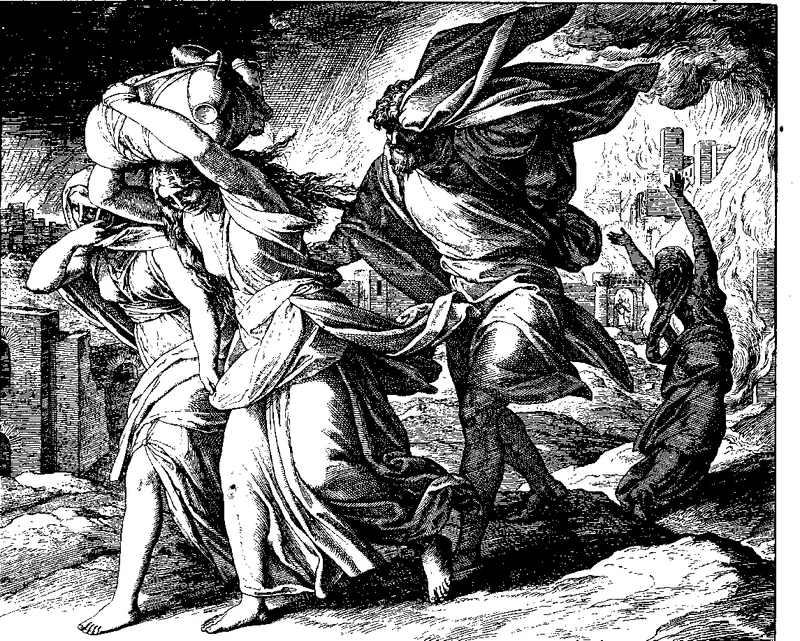
12And the men said unto Lot, Hast thou here any besides? son in law, and thy sons, and thy daughters, and whatsoever thou hast in the city, bring them out of this place: 13For we will destroy this place, because the cry of them is waxen great before the face of the LORD; and the LORD hath sent us to destroy it. 14And Lot went out, and spake unto his sons in law, which married his daughters, and said, Up, get you out of this place; for the LORD will destroy this city. But he seemed as one that mocked unto his sons in law. 15And when the morning arose, then the angels hastened Lot, saying, Arise, take thy wife, and thy two daughters, which are here; lest thou be consumed in the iniquity of the city. 16And while he lingered, the men laid hold upon his hand, and upon the hand of his wife, and upon the hand of his two daughters; the LORD being merciful unto him: and they brought him forth, and set him without the city. 17And it came to pass, when they had brought them forth abroad, that he said, Escape for thy life; look not behind thee, neither stay thou in all the plain; escape to the mountain, lest thou be consumed. 18And Lot said unto them, Oh, not so, my LORD: 19Behold now, thy servant hath found grace in thy sight, and thou hast magnified thy mercy, which thou hast shewed unto me in saving my life; and I cannot escape to the mountain, lest some evil take me, and I die: 20Behold now, this city is near to flee unto, and it is a little one: Oh, let me escape thither, (is it not a little one?) and my soul shall live. 21And he said unto him, See, I have accepted thee concerning this thing also, that I will not overthrow this city, for the which thou hast spoken. 22Haste thee, escape thither; for I cannot do anything till thou be come thither. Therefore the name of the city was called Zoar.
Lot warns relatives, but his warning seems like a joke to them. When Lot lingers, angels take the hands of him, his wife, and two daughters and bring them out; verse 16 calls this mercy. They are commanded to flee, and Zoar is granted as a refuge.
Genesis 19:23-29The Overthrow of Sodom
23The sun was risen upon the earth when Lot entered into Zoar. 24Then the LORD rained upon Sodom and upon Gomorrah brimstone and fire from the LORD out of heaven; 25And he overthrew those cities, and all the plain, and all the inhabitants of the cities, and that which grew upon the ground. 26But his wife looked back from behind him, and she became a pillar of salt. 27And Abraham gat up early in the morning to the place where he stood before the LORD: 28And he looked toward Sodom and Gomorrah, and toward all the land of the plain, and beheld, and, lo, the smoke of the country went up as the smoke of a furnace. 29And it came to pass, when God destroyed the cities of the plain, that God remembered Abraham, and sent Lot out of the midst of the overthrow, when he overthrew the cities in the which Lot dwelt.
After Lot reaches Zoar, the LORD overthrows Sodom and Gomorrah with brimstone and fire. Lot's wife looks back after being told not to and becomes a pillar of salt. Genesis 19 does not explain her motive or the event's mechanism.
Genesis 19:30-38Lot in the Cave
30And Lot went up out of Zoar, and dwelt in the mountain, and his two daughters with him; for he feared to dwell in Zoar: and he dwelt in a cave, he and his two daughters. 31And the firstborn said unto the younger, Our father is old, and there is not a man in the earth to come in unto us after the manner of all the earth: 32Come, let us make our father drink wine, and we will lie with him, that we may preserve seed of our father. 33And they made their father drink wine that night: and the firstborn went in, and lay with her father; and he perceived not when she lay down, nor when she arose. 34And it came to pass on the morrow, that the firstborn said unto the younger, Behold, I lay yesternight with my father: let us make him drink wine this night also; and go thou in, and lie with him, that we may preserve seed of our father. 35And they made their father drink wine that night also: and the younger arose, and lay with him; and he perceived not when she lay down, nor when she arose. 36Thus were both the daughters of Lot with child by their father. 37And the first born bare a son, and called his name Moab: the same is the father of the Moabites unto this day. 38And the younger, she also bare a son, and called his name Benammi: the same is the father of the children of Ammon unto this day.
Lot and his daughters live in a cave. The daughters make their intoxicated father unaware and have sex with him on two nights; this is incest and sexual exploitation. The text names their sons Moab and Ben-ammi without making later peoples morally fixed by this origin story.
Research trail
Sources & further study
These references support the historical, linguistic, manuscript, and contextual notes in this chapter. Scripture remains the primary text; external sources are provided so readers can inspect the research directly.
Where this echoes in Scripture
Lot Welcomes the Visitors
- Genesis 18:1-8Abraham welcomed three visitors with water, rest, and a meal at Mamre.The preceding chapter also begins with visitors and hospitality, though the two scenes develop differently.
- Hebrews 13:2Be not forgetful to entertain strangers: for thereby some have entertained angels unawares.A general exhortation about hospitality, not a verdict on every action in Genesis 19.
- 2 Peter 2:7-8And delivered just Lot, vexed with the filthy conversation of the wicked.A later appraisal of Lot that must be read alongside the troubling actions Genesis 19 itself records.
Violence at the House
- Ezekiel 16:49-50Behold, this was the iniquity of thy sister Sodom, pride, fulness of bread, and abundance of idleness was in her and in her daughters.A later prophetic critique of Sodom. It adds context but does not replace the violence Genesis 19 depicts.
- Jude 7Even as Sodom and Gomorrha... are set forth for an example, suffering the vengeance of eternal fire.A later New Testament reference to Sodom's judgment; it should not be used to label a modern community or identity.
The Flight to Zoar
- Genesis 19:29God remembered Abraham, and sent Lot out of the midst of the overthrow.The chapter later names Lot's rescue in connection with Abraham, without making the escape a simple formula.
- Luke 17:28-30The same day that Lot went out of Sodom it rained fire and brimstone from heaven, and destroyed them all.Jesus later recalls Lot's departure and Sodom's overthrow when teaching about the Son of Man.
The Overthrow of Sodom
Lot in the Cave
- Ruth 1:4They took them wives of the women of Moab; the name of the one was Orpah, and the name of the other Ruth.Ruth is specifically identified as a Moabite in a later book.
- Ruth 4:17, 22There is a son born to Naomi... and he is the father of Jesse, the father of David.Ruth's family line leads to David.
- Matthew 1:5-6Booz begat Obed of Ruth; and Obed begat Jesse; And Jesse begat David the king.Matthew includes Ruth in the genealogy of Jesus without making Moabite ancestry a moral verdict.