Exodus 34
People in this chapter
Exodus 34 opens after catastrophe. The people have broken covenant at the golden calf - they have made and worshiped an idol while Moses is still on Sinai receiving God's law. The tablets are shattered. The agreement is broken. But instead of withdrawing, God does something stunning: He comes down and renews the covenant on fresh tablets. He reveals His name more fully than ever: merciful and gracious, longsuffering and abundant in goodness and truth. It is the same God, but the same people now encounter Him through failure, and through forgiveness.
Tap any highlighted word or phrase to jump to commentary and discover what it means.
Exodus 34:1-3The Call to Return
1And the LORD said unto Moses, Hew thee two tables of stone like unto the first: and I will write upon these tables the words that were in the first tables, which thou brakest.
Moses must cut the stone himself. God is not going to hand him something he can simply receive - he will participate in the repair. After covenant-breaking, there is work ahead. But God says He will write on the new stone, just as He did on the first12.
The same words will be restored. The covenant is renewed. This is mercy at the deepest level: writing the law again into a people who have betrayed it.
The text lets the accusation hang in the air: which thou brakest. God is not pretending the sin didn't happen. He is acknowledging it directly while simultaneously moving toward restoration. This is how God handles failure.
2And be ready in the morning, and come up in the morning unto mount Sinai, and present thyself there to me in the top of the mount. 3And no man shall come up with thee, neither let any man be seen throughout all the mount; neither let the flocks nor herds feed before that mount.
Moses goes up alone. After the people's failure, the mediator must stand alone before God. This is the shape of intercession: one person standing between the people and God.
Even the animals are kept back. The mountain is a place of covenant, and all the ordinary life of the camp must cease. This is the cost and the gravity of meeting God after rebellion.
Exodus 34:4-9The Name of God
4And he hewed two tables of stone like unto the first; and Moses rose up early in the morning, and went up unto mount Sinai, as the LORD had commanded him, and took in his hand the two tables of stone. 5And the LORD descended in the cloud, and stood with him there, and proclaimed the name of the LORD.
The cloud is visible. God's presence descends in a way Moses can see and stand in. After the people's failure, God meets His people in their brokenness with visible presence.
6And the LORD passed by before him, and proclaimed, The LORD, The LORD God, merciful and gracious, longsuffering, and abundant in goodness and truth,
7Keeping mercy for thousands, forgiving iniquity and transgression and sin, and that will by no means clear the guilty; visiting the iniquity of the fathers upon the children, and upon the children’s children, unto the third and to the fourth generation.
God forgives. Not sometimes. Not grudgingly. Iniquity (the twisted thing we do wrong), transgression (the boundary we cross), and sin (the missing of the mark) - all three words, all covered by forgiveness. This is the God whom Moses calls upon after the covenant is broken.
And yet: "will by no means clear the guilty." God is not indifferent to sin. He does not wink at evil. The text holds forgiveness and justice together without collapsing them. This is the hardest line in the passage, and it is here on purpose. The Cross is where these two meet without contradiction - where God's mercy is satisfied and God's justice is upheld at the same time.
8And Moses made haste, and bowed his head toward the earth, and worshipped. 9And he said, If now I have found grace in thy sight, O LORD, let my LORD, I pray thee, go among us; for it is a stiffnecked people; and pardon our iniquity and our sin, and take us for thine inheritance.
Moses' first response to God's name is worship. When you truly encounter God's character - His mercy, His patience, His faithfulness - the only right response is to bow.
Moses prays for the people. He names them as stiffnecked - stubborn, hard to lead - yet asks God to go with them anyway. This is intercession: standing before God and asking Him to stay with people who don't deserve it.
He asks God to "take us for thine inheritance." God claims them as His own. They belong to Him because He has chosen them.
Exodus 34:10-17The Renewed Commands
10And he said, Behold, I make a covenant: before all thy people I will do marvels, such as have not been done in all the earth, nor in any nation: and all the people among which thou art shall see the work of the LORD: for it is a terrible thing that I will do with thee.
After failure, God promises fresh wonders. He will do marvels - signs and spectacles of His power - to anchor His people's faith in the reality of the covenant. The same covenant, renewed. The same God, now making His faithfulness visible before all the nations.
11Observe thou that which I command thee this day: behold, I drive out before thee the Amorite, and the Canaanite, and the Hittite, and the Perizzite, and the Hivite, and the Jebusite. 12Take heed to thyself, lest thou make a covenant with the inhabitants of the land whither thou goest, lest it be for a snare in the midst of thee:
13But ye shall destroy their altars, break their images, and cut down their groves: 14For thou shalt worship no other god: for the LORD, whose name is Jealous, is a jealous God:
The command is not arbitrary. The people have just broken covenant by worshiping the golden calf. God's next words are a merciful warning: do not let this happen again. Do not divide your heart between the true God and false ones.
15Lest thou make a covenant with the inhabitants of the land, and they go a whoring after their gods, and do sacrifice unto their gods, and one call thee, and thou eat of his sacrifice; 16And thou take of their daughters unto thy sons, and their daughters go a whoring after their gods, and make thy sons go a whoring after their gods. 17Thou shalt make thee no molten gods.
Exodus 34:18-28Tablets of Stone, Face of Fire
18The feast of unleavened bread shalt thou keep. Seven days thou shalt eat unleavened bread, as I commanded thee, in the time of the month Abib: for in the month Abib thou camest out from Egypt. 19All that openeth the matrix is mine; and every firstling among thy cattle, whether ox or sheep, that is male. 20But the firstling of an ass thou shalt redeem with a lamb: and if thou redeem him not, then shalt thou break his neck. All the firstborn of thy sons thou shalt redeem. And none shall appear before me empty.
21Six days thou shalt work, but on the seventh day thou shalt rest: in earing time and in harvest thou shalt rest. 22And thou shalt observe the feast of weeks, of the firstfruits of wheat harvest, and the feast of ingathering at the year’s end. 23Thrice in the year shall all your menchildren appear before the LORD God, the God of Israel.
These laws are about time, not just behavior. Feasts that mark the year, a seventh day of rest built into every week, a first-born held sacred. God is teaching His people to live by rhythms of remembrance and release. The law trains the body and the calendar to remember whose you are.
24For I will cast out the nations before thee, and enlarge thy borders: neither shall any man desire thy land, when thou shalt go up to appear before the LORD thy God thrice in the year. 25Thou shalt not offer the blood of my sacrifice with leaven; neither shall the sacrifice of the feast of the passover be left unto the morning. 26The first of the firstfruits of thy land thou shalt bring unto the house of the LORD thy God. Thou shalt not seethe a kid in his mother’s milk.
Wrapped inside the law is a promise of protection. If you keep the covenant, God will guard your borders while you are away worshiping Him. God's law is the structure of blessing.
27And the LORD said unto Moses, Write thou these words: for after the tenor of these words I have made a covenant with thee and with Israel. 28And he was there with the LORD forty days and forty nights; he did neither eat bread, nor drink water. And he wrote upon the tables the words of the covenant, the ten commandments.
The words are to be written down, inscribed - made permanent, unchangeable. God makes His covenant as a written pledge, stone-carved and clear.
Forty days and forty nights. The same duration Jesus will spend in the wilderness (Matt. 4:2). A number in Scripture that marks a time of testing or covenant renewal, a season where the ordinary world falls away and only God remains. Moses is sustained on nothing but God's presence.
Exodus 34:29-35Radiance and the Veil
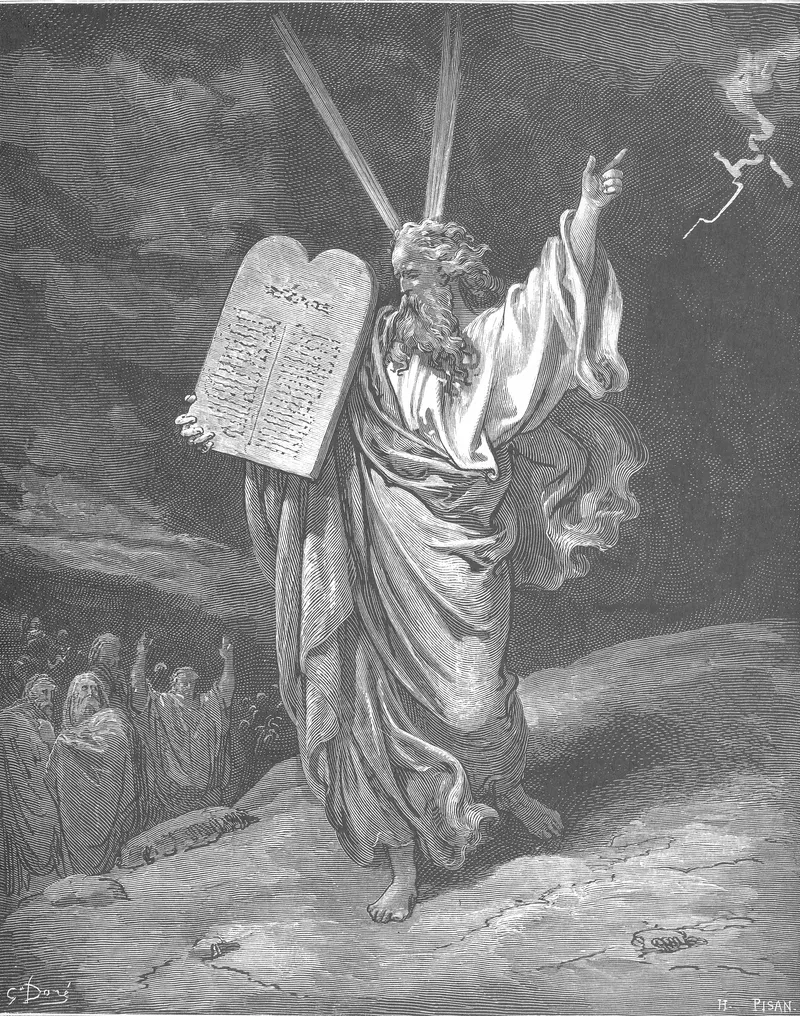
29And it came to pass, when Moses came down from mount Sinai with the two tables of testimony in Moses’ hand, when he came down from the mount, that Moses wist not that the skin of his face shone while he talked with him.
Moses has been in the presence of God for forty days and forty nights. The radiance is not something he manufactures or claims - it is a simple fact of standing long in the presence of God. He shines and does not know it. The glory reflects off him without his awareness.
30And when Aaron and all the children of Israel saw Moses, behold, the skin of his face shone; and they were afraid to come nigh him.
The people see it and fear. Not because the shining is anger or judgment, but because they are encountering the spillover of God's presence. To stand near holiness is frightening when you know you are not holy.
31And Moses called unto them; and Aaron and all the rulers of the congregation returned unto him: and Moses talked with them. 32And afterward all the children of Israel came nigh: and he gave them in commandment all that the LORD had spoken with him in mount Sinai.
33And till Moses had done speaking with them, he put a vail on his face. 34But when Moses went in before the LORD to speak with him, he took the vail off, until he came out. And he came out, and spake unto the children of Israel that which he was commanded. 35And the children of Israel saw the face of Moses, that the skin of Moses’ face shone: and Moses put the vail upon his face again, until he went in to speak with him.
The veil protects the people. Their fear is real - they are sinners encountering the radiance of someone who has just been with the Holy God. Moses wears the veil as a mercy to make God's word available.
When Moses speaks to God, the veil comes off. In that private moment, there is no barrier between the mediator and the God he represents. Only when standing before God is the full radiance visible. When delivering God's word to the people, the veil softens the encounter.
Research trail
Sources & further study
These references support the historical, linguistic, manuscript, and contextual notes in this chapter. Scripture remains the primary text; external sources are provided so readers can inspect the research directly.