Exodus 35
People in this chapter
Exodus 35 opens in the long shadow of the golden calf. Israel had sinned grievously; Moses had interceded; the LORD had relented and promised that His presence would go with them. Now Moses gathers all the congregation of the children of Israel together (v. 1) and sets two matters before the whole people. The first is the sabbath: Six days shall work be done, but on the seventh day there shall be to you an holy day, a sabbath of rest to the LORD (v. 2).
The work of building God's dwelling is about to begin, and yet the rhythm of rest is laid down first, before a single board is cut.1
Tap any highlighted phrase to jump to the commentary that unpacks it.
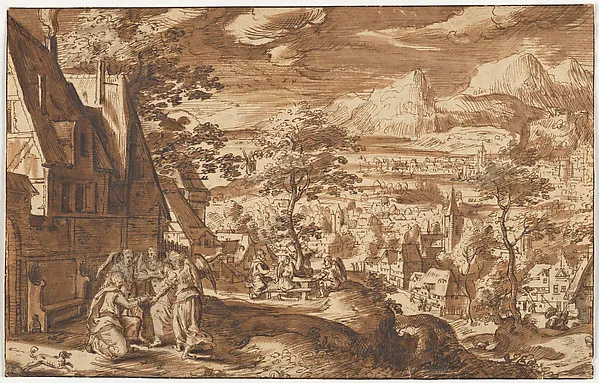
Exodus 35:1-3A Sabbath of Rest to the LORD
1And Moses gathered all the congregation of the children of Israel together, and said unto them, These are the words which the LORD hath commanded, that ye should do them. 2Six days shall work be done, but on the seventh day there shall be to you an holy day, a sabbath of rest to the LORD: whosoever doeth work therein shall be put to death. 3Ye shall kindle no fire throughout your habitations upon the sabbath day.
The chapter begins with the whole people drawn together: Moses gathered all the congregation of the children of Israel together (v. 1). Everyone. And what he places before them first is the sabbath: Six days shall work be done, but on the seventh day there shall be to you an holy day, a sabbath of rest to the LORD (v. 2). This is no new commandment; it is the fourth word of the ten, restated almost exactly.
But the placement is striking. Israel is about to throw itself into the most important construction it will ever undertake - a house for the presence of God - and before any of it begins, the rhythm of rest is set down. The urgency of holy work does not cancel the sabbath; if anything, it makes the rest more necessary. The added detail, Ye shall kindle no fire throughout your habitations upon the sabbath day (v. 3), drives the point home: even the fires of the workshop, the smelting and forging the tabernacle will demand, must fall silent on the seventh day.
The work belongs to God, and so does the rest - and the rest comes first.1
Exodus 35:4-6Whosoever Is of a Willing Heart
4And Moses spake unto all the congregation of the children of Israel, saying, This is the thing which the LORD commanded, saying, 5Take ye from among you an offering unto the LORD: whosoever is of a willing heart, let him bring it, an offering of the LORD; gold, and silver, and brass, 6And blue, and purple, and scarlet, and fine linen, and goats’ hair,
Now comes the call, and everything turns on a single phrase: Take ye from among you an offering unto the LORD: whosoever is of a willing heart, let him bring it (v. 5). The LORD does not levy this offering; He invites it. The language is not the language of taxation or tribute but of an open hand held out - whosoever is of a willing heart. No quota is named, no household is assessed, no one is compelled.
The gift is to come from the inside out, from a heart that wants to give. And what is asked for is the best a person owns: gold, and silver, and brass (v. 5); the costly dyed yarns, blue, and purple, and scarlet, and fine linen (v. 6); skins and wood, oil and fragrant spices, and the precious onyx stones set for the high priest's garments (vv. 7-9). The materials of a holy place are to come from willing hands.
This is what gives the whole scene its weight: only a short time before, these same people had brought their gold to make a calf. Now the gold is asked for again - and the only gold God will take is the gold that is gladly given.
Exodus 35:7-9Oil, Spice, and Onyx Stones
7And rams’ skins dyed red, and badgers’ skins, and shittim wood, 8And oil for the light, and spices for anointing oil, and for the sweet incense, 9And onyx stones, and stones to be set for the ephod, and for the breastplate.
Exodus 35:10-12Every Wise Hearted Among You
10And every wise hearted among you shall come, and make all that the LORD hath commanded; 11The tabernacle, his tent, and his covering, his taches, and his boards, his bars, his pillars, and his sockets, 12The ark, and the staves thereof, with the mercy seat, and the vail of the covering,
Exodus 35:13-16Candlestick, Table, and Incense Altar
13The table, and his staves, and all his vessels, and the shewbread, 14The candlestick also for the light, and his furniture, and his lamps, with the oil for the light, 15And the incense altar, and his staves, and the anointing oil, and the sweet incense, and the hanging for the door at the entering in of the tabernacle, 16The altar of burnt offering, with his brasen grate, his staves, and all his vessels, the laver and his foot,
Exodus 35:17-19The Holy Garments for Aaron the Priest
17The hangings of the court, his pillars, and their sockets, and the hanging for the door of the court, 18The pins of the tabernacle, and the pins of the court, and their cords, 19The cloths of service, to do service in the holy place, the holy garments for Aaron the priest, and the garments of his sons, to minister in the priest’s office.
Beside the givers, Moses summons the makers: And every wise hearted among you shall come, and make all that the LORD hath commanded (v. 10). Then he reads off the inventory of what must be built, piece by piece - and the list is its own kind of teaching. The tabernacle frame with its boards and bars and sockets (v. 11); the ark, the mercy seat, and the veil (v. 12); the table for the shewbread (v. 13); the lampstand with its lamps (v. 14); the incense altar and the great altar of burnt offering (vv. 15-16); the hangings of the court, the pins, the cords (vv. 17-18); and at last the holy garments for Aaron and his sons (v. 19).
Read straight through, it is a path: from the outer court with its altar of sacrifice, in through the hangings, to the holy place with its table and light and incense, and on to the ark behind the veil. Every named object is a station on the way into the presence of God, and every one of them must be made by a wise hearted worker. Two callings are now on the table - bring, and make - and the chapter will honour both.
Exodus 35:20-29Every One Whom His Spirit Made Willing
20And all the congregation of the children of Israel departed from the presence of Moses. 21And they came, every one whose heart stirred him up, and every one whom his spirit made willing, and they brought the LORD’s offering to the work of the tabernacle of the congregation, and for all his service, and for the holy garments. 22And they came, both men and women, as many as were willing hearted, and brought bracelets, and earrings, and rings, and tablets, all jewels of gold: and every man that offered offered an offering of gold unto the LORD.
The people leave Moses' presence (v. 20), and then the response begins to pour in: And they came, every one whose heart stirred him up, and every one whom his spirit made willing, and they brought the LORD's offering (v. 21). Notice how carefully the verse locates the source of the giving. It does not say they came because Moses pressed them, or because the need was advertised, or because their neighbours were watching.
It says each one came whose heart stirred him up - the giving rose from within, an inward movement before it was ever an outward gift. And the first thing named among the gifts is telling: bracelets, and earrings, and rings, and tablets, all jewels of gold (v. 22). This is personal treasure - the ornaments people wore, the gold closest to the body. It is impossible to miss the echo and the reversal. When Israel made the calf, it was earrings of gold that were broken off and thrown into the fire.
Now the gold ornaments come off again, but this time they are carried freely to the LORD. The same kind of gift that had served an idol is reclaimed for the worship of God - and the heart that brings it is what makes all the difference.
23And every man, with whom was found blue, and purple, and scarlet, and fine linen, and goats’ hair, and red skins of rams, and badgers’ skins, brought them. 24Every one that did offer an offering of silver and brass brought the LORD’s offering: and every man, with whom was found shittim wood for any work of the service, brought it. 25And all the women that were wise hearted did spin with their hands, and brought that which they had spun, both of blue, and of purple, and of scarlet, and of fine linen. 26And all the women whose heart stirred them up in wisdom spun goats’ hair.
The gifts keep coming, and the text takes pains to show how widely they are spread. Every man, with whom was found the dyed yarns and the linen and the skins, brought them (v. 23); those who had silver and brass brought it; those who had acacia wood for any work of the service brought that (v. 24). The repeated phrase with whom was found is gentle and important: no one is asked for what they do not have.
Each person brings what is already in their hand - gold from those who had gold, wood from those who had wood. Then the camera turns to the women, and lingers: all the women that were wise hearted did spin with their hands, and brought that which they had spun (v. 25), and those whose heart stirred them up in wisdom spun goats' hair (v. 26). This is not a footnote. Spinning thread by hand - especially the coarse goats' hair for the tent coverings - was demanding, skilled, time-consuming labour.
The women do not merely hand over raw material; they give their craft and their hours, transforming wool and hair into the very fabric of the sanctuary. The same words used of Bezaleel are used of them: they are wise hearted, their hearts stirred up in wisdom. The house of God is being built by the skilled hands of women as truly as by the skilled hands of men.
27And the rulers brought onyx stones, and stones to be set, for the ephod, and for the breastplate; 28And spice, and oil for the light, and for the anointing oil, and for the sweet incense. 29The children of Israel brought a willing offering unto the LORD, every man and woman, whose heart made them willing to bring for all manner of work, which the LORD had commanded to be made by the hand of Moses.
The roll of givers reaches all the way up: the rulers brought onyx stones, and stones to be set, for the ephod, and for the breastplate; and spice, and oil for the light (vv. 27-28). The leaders bring the rarest and costliest things - the precious stones for the high priest's garments, the fragrant spices, the oil for the lamp. From the woman at her spindle to the ruler with his jewels, the whole community is moving in one direction, each contributing according to what they have and what they can do.
And then verse 29 gathers the entire scene into a single summary sentence: The children of Israel brought a willing offering unto the LORD, every man and woman, whose heart made them willing to bring for all manner of work. There is the keynote struck one final time - whose heart made them willing. Across every line of this section, through every kind of gift and every rank of giver, one thing has held constant: the offering came from willing hearts.
The repetition is deliberate: it is the chapter's whole point. God's house rises on the gladness of His people.
Exodus 35:30-35Filled With the Spirit of God
30And Moses said unto the children of Israel, See, the LORD hath called by name Bezaleel the son of Uri, the son of Hur, of the tribe of Judah; 31And he hath filled him with the spirit of God, in wisdom, in understanding, and in knowledge, and in all manner of workmanship; 32And to devise curious works, to work in gold, and in silver, and in brass, 33And in the cutting of stones, to set them, and in carving of wood, to make any manner of cunning work.
Moses now names the man at the head of the work: See, the LORD hath called by name Bezaleel the son of Uri, the son of Hur, of the tribe of Judah (v. 30). The emphasis falls entirely on the LORD's initiative - the LORD hath called by name. He was called, by name, by God. And what equips him for the task is named with equal clarity: he hath filled him with the spirit of God, in wisdom, in understanding, and in knowledge, and in all manner of workmanship (v. 31).
His artistry, at root, is gift. The ability to devise curious works, to work in gold, and in silver, and in brass, to cut and set stones, to carve wood (vv. 32-33) - all of it is traced back to a filling of the Spirit of God. This is one of the first places in Scripture where someone is said to be filled with God's Spirit, and it is worth pausing on what that filling produces here: exquisite craftsmanship.
The Spirit who moved over the waters at creation now fills a man to make beautiful things for the worship of God. Skill itself, the text insists, is a gift from above.
34And he hath put in his heart that he may teach, both he, and Aholiab, the son of Ahisamach, of the tribe of Dan. 35Them hath he filled with wisdom of heart, to work all manner of work, of the engraver, and of the cunning workman, and of the embroiderer, in blue, and in purple, in scarlet, and in fine linen, and of the weaver, even of them that do any work, and of those that devise cunning work.
Two more strokes complete the portrait. First, the gift is given not only to make but to multiply: he hath put in his heart that he may teach (v. 34). Bezaleel and Aholiab are filled not merely so that they can build, but so that they can train others to build. The skill is meant to be handed on, poured into the wise-hearted workers who will labour beside them. A gift kept to oneself would leave the tabernacle the work of two pairs of hands; a gift that teaches makes it the work of a whole skilled community.
Second, the breadth of the gifting is spread out in full: Them hath he filled with wisdom of heart, to work all manner of work, of the engraver, and of the cunning workman, and of the embroiderer… and of the weaver (v. 35). Engraving, designing, embroidering, weaving - trade after trade, each one named, each one a filling of wisdom of heart. Note too that Aholiab comes from the tribe of Dan, while Bezaleel is from Judah: the leading craftsmen are drawn from different tribes, the gift scattered widely across Israel, poured into many tribes and many hands.
From the willing givers of the opening, through the spinning women, to these Spirit-filled masters and the apprentices they will teach, the whole chapter has been building one quiet argument - that God supplies everything His house requires, and distributes the supplying across all His people.
Research trail
Sources & further study
These references support the historical, linguistic, manuscript, and contextual notes in this chapter. Scripture remains the primary text; external sources are provided so readers can inspect the research directly.
- Exodus 35 - Translators' NotesThe NET Bible's detailed footnotes on Exodus 35 - the restated sabbath law and the kindling of no fire (vv. 2-3), the list of freewill materials (vv. 5-9), the idioms for the stirred and willing heart (vv. 21, 29), and the description of Bezaleel filled with the spirit of God in skill and in teaching (vv. 30-35).
- Exodus 35 · Hebrew + classical Jewish commentaryThe Hebrew text of Exodus 35 with Rashi, Ibn Ezra, and other classical commentators side by side - useful for the repeated phrase nediv lev (vv. 5, 22, “willing heart”), for the idiom nasa libbo (v. 21, the heart that “stirred him up”), and for chacham-lev (vv. 10, 25, 35, the “wise hearted” skill given for the work).
- Exodus 35 ↔ 2 Corinthians 8-9 · 1 Corinthians 12 · Ephesians 4Traces the threads tying Exodus 35 to the rest of Scripture - the willing-hearted offering (vv. 5, 21, 29) read beside God loveth a cheerful giver (2 Cor. 9:7), and the Spirit-filled craftsmen and teachers (vv. 31-35) read beside the Spirit who divideth to every man severally as he will (1 Cor. 12:11) and gives gifts for the edifying of the body (Eph. 4:11-12).
Where this echoes in Scripture
The Holy Garments for Aaron the Priest
- Exodus 20:8-10Remember the sabbath day, to keep it holy. Six days shalt thou labour... but the seventh day is the sabbath of the LORD thy God.The sabbath command of verses 2-3 in its original form - restated here at the head of the tabernacle work.
- Hebrews 4:9-10There remaineth therefore a rest to the people of God. For he that is entered into his rest, he also hath ceased from his own works.The rest set before the work in verse 2 - pointing to the deeper rest that still remains.
- 2 Corinthians 9:7Every man according as he purposeth in his heart, so let him give; not grudgingly, or of necessity: for God loveth a cheerful giver.The willing-hearted offering of verse 5 - the gladness in giving that God loves.
- Exodus 31:3-5And I have filled him with the spirit of God, in wisdom... to devise cunning works, to work in gold, and in silver, and in brass.The wise-hearted skill of verse 10 traced to its source - a filling of the Spirit of God.
- 1 Chronicles 29:9Then the people rejoiced, for that they offered willingly... with perfect heart they offered willingly to the LORD.The same willing-hearted giving for a house of God - later, the people bringing for the temple.
Every One Whom His Spirit Made Willing
- Exodus 32:2-4Break off the golden earrings... And all the people brake off the golden earrings... and he... made it a molten calf.The dark mirror of verse 22 - the same gold ornaments, once given to an idol, now brought freely to the LORD.
- Psalm 110:3Thy people shall be willing in the day of thy power, in the beauties of holiness.The willing people of verses 21 and 29 - a whole people made glad to offer themselves to their King.
- 1 Chronicles 29:14But who am I, and what is my people, that we should be able to offer so willingly after this sort? for all things come of thee.The same willing offering for God's house - David marveling that the people could give at all, since all is God's already.
- Mark 12:43-44this poor widow hath cast more in, than all they... she of her want did cast in all that she had.The heart of the willing offering (vv. 21-29) - what is given gladly, out of love, is what God weighs.
- 2 Corinthians 8:12For if there be first a willing mind, it is accepted according to that a man hath, and not according to that he hath not.The principle of verses 23-24 - each gives of what is found in their hand, and the willing mind is what is accepted.
Filled With the Spirit of God
- 1 Corinthians 12:4-11There are diversities of gifts, but the same Spirit... dividing to every man severally as he will.The principle behind verses 31-35 - the one Spirit distributing many gifts across the whole body.
- Ephesians 4:11-12And he gave some, apostles... and some, pastors and teachers; for the perfecting of the saints... for the edifying of the body of Christ.Gifts given to build and to teach (vv. 31, 34) - the risen Christ gifting His people for the work.
- Exodus 31:1-6I have called by name Bezaleel... and I have filled him with the spirit of God... And I, behold, I have given with him Aholiab.The first naming of Bezaleel and Aholiab - the calling Moses now repeats to the whole people.
- James 1:17Every good gift and every perfect gift is from above, and cometh down from the Father of lights.The truth at the heart of verses 31-35 - that skill itself, like every good gift, comes down from God.
- 1 Peter 4:10As every man hath received the gift, even so minister the same one to another, as good stewards of the manifold grace of God.The gift meant to be used, taught, and poured out (v. 34) - each gift given to serve the rest.