Exodus 31
People in this chapter
For six chapters the LORD has been giving Moses the pattern of the tabernacle - the ark, the table, the lampstand, the altars, the garments, every loop and board and bowl described in detail. Exodus 31 answers the obvious question the blueprint raises: who is going to make all this? And the answer is not what you might expect. God names two men, Bezaleel of the tribe of Judah and Aholiab of the tribe of Dan, and says of the first, I have filled him with the spirit of God, in wisdom, and in understanding, and in knowledge, and in all manner of workmanship (v. 3).
These are the first people in the whole Bible described as filled with God's Spirit - and the filling is for skilled, beautiful work in gold and silver and brass and stone and timber.1
Tap any highlighted phrase to jump to the commentary that unpacks it.
Exodus 31:1-4Filled With the Spirit of God, to Devise
1And the LORD spake unto Moses, saying, 2See, I have called by name Bezaleel the son of Uri, the son of Hur, of the tribe of Judah: 3And I have filled him with the spirit of God, in wisdom, and in understanding, and in knowledge, and in all manner of workmanship, 4To devise cunning works, to work in gold, and in silver, and in brass,
The blueprint is finished; now the LORD names the builder. See, I have called by name Bezaleel the son of Uri, the son of Hur, of the tribe of Judah (v. 2). The word see arrests attention, as if to say: do not miss this. God does not simply put out a general call for volunteers; He calls a man by name. And He names him with care - his father Uri, his grandfather Hur, his tribe Judah.
This is not anonymous, interchangeable labour. The Bible insists that the particular person matters, that this man with this lineage and these hands has been singled out by God for this work. The tribe named is significant too: Judah, the royal tribe through which the promised king would come. The first craftsman of God's dwelling comes from the line that would one day give Israel David, and through David the One greater than David.
There is dignity here for every worker. God knows the name of the one He calls, and He knows the exact work He made that person able to do.2
What God says next has never quite been said before in Scripture: And I have filled him with the spirit of God, in wisdom, and in understanding, and in knowledge, and in all manner of workmanship, to devise cunning works (vv. 3-4). This is the first time the Bible describes a person as filled with the Spirit of God - and the purpose of the filling is craft. Skill in gold and silver and brass; skill in cutting and setting stones; skill in carving timber.
To devise cunning works means to design and invent with artistry, bringing imagination and beauty to the making rather than merely copying a pattern by rote. And the text is emphatic that all of this is a gift: God did not find a man who happened to be talented; He filled him. The wisdom, the understanding, the knowledge, the workmanship - every part is named as something the Spirit supplies. This quietly overturns a way we tend to think.
We are prone to file artistic and practical skill under natural ability, as though it were spiritually neutral, while reserving the word spiritual for prayer and preaching. Here the line is erased. The hands that will beautify God's house are moved by God's own Spirit.
Exodus 31:5-6Aholiab, and All the Wise Hearted
5And in cutting of stones, to set them, and in carving of timber, to work in all manner of workmanship. 6And I, behold, I have given with him Aholiab, the son of Ahisamach, of the tribe of Dan: and in the hearts of all that are wise hearted I have put wisdom, that they may make all that I have commanded thee;
The gift does not stop with one man. And I, behold, I have given with him Aholiab, the son of Ahisamach, of the tribe of Dan: and in the hearts of all that are wise hearted I have put wisdom, that they may make all that I have commanded thee (v. 6). Bezaleel is not a solitary genius; God gives him a partner, Aholiab, and behind the two of them a whole company of skilled workers.
The phrase is worth lingering over: God puts wisdom in the hearts of all that are wise hearted. It is a pattern that runs through Scripture: God meets an existing inclination and fills it, deepens it, consecrates it. To those who already have a bent toward skill, He adds the wisdom to use it for His purpose. Notice too the spread of the tribes: Bezaleel from Judah in the south, Aholiab from Dan in the far north, and around them the wise-hearted from across Israel.
The making of God's dwelling is a shared labour, drawing in many hands and many gifts. No single person builds it; the whole people, each contributing the particular skill God has given, builds it together.
Exodus 31:7-11The Holy Garments, and All That I Have Commanded
7The tabernacle of the congregation, and the ark of the testimony, and the mercy seat that is thereupon, and all the furniture of the tabernacle, 8And the table and his furniture, and the pure candlestick with all his furniture, and the altar of incense, 9And the altar of burnt offering with all his furniture, and the laver and his foot, 10And the cloths of service, and the holy garments for Aaron the priest, and the garments of his sons, to minister in the priest’s office, 11And the anointing oil, and sweet incense for the holy place: according to all that I have commanded thee shall they do.
God now lists what the wise-hearted are to make, and the list is the whole tabernacle, named piece by piece: the tabernacle of the congregation, and the ark of the testimony, and the mercy seat… the table… the pure candlestick… the altar of incense… the altar of burnt offering… the laver and his foot… the holy garments for Aaron… the anointing oil, and sweet incense (vv. 7-11). Nothing is left vague. From the ark at the center to the wash-basin in the court, from the high priest's vestments to the very incense burned before the LORD, every object of worship is the work of these consecrated hands.
The breadth of the list makes a point the chapter has been building toward: there is no division here between sacred and secular work. The Spirit-filled craftsmen do not merely build a frame and leave the holy things to someone more spiritual. They make all of it - the most sacred objects in Israel's life are fashioned by skilled workers whom God has filled. The beauty of the lampstand, the gold of the mercy seat, the colors of the priestly garments: all of it is consecrated skill, offered up as worship.
The whole inventory ends on a single governing phrase: according to all that I have commanded thee shall they do (v. 11). The craftsmen are filled with the Spirit and free to devise cunning works - and yet they are not free to build whatever they please. Their artistry serves a pattern they did not invent. God has shown Moses the design on the mountain, and the wise-hearted are to make it according to all that I have commanded. Here two things hold together that we often pull apart: genuine creativity and faithful obedience.
The Spirit's gift does not make the worker a law unto himself; it equips him to render, with skill and beauty, the thing God has appointed. There is great freedom inside that boundary - room for imagination, excellence, and craft - but the boundary itself is set by God. The dwelling of the LORD is built where Spirit-given skill and God-given pattern meet, where the most gifted hands gladly submit their gifts to the One who gave them.
Exodus 31:12-17My Sabbaths Ye Shall Keep · A Sign Between Me and You
12And the LORD spake unto Moses, saying, 13Speak thou also unto the children of Israel, saying, Verily my sabbaths ye shall keep: for it is a sign between me and you throughout your generations; that ye may know that I am the LORD that doth sanctify you.
The timing of these verses is the first thing to notice. God has just commissioned the most urgent building project in Israel's history - the house where His own presence will dwell - and before a single tool is lifted, He stops to speak of rest: Verily my sabbaths ye shall keep (v. 13). The word verily presses it home; my sabbaths makes the day His own. The placement is deliberate and searching. If anything could justify working without ceasing, surely it would be building the dwelling of God.
Yet the LORD draws the line here, of all places. The work is holy and it matters - but it does not outrank the rhythm God set into the fabric of the world. The people who build His house are not permitted to make the work an idol that consumes every day. There is something freeing in this. It tells the wise-hearted craftsmen, and us, that the world does not finally rest on our productivity.
Even the holiest labour must bow, one day in seven, to the God who needs no help holding His creation together.
The sabbath is given for a reason that goes to the heart of the covenant: it is a sign throughout your generations; that ye may know that I am the LORD that doth sanctify you (v. 13). To sanctify is to set apart, to make holy - and the verse names the LORD as the one who does this to His people. The weekly rest, then, is more than a pause for recovery. It is a recurring reminder of who Israel is and whose they are: a people the LORD Himself has set apart.
Each seventh day says it again - you are mine, and I am the One who makes you holy. Holiness here is something God works in His people, and the sabbath is the sign that points to it. There is rest in that truth. The day set apart for stopping is also the day that announces, week after week, that the people's standing before God rests on God's own sanctifying work. They keep the day; but it is the LORD who keeps them holy.
14Ye shall keep the sabbath therefore; for it is holy unto you: every one that defileth it shall surely be put to death: for whosoever doeth any work therein, that soul shall be cut off from among his people. 15Six days may work be done; but in the seventh is the sabbath of rest, holy to the LORD: whosoever doeth any work in the sabbath day, he shall surely be put to death.
The language now turns grave. Ye shall keep the sabbath therefore; for it is holy unto you: every one that defileth it shall surely be put to death… whosoever doeth any work in the sabbath day, he shall surely be put to death (vv. 14-15). The severity can startle a modern reader, and it is meant to. The penalty marks the weight of what is at stake: the sabbath is no minor custom but a boundary the LORD has set around His covenant, and to trample it is to despise the sign itself and the God who gave it.
To defile the day is to treat as common what God has made holy - to declare, in effect, that the bond the day signifies does not bind. The phrase cut off from among his people describes the deepest loss: severance from the very covenant community the sabbath was given to mark. The reason the day is guarded so fiercely is given plainly - it is holy. Set apart by God, the seventh day belongs to a different order than the other six.
The sanctions are the fence around something genuinely sacred. What God has marked as holy, His people are not free to make ordinary.
16Wherefore the children of Israel shall keep the sabbath, to observe the sabbath throughout their generations, for a perpetual covenant. 17It is a sign between me and the children of Israel for ever: for in six days the LORD made heaven and earth, and on the seventh day he rested, and was refreshed.
The sabbath is no temporary arrangement for the wilderness years. The children of Israel shall keep the sabbath, to observe the sabbath throughout their generations, for a perpetual covenant. It is a sign between me and the children of Israel for ever (vv. 16-17). The words reach as far as words can - throughout their generations, perpetual, for ever. As long as there is a covenant people, there is the seventh day. And the day is rooted not in convenience but in creation itself: for in six days the LORD made heaven and earth, and on the seventh day he rested. This is the deepest ground the sabbath has: a sharing in the very rhythm by which God ordered the world.
When Israel works six days and rests on the seventh, the people are tracing in their own week the pattern of the LORD's own work and rest at the founding of all things. The sabbath ties the covenant people back to creation: the God who made heaven and earth, and rested, calls His people to rest with Him - week after week, generation after generation, a sign that does not expire.
The chapter grounds the sabbath in something tender: in six days the LORD made heaven and earth, and on the seventh day he rested, and was refreshed (v. 17). The word refreshed is striking applied to God - the Hebrew suggests the recovery of breath, a kind of being renewed. The prophet declares of the everlasting God, fainteth not, neither is weary (Isa. 40:28); the seventh-day rest is the rest of completion - the work finished, the creation standing whole and good before its Maker, and God delighting in it.
The day is filled not with exhaustion but with satisfaction. And this is the rest into which Israel is invited. Their sabbath is patterned on God's: a settled, glad resting in work brought to its proper end. The day says that there is such a thing as enough - that a person may stop, survey what God has given and what the week has held, and be refreshed in the presence of the One who finished His own work and called it good.
Exodus 31:18Written With the Finger of God
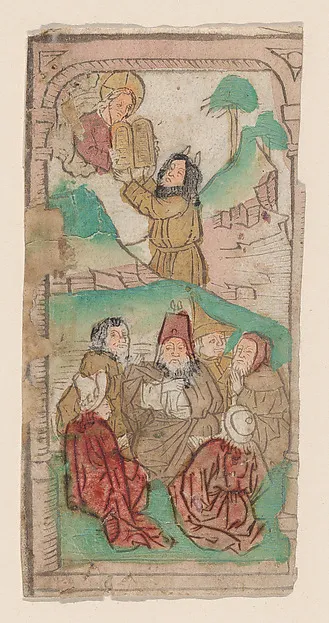
18And he gave unto Moses, when he had made an end of communing with him upon mount Sinai, two tables of testimony, tables of stone, written with the finger of God.
The chapter ends on the mountain, at the close of the long conversation: And he gave unto Moses, when he had made an end of communing with him upon mount Sinai, two tables of testimony, tables of stone (v. 18). For chapters the LORD has been speaking - the pattern of the tabernacle, the calling of the craftsmen, the guarding of the sabbath - and now the speaking comes to its end with a gift placed into Moses' hands.
The tablets are called tables of testimony, for they bear witness to the covenant between God and Israel; and they are tables of stone. The medium matters. Stone: the most enduring material a person could write on, meant to outlast every hand that would ever hold it. The law is set in stone because it is meant to stand. And there are two tablets, as covenants in the ancient world were commonly made in duplicate, a copy for each party.
The God who has been ordering a dwelling and a people now gives the abiding word that will sit at the very center of it all - in the ark, beneath the mercy seat, in the holiest place the craftsmen will build.
The last phrase is the most arresting: the tablets were written with the finger of God (v. 18). The writing is God's own. This is the only law in all of Scripture said to be inscribed directly by the hand of God. The image is meant to impress on Israel the absolute authority and origin of these words: they come from God Himself. The same striking phrase appears elsewhere - the magicians of Egypt, overcome, confessed of the plagues, This is the finger of God (Exod. 8:19); and Jesus would say of His own works, If I with the finger of God cast out devils, no doubt the kingdom of God is come upon you (Luke 11:20), where the parallel Gospel reads the Spirit of God (Matt. 12:28).
The finger of God is shorthand for God acting directly, by His own power. Here that power authors the covenant law and gives it to Moses on stone - the abiding word, written by the very hand of the One who made heaven and earth.
Research trail
Sources & further study
These references support the historical, linguistic, manuscript, and contextual notes in this chapter. Scripture remains the primary text; external sources are provided so readers can inspect the research directly.
- Exodus 31 - Translators' NotesThe NET Bible's detailed footnotes on Exodus 31 - the meaning of being “filled with the spirit of God” for skilled work (v. 3), the long inventory of what the craftsmen are to make (vv. 7-11), the sabbath as covenant sign and the severity of its sanctions (vv. 14-15), and the phrase “written with the finger of God” in verse 18.
- Exodus 31 · Hebrew + classical Jewish commentaryThe Hebrew text of Exodus 31 with Rashi, Ibn Ezra, and other classical commentators side by side - useful for chacham-lev (v. 6, the “wise hearted” whose skill is God-given), for ruach Elohim (v. 3, the “spirit of God” filling Bezaleel), and for oth (vv. 13, 17, the sabbath as a covenant “sign”).
- Exodus 31 ↔ 1 Corinthians 12 · Hebrews 4 · 2 Corinthians 3Traces the threads tying Exodus 31 to the rest of Scripture - the Spirit filling craftsmen (vv. 3-6) read beside the Spirit dividing to every man severally (1 Cor. 12:11); the sabbath rest (vv. 13-17) read beside the rest that remaineth… to the people of God (Heb. 4:9); and the law on stone (v. 18) read beside the law written in fleshy tables of the heart (2 Cor. 3:3).
Where this echoes in Scripture
The Holy Garments, and All That I Have Commanded
- 1 Corinthians 12:4-11there are diversities of gifts, but the same Spirit... all these worketh that one and the selfsame Spirit, dividing to every man severally as he will.The same Spirit who filled Bezaleel for craft (vv. 3-6), now distributing gifts to build up the body.
- Exodus 35:30-35the LORD hath called by name Bezaleel... and he hath filled him with the spirit of God... them hath he filled with wisdom of heart.Moses repeats this calling to the people - the same Spirit-given skill of verses 2-6, now announced for the work to begin.
- Hebrews 8:5See, saith he, that thou make all things according to the pattern shewed to thee in the mount.The governing word of verse 11 - the tabernacle built after a heavenly pattern shown on Sinai.
- Ephesians 2:21-22In whom all the building fitly framed together groweth unto an holy temple in the Lord... an habitation of God through the Spirit.The dwelling these craftsmen built (vv. 7-11), read as a shadow of the true house God builds in Christ.
- Romans 12:6Having then gifts differing according to the grace that is given to us...The shared, varied gifting of the wise-hearted (v. 6) - many hands, many gifts, one work.
My Sabbaths Ye Shall Keep · A Sign Between Me and You
- Genesis 2:2-3And on the seventh day God ended his work... and he rested on the seventh day... And God blessed the seventh day, and sanctified it.The creation rest that verse 17 names as the ground of the sabbath - God resting and hallowing the seventh day.
- Hebrews 4:9-10There remaineth therefore a rest to the people of God. For he that is entered into his rest, he also hath ceased from his own works.The rest of verse 17 carried forward - a rest still held out, entered by ceasing from one's own works.
- Matthew 11:28-29Come unto me, all ye that labour and are heavy laden, and I will give you rest... and ye shall find rest unto your souls.The rest the sabbath signified (vv. 13-17), offered in person to all who are weary.
- Ezekiel 20:12Moreover also I gave them my sabbaths, to be a sign between me and them, that they might know that I am the LORD that sanctify them.The very claim of verse 13 echoed by the prophet - the sabbath as the sign that the LORD sanctifies His people.
- Matthew 12:8For the Son of man is Lord even of the sabbath day.The One who is Lord of the day the chapter so carefully guards (vv. 14-17).
Written With the Finger of God
- 2 Corinthians 3:3written not with ink, but with the Spirit of the living God; not in tables of stone, but in fleshy tables of the heart.The stone tablets of verse 18 set against the law the Spirit writes within - God's word moved from stone to heart.
- Jeremiah 31:33I will put my law in their inward parts, and write it in their hearts; and will be their God, and they shall be my people.The promise that answers verse 18 - the law God wrote on stone, one day written within His people.
- Exodus 8:19Then the magicians said unto Pharaoh, This is the finger of God.The same phrase as verse 18 - the finger of God as shorthand for God acting directly by His own power.
- Deuteronomy 9:10the LORD delivered unto me two tables of stone written with the finger of God; and on them was written according to all the words.Moses recalling the gift of verse 18 - the tablets written by God's own hand on the mountain.
- Ezekiel 36:26-27A new heart also will I give you... I will put my spirit within you, and cause you to walk in my statutes.The deeper writing promised - God's law (v. 18) brought home to the heart by His Spirit.