Matthew 14
People in this chapter
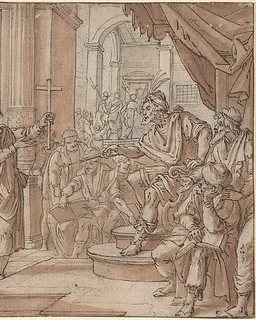
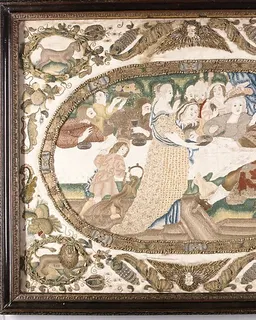
Matthew frames the whole chapter with a question about identity. Word of Jesus' works reaches the palace, and Herod the tetrarch - the same Herod who had silenced John - jumps to a haunted conclusion: This is John the Baptist; he is risen from the dead; and therefore mighty works do shew forth themselves in him (v. 2). It is the reasoning of a guilty man. So Matthew turns back to recount how John died: imprisoned for naming Herod's marriage unlawful, then beheaded to satisfy a rash oath sworn before dinner guests, his head brought in on a platter at the request of a dancing girl coached by her mother.
His disciples come, take up the body, bury it, and go and tell Jesus.1
Tap any highlighted phrase to jump to the commentary that unpacks it.
Matthew 14:1-13The Death of John the Baptist
1At that time Herod the tetrarch heard of the fame of Jesus, 2And said unto his servants, This is John the Baptist; he is risen from the dead; and therefore mighty works do shew forth themselves in him. 3For Herod had laid hold on John, and bound him, and put him in prison for Herodias’ sake, his brother Philip’s wife. 4For John said unto him, It is not lawful for thee to have her. 5And when he would have put him to death, he feared the multitude, because they counted him as a prophet. 6But when Herod’s birthday was kept, the daughter of Herodias danced before them, and pleased Herod. 7Whereupon he promised with an oath to give her whatsoever she would ask. 8And she, being before instructed of her mother, said, Give me here John Baptist’s head in a charger. 9And the king was sorry: nevertheless for the oath’s sake, and them which sat with him at meat, he commanded it to be given her. 10And he sent, and beheaded John in the prison. 11And his head was brought in a charger, and given to the damsel: and she brought it to her mother. 12And his disciples came, and took up the body, and buried it, and went and told Jesus. 13When Jesus heard of it, he departed thence by ship into a desert place apart: and when the people had heard thereof, they followed him on foot out of the cities.
The chapter opens not with Jesus but with a frightened king. Herod the tetrarch heard of the fame of Jesus, and said unto his servants, This is John the Baptist; he is risen from the dead (vv. 1-2). This Herod - Herod Antipas, who ruled Galilee under Rome - had killed John, and now the miracles of Jesus loom up in his imagination as the dead man come back. It is the logic of a guilty conscience: the man he silenced will not stay silent.
Matthew has shown us crowds and disciples puzzling over who Jesus is; here a murderer answers the question in his own haunted way, and the answer torments him. There is something terrible and revealing in it. Herod is not moved to repentance by the works of God; he is only made afraid, certain that judgment has caught up with him. The fame that draws the hungry multitudes to be healed drives the king to dread.
The same news of Jesus that is good news to the poor is a sentence to the man who will not turn.1
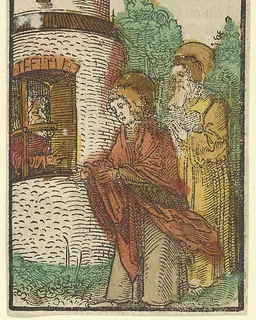
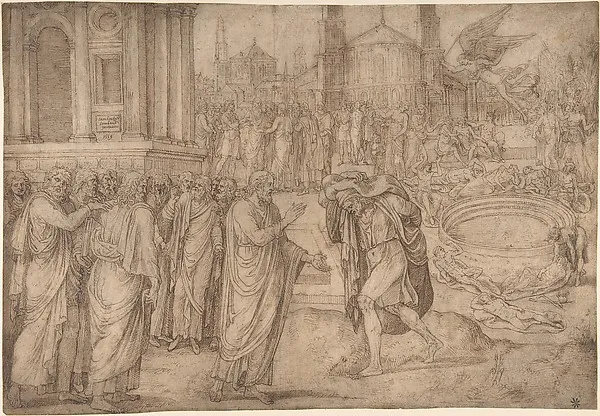
Matthew now reaches back to explain how it came to this. Herod had laid hold on John, and bound him, and put him in prison for Herodias' sake, his brother Philip's wife. For John said unto him, It is not lawful for thee to have her (vv. 3-4). John's crime was telling a king the truth he did not want to hear. Herod had taken his own brother's wife, and John would not soften it: it is not lawful. A prophet's task is not to flatter power but to speak the word of God to it plainly, and John did so knowing the cost.
The cost was a prison cell. Notice too what stayed Herod's hand for a time: when he would have put him to death, he feared the multitude, because they counted him as a prophet (v. 5). Herod's decisions are governed throughout by fear - first fear of the crowd, then fear of looking weak before his guests. He is a man ruled by what others will think, and that fear is about to make him a murderer.
Set this beside the Jesus the chapter will show: One who acts not from fear of the crowd but from compassion for it.
The death itself comes through a chain of vanity and weakness. When Herod's birthday was kept, the daughter of Herodias danced before them, and pleased Herod. Whereupon he promised with an oath to give her whatsoever she would ask (vv. 6-7). A lavish banquet, a pleased and flattered king, an extravagant promise made in the warmth of the moment and the eyes of his guests - and a girl coached by a mother who has been waiting for exactly this.
She, being before instructed of her mother, said, Give me here John Baptist's head in a charger (v. 8). Herodias, whom John's preaching had exposed, now has her revenge handed to her by her husband's rashness. And here the text records something it does not excuse: the king was sorry: nevertheless for the oath's sake, and them which sat with him at meat, he commanded it to be given her (v. 9).
Herod did not want to do it. But he wanted to keep his word before his guests more than he wanted to spare an innocent man, and so he chose the murder over the embarrassment. It is a portrait of how a weak man does great evil: not from conviction, but from the inability to lose face. A foolish oath does not bind a person to wickedness; honoring it here only doubles the sin.
And he sent, and beheaded John in the prison. And his head was brought in a charger, and given to the damsel: and she brought it to her mother (vv. 10-11). The greatest man born of woman, the voice crying in the wilderness, the forerunner who prepared the way of the Lord, dies alone in a cell and is carried in on a serving dish to a banquet. Matthew reports it with stark, unflinching restraint, adding no comment, sparing us no detail.
The brutality is left to speak for itself. And then a quiet, dignified line falls across the horror: his disciples came, and took up the body, and buried it, and went and told Jesus (v. 12). John's own followers do the last faithful thing - they honor his body with burial, and then they go to the one John had pointed them toward all along. In their grief they carry the news to Jesus. It is the right instinct of sorrow: to bring it to Him.
The forerunner's death is not the end of the story; even now it drives his mourners toward the Lamb of God he had named.
The news reaches Jesus, and His response is deeply human: When Jesus heard of it, he departed thence by ship into a desert place apart (v. 13). He withdraws. He had lost His forerunner, His kinsman, the man who baptized Him - and He seeks a solitary place, as a person seeks solitude in grief. There is no hint that Jesus is unmoved by John's death; the withdrawal itself testifies that He feels it. Yet even this attempt at quiet is interrupted: when the people had heard thereof, they followed him on foot out of the cities. The crowds will not leave Him alone with His sorrow.
What He does with that interruption - in the very next verse - is the hinge of the whole chapter. A lesser man, grieving and pursued, would have sent them away. The shadow of John's death hangs over everything that follows; against that shadow, the compassion of Jesus shines all the more clearly.
Matthew 14:14-21Moved with Compassion · The Feeding of the Five Thousand
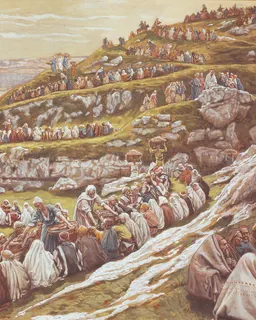
14And Jesus went forth, and saw a great multitude, and was moved with compassion toward them, and he healed their sick. 15And when it was evening, his disciples came to him, saying, This is a desert place, and the time is now past; send the multitude away, that they may go into the villages, and buy themselves victuals. 16But Jesus said unto them, They need not depart; give ye them to eat. 17And they say unto him, We have here but five loaves, and two fishes. 18He said, Bring them hither to me. 19And he commanded the multitude to sit down on the grass, and took the five loaves, and the two fishes, and looking up to heaven, he blessed, and brake, and gave the loaves to his disciples, and the disciples to the multitude. 20And they did all eat, and were filled: and they took up of the fragments that remained twelve baskets full. 21And they that had eaten were about five thousand men, beside women and children.
Everything turns on the first verse of this scene. Jesus has just lost John; He has come away by ship to be alone; and now Jesus went forth, and saw a great multitude, and was moved with compassion toward them, and he healed their sick (v. 14). He does not see an intrusion on His grief. He sees need, and is moved at the deepest level. The verb Matthew uses is strong and physical - a compassion felt in the inward parts, a being-moved that cannot stay still but must act.
So He heals their sick, one after another, through the long afternoon. This is the answer the chapter gives to the question Herod raised: who is this Jesus? He is the King whose first instinct, even in sorrow, even when He had every reason to withdraw, is mercy toward the broken. Where Herod's fear took a life, Jesus' compassion restores them. The crowd has pressed in on His solitude, and instead of resenting them, He spends Himself on them.2
As evening falls the disciples do the sensible thing - they propose a logistics solution: This is a desert place, and the time is now past; send the multitude away, that they may go into the villages, and buy themselves victuals (v. 15). It is reasonable. There is no food here, it is getting late, and these people need to fend for themselves. But Jesus refuses the whole premise: They need not depart; give ye them to eat (v. 16).
With a word He moves the burden from the crowd's shoulders onto the disciples' - and onto His own. Give ye them to eat. The command is impossible, and He knows it; that is the point. The disciples answer with the arithmetic of scarcity: We have here but five loaves, and two fishes (v. 17). Five loaves and two fishes against five thousand men - the numbers are absurd, and the word but carries all their helplessness.
This is exactly the place Jesus wants them: at the end of their own resources, holding their pitiful little, with nowhere to look but to Him. His next word turns the whole thing around: Bring them hither to me (v. 18). The little is not the problem. What matters is into whose hands it is placed.
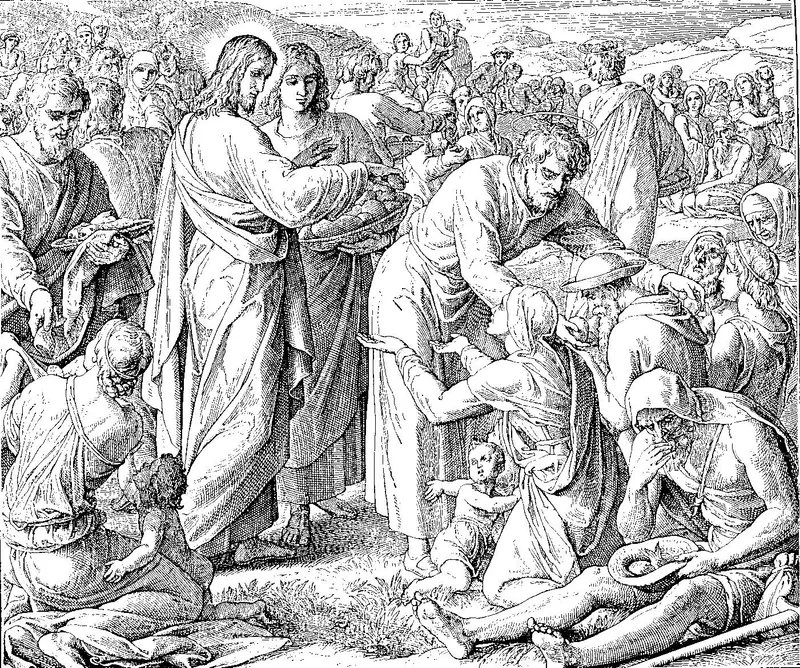
Watch what Jesus does, for Matthew records each motion deliberately: he commanded the multitude to sit down on the grass, and took the five loaves, and the two fishes, and looking up to heaven, he blessed, and brake, and gave the loaves to his disciples, and the disciples to the multitude (v. 19). First He seats them - an act of calm authority, as a host seats his guests at a table he is about to fill.
Then four verbs that will echo through the rest of the Gospel: He took, He blessed, He brake, He gave. He looks up to heaven, acknowledging the Father as the source of every good gift, and in that posture of dependence the multiplication happens - not with a flourish or a spoken spell, but quietly, in the breaking and the handing out. And note who carries the bread to the people: the disciples. The same men who said we have but five loaves now find their hands never emptying as they distribute.
Jesus is the source; they are the servers. He still works this way - taking the little His people bring, blessing it, breaking it, and feeding the hungry through the very hands that thought they had nothing to give.
The result is told in three short, staggering phrases: they did all eat, and were filled: and they took up of the fragments that remained twelve baskets full. And they that had eaten were about five thousand men, beside women and children (vv. 20-21). All ate - not a sample, not the front rows, but everyone. They were filled - not given a token taste but satisfied. And there was more left at the end than there had been at the start: twelve baskets full of fragments gathered up, one basket, by ancient telling, for each of the twelve who had despaired of feeding anyone.
The God who provides does not provide stingily. The crowd numbered five thousand men, beside women and children - so the true number is far larger, a whole town's worth of people fed in a wilderness from a boy's lunch. This is the same God who rained manna in the desert and made it enough every morning, who set a table in the wilderness for a grumbling people. The abundance is the signature. Where the world counts what is lacking and sends people away hungry, the King takes the little, gives thanks, and there is enough - and more than enough - for all.3
Matthew 14:22-33It Is I; Be Not Afraid · Walking on the Sea
22And straightway Jesus constrained his disciples to get into a ship, and to go before him unto the other side, while he sent the multitudes away. 23And when he had sent the multitudes away, he went up into a mountain apart to pray: and when the evening was come, he was there alone. 24But the ship was now in the midst of the sea, tossed with waves: for the wind was contrary. 25And in the fourth watch of the night Jesus went unto them, walking on the sea. 26And when the disciples saw him walking on the sea, they were troubled, saying, It is a spirit; and they cried out for fear. 27But straightway Jesus spake unto them, saying, Be of good cheer; it is I; be not afraid. 28And Peter answered him and said, Lord, if it be thou, bid me come unto thee on the water. 29And he said, Come. And when Peter was come down out of the ship, he walked on the water, to go to Jesus. 30But when he saw the wind boisterous, he was afraid; and beginning to sink, he cried, saying, Lord, save me. 31And immediately Jesus stretched forth his hand, and caught him, and said unto him, O thou of little faith, wherefore didst thou doubt? 32And when they were come into the ship, the wind ceased. 33Then they that were in the ship came and worshipped him, saying, Of a truth thou art the Son of God.
Immediately after the feeding, Jesus takes deliberate steps to be alone with the Father. Straightway Jesus constrained his disciples to get into a ship, and to go before him unto the other side, while he sent the multitudes away (v. 22). The word constrained is firm; He all but compels them to go ahead without Him. Then, the crowds dismissed, he went up into a mountain apart to pray: and when the evening was come, he was there alone (v. 23).
This is the rhythm of His life that Matthew keeps showing us. After the press of the crowd and the spending of Himself in mighty works, He withdraws to pray. The One through whom the loaves multiplied does not run on His own strength; He goes up the mountain alone to be with His Father. And He sends His disciples out onto the water at His own command - which is worth holding onto, because the storm they are about to meet finds them exactly where Jesus put them.
They are not off course. They are obeying. The contrary wind rises over disciples who did the very thing He told them to do.
Out on the lake the night turns hard. The ship was now in the midst of the sea, tossed with waves: for the wind was contrary (v. 24). They are far from land, the wind is dead against them, and the waves are beating the boat. Then comes one of the most quietly loaded phrases in the chapter: in the fourth watch of the night Jesus went unto them, walking on the sea (v. 25).
The fourth watch is the last stretch before dawn, roughly three to six in the morning - the darkest, coldest, most exhausted hours, when a person has been straining at the oars all night and the night will not end. He does not come at the first cry. He comes in the fourth watch, when their strength is gone and the dark is deepest. There is mercy in the timing as well as in the coming.
And He comes walking on the sea - the same churning, hostile water that is defeating these seasoned fishermen is, under His feet, a road. The chaos that terrifies them is simply the surface He walks upon to reach them. He is not kept back by the storm; He comes to them through the very thing they fear.1
The disciples' first response to His coming is not relief but terror: when the disciples saw him walking on the sea, they were troubled, saying, It is a spirit; and they cried out for fear (v. 26). A figure moving across the water in the dark - their minds reach for the only category that fits, a ghost, an omen of death, and they scream. It is into that screaming fear that His voice comes: But straightway Jesus spake unto them, saying, Be of good cheer; it is I; be not afraid (v. 27).
Three things, all at once. Be of good cheer - take courage, the very last thing the moment seems to allow. It is I - the assurance that the figure on the water is not their doom but their Lord. Be not afraid - the word He speaks again and again to people undone by His nearness. Everything hangs on the middle phrase. Their fear is not cured by the storm stopping; the storm is still raging. It is cured by knowing who is with them in it.
The terror was real; the figure was real; but the figure was Him - and that changes everything about the terror.
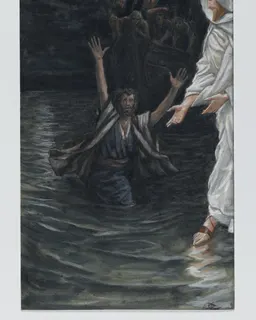
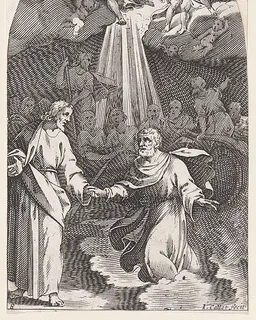
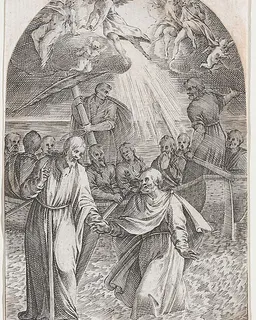
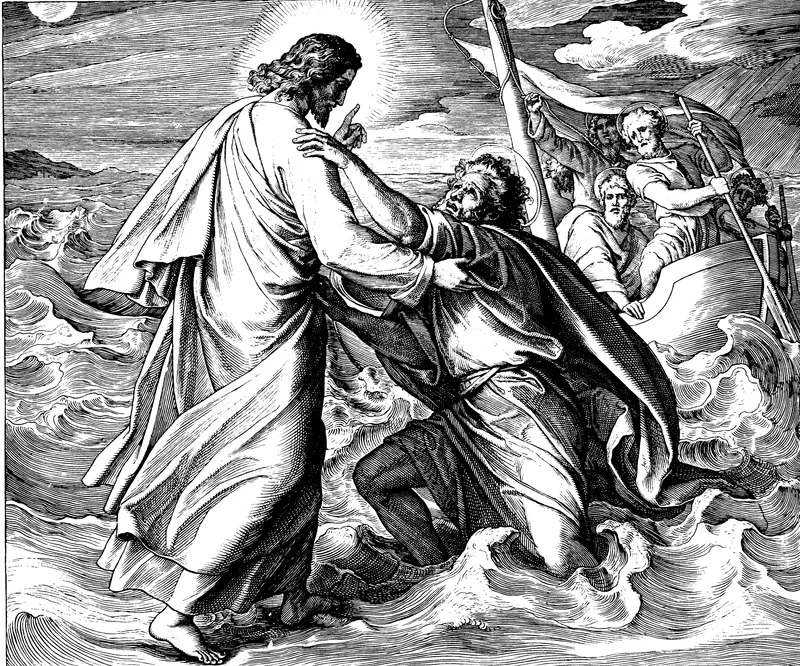
Peter, hearing that voice, does something audacious: Lord, if it be thou, bid me come unto thee on the water (v. 28). It is half faith and half test, but it is aimed in the right direction - toward Jesus. And the answer is a single word: Come (v. 29). On that one word Peter climbs over the side of a pitching boat into open, storm-tossed water - and he walks. When Peter was come down out of the ship, he walked on the water, to go to Jesus. For a few astonishing steps a fisherman does what only his Lord had done, held up by nothing but the word Come and the One who spoke it.
Then his attention shifts: when he saw the wind boisterous, he was afraid; and beginning to sink, he cried, saying, Lord, save me (v. 30). Nothing about the storm changed. What changed was where Peter was looking. While his eyes were on Jesus he walked; when they went to the wind and the waves, he began to go down. His faith did not vanish - even sinking, he knew exactly where to turn - but it was divided, pulled between the Lord in front of him and the storm around him.
The cry that breaks out of him is one of the shortest, truest prayers in all of Scripture: Lord, save me.
The response is instant. Immediately Jesus stretched forth his hand, and caught him, and said unto him, O thou of little faith, wherefore didst thou doubt? (v. 31). Note the word immediately. Jesus does not let Peter thrash, does not make him earn rescue, does not wait for the lesson to sink in while the man goes under. The cry Lord, save me is met at once by a hand that takes hold. And only then, with Peter already safe in His grip, does Jesus speak the gentle question: O thou of little faith, wherefore didst thou doubt? The rebuke is real, but it comes from a hand that is already holding him up - correction inside rescue, never instead of it.
And the question is searching: wherefore didst thou doubt? There was no reason to. The same Lord who said Come was standing right there, just as able to hold him at step ten as at step one. Nothing had changed about Jesus between the walking and the sinking; only Peter's gaze had wandered to the wind. Then the scene resolves: when they were come into the ship, the wind ceased (v. 32). The storm that had fought them all night simply stops the moment He steps aboard.
The wind that no oar could master falls silent at His presence.
The chapter that began with a frightened king naming Jesus a ghost of the dead ends with a boatful of disciples on their faces: Then they that were in the ship came and worshipped him, saying, Of a truth thou art the Son of God (v. 33). They have just watched Him walk on water no man can walk on, pull a sinking man from the deep, and silence a storm with His presence - and they respond not with mere amazement but with worship.
The little phrase of a truth matters: this is not a guess or a hopeful title, but a settled conviction wrung out of them by what they have seen. Thou art the Son of God. Set this confession against Herod's in verse 2. Herod, hearing of Jesus' works, concluded in dread that John was risen to haunt him. The disciples, having seen far greater works, conclude in worship that the Son of God is in their boat.
The same Jesus draws guilty fear from the one and adoring worship from the others. And He receives their worship - does not wave it off, does not correct them - for it is the right and only response to who He is. The chapter has carried the reader from a murdered forerunner all the way to the worshipped Son.
Matthew 14:34-36The Hem of His Garment
34And when they were gone over, they came into the land of Gennesaret. 35And when the men of that place had knowledge of him, they sent out into all that country round about, and brought unto him all that were diseased; 36And besought him that they might only touch the hem of his garment: and as many as touched were made perfectly whole.
The chapter closes quietly, but the quiet is full of faith. When they were gone over, they came into the land of Gennesaret. And when the men of that place had knowledge of him, they sent out into all that country round about, and brought unto him all that were diseased (vv. 34-35). The contrast with the palace of the opening could not be sharper. Herod, knowing of Jesus, was filled with guilty dread; these ordinary townspeople, knowing of Jesus, spring into action - word goes out across the whole region, and the sick are gathered and carried to Him from every direction.
There is an urgency and a generosity in it: no one keeps the news to himself, no neighbor's suffering is left out. They have heard who has come among them, and their one thought is to get every hurting person they can into His presence. It is what knowing of Jesus should produce - not the cornered fear of a guilty king, but a whole community sending out to bring the broken to the One who heals.
Their faith narrows to a single, touching request: they besought him that they might only touch the hem of his garment: and as many as touched were made perfectly whole (v. 36). They do not presume to ask for much - only to touch the border of His robe, the fringe at the edge of His clothing. It echoes the woman earlier in Matthew who said within herself, If I may but touch his garment, I shall be whole, and was healed.
Here a whole multitude reaches for that same hem, and the result is told without limit: as many as touched were made perfectly whole. Not some. Not most. As many as touched. And not merely improved or eased, but made perfectly whole - completely, soundly restored. There is no straining of His power here, no running short; the One who fed five thousand and walked the sea heals an entire countryside through the touch of His garment's edge.
The chapter that opened with a man losing his head to a king's vanity ends with crowds being made perfectly whole by the King who came not to take life but to restore it.1
Research trail
Sources & further study
These references support the historical, linguistic, manuscript, and contextual notes in this chapter. Scripture remains the primary text; external sources are provided so readers can inspect the research directly.
- Matthew 14 - Translators' NotesThe NET Bible's detailed footnotes on Matthew 14 - Herod the tetrarch and the politics behind John's imprisonment (vv. 1-5), the rash oath and the dancing daughter (vv. 6-11), the “fourth watch of the night” (v. 25), and the force of Jesus' words over the storm (v. 27).
- Matthew 14 · Greek interlinearThe Greek text of Matthew 14 word by word with parsing and Strong's numbers - useful for esplanchnisthē (v. 14, “moved with compassion,” from the word for the inward parts), for egō eimi (v. 27, “it is I”), and for oligopiste (v. 31, “O thou of little faith”).
- Matthew 14 ↔ John 6 · Exodus 16 · Job 9 · Psalm 77Traces the threads tying Matthew 14 to the rest of Scripture - the feeding (vv. 14-21) read alongside the manna of Exodus 16 and the bread-of-life discourse of John 6, and the walking on the sea (vv. 22-33) read beside the One who treadeth upon the waves of the sea (Job 9:8) and whose way is in the great waters (Ps. 77:19).
Where this echoes in Scripture
The Death of John the Baptist
- Mark 6:17-29For Herod himself had sent forth and laid hold upon John... And his disciples came, and took up his corpse, and laid it in a tomb.The fuller account of the same events - John's imprisonment, the oath, and the burial of verses 3-12.
- John 1:29Behold the Lamb of God, which taketh away the sin of the world.The forerunner's testimony - the One John named, toward whom his grieving disciples now turn (v. 12).
- John 3:30He must increase, but I must decrease.John's own measure of his calling, fulfilled to the end in the death of verses 10-12.
- 1 Kings 19:2So let the gods do to me, and more also, if I make not thy life as the life of one of them by to morrow about this time.Jezebel against Elijah - the old pattern of a vengeful queen against the prophet who named her sin, behind Herodias in verses 3-8.
- Matthew 27:24When Pilate saw that he could prevail nothing... he washed his hands before the multitude, saying, I am innocent of the blood of this just person.A second ruler condemning the innocent for fear of the crowd - Herod over John foreshadowing Pilate over Jesus.
Moved with Compassion · The Feeding of the Five Thousand
- John 6:35I am the bread of life: he that cometh to me shall never hunger; and he that believeth on me shall never thirst.The meaning of the feeding drawn out - the discourse that follows this very miracle in John's account.
- Exodus 16:4Behold, I will rain bread from heaven for you; and the people shall go out and gather a certain rate every day.The God who fed Israel in the wilderness - the pattern behind the wilderness feeding of verses 19-21.
- Matthew 26:26Jesus took bread, and blessed it, and brake it, and gave it to the disciples, and said, Take, eat; this is my body.The same four verbs - took, blessed, brake, gave - that Jesus uses over the loaves in verse 19.
- Psalm 78:19Can God furnish a table in the wilderness?Israel's doubting question, answered in a desert place at evening (vv. 15-21).
- Matthew 9:36But when he saw the multitudes, he was moved with compassion on them, because they fainted, and were scattered abroad, as sheep having no shepherd.The same compassion that moves Him in verse 14 - the gut-deep mercy that drives His works.
It Is I; Be Not Afraid · Walking on the Sea
- Job 9:8Which alone spreadeth out the heavens, and treadeth upon the waves of the sea.The deed Scripture attributes to God alone - done here, in person, by Jesus walking on the sea (v. 25).
- Psalm 77:19Thy way is in the sea, and thy path in the great waters, and thy footsteps are not known.The LORD's path through the deep - the great waters He treads, beneath Jesus' feet in verse 25.
- Exodus 3:14And God said unto Moses, I AM THAT I AM... I AM hath sent me unto you.The divine self-naming behind Jesus' it is I (egō eimi) spoken over the storm in verse 27.
- Isaiah 43:2When thou passest through the waters, I will be with thee; and through the rivers, they shall not overflow thee.The promise lived out - the Lord present in the deep waters, reaching the sinking in verses 30-31.
- Psalm 18:16He sent from above, he took me, he drew me out of many waters.The God who draws His own out of the deep - the hand stretched forth to catch Peter (v. 31).
The Hem of His Garment
- Matthew 9:20-22If I may but touch his garment, I shall be whole... thy faith hath made thee whole.The same reach for the hem - one woman's faith, now a whole multitude's at Gennesaret (v. 36).
- Malachi 4:2But unto you that fear my name shall the Sun of righteousness arise with healing in his wings.Healing in the “wings” - the same word as the hem of a garment - foretold and fulfilled in verse 36.
- Matthew 8:16-17he healed all that were sick: that it might be fulfilled... Himself took our infirmities, and bare our sicknesses.The same wholesale healing as verses 35-36 - all the sick made whole by the One who bore their infirmities.
- Isaiah 53:5with his stripes we are healed.The deeper wholeness behind the healings of Gennesaret - the cost at which the King makes whole.
- Acts 5:15they brought forth the sick into the streets... that at the least the shadow of Peter passing by might overshadow some of them.The same reaching faith carried on in the apostles - the crowds bringing their sick to be made whole (vv. 35-36).