Genesis 5
Genesis 5 opens with a heading the rest of the book will reuse like a seam: This is the book of the generations of Adam (v. 1). And before it begins counting the dead, it pauses to remember where the whole line came from: In the day that God created man, in the likeness of God made he him; male and female created he them; and blessed them, and called their name Adam (vv. 1-2). Then the genealogy begins, and it moves with a fixed and solemn rhythm. A man lives so many years and begets a son; he lives on and begets sons and daughters; the sum of his days is given; and then the refrain falls - and he died. Adam, Seth, Enos, Cainan, Mahalaleel, Jared: six times the same closing word, the meter of mortality sounding down a thousand years.3
Then, in the seventh place, the rhythm breaks. And Enoch walked with God: and he was not; for God took him (v. 24). Of every other man the chapter says and he died; of Enoch alone it does not. The drumbeat that has tolled through the whole list simply stops for one man - the one who walked with God.2 The chapter then resumes its count: Methuselah, who outlived every other man in Scripture, and still died; Lamech; and at last the birth of Noah, of whom his father says, This same shall comfort us concerning our work and toil of our hands, because of the ground which the LORD hath cursed (v. 29). It closes, as so many beginnings do, with three sons born - Shem, Ham, and Japheth.
So the chapter holds three things at once, and they are not random. There is the long reign of death, written in the eightfold and he died. There is the single man whom death did not take. And there is a father's hope, spoken over a newborn, that one would come to comfort a world worn out under a curse. Read together, the list of the dead becomes the strangest kind of witness: it counts the cost of the Fall honestly, name by name, and then it points twice past the grave - once in a man who was taken, once in a child who was longed for - toward a hope this chapter does not yet name but cannot stop reaching for.
Tap any highlighted phrase to jump to the commentary that unpacks it.

Genesis 5:1-20The Book of the Generations of Adam
1This is the book of the generations of Adam. In the day that God created man, in the likeness of God made he him; 2Male and female created he them; and blessed them, and called their name Adam, in the day when they were created. 3And Adam lived an hundred and thirty years, and begat a son in his own likeness, after his image; and called his name Seth: 4And the days of Adam after he had begotten Seth were eight hundred years: and he begat sons and daughters: 5And all the days that Adam lived were nine hundred and thirty years: and he died.
The chapter opens with a heading that frames everything to follow: This is the book of the generations of Adam (v. 1). The phrase - the generations of - is one of the great structural seams of Genesis; it will open the account of Noah, of Shem, of Terah, of Jacob. It marks out the lines God is tracing through history, the thread He means the reader to follow. And before a single death is recorded, the heading reaches all the way back to the beginning to remember how this line started: In the day that God created man, in the likeness of God made he him; male and female created he them; and blessed them (vv. 1-2). The genealogy is about to become an inventory of mortality, but it does not begin there. It begins with the dignity of the source - humanity made in God's likeness, made male and female, made under blessing. Whatever the long list of deaths will say about what went wrong, it is anchored first in what was true at the start: these are not anonymous lives but image-bearers, named and blessed by their Maker.3
Verse 3 echoes the language of the opening lines, but with a small and deliberate shift worth pausing over. In verse 1 it was said that God made man in the likeness of God; now Adam begat a son in his own likeness, after his image. The same two words - likeness and image - that described humanity's relation to God in Genesis 1 are here used of a son's relation to his father. The text is keeping a careful record. The image-bearer begets an image-bearer; what Adam is, Seth becomes. This is not said with horror or with celebration; it is simply stated, the way the whole chapter states things. But it sets the terms for everything that follows. Whatever Adam now is - mortal, east of Eden, under the conditions of Genesis 3 - passes to his son in his likeness. The line will carry both the dignity of the image and the inheritance of death, generation after generation, exactly as the chapter is about to show.
And then, for the first time in Scripture, the refrain that will toll through the whole chapter: And all the days that Adam lived were nine hundred and thirty years: and he died (v. 5). Adam is the first to die. The span is almost unimaginable - nine hundred and thirty years - and the length of it makes the ending land all the heavier. So long a life, and still the same three words. There is a quiet but unmistakable line being drawn back here. In the garden the warning had been given: in the day that thou eatest thereof thou shalt surely die (Gen. 2:17). Now, in the book of the generations of Adam, the warning comes due. The man made in the likeness of God, blessed and set over creation, lies down at last in the dust he was taken from. The first death in the Bible is not a stranger's; it is Adam's, the father of them all. And it sets the pattern that the rest of the chapter will simply repeat, name after name, until one name does not fit.
6And Seth lived an hundred and five years, and begat Enos: 7And Seth lived after he begat Enos eight hundred and seven years, and begat sons and daughters: 8And all the days of Seth were nine hundred and twelve years: and he died. 9And Enos lived ninety years, and begat Cainan: 10And Enos lived after he begat Cainan eight hundred and fifteen years, and begat sons and daughters: 11And all the days of Enos were nine hundred and five years: and he died. 12And Cainan lived seventy years, and begat Mahalaleel: 13And Cainan lived after he begat Mahalaleel eight hundred and forty years, and begat sons and daughters: 14And all the days of Cainan were nine hundred and ten years: and he died.
Now the chapter settles into its rhythm, and the rhythm is the message. Seth, Enos, Cainan - each entry is built on the same frame, almost word for word: he lived so many years and begat a son; he lived on and begat sons and daughters; all his days were so many years; and he died. The repetition is not poor writing; it is the whole point. Death is not presented here as a tragedy that strikes some and spares others, an accident or a misfortune. It is the default, the common inheritance, the one line every paragraph arrives at. The lifespans are vast - nine hundred and twelve, nine hundred and five, nine hundred and ten - and the vastness only sharpens the refrain. It is as if the chapter is testing whether any amount of years can outrun the closing word, and answering, each time, no. However a man fills the years between, the years between are bounded on both ends, and the second end is always the same. And he died. The drumbeat is steady, and it is meant to be felt as steady - the meter of a world living under the conditions of Genesis 3.
15And Mahalaleel lived sixty and five years, and begat Jared: 16And Mahalaleel lived after he begat Jared eight hundred and thirty years, and begat sons and daughters: 17And all the days of Mahalaleel were eight hundred ninety and five years: and he died. 18And Jared lived an hundred sixty and two years, and he begat Enoch: 19And Jared lived after he begat Enoch eight hundred years, and begat sons and daughters: 20And all the days of Jared were nine hundred sixty and two years: and he died.
Mahalaleel and Jared close out the first movement, and with them the refrain reaches its sixth sounding: and he died… and he died. Six men now, from Adam through Jared, have lived their long lives and lain down under the same word. By this point the pattern feels fixed, unbreakable, a law of the world the chapter is describing. On the long lives themselves, the text offers no explanation and invites none; it simply gives the years as it gives them - nine hundred and ten, eight hundred ninety-five, nine hundred sixty-two - and lets them stand. What it is interested in is not the arithmetic of longevity but the certainty of the ending. And yet, buried in the sixth entry, a name is quietly set in place that will break the rhythm. Jared… begat Enoch (v. 18). The reader does not yet know what is coming. Enoch's line begins exactly like all the others. But the one man of whom the chapter will not say and he died has just been born into the list - and the next time his name comes up, the drumbeat will miss its beat.
A small detail in verse 2 is easy to read past but worth holding: God called their name Adam. The name given is shared - the man and the woman together are called Adam, the word that means humanity, the same word used for the dust-formed creature of Genesis 2. Male and female are blessed together and named together at the head of this book of generations. It is a fitting overture to a chapter that will trace a single human line down the centuries: before the list of individuals begins, the text frames the whole race as one, made and blessed by God. The genealogy that follows is not a collection of unrelated lives but the unfolding of this one named, blessed humanity through time - which is part of why the apostle can later speak of the entire race in terms of its one head: in Adam all die (1 Cor. 15:22). The shared name at the top of the chapter is the seed of that thought.
Genesis 5:21-24Enoch Walked With God: And He Was Not
21And Enoch lived sixty and five years, and begat Methuselah: 22And Enoch walked with God after he begat Methuselah three hundred years, and begat sons and daughters: 23And all the days of Enoch were three hundred sixty and five years: 24And Enoch walked with God: and he was not; for God took him.
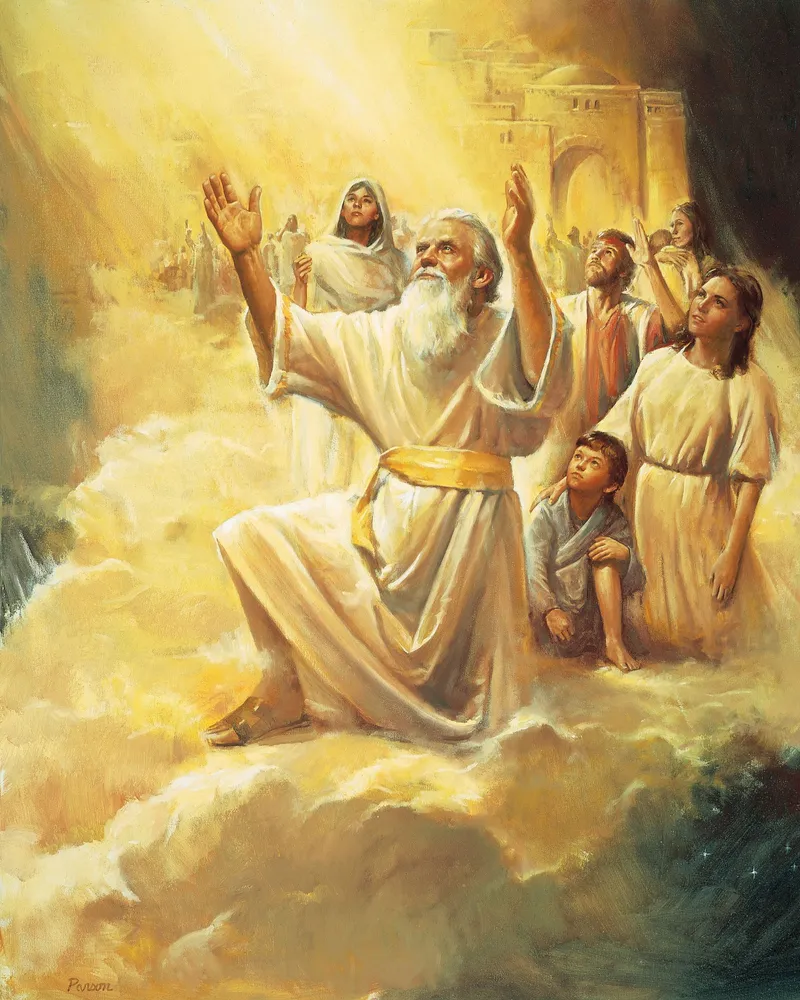
For six entries the chapter has told us only how long a man lived and that he begat children and died. Of Enoch it suddenly tells us something else - something it has said of no one before: And Enoch walked with God (v. 22). The formula breaks open. In place of the bare record of years, there is now a relationship described. Twice the chapter says it, framing his whole adult life: he walked with God after he begat Methuselah, and again, at the end, he walked with God (vv. 22, 24). This is not said of Adam, nor of Seth, nor of any of the others, however long they lived. The thing that distinguishes Enoch is not the length of his days - in fact his three hundred sixty-five years are by far the shortest span in the chapter, less than half of anyone around him. What sets him apart is not how long he lived but how he lived: in company with God, walking with Him through the ordinary length of a life. The chapter has been measuring men by their years; with Enoch it quietly changes the measure.
It is worth noticing what Enoch's walk with God did not mean. It did not mean withdrawal from the ordinary business of human life. The same verse that says he walked with God says, in the same breath, that he begat sons and daughters (v. 22). His communion with God did not lift him out of the world of marriage and children and the passing of years; it ran straight through the middle of it. He walked with God while raising a family, while living the full, generative life the chapter describes for everyone else. So whatever “walking with God” is, it is not a thing reserved for those who have left normal life behind. It is something done in the midst of normal life - in the years of begetting and raising and working, the very years everyone else in the chapter is also living. Enoch was not taken because his life was empty or unlived. He was taken in the full course of an ordinary, fruitful human life that happened, all the way through, to be lived with God.
And then the sentence every reader of the chapter has been unconsciously waiting for - the one that should end and he died - does not. And Enoch walked with God: and he was not; for God took him (v. 24). The drumbeat misses its beat. Where six men before him met the refrain, Enoch meets a different word entirely. He was not - he was no longer here, no longer found among the living - for God took him. The cause is stated with perfect plainness and no further explanation: God took him. The text does not describe how, and it does not speculate; it simply reports that the man who walked with God did not go the way of all the others. This is the single interruption in the chapter's relentless meter, and it lands with enormous weight precisely because of all the and he dieds that came before. The chapter has been quietly building a case - that death is the universal end - and then, in one verse, it shows the exception. Death is the rule of this fallen world; but it is not, the chapter insists, an absolute and unbreakable law. For one man who walked with God, the rule did not hold.
Genesis 5:25-32This Same Shall Comfort Us: The Birth of Noah
25And Methuselah lived an hundred eighty and seven years, and begat Lamech: 26And Methuselah lived after he begat Lamech seven hundred eighty and two years, and begat sons and daughters: 27And all the days of Methuselah were nine hundred sixty and nine years: and he died. 28And Lamech lived an hundred eighty and two years, and begat a son: 29And he called his name Noah, saying, This same shall comfort us concerning our work and toil of our hands, because of the ground which the LORD hath cursed.
The chapter has one more proof to offer before it turns toward hope, and it is the strongest proof of all. And all the days of Methuselah were nine hundred sixty and nine years: and he died (v. 27). Methuselah lived longer than any other human named in all of Scripture - nine hundred and sixty-nine years, a span that brushes the very edge of a thousand. If sheer length of life could outlast death, here is the man who would have done it. And the refrain falls on him exactly as it fell on all the rest: and he died. The chapter could not make its point more pointedly. The longest life ever lived still ends in the same three words as the shortest. There is no quantity of years that finally escapes the closing word; the man who came nearest to a thousand years arrives at the same end as his father and his father's father. It is the seventh sounding of the refrain, and the most emphatic - the chapter's final word on what years alone can do. And then, immediately after the oldest man dies, a baby is born, and the tone changes entirely.
At the birth of his son, Lamech does something no father in the chapter has done: he stops the count to speak a hope. And he called his name Noah, saying, This same shall comfort us concerning our work and toil of our hands, because of the ground which the LORD hath cursed (v. 29). It is the first speech in the whole genealogy - every other entry is bare record, but here a father looks at his newborn son and says something. And what he says reaches back past the long list of the dead, all the way to Eden. The ground which the LORD hath cursed recalls the words spoken to Adam: cursed is the ground for thy sake; in sorrow shalt thou eat of it… in the sweat of thy face shalt thou eat bread (Gen. 3:17-19). Lamech knows what world he lives in - a world of work and toil of our hands, labour under a curse, the very weariness Genesis 3 announced. And looking at his son, he hopes for relief: this same shall comfort us. It is a remarkable turn. In a chapter that has counted nothing but death, a father dares to name a child after the longing for rest - the hope that this one, somehow, might be the beginning of comfort for a worn and cursed creation.
30And Lamech lived after he begat Noah five hundred ninety and five years, and begat sons and daughters: 31And all the days of Lamech were seven hundred seventy and seven years: and he died. 32And Noah was five hundred years old: and Noah begat Shem, Ham, and Japheth.
The chapter closes the way so many of Scripture's turning points open - with the naming of sons. And Noah was five hundred years old: and Noah begat Shem, Ham, and Japheth (v. 32). Lamech's own days end on the familiar refrain, the eighth and last and he died (v. 31); but the very next breath is birth, not death - three sons through whom the world after the flood will be repopulated. It is a deliberate ending. The genealogy of death does not trail off into the grave; it sets down, as its final word, three new lives. Shem, Ham, and Japheth are the doorway out of this chapter and into everything that follows - the flood, the covenant with Noah, the table of nations, and the long line that will run, in time, toward Abraham and beyond. So the chapter that began with the book of the generations of Adam and tolled so steadily toward death ends facing forward, toward generations yet unborn. The reign of death is real, and the chapter has counted it honestly - but it does not get the last line. The last line is three sons and a future.
It is worth weighing how much theology is folded into Lamech's short speech. He does not say merely that life is hard; he names why it is hard, and his answer reaches back to Genesis 3: because of the ground which the LORD hath cursed (v. 29). He is reading his own toil in the light of the whole story - the curse on the ground, the sweat of the face, the sorrow of labour that has shadowed every life since Eden. And against that backdrop he speaks a hope: this same shall comfort us. The longing is for the curse itself to be answered, for the ground's resistance to give way to rest. In Noah's own day, that hope would find a partial and temporary answer - after the flood the LORD would say I will not again curse the ground any more for man's sake (Gen. 8:21), and the rhythms of seedtime and harvest would be secured. But the deeper ache Lamech names - the full lifting of the curse, true and lasting rest for a weary creation - reaches past Noah toward a comfort the chapter can only gesture at. Lamech's words are larger than he knew: a father's hope, spoken over one child, that turns out to be the hope of the whole world.
Further study
- The Hebrew text of Genesis 5 with Rashi, Ibn Ezra, and other classical commentators side by side - useful for the recurring verb vayyamot (“and he died,” vv. 5, 8, 11, and on), for hithhallekh et-ha-elohim (v. 22, “walked with God”), for laqach (v. 24, “took”), and for the wordplay on the name Noach in verse 29.
- Genesis 5 ↔ Hebrews 11 · Romans 5 · 1 Corinthians 15 · JudeIntertextual BibleTraces the threads tying Genesis 5 to the rest of Scripture - the eightfold and he died read alongside death passed upon all men (Rom. 5:12), Enoch's being taken (v. 24) read beside by faith Enoch was translated that he should not see death (Heb. 11:5) and Jude's naming of Enoch as a prophet (Jude 14), and Lamech's hope of comfort (v. 29) read beside the rest of the last Adam (1 Cor. 15:45).
- Genesis 5 - Translators' NotesNET BibleThe NET Bible's detailed footnotes on Genesis 5 - the heading the book of the generations (v. 1), the language of likeness and image carried from Genesis 1 into verse 3, the repeated formula of the genealogy, the unusual wording of Enoch's departure in verse 24, and the explanation Lamech gives for the name Noah in verse 29.
Where this echoes in Scripture
The Book of the Generations of Adam
- Genesis 1:26-27Let us make man in our image, after our likeness... So God created man in his own image.The making in God’s image and likeness that verses 1-3 deliberately echo - the dignity at the head of the line.
- Genesis 2:17in the day that thou eatest thereof thou shalt surely die.The warning that comes due in the eightfold “and he died” - first of all in Adam (v. 5).
- Romans 5:12by one man sin entered into the world, and death by sin; and so death passed upon all men.The reign of death this whole genealogy records, traced by the apostle to its one source.
- 1 Corinthians 15:21-22For since by man came death... For as in Adam all die, even so in Christ shall all be made alive.The two heads of humanity - the Adam whose line dies here, and the One in whom that line is made alive.
- Hebrews 9:27it is appointed unto men once to die, but after this the judgment.The appointment the refrain (vv. 5, 8, 11…) records as common to all - the ending no length of years escapes.
Enoch Walked With God: And He Was Not
- Hebrews 11:5By faith Enoch was translated that he should not see death... for... he had this testimony, that he pleased God.The New Testament reading of verse 24 - Enoch’s walk named as faith, his being taken as not seeing death.
- Jude 14-15Enoch also, the seventh from Adam, prophesied... Behold, the Lord cometh with ten thousands of his saints.The man taken without dying (v. 24) named also as a prophet who foretold the Lord’s coming.
- Genesis 6:9Noah was a just man and perfect in his generations, and Noah walked with God.The same phrase that marks Enoch (vv. 22, 24) - the rare company of those who walk with God.
- Psalm 49:15But God will redeem my soul from the power of the grave: for he shall receive me.The hope beyond the grave that Enoch’s being “taken” (v. 24) embodies - God receiving His own.
- 1 Thessalonians 4:17then we which are alive and remain shall be caught up together... to meet the Lord in the air.The hope Enoch foretastes (v. 24) - the living caught up to the Lord, death bypassed for those who are His.
This Same Shall Comfort Us: The Birth of Noah
- Genesis 3:17-19cursed is the ground for thy sake... in the sweat of thy face shalt thou eat bread.The curse Lamech names in verse 29 - the toil and weariness his hope for Noah looks to see relieved.
- Genesis 8:21-22I will not again curse the ground any more for man’s sake... seedtime and harvest... shall not cease.The partial answer to Lamech’s hope (v. 29) in Noah’s own day - the LORD’s pledge after the flood.
- Matthew 11:28-29Come unto me, all ye that labour and are heavy laden, and I will give you rest.The comfort Lamech longed for (v. 29), answered in the very word he reached for - rest for the weary.
- 1 Corinthians 15:45The first man Adam was made a living soul; the last Adam was made a quickening spirit.The first Adam, whose line dies through this chapter, set beside the last Adam who gives life and rest.
- Hebrews 4:9-10There remaineth therefore a rest to the people of God.The lasting rest the cursed ground could never give - the deeper answer to the hope spoken over Noah (v. 29).