Genesis 6
After Eden, after the first murder, after generation upon generation drifting further from God, Genesis 6 arrives at the moment the whole story has been bending toward: the LORD looks at the world He made and sees that it has gone wholly wrong. The opening verses are among the strangest in the Bible - the sons of God, the daughters of men, the giants in the earth - and the chapter does not pause to explain them. It simply lets them stand as a sign of a world where every boundary is being crossed and every restraint is failing. Over it all the LORD speaks a word of limit: My spirit shall not always strive with man… yet his days shall be an hundred and twenty years (v. 3).3
Then the verdict, stated as plainly as Scripture ever states anything: God saw that the wickedness of man was great in the earth, and that every imagination of the thoughts of his heart was only evil continually (v. 5). It is not that some are wicked and some are good; the whole inward life of humanity has turned. And the response is not detached. It repented the LORD that he had made man on the earth, and it grieved him at his heart (v. 6). The Maker is wounded by what His world has become. He resolves to wipe the slate clean - and there, before the sentence is even finished sounding, the hinge of the chapter falls: But Noah found grace in the eyes of the LORD (v. 8). It is the first time the word grace is spoken in Scripture, and it is spoken into the darkest hour the world has yet seen.
The rest of the chapter shows what that grace does. Noah is named a just man and perfect in his generations, one who walked with God (v. 9) while the earth around him filled with violence and corruption. God tells him the end of all flesh has come, and then gives him a way through it: an ark of gopher wood, sealed within and without, with its rooms and three stories and door, built to a precise pattern. And God speaks a word never heard before in the Bible - with thee will I establish my covenant (v. 18) - a promise of relationship given before the first drop of rain. Noah answers with the quietest, most complete obedience: according to all that God commanded him, so did he (v. 22). One man carried through the waters of judgment, with his house, in a vessel God appointed.2
Tap any highlighted phrase to jump to the commentary that unpacks it.
Genesis 6:1-4The Sons of God and the Giants in the Earth
1And it came to pass, when men began to multiply on the face of the earth, and daughters were born unto them, 2That the sons of God saw the daughters of men that they were fair; and they took them wives of all which they chose. 3And the LORD said, My spirit shall not always strive with man, for that he also is flesh: yet his days shall be an hundred and twenty years. 4There were giants in the earth in those days; and also after that, when the sons of God came in unto the daughters of men, and they bare children to them, the same became mighty men which were of old, men of renown.
The chapter opens on one of the most discussed passages in the Old Testament, and the wisest first step is to read it slowly and let it say what it says before reaching for an explanation. As humanity multiplies across the earth, the sons of God saw the daughters of men that they were fair; and they took them wives of all which they chose (vv. 1-2). The phrase sons of God has been understood in more than one way by careful readers across the centuries - some have heard it of an order of heavenly beings, some of the godly line of Seth marrying into the line of Cain, some of powerful rulers seizing whatever they desired - and the text itself does not pause to settle the question. What it does emphasize is the language of seeing, taking, and choosing: the same pattern of grasping that ran through Eden, where the fruit was good… pleasant… to be desired and the hand reached out and took. Whatever the exact identity of these “sons of God,” the picture is of a world where desire has slipped its restraints and people simply take what they want. The boundaries built into creation are being overrun.3
Into this overflowing of human will the LORD speaks a word of limit: My spirit shall not always strive with man, for that he also is flesh: yet his days shall be an hundred and twenty years (v. 3). The verse is famously difficult, but its drift is clear enough. God's patience with a humanity that will not turn is not without end; His Spirit will not contend forever with a creature so set in its way. And the long lifespans of the early chapters - the centuries piled up in the genealogy of Genesis 5 - will be drawn in. His days shall be an hundred and twenty years. Whether that number marks a new ceiling on human life or a span of grace before the flood, the meaning is mercy as much as judgment: this will not go on forever. A world that has set itself against its Maker is being told, quietly, that there is a horizon. The striving Spirit of God is patient, but His patience has an outer edge, and beyond that edge lies the reckoning the rest of the chapter will describe.
Then the strangest line of all: There were giants in the earth in those days; and also after that, when the sons of God came in unto the daughters of men, and they bare children to them, the same became mighty men which were of old, men of renown (v. 4). The word the King James renders giants is nephilim, a term that surfaces again only once more in the Hebrew Bible, when the spies report seeing such beings in Canaan. Their offspring are called mighty men… men of renown - the celebrated, the famous, the heroes whose names a fallen world loves to sing. Here the text shows real restraint, and so should the reader: it does not build a system out of these figures or explain their origins, and neither should we. What it does is set the scene. The age just before the flood was an age of crossed boundaries and famous strongmen, of renown won by force in a world rushing toward ruin. The thing to notice is the contrast the chapter is setting up: against all these celebrated “men of renown,” the one name God will single out is a man the world had no reason to remember at all - Noah.1
Genesis 6:5-8But Noah Found Grace in the Eyes of the LORD
5And God saw that the wickedness of man was great in the earth, and that every imagination of the thoughts of his heart was only evil continually. 6And it repented the LORD that he had made man on the earth, and it grieved him at his heart. 7And the LORD said, I will destroy man whom I have created from the face of the earth; both man, and beast, and the creeping thing, and the fowls of the air; for it repenteth me that I have made them. 8But Noah found grace in the eyes of the LORD.
Now comes the verdict, and it is sweeping: God saw that the wickedness of man was great in the earth, and that every imagination of the thoughts of his heart was only evil continually (v. 5). Each word presses the diagnosis wider. Not some imaginations but every one; not the deeds only but the thoughts of the heart, the inner spring from which deeds flow; not occasionally but continually; not mixed good and bad but only evil. This is the corruption that brought the flood, and the text states it without flinching. The trouble was not on the surface of life, in a few bad actors who could be removed; it had gone all the way down, into the imagining heart of humanity itself. There is a deliberate echo here of the creation account. In Genesis 1, again and again, God saw what He had made and it was good. Now God saw again - and what He sees is that the goodness has been turned wholly the other way. The same divine seeing that once pronounced the world good now registers how far it has fallen. A world made for blessing has bent itself, heart and thought, toward evil; and the Maker sees it whole.
The LORD's resolve follows from the verdict: I will destroy man whom I have created from the face of the earth; both man, and beast, and the creeping thing, and the fowls of the air; for it repenteth me that I have made them (v. 7). This is not the lashing out of a short temper; it is the considered response of holiness to a world that has filled itself with evil. Notice how the judgment reaches outward from man to the whole order of creatures placed under him - beast… creeping thing… fowls of the air. When the crown of creation falls, the creation under its care falls with it; sin is never a private matter that touches only the sinner. And yet even here the word is heavy with reluctance. The same God who six times called His work good and once very good now speaks of undoing it, and the verse lets us feel the cost of that to Him. Judgment, when it comes, is no light thing to the One who made the world; it is the grief-laden response of a holiness that cannot simply pretend the corruption is not there. But the sentence is not the last word of the passage. The next verse will turn on a single, world-changing conjunction: But.
Then the hinge of the entire chapter, and one of the great turning-words of the Bible: But Noah found grace in the eyes of the LORD (v. 8). Everything before it has run downhill - multiplying wickedness, crossed boundaries, a grieving God, a sentence of destruction - and then this one short sentence reverses the current. The word But stands like a wall against the flood that is coming. And the word that breaks the darkness is grace. It is worth pausing to feel the weight of where it falls: the first time Scripture ever speaks of grace, it speaks of it here, at the bottom of the world's worst hour. Notice too what the verse does not say. It does not say Noah earned favour, or that he stood out as the one good man who deserved to be spared. It says he found grace - the language of something received, not achieved, discovered in the eyes of the LORD rather than won by the merit of Noah. The chapter will go on to tell us Noah was just and walked with God, but the order matters: grace comes first, in verse 8, before a single word is said about Noah's righteousness in verse 9. He is not saved because he is good; he is found by grace, and grace is what makes the rest possible.
Genesis 6:9-22Noah Walked with God · Make Thee an Ark
9These are the generations of Noah: Noah was a just man and perfect in his generations, and Noah walked with God. 10And Noah begat three sons, Shem, Ham, and Japheth. 11The earth also was corrupt before God, and the earth was filled with violence. 12And God looked upon the earth, and, behold, it was corrupt; for all flesh had corrupted his way upon the earth.
The narrative now slows and circles back to set Noah against his world. These are the generations of Noah: Noah was a just man and perfect in his generations, and Noah walked with God (v. 9). Three things are said of him, and each cuts against the grain of his age. He was just - right in his dealings, when those around him took whatever they wished. He was perfect in his generations - whole, complete, of sound integrity, in a generation that was anything but. And he walked with God - the same phrase used of Enoch a chapter earlier, the language of a life lived in steady company with the LORD. Then the text turns to the world he walked through: The earth also was corrupt before God, and the earth was filled with violence… for all flesh had corrupted his way upon the earth (vv. 11-12). The word corrupt tolls three times in these verses; the whole earth has spoiled itself, and the corruption shows itself as violence - the strong devouring the weak, the world Noah's “men of renown” had made. The contrast could not be sharper: one man walking with God, inside a planet that has corrupted its every way. His righteousness is not the absence of a fallen world around him; it is faithfulness in the thick of it.
13And God said unto Noah, The end of all flesh is come before me; for the earth is filled with violence through them; and, behold, I will destroy them with the earth. 14Make thee an ark of gopher wood; rooms shalt thou make in the ark, and shalt pitch it within and without with pitch. 15And this is the fashion which thou shalt make it of: The length of the ark shall be three hundred cubits, the breadth of it fifty cubits, and the height of it thirty cubits. 16A window shalt thou make to the ark, and in a cubit shalt thou finish it above; and the door of the ark shalt thou set in the side thereof; with lower, second, and third stories shalt thou make it.
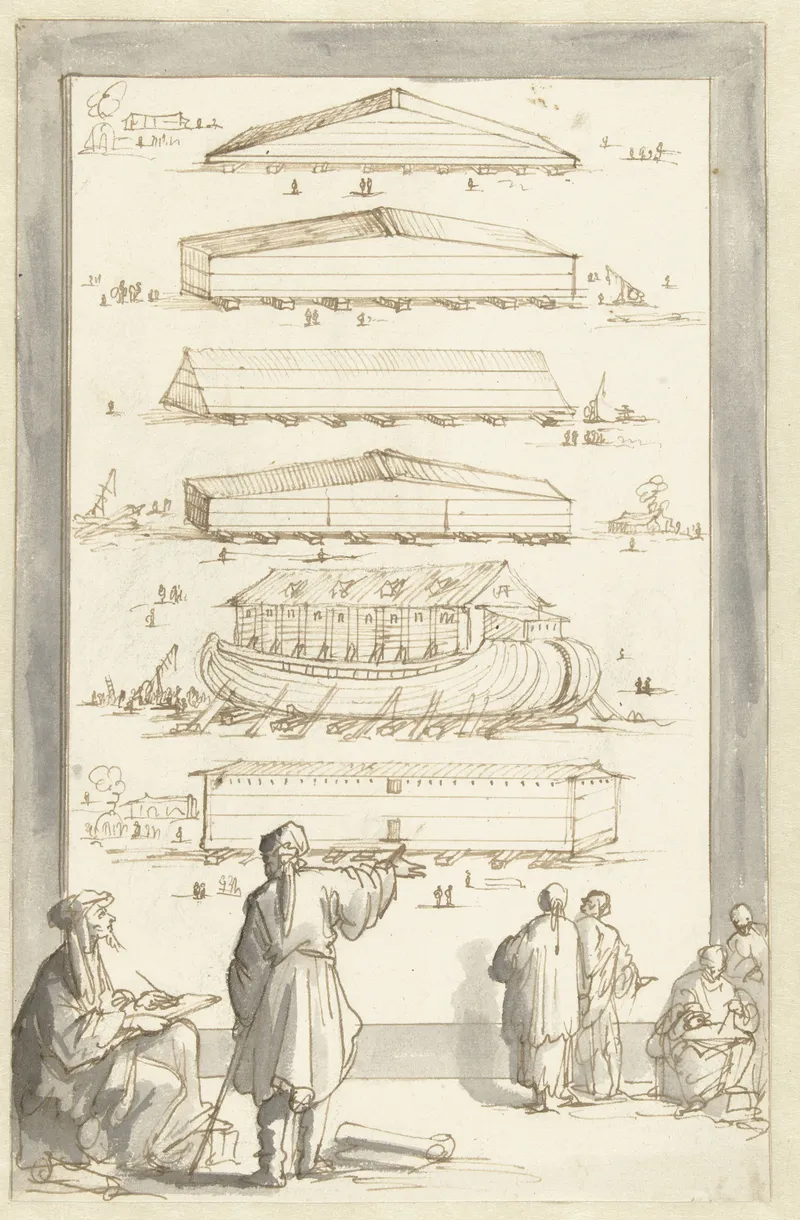
God now tells Noah what is coming and how he will be carried through it. The end of all flesh is come before me… behold, I will destroy them with the earth (v. 13) - and then, immediately, the way of rescue: Make thee an ark of gopher wood; rooms shalt thou make in the ark, and shalt pitch it within and without with pitch (v. 14). The detail is striking. God does not merely warn Noah; He gives him a precise pattern - a particular wood, rooms within, a sealing of pitch inside and out against the water, exact dimensions of length and breadth and height, a window above, a door in the side, three stories rising. This is salvation with a shape, designed by God and built by human hands in obedience. The ark is enormous - far larger than any vessel its world had seen - and it is built for one purpose: to carry life safely through the waters of judgment and set it down on the other side. Note where the rescue comes from. Noah does not devise his own way of surviving the flood; the design is given to him, down to the last cubit, and his part is to build exactly what God specifies. The way through judgment is always God's provision, received and obeyed - never a refuge the threatened person invents for himself.3
17And, behold, I, even I, do bring a flood of waters upon the earth, to destroy all flesh, wherein is the breath of life, from under heaven; and every thing that is in the earth shall die. 18But with thee will I establish my covenant; and thou shalt come into the ark, thou, and thy sons, and thy wife, and thy sons' wives with thee. 19And of every living thing of all flesh, two of every sort shalt thou bring into the ark, to keep them alive with thee; they shall be male and female. 20Of fowls after their kind, and of cattle after their kind, of every creeping thing of the earth after his kind, two of every sort shall come unto thee, to keep them alive. 21And take thou unto thee of all food that is eaten, and thou shalt gather it to thee; and it shall be for food for thee, and for them. 22Thus did Noah; according to all that God commanded him, so did he.
Now the announcement and the promise stand side by side. I, even I, do bring a flood of waters upon the earth… and every thing that is in the earth shall die (v. 17) - the judgment will be real and total. And then, immediately, the first covenant named in Scripture: But with thee will I establish my covenant; and thou shalt come into the ark, thou, and thy sons, and thy wife, and thy sons' wives with thee (v. 18). That little word But sounds again, just as it did in verse 8 - the flood is coming, but there is a covenant, a sworn relationship, a promise from God that holds firm against the rising water. And it is generous in its reach: not Noah alone but his whole household, and from every kind of creature two preserved alive, with food gathered for them all. God means to carry not just one righteous man but a remnant of life through the deluge into a renewed world. The chapter closes on the quietest and most complete obedience in Scripture: Thus did Noah; according to all that God commanded him, so did he (v. 22). There is no recorded argument, no bargaining, no delay - only a man who heard the word of God and did all of it. After verses of mounting darkness, the final line is simply faithfulness: the grace Noah found in verse 8 working itself out, years later, in patient, complete obedience to everything God had said.
Further study
- The Hebrew text of Genesis 6 with Rashi, Ibn Ezra, and other classical commentators side by side - useful for chen (v. 8, the first “grace” in Scripture), for tamim (v. 9, Noah “perfect in his generations”), and for the much-debated b'nei ha-elohim and nephilim of verses 2 and 4.
- Genesis 6 ↔ Hebrews 11 · 1 Peter 3 · Matthew 24Intertextual BibleTraces the threads tying Genesis 6 to the rest of Scripture - Noah's ark read alongside By faith Noah… prepared an ark to the saving of his house (Heb. 11:7) and eight souls were saved by water… the like figure… even baptism (1 Pet. 3:20-21), and the days of Noah read beside the Lord's own warning, as the days of Noe were, so shall… the coming of the Son of man be (Matt. 24:37).
- Genesis 6 - Translators' NotesNET BibleThe NET Bible's detailed footnotes on Genesis 6 - the disputed identity of the “sons of God” in verses 2 and 4, the difficult phrase my spirit shall not always strive with man (v. 3), the verb behind “it repented the LORD” (v. 6), and the construction details of the ark in verses 14-16.
Where this echoes in Scripture
The Sons of God and the Giants in the Earth
- Matthew 24:37-39as the days of Noe were, so shall also the coming of the Son of man be... they were eating and drinking... and knew not until the flood came.The Lord points back to the world of Genesis 6 - an age living heedlessly right up to the day of judgment.
- Genesis 3:6the woman saw that the tree was good for food, and that it was pleasant to the eyes... she took of the fruit thereof.The same pattern as verse 2 - seeing what is “fair” and reaching out to take.
- Numbers 13:33And there we saw the giants, the sons of Anak, which come of the giants: and we were in our own sight as grasshoppers.The only other place the word rendered “giants” (nephilim) appears in the Hebrew Bible (v. 4).
- 1 Peter 3:20when once the longsuffering of God waited in the days of Noah, while the ark was a preparing.The patience hinted at in verse 3 - God’s Spirit striving, His longsuffering waiting, before the flood came.
But Noah Found Grace in the Eyes of the LORD
- Ephesians 2:8-9For by grace are ye saved through faith; and that not of yourselves: it is the gift of God: Not of works, lest any man should boast.The pattern set in verse 8 - grace freely found, not earned; salvation as gift.
- Luke 19:41-42And when he was come near, he beheld the city, and wept over it... the things which belong unto thy peace!The grieving heart of God in verse 6 seen in person - Christ weeping over a city that would not turn.
- Ephesians 4:30And grieve not the holy Spirit of God, whereby ye are sealed unto the day of redemption.The same note as verse 6 - the Spirit of God genuinely grieved by sin, not indifferent to it.
- Genesis 8:21the imagination of man’s heart is evil from his youth.The verdict of verse 5 echoed after the flood - the human heart the LORD sees so clearly.
- Romans 5:20But where sin abounded, grace did much more abound.The shape of verses 5-8 in a sentence - grace overflowing exactly where sin is greatest.
Noah Walked with God · Make Thee an Ark
- Hebrews 11:7By faith Noah, being warned of God of things not seen as yet, moved with fear, prepared an ark to the saving of his house.Noah’s building of the ark (vv. 14-22) named as the act of faith - obedience to a word not yet seen.
- 1 Peter 3:20-21eight souls were saved by water. The like figure whereunto even baptism doth also now save us.The ark of verses 14-18 read as a figure of salvation - carried through the waters of judgment.
- Genesis 5:24And Enoch walked with God: and he was not; for God took him.The same phrase used of Noah in verse 9 - a life lived in steady company with God.
- Genesis 17:1I am the Almighty God; walk before me, and be thou perfect.The word “perfect” (tamim) of verse 9 - wholeness of life, spoken later to Abraham.
- Luke 6:46And why call ye me, Lord, Lord, and do not the things which I say?The obedience of verse 22 - faith that does what God commands, not merely admires it.