Numbers 13
People in this chapter
Israel has arrived. After the Red Sea, after Sinai, after the long haul through the desert, the people stand at the southern edge of the very land God swore to Abraham. And so, at the LORD's own command, Moses sends twelve men: rulers, one leader from every tribe1 - to search out the land of Canaan. They are to see the people and the cities, the soil and the fruit, and to be of good courage.
Before they leave, Moses does one small thing the narrator pauses to record: he takes Oshea the son of Nun and gives him a new name - Jehoshua, “the LORD is salvation” (v. 16). It is a name worth remembering, because the whole chapter will finally hang on it.
Tap any highlighted phrase to jump to the commentary that unpacks it.
Numbers 13:1-3, 16Sent to Search the Land
1And the LORD spake unto Moses, saying, 2Send thou men, that they may search the land of Canaan, which I give unto the children of Israel: of every tribe of their fathers shall ye send a man, every one a ruler among them. 3And Moses by the commandment of the LORD sent them from the wilderness of Paran: all those men were heads of the children of Israel. 16These are the names of the men which Moses sent to spy out the land. And Moses called Oshea the son of Nun Jehoshua.
These are rulers, one chosen from each of the twelve tribes - all those men were heads of the children of Israel (v. 3). That detail sets the stakes high before a single grape is cut. Whatever these men decide they have seen, they will carry home not as private opinion but as the word of the tribe's own leader. The people will not weigh the report; they will inherit it. So the chapter is quietly a study in influence: the men sent to gather facts will, by the way they frame those facts, shape the faith or the fear of a whole nation.
Leadership here is a matter of report - of what a trusted voice tells the people is true about their situation and their God.1
Numbers 13:17-20See the Land - and Be of Good Courage
17And Moses sent them to spy out the land of Canaan, and said unto them, Get you up this way southward, and go up into the mountain: 18And see the land, what it is; and the people that dwelleth therein, whether they be strong or weak, few or many; 19And what the land is that they dwell in, whether it be good or bad; and what cities they be that they dwell in, whether in tents, or in strong holds; 20And what the land is, whether it be fat or lean, whether there be wood therein, or not. And be ye of good courage, and bring of the fruit of the land. Now the time was the time of the firstripe grapes.
Moses' instructions are strikingly clinical: see the land… the people, whether strong or weak… the cities, whether in tents or in strong holds… the land, whether fat or lean. He is asking for hard, honest reconnaissance - no pretending the giants away, no minimizing the walls. And yet, woven into the middle of that practical checklist, he plants a charge that is not about data at all: be ye of good courage. That single phrase tells the spies, before they ever go, what the real test will be.
The assignment is to face the obstacle without losing heart - to gather the facts and keep the faith in the same forty days. Faith, in Scripture, is never asked to deny what the eye sees. Moses does not say “don't look at the strongholds.” He says look hard, count carefully - and be of good courage anyway. The courage is confidence in the God who is sending them in. And the closing line lands like a small grace: now the time was the time of the firstripe grapes. God timed the mission for the harvest.
The land would meet them at its sweetest.
Numbers 13:21-25Forty Days and the Cluster of Eshcol
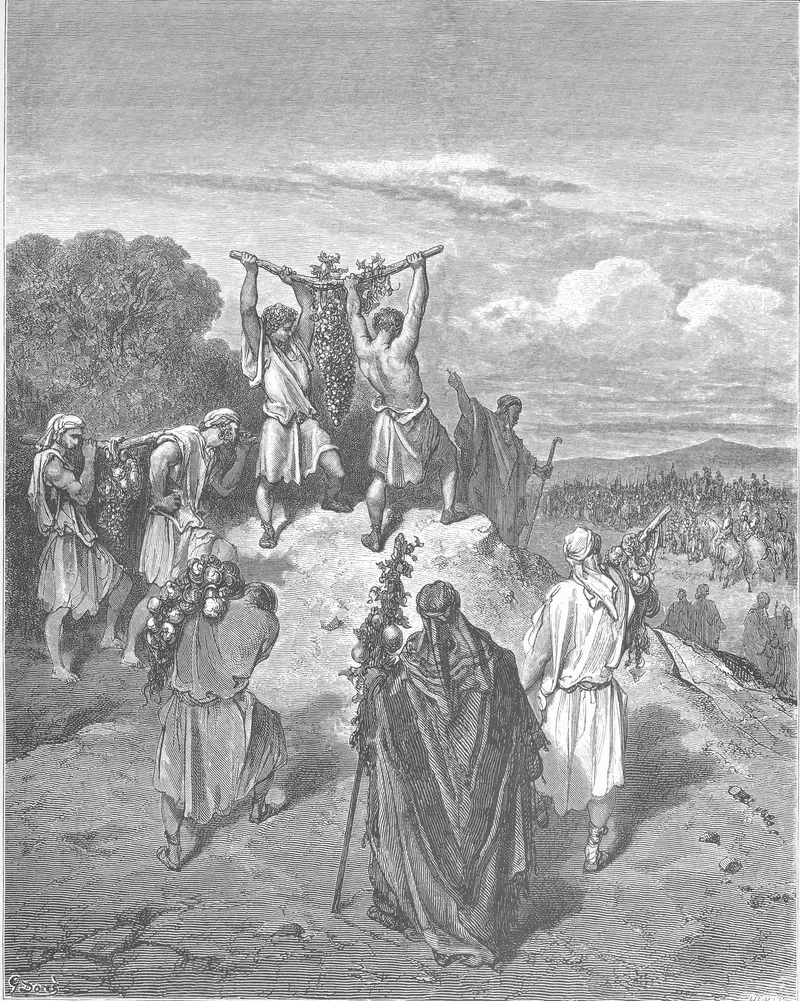
21So they went up, and searched the land from the wilderness of Zin unto Rehob, as men come to Hamath. 22And they ascended by the south, and came unto Hebron; where Ahiman, Sheshai, and Talmai, the children of Anak, were. (Now Hebron was built seven years before Zoan in Egypt.) 23And they came unto the brook of Eshcol, and cut down from thence a branch with one cluster of grapes, and they bare it between two upon a staff; and they brought of the pomegranates, and of the figs. 24The place was called the brook Eshcol, because of the cluster of grapes which the children of Israel cut down from thence. 25And they returned from searching of the land after forty days.
The narrator slows down at Hebron to name three of the giants by name - Ahiman, Sheshai, and Talmai, the children of Anak - and to note, almost in passing, that Hebron was built seven years before Zoan in Egypt. Both details matter. Naming the Anakim makes them concrete; these are not rumored monsters but known men with known names, settled in a known city. And dating Hebron against Zoan (Tanis) reminds Israel that they are looking at an ancient, long-established civilization - walled cities older than the Egypt they just left, the kind of fortified hill-country town the archaeological record of Late Bronze Canaan bears out2.
So the obstacle is real and the chapter refuses to shrink it. The Anakim are genuinely there; the cities are genuinely old and strong. Faith in this chapter is never asked to deny the giants exist. It is asked to remember who promised the land in the first place.
Numbers 13:26-29The Turn at “Nevertheless”
26And they went and came to Moses, and to Aaron, and to all the congregation of the children of Israel, unto the wilderness of Paran, to Kadesh; and brought back word unto them, and unto all the congregation, and shewed them the fruit of the land. 27And they told him, and said, We came unto the land whither thou sentest us, and surely it floweth with milk and honey; and this is the fruit of it. 28Nevertheless the people be strong that dwell in the land, and the cities are walled, and very great: and moreover we saw the children of Anak there. 29The Amalekites dwell in the land of the south: and the Hittites, and the Jebusites, and the Amorites, dwell in the mountains: and the Canaanites dwell by the sea, and by the coast of Jordan.
For one sentence, the report is flawless. We came unto the land whither thou sentest us, and surely it floweth with milk and honey; and this is the fruit of it. Every word is true. They confirm the promise in God's own language - milk and honey is exactly how He had described the land to Moses at the burning bush (Ex. 3:8) - and they hold up the cluster as proof. If the report had ended there, this would be a chapter about faith vindicated.
The land is good; God told the truth; here is the fruit. But the honest acknowledgment of God's faithfulness is not yet the same thing as trust in it. The ten will agree with every promise and then refuse to act on any of them. It is possible to say true things about God - to recite His goodness, to display the evidence - and still let the next word undo it all.
And here is the next word: Nevertheless. The entire chapter pivots on it. Everything before it is promise; everything after it is fear. Nevertheless the people be strong… the cities are walled, and very great… we saw the children of Anak there. Notice what the ten do not do: they do not lie. The people are strong. The cities are walled and very great. The Anakim are there. Every fact in verse 28 is accurate.
The failure is not in their data; it is in their nevertheless - in the small, devastating word that sets the size of the obstacle over against the promise of God, as though the two were rivals and the giants were winning. Fear almost always begins with a true observation. The obstacle is real. The danger is genuine. What fear adds is the verdict: given this, trust is foolish. The whole question of the chapter is whether the “nevertheless” gets the last word, or whether the LORD does.
Numbers 13:30-33Two Reports, One Land
30And Caleb stilled the people before Moses, and said, Let us go up at once, and possess it; for we are well able to overcome it. 31But the men that went up with him said, We be not able to go up against the people; for they are stronger than we. 32And they brought up an evil report of the land which they had searched unto the children of Israel, saying, The land, through which we have gone to search it, is a land that eateth up the inhabitants thereof; and all the people that we saw in it are men of a great stature. 33And there we saw the giants, the sons of Anak, which come of the giants: and we were in our own sight as grasshoppers, and so we were in their sight.
Into the rising murmur, one voice cuts clean: And Caleb stilled the people before Moses, and said, Let us go up at once, and possess it; for we are well able to overcome it. Listen to exactly what Caleb claims and what he does not. He does not say the giants are small or the walls are low or the danger imagined. He has seen everything the other ten have seen. What he says is we are well able - and the “we” is the key to the whole chapter.
Caleb is not boasting in Israel's strength against the Anakim; on those terms the ten are right, the people are stronger. Caleb is doing the arithmetic with God counted in. The same facts that read as impossible without the LORD read as well able with Him. This is the heart of biblical faith: the inclusion of God in the sum. Caleb and the ten stood in the same cities, tasted the same grapes, measured the same giants.
The only variable between “we be not able” and “we are well able” is whether God is in the equation.
The ten answer Caleb in language that mirrors his and inverts his conclusion: We be not able to go up against the people; for they are stronger than we. Their sentence is true as far as it goes - measured Israelite against Anakite, sword against sword, they are outmatched. The problem is the frame. They have set the contest as the people against the people, Israel versus Canaan, and left the LORD who commanded the mission entirely out of the reckoning.
That is the quiet apostasy at the center of unbelief: the practical forgetting of God - doing the real math of life as if He were not a factor. Moses would name the sin exactly when he retold this day: ye did not believe the LORD your God (Deut. 1:32). Their eyes were accurate. Their conclusion was faithless. And a whole generation would follow the verdict of the ten rather than the faith of the two.
As the fear gathers momentum, the report grows wilder. The land that a moment ago floweth with milk and honey has become a land that eateth up the inhabitants thereof. The very same country is now described as a devourer. This is what fear does to a true report given enough time: it does not merely note the danger, it darkens everything, until the land of promise is recast as a land of death. The exaggeration is the tell.
A sober scout reports walls and giants; a frightened heart reports a land that eats people. And the contradiction goes unnoticed by the crowd - the same congregation looking at the cluster of grapes that proves the land's lush abundance now hears that the land devours its own and believes it. Fear, once it has the floor, rewrites even the evidence in front of the eyes.
Research trail
Sources & further study
These references support the historical, linguistic, manuscript, and contextual notes in this chapter. Scripture remains the primary text; external sources are provided so readers can inspect the research directly.
- Numbers 13 - Translators' NotesThe NET Bible's detailed footnotes on Numbers 13 - the sense of tur (“to spy out, explore”), the meaning of the name Jehoshua in verse 16, the identity of the Anakim, and the rhetorical force of the “evil report” in verses 32-33.
- Late Bronze Canaan · Walled Cities of the Hill CountryHoldings from Late Bronze Age Canaan illuminate the fortified, “walled, and very great” cities the spies describe (v. 28) and the long-settled antiquity of towns like Hebron - the world behind the ten spies' fear and Caleb's confidence.
- Numbers 13 · Hebrew + classical Jewish commentaryThe Hebrew text of Numbers 13 with Rashi, Ibn Ezra, and other classical commentators side by side - useful for the verb tur (v. 2, “to search out, explore”), for the renaming of Oshea to Jehoshua (v. 16), and for dibbah (v. 32, the “evil report,” whispered slander) and the “grasshopper” saying of verse 33.
- Numbers 13 ↔ Hebrews 3-4 · Deuteronomy 1 · Numbers 14Traces the threads that bind the spies' failure to its later readings - Moses' retelling in Deuteronomy 1, the verdict that they could not enter in because of unbelief (Heb. 3:19), and the rest still left… of entering into God's promise (Heb. 4:1).
Where this echoes in Scripture
Sent to Search the Land
- Matthew 1:21And she shall bring forth a son, and thou shalt call his name JESUS: for he shall save his people from their sins.The same name Moses gave Oshea in verse 16 - Yehoshua, “the LORD is salvation” - given again to the Savior.
- Hebrews 4:8-9For if Jesus had given them rest, then would he not afterward have spoken of another day. There remaineth therefore a rest to the people of God.The “Jesus” here is Joshua - the faithful spy who led Israel in, yet pointed past himself to a deeper rest.
- Numbers 14:30Doubtless ye shall not come into the land... save Caleb the son of Jephunneh, and Joshua the son of Nun.The reward of the two faithful spies - only Caleb and the renamed Joshua live to enter the land.
- Numbers 10:33The ark of the covenant of the LORD went before them... to search out a resting place for them.The same verb tur - God Himself “searches out” rest for His people; the mission of the twelve is good.
See the Land - and Be of Good Courage
- Joshua 1:9Have not I commanded thee? Be strong and of a good courage; be not afraid... for the LORD thy God is with thee whithersoever thou goest.The same charge spoken to the same man - God tells Joshua again to be of good courage, now to lead the people in.
- Deuteronomy 31:6Be strong and of a good courage, fear not... for the LORD thy God, he it is that doth go with thee.Courage grounded where Moses grounds it: in the presence of God.
- Psalm 27:14Wait on the LORD: be of good courage, and he shall strengthen thine heart.The courage of verse 20 made into prayer - a strength that God supplies to the heart that waits on Him.
Forty Days and the Cluster of Eshcol
- 1 Corinthians 15:20But now is Christ risen from the dead, and become the firstfruits of them that slept.The one cluster brought back from death - Christ's resurrection as firstfruits of the whole harvest to come.
- Ephesians 1:13-14Ye were sealed with that holy Spirit of promise, which is the earnest of our inheritance.The firstfruits carried through the wilderness now - the Spirit as a down payment on the promised land of God.
- Exodus 3:8To bring them up out of that land unto a good land and a large, unto a land flowing with milk and honey.The promise the cluster proves true - the land is exactly what God told Moses at the bush it would be.
- Deuteronomy 8:7-8A land of wheat, and barley, and vines, and fig trees, and pomegranates; a land of oil olive, and honey.The grapes, figs, and pomegranates of verse 23 named again - the abundance the spies tasted firsthand.
The Turn at “Nevertheless”
- Numbers 14:9Only rebel not ye against the LORD, neither fear ye the people of the land; for they are bread for us... the LORD is with us: fear them not.Caleb and Joshua's answer to the “nevertheless” - the giants are real, but the LORD is with us.
- Romans 8:31If God be for us, who can be against us?The math the ten forgot - the obstacle is real, but it is not the largest fact in the equation.
- Psalm 56:3What time I am afraid, I will trust in thee.The faithful “nevertheless” in miniature - the fear is admitted, and trust gets the final word.
Two Reports, One Land
- Hebrews 3:18-19And to whom sware he that they should not enter into his rest, but to them that believed not? So we see that they could not enter in because of unbelief.The New Testament verdict on this very day - the land was lost to unbelief.
- Hebrews 4:1-2Let us therefore fear, lest... any of you should seem to come short of it... the word preached did not profit them, not being mixed with faith.The warning drawn straight from Numbers 13 - the promise heard without faith profits nothing.
- Isaiah 40:22It is he that sitteth upon the circle of the earth, and the inhabitants thereof are as grasshoppers.The grasshopper-word turned right side up - before God, the nations and their giants are the small ones.
- Deuteronomy 1:32-33Yet in this thing ye did not believe the LORD your God, who went in the way before you... to shew you by what way ye should go.Moses names the sin of the ten plainly: a failure to believe the LORD.