Deuteronomy 31
People in this chapter
Deuteronomy 31 is Moses' farewell. He is 120 years old, told he will not cross the Jordan. His life of leadership is over. But before he steps down, he leaves Israel with three great gifts: a charge to Joshua, a public covenant-reading ceremony to happen every seven years, and a written law placed inside the ark, beside the mercy seat. "I know thy rebellion," he says. God's mercy is not naive.
Tap any highlighted phrase to jump to the commentary that unpacks it.
Deuteronomy 31:1-3"I Can No More Go Out and Come In"
1And Moses went and spake these words unto all Israel. 2And he said unto them, I am an hundred and twenty years old this day; I can no more go out and come in: also the LORD hath said unto me, Thou shalt not go over this Jordan. 3The LORD thy God, he will go over before thee, and he will destroy these nations from before thee, and thou shalt possess them: and Joshua, he shall go over before thee, as the LORD hath said.
Moses is 120 years old - the span of a full human life under the old covenant. His eyes are not dim; his natural force is not abated. But the season of his leadership is finished. This is not failure. This is the natural order: one generation must yield to the next.
The phrase "go out and come in" refers to the duties of a leader - to lead armies, to judge, to shepherd. Moses has done this for forty years. Now he cannot. But before he steps aside, he does the most important thing a leader can do: he names his successor and commissions him.
Deuteronomy 31:4-8"I Will Never Leave Thee, Nor Forsake Thee"
4And the LORD shall do unto them as he did to Sihon and to Og, kings of the Amorites, and unto the land of them, whom he destroyed. 5And the LORD shall give them up before your face, that ye may do unto them according unto all the commandments which I have commanded you. 6Be strong and of a good courage, fear not, nor be afraid of them: for the LORD thy God, he it is that doth go with thee; he will not fail thee, nor forsake thee.
The word "commandments" here is plural - the whole of the Torah Moses has just given. The law is a map for living in covenant with their God. Joshua is to lead according to it.
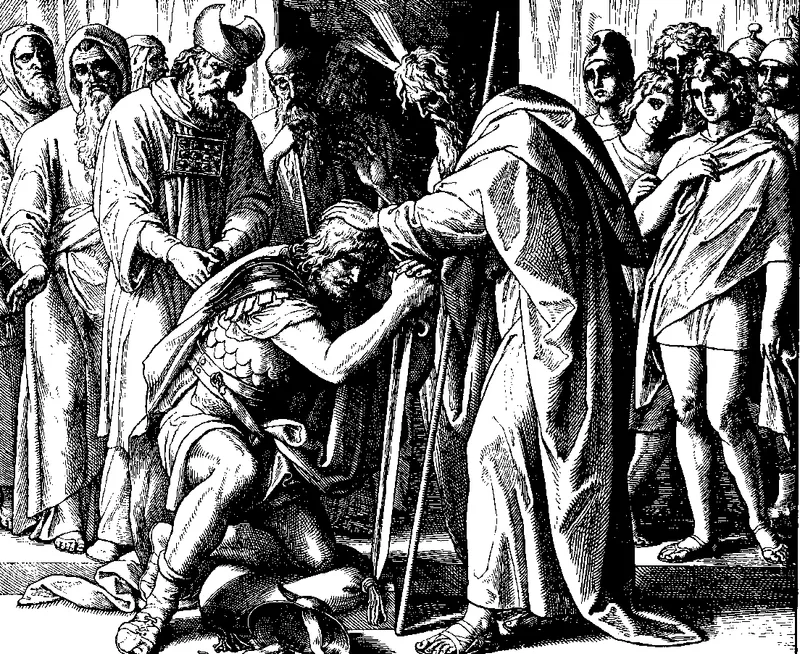
7And Moses called unto Joshua, and said unto him in the sight of all Israel, Be strong and of a good courage: for thou must go with this people unto the land which the LORD hath sworn unto their fathers to give them; and thou shalt cause them to inherit it. 8And the LORD, he it is that doth go before thee; he will be with thee, he will not fail thee, neither forsake thee: fear not, neither be dismayed.
Moses repeats the commission twice - once as God speaks it to him, once as he speaks it aloud to Joshua in the sight of all Israel. The repetition is deliberate. Joshua hears it from the Lord's own lips and from Moses' lips. There is no ambiguity. There is no hiding. What Joshua is called to do is publicly witnessed, publicly endorsed.
Deuteronomy 31:9-13The Seven-Year Torah Reading
9And Moses wrote this law, and delivered it unto the priests the sons of Levi, which bare the ark of the covenant of the LORD, and unto all the elders of Israel. 10And Moses commanded them, saying, At the end of every seven years, in the solemnity of the year of release, in the feast of tabernacles, 11When all Israel is come to appear before the LORD thy God in the place which he shall choose, thou shalt read this law before all Israel in their hearing. 12Gather the people together, men, and women, and children, and thy stranger that is within thy gates, that they may hear, and that they may learn, and fear the LORD your God, and observe to do all the words of this law: 13And that their children, which have not known any thing, may hear, and learn to fear the LORD your God, as long as ye live in the land whither ye go over Jordan to possess it.
Moses physically writes the law - inscribed, preserved, entrusted to the priestly order. The written word survives the speaker. The law is meant to outlast Moses himself.
Every seven years - a sabbath cycle - the entire law is read aloud to all Israel: men, women, children, strangers, every rank and age, cyclically. This is the church's inheritance: a yearly or multi-year reading cycle (Advent, Lent, Ordinary Time, Lectionary) that ensures the whole Scripture is heard, not cherry-picked passages. God ordained public, rhythmic encounter with His word.
"That they may hear, and that they may learn, and fear the Lord." Three actions: hearing, learning, fearing. The fear in view is reverence - the awe that comes from knowing who God is and how safe you are with Him. The seven-year rhythm embeds this in the national memory. Every seven years, no one misses it.
Deuteronomy 31:14-18Foreknown Sin, Foreknown Judgment
14And the LORD said unto Moses, Behold, thy days approach that thou must die: call Joshua, and present yourselves in the tabernacle of the congregation, that I may give him a charge. And Moses and Joshua went, and presented themselves in the tabernacle of the congregation. 15And the LORD appeared in the tabernacle in a pillar of a cloud: and the pillar of the cloud stood over the door of the tabernacle. 16And the LORD said unto Moses, Behold, thou shalt sleep with thy fathers; and this people will rise up, and go a whoring after the gods of the strangers of the land, whither they go to be among them, and will forsake me, and break my covenant which I have made with them. 17Then my anger shall be kindled against them in that day, and I will forsake them, and I will hide my face from them, and they shall be devoured, and many evils and troubles shall befall them; so that they will say in that day, Are not these evils come upon us, because our God is not among us? 18And I will surely hide my face in that day for all the evils which they shall have wrought, in that they are turned unto other gods.
The phrase "sleep with thy fathers" is a euphemism for death - honorable death, the death of the righteous. Moses will not live to see Israel's failure, but God tells him it is coming. He will know it beforehand.
God says plainly: they will break the covenant. Not "they might," not "they could" - they will. This is not surprise or failure on God's part. He knows the human heart. He knows Israel will fail. But He makes the covenant anyway. He makes it knowing it will be broken. And He already has a plan for that broken covenant.
Deuteronomy 31:19-27The Song as Witness
19Now therefore write ye this song for you, and teach it the children of Israel: put it in their mouths, that this song may be a witness for me against the children of Israel. 20For when I shall have brought them into the land which I sware unto their fathers, that floweth with milk and honey; and they shall have eaten and filled themselves, and waxen fat; then will they turn unto other gods, and serve them, and provoke me, and break my covenant. 21And it shall come to pass, when many evils and troubles are befallen them, that this song shall testify against them as a witness; for it shall not be forgotten out of the mouths of their seed: for I know their imagination which they go about, even now, before I have brought them into the land which I sware.
God commands that the law be set in a song - Deuteronomy 32 will record it. Why a song? Because people remember songs. Songs lodge in the mouth and memory in a way mere prose does not. When Israel sins and forgets, the song will still be there, remembered unconsciously, carrying the memory of covenant forward. The song is a mercy: it is the voice of God they cannot quite kill.
22Moses therefore wrote this song the same day, and taught it the children of Israel. 23And he gave Joshua the son of Nun a charge, and said, Be strong and of a good courage: for thou shalt bring the children of Israel into the land which I sware unto them: and I will be with thee.
Moses gives the charge to Joshua that very day. The song is written. The law is written. Joshua is commissioned. Everything is in place for Moses to step down. He has prepared his successor by providing witnesses: a written law, a song, a public charge.
24And it came to pass, when Moses had made an end of writing the words of this law in a book, until they were finished, 25That Moses commanded the Levites, which bare the ark of the covenant of the LORD, saying, 26Take this book of the law, and put it in the side of the ark of the covenant of the LORD your God, that it may be there for a witness against thee. 27For I know thy rebellion, and thy stiff neck: behold, while I am yet alive with you this day, ye have been rebellious against the LORD; and how much more after my death?
The law is written in a book - a complete, physical, preservable form. This is not an oral tradition subject to erosion. It is ink on parchment, placed where it cannot be lost.
Deuteronomy 31:28-30Heaven and Earth as Witness
28Gather unto me all the elders of your tribes, and your officers, that I may speak these words in their ears, and call heaven and earth to record against them. 29For I know that after my death ye will utterly corrupt yourselves, and turn aside from the way which I have commanded you; and evil will befall you in the latter days; because ye will do evil in the sight of the LORD, to provoke him to anger through the work of your hands. 30And Moses spake in the ears of all the congregation of Israel the words of this song, until they were ended.
Calling heaven and earth to witness is an ancient covenant formula. The heavens and the earth themselves are summoned as unchanging witnesses to what has been sworn. Nothing can be hidden from them. This is the most solemn form of oath-taking the ancient world knew.
Moses predicts judgment in "the latter days" - the coming exile. But the phrase also echoes with prophetic weight. What Moses foresees of Israel's scattered future will resonate through the whole Old Testament hope for restoration, and ultimately into the New Testament promise of Christ's return. Even in judgment, the biblical arc bends toward redemption.
Research trail
Sources & further study
These references support the historical, linguistic, manuscript, and contextual notes in this chapter. Scripture remains the primary text; external sources are provided so readers can inspect the research directly.
- Deuteronomy 31Open-access source text and rabbinic commentary on Joshua's commissioning, the Torah scroll [res:sefaria-deuteronomy-31], and triennial Torah reading mandate.
- Triennial Torah Reading and Covenant MemoryExamines how regular Torah reading serves [res:torah-reading-cycle-covenant-memory-practice] as covenant renewal, binding each generation to the words spoken at Sinai.